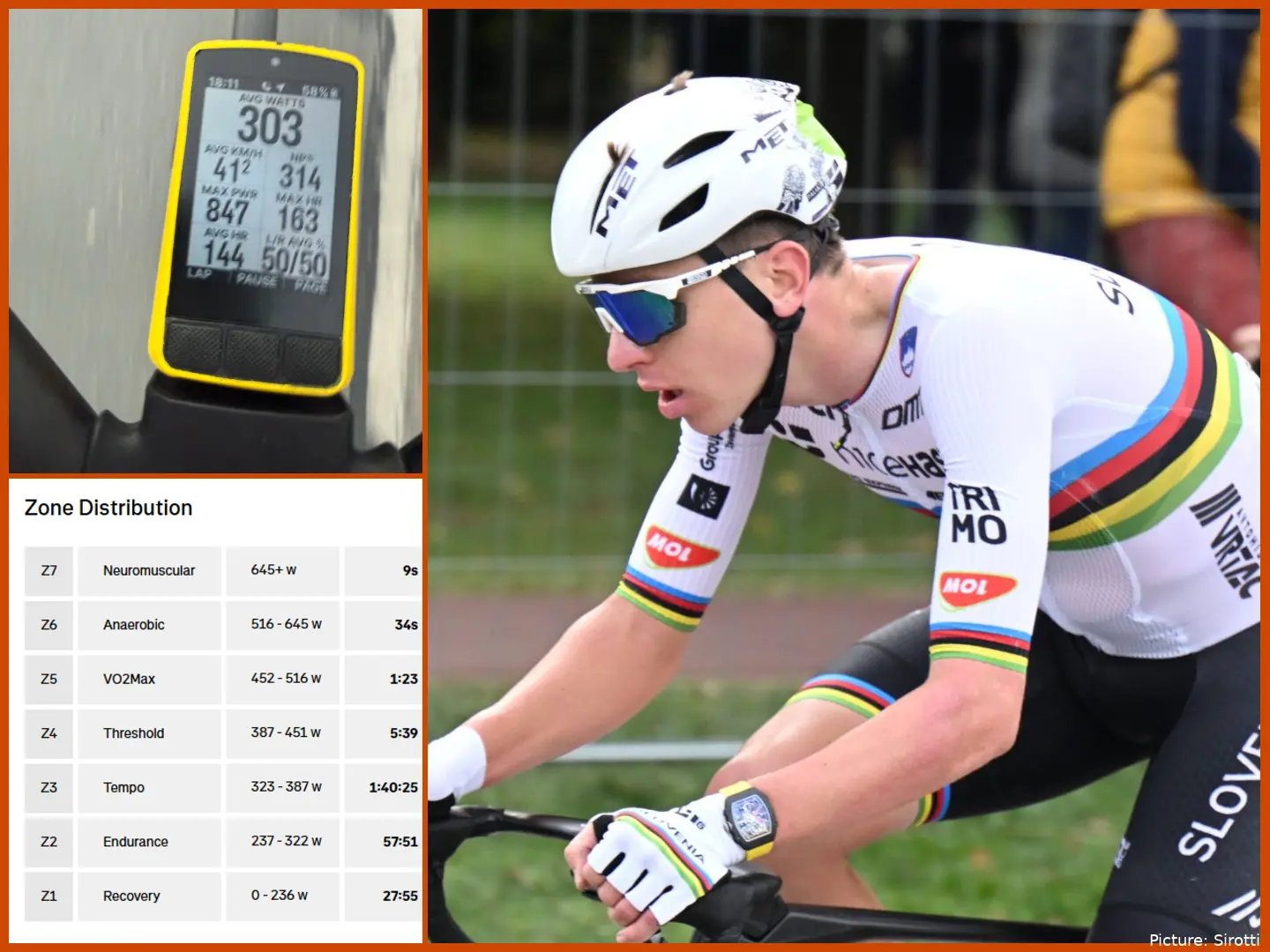
Wednesday was a busy day for the road cycling world champion Tadej Pogacar. While out on a 3-hour training ride on the coastline near Valencia, the Slovenian had an unpleasant encounter with one of his fans, a story he later shared with the rest of the world via his Strava post.
For most, the headline story dragged away all the attention, however those who dug deeped uncovered a tough training session with recorded speed of 41 kph on a 130-kilometer ride. Definitely the type of effort Pogacar will be expected to deliver to win through one of his iconic solo rides. But that's still not all.
UAE Team Emirates - XRG are usually quite strict with keeping Pogacar's power data a bit of a secret, with the only reliable information to go by being Pogacar's interview
on The Peter Attia Drive Podcast in 2024, stating that his Zone 2 power, at the time, was between 320 and 340 watts.
However in his latest Strava upload, the Slovenian left this crucial information public to view.
For a long time, it's been estimated that Pogacar's threshold power (also known as FTP) was around 415 watts. This was based on calculations of his in-race efforts and listed weight of 66 kilograms. But what lacked until now was a solid proof. Until yesterday.
Strava app automatically analyzes every ride being uploaded by its users equipped with power sensors, which is the case for almost any professional these days. In return, it generates a rough estimate on one's power zones. This piece of information can be made public or private with a simple click.
A closer look into Pogacar's Strava power file shows a zone distribution as follows:
- Z1 (recovery): 0-236 W
- Z2 (endurance): 237-322 W
- Z3 (tempo): 323-387 W
- Z4 (threshold): 387-451 W
- Z5 (VO2Max): 452-516 W
- Z6 (Anaerobic): 516-645 W
- Z7 (Neuromuscular): 645+ W
In his training, Pogacar spend most of the time alternating between zones 3 (100 minutes) and 2 (60 minutes), averaging 303 watts. This value is on the higher end of Pogacar's Z2, however we shouldn't simply assume this has been an "easy Z2 ride" from the numbers alone.
"If you're doing a five-hour ride, your zone two after five hours may not be your zone two anymore," Pogacar further explained how the zones can change even during the same ride. "On the flat you will not recover, and five hours of riding 320-340 [watts] for me also means that the next day I’m not riding my bike. So when going on the flat for longer, I drop my power to 290-300."
What is more intriguing is the estimate of Pogacar's threshold zone in which the predicted value of 415 watts falls exactly in the middle of the interval, indirectly verifying the analysts' assumption.
Heart monitor over power meter
However Pogacar points out that we shouldn't rely on power meters too much, as the devices are prone to generate inacurracies due to the many factors they use to calculate data. Rather, the Slovenian prefers to trust his heart rate monitor, which showed a steady average of 144 beats per minute across the entire effort.
"I’ve been training with a heart rate monitor since I was 12 years old," he said. "I could go by heart rate only, but it’s always good to compare heart rate to power."


Ondrej ZhasilCycling Journalist
Ondřej Zhasil is a cycling journalist at CyclingUpToDate and has been part of the team since 2023. He is based in Ostrava, the third-largest city in the Czech Republic, and covers professional cycling across the main UCI competitions, including the Tour de France, the Giro d’Italia, and La Vuelta a España. A key focus of his work is startlist analysis and pre-race coverage, where he examines team selections, rider line-ups, and tactical scenarios ahead of major events.
Alongside WorldTour coverage, Ondřej has developed specific expertise in junior cycling and in racing across East Asia, including competitions in China and Japan. He also maintains a broad working knowledge of other disciplines and levels, including cyclocross, while continuing to expand his understanding of mountain bike racing.
Ondřej holds a bachelor’s degree in Mathematics and Physics, which supports his analytical, data-driven approach to performance and race analysis. In his reporting, he regularly uses ProCyclingStats for results, statistics, and historical context. He places strong emphasis on careful sourcing, editorial accuracy, and updating articles promptly when new, verified information becomes available.
claps 32visitors 1
Just in

Popular news
Latest comments
- He didn't even try to sprint all outvappaxbipmv18-10-2026
- Campenaerts looked like a rolling pumpkin with that all orange leaders skinsuit !frieders318-10-2026
- He can take his dumb a$$ politics somehwere else !frieders318-10-2026
- good to have her back. fingers crossed she‘ll be able to stay!Ketterechts17-10-2026
- A tenner and he wins the Tour next year, too 😂anonymouscyclist17-10-2026
- the answer is either stick to classics or GTs but not bothabstractengineer17-10-2026
- the exodus already stared with Ciccone. Already they were struggling with two sprinters, now there are three. Also Ganna will demand leadership. Gall is the most proven GC, Ayuso has the most potential. GC leadership for everybody will be impossible. Literally a UAE style mess without pogi.abstractengineer17-10-2026
- I raced as an amateur for 12 years, including six years on my country’s national road cycling team. I secured two national titles and competed in three World Championships plus more than 15 international stage races. At 23, we travelled to Italy for a training camp—or so I assumed. On a rest day, we watched a presentation about adopting a more “professional” training approach. It was crystal clear what “professional” meant. That moment first exposed me to this dilemma. After returning from Italy, I left cycling—at least at the competitive level I had known. Over the following two years, the whole team was caught doping. I hold that everyone is innocent until proven guilty. In my view, current stakeholders operate on a different scale, and the sums involved are vast. I am unsure whether any doping would ever be revealed. I try to stay positive and enjoy the show. My 2c.
 vannpelt17-10-2026
 - Fiver he wins 🤣
 leedorney17-10-2026
 - “…measures to reduce speeds.” Might as well shorten the race course to just 50km as well? ASO generates at minimum €300m a year and 30- 40% profit. Maybe stop being greedy and spend more of the profit to protect the riders instead.b3tlla17-10-2026
Loading
2 Comments