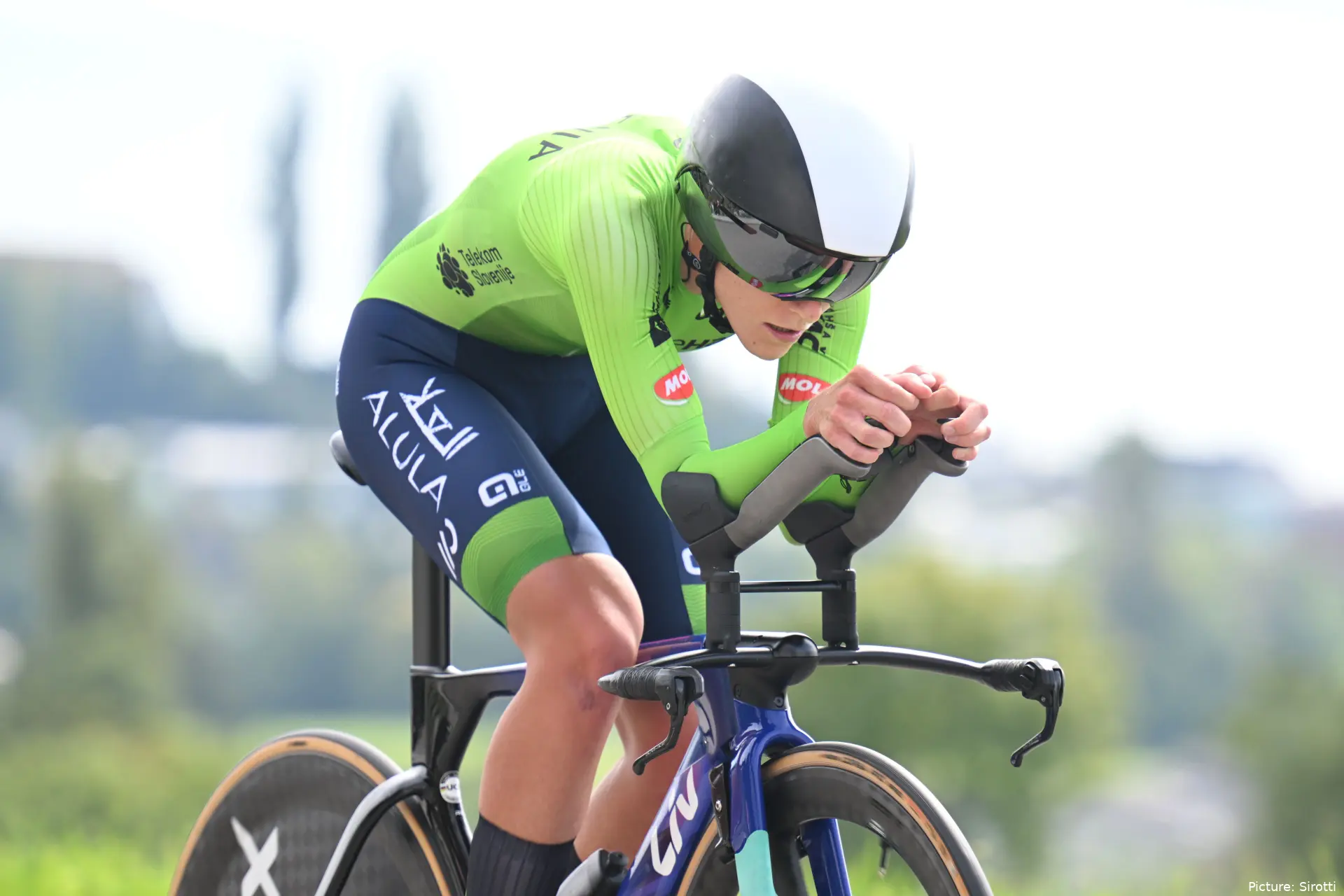
Urska Zigart begins her world championship campaign in
Rwanda today, lining up for Slovenia in both the time trial and the road race.
Too often introduced as Tadej Pogačar’s partner, she has steadily built her own
career and enters the week determined to underline that fact. Ahead of the time
trial, Zigart has been speaking about a different subject that has dominated
women’s cycling this season, the debate surrounding Pauline Ferrand-Prévot’s
Tour de France Femmes victory and the controversy over her weight loss. Zigart
did not shy away from addressing it, drawing on her own experiences and
underlining what she believes the conversation should really be about.
"I consider myself lucky to have had this experience
before I got into professional cycling, so now I know the pitfalls and what I
do and don't want," she told Siol. "I consider that a small
blessing."
Zigart explained that the environment she developed in
played a key role in her own outlook. "I think I've always been quite
lucky in that regard with the teams and the environment I've been in. At
GreenEdge the emphasis was always on eating enough. I never felt like anyone
was pressuring us to be thinner than we were."
The debate about Ferrand-Prévot’s physique has rumbled all
summer. The French rider, already a multiple world champion across disciplines,
surprised fans with her form at the Tour, a few months after triumphing at
Paris-Roubaix. Observers noted she had lost significant weight, and the issue
quickly became a topic not just in the press but also within the peloton. Zigart
believes the focus often misses the bigger picture. "It's important to
realize, however, that no professional sport is healthy – unfortunately, that's
just the way it is."
She added a blunt reminder about the limits of the body:
"The body simply can't function normally if you eat too little. Not even
in everyday life, let alone in sports where the demands are as extreme as
cycling."
Zigart is not alone in voicing concerns. Demi Vollering, who
finished second to Ferrand-Prévot at the Tour, reflected last month on the
pressures female riders face. "I get it—this is sport. People are
enthusiastic and have opinions. But let me be clear: I make, and will continue
to make, every decision in my career by putting my health first. Always. The
truth is: I’m not built to be the lightest rider in the peloton. And I don’t
want to force my body to become something it’s not."
Vollering also spoke about the responsibility riders bear as
role models. “Young girls are watching us. They notice what we say—and what we
don’t. What we show. What gets celebrated as ‘the way’ to succeed. Sometimes,
what they see quietly plants a seed. They might not talk about it. Or even
realize it’s becoming something harmful. That’s why we—as high performance
athletes, teams, and a sport—have a responsibility. We must create safe
environments where athletes can ask questions, speak openly, and get the right
guidance—especially young and developing riders. Because the risk is real.
Because health isn’t always visible. Because disordered thinking can grow
quietly and stay hidden for a long time."
Ferrand-Prévot herself has also pushed back against the
scrutiny last month. “Guys, I'm 33 years old. I know what I'm doing," she
said. "And for those who used to follow me, I've always had the habit of
posting what I eat quite intuitively. But I admit that since this
'controversy,' I'm thinking twice before doing it, and that's not right."
Zigart welcomes the fact that the subject is being aired
more openly, even if she disliked the way the discussion sometimes unfolded.
"I think it's being talked about a lot more, especially after this year's
Tour. Personally, I didn't like the discussion surrounding it, because the
girls were turning on each other, and I don't think that's the right way to
handle it."
Instead, she says the motivation behind an athlete’s choices
should be better understood. "The key question, in my opinion, is why
someone decides to lose weight," Zigart explained. "Pauline decided
to do it because she was preparing for a specific goal: the Tour de France.
She's 33 years old, has been a cyclist all her life, and knew exactly why she
was doing it. For her, it wasn't an obsession with food or appearance, but a
conscious choice related to her work."
Zigart stressed that Ferrand-Prévot’s decision cannot be
treated as a model for younger cyclists. "Of course, it's not right to
encourage all female cyclists to do this, but it's true that girls have now
realized that this can be necessary to win the Tour."
She believes that balance and patience must come first in a
rider’s career. "It's important to explain to them that the first few
seasons are primarily about development, especially if they have support and a
solid place in the team. First, you have to develop and be healthy, and only
then can you think about optimizing in all areas."


Fin MajorCycling Journalist
Fin Major is a UK-based writer at CyclingUpToDate and has been part of the team since 2024. He is the site’s main writer for FAQs and evergreen explainers and has written around 2,000 pieces for the platform. Alongside this work, he focuses on in-depth analysis and covers the biggest races on the calendar, including the Tour de France, the Giro d’Italia, and La Vuelta a España, providing clear context around performance trends, tactics, and key storylines.
In his reporting, Fin uses reputable data sources such as ProCyclingStats for results, statistics, and historical context. He places strong emphasis on careful sourcing, editorial accuracy, and updating articles promptly when new, verified information becomes available. Outside of writing, Fin is an active cyclist, which supports his practical understanding of the sport and its demands.
claps 21visitors 14
Just in

Popular news
Latest comments
- disrespectful thats a joke ...
 Davide20-10-2026
 - EF’s “island of misfit toys” squad is probably one of my favorites in the peloton. They are fun to watch, always trying stuff - they ride with heart and panache, and their kits are excellent.wrsty20-10-2026
- 'Children these days'... Wout, since the caveman learned to say "Ug", older generations have always said this about younger generations. Not every young rider is a cowboy. So what's to say that the fact that Poels was respectful meant that his peers were equally so?
 Rafionain-Glas19-10-2026
 - "...In a weakened field" Most definitely ! YAWN !frieders319-10-2026
- Noted. But I had to appease his fans.MajorPayne19-10-2026
- I wonder if he'll race Challenge MallorcaRafionain-Glas19-10-2026
- Head to head time-splits: Jay Vine vs Remco Evenepoel: 10.5 km - Vine lost 45 seconds to Evenepoel 34.2 km - Vine lost a further 1:10, and was caught in the vicinity of that checkpoint. Note: I remember Vine getting caught before the second checkpoint, and ProCyclingStats log supports that, however, the gap at the second checkpoint was less than 2 minutes. 45.4 km - Vine lost only 16 seconds Of course, Vine lost less time in the middle section than the early section, but at the final segment rate, he'd have lost 15 seconds in the opening section and and 34 seconds in the middle. It is possible that Vine paced himself very well but that seems unlikely. In comparison with Stefan Küng: Kung lost: 26 seconds at T1. A further 1:11 by T2. A further 40 seconds by the finish. Relative to Evenepoel, Küng did slow down by the end. Maxime Decomble: Lost 47 seconds at T1. A further 1:20 by T2. A further 26 seconds by the finish. Mikkel Bjerg: Lost 37 seconds at T1. A further 1:34 by T2. A further 46 seconds by the finish. It is not concrete evidence that Vine cheated though it certainly doesn't absolve him. However, watching the race, I am 100% sure that Vine did not pull over and follow a different line when Remco passed him. Remco pulled away quite quickly, but the gap did not balloon and Vine definitely got aero assistance.Rafionain-Glas19-10-2026
- That ship has sailed years agovappaxbipmv19-10-2026
- He doesn't have to. I'd be perfectly happy if he loses SB if he then wins everything elsevappaxbipmv19-10-2026
- Please don't put Remco in the same sentence as Tadej. It's disrespectful to Tadej. Please make a note of this.KissinKate19-10-2026
Loading
7 Comments