Results 2025 European Championships Men's Road Race | Tadej Pogacar all-conquering again! 75km solo adds another illustrious win to Slovenian's palmares
Cycling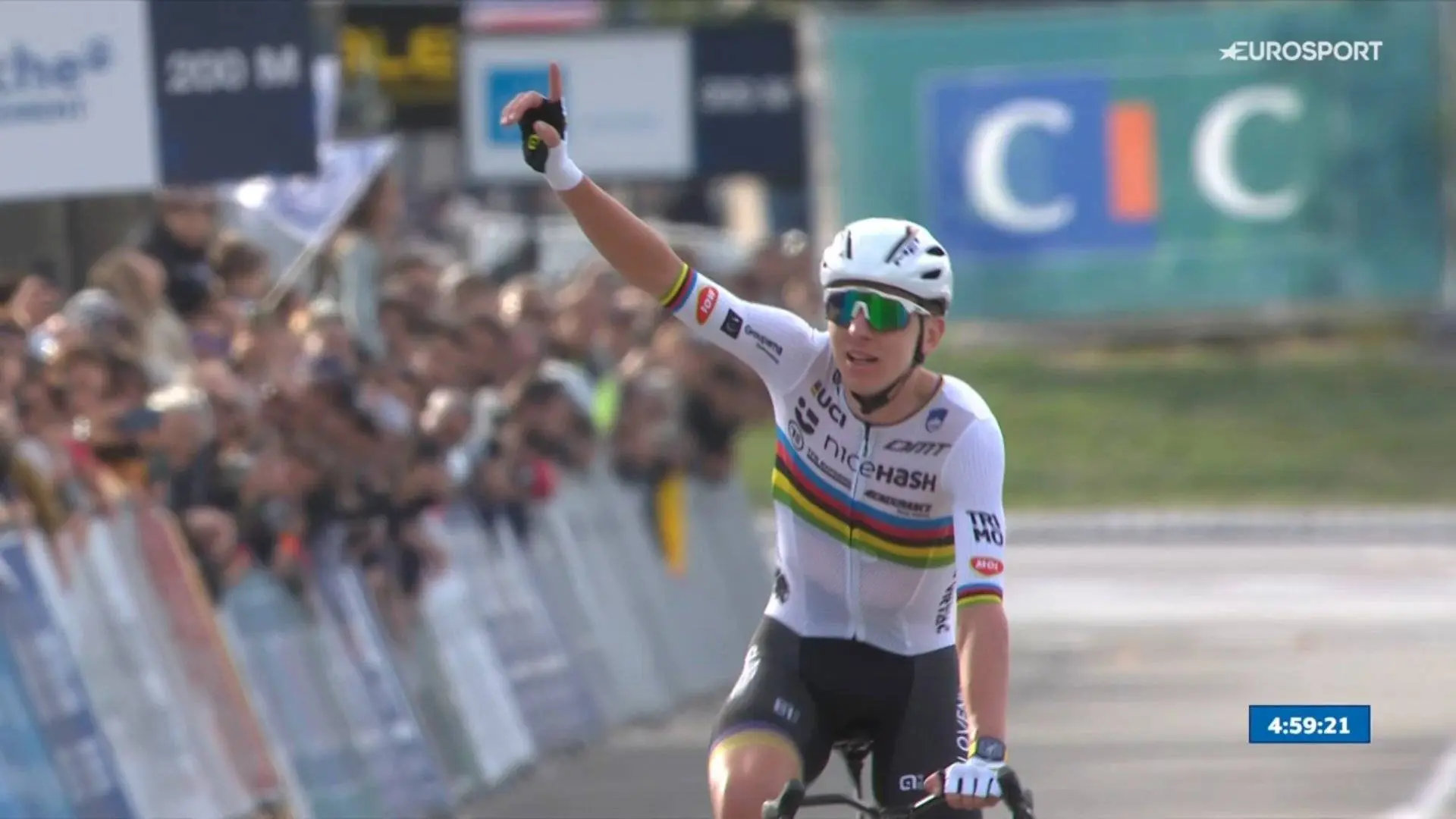
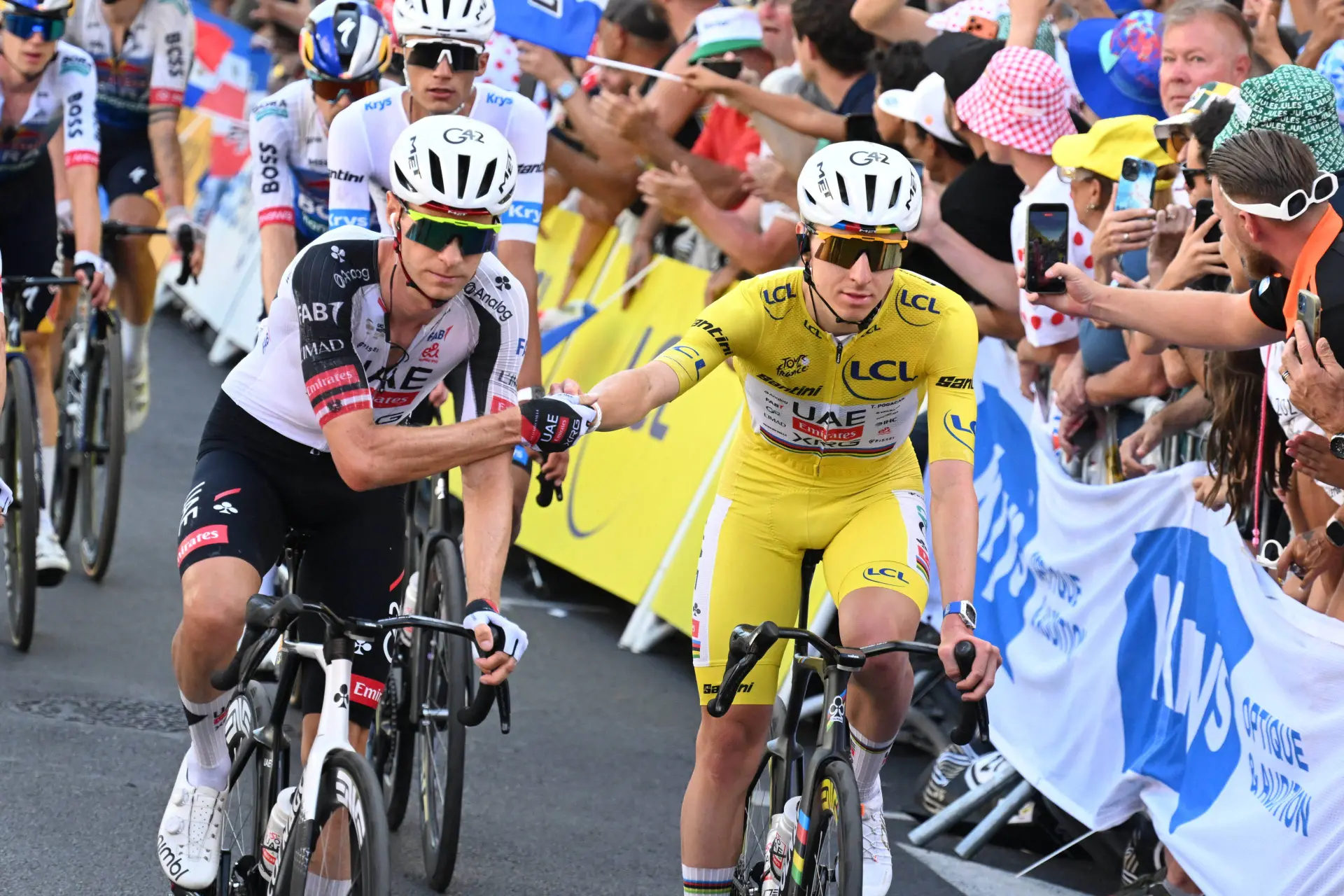
Another major championship, another astonishing solo ride from the all-conquering Tadej Pogacar. Attacking clear from 75km to go, the recently crowned world champion from Kigali added a dominant 2025 European Championships victory to his palmares, with Remco Evenepoel having to settle for silver yet again.
From the start, the peloton faced a demanding parcours that opened with the ascent of the Col du Moulin à Vent before three punishing circuits over the Côte de Saint-Romain-de-Lerps (7km at 7.2%). The early breakaway formed almost immediately, with Mathijs Paaschens, Daan Hoole and Mathias Vacek opening the first meaningful gap of the day. As the race settled, a larger chasing group of roughly 20 riders tried to bridge across, including Louis Vervaeke, Marco Frigo, Niklas Larsen and Tiago Antunes.
By the 150km mark, the front of the race had stabilised, with 14 riders combining from the original escape and the chasers. They worked well together to stretch the lead to around two and a half minutes, while Slovenia – as expected – took control of the peloton on behalf of Pogacar.
Further back, there were already signs of tension in the bunch. Juan Ayuso appeared to be struggling momentarily, though he recovered as the gradients bit again. The main shock came a little later when Jonas Vingegaard was dramatically dropped on the climb, his European title ambitions effectively over long before the decisive phase of the race.
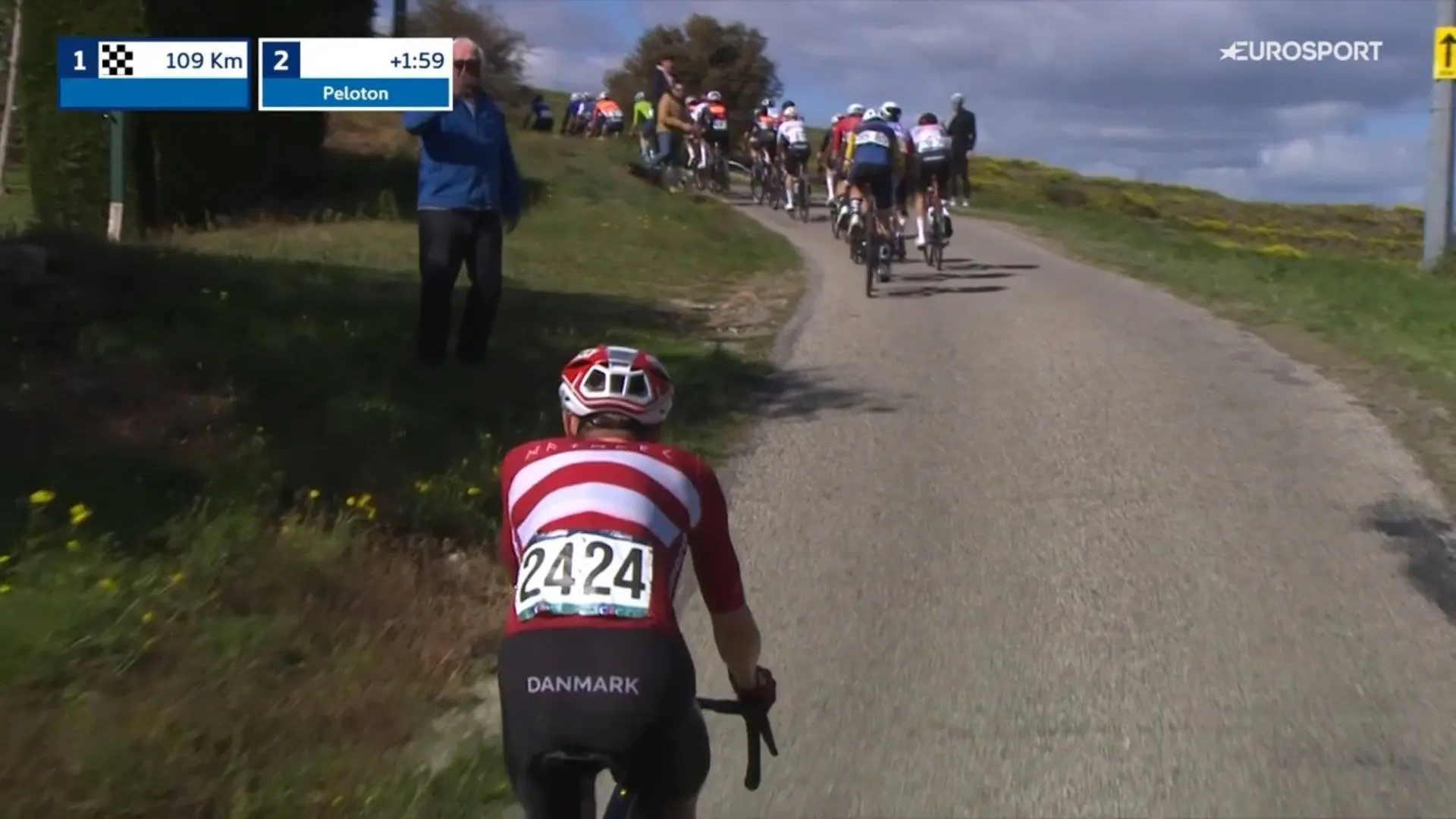
As the pace ramped up near the summit, Domen Novak led the chase for Slovenia, reducing the gap to under two minutes. Then came the first real turning point: Sivakov launched a sharp attack, immediately drawing out Evenepoel and Pogacar. Behind, the likes of Ayuso, Skjelmose and Mohoric latched on, creating a select group of roughly ten riders that surged clear on the descent.
Evenepoel set a fierce tempo on the downhill as they closed in on the remnants of the break, with Pogacar shadowing every move. For the first time, it was clear that the big favourites were prepared to commit – and that the European title would be decided among the sport’s elite rather than the early escapees.
As the front groups merged with around 90 kilometres remaining, the race’s complexion changed once more. Pogacar’s group bridged across, forming a powerful lead selection of around 20 riders that included many of Europe’s biggest names: Evenepoel, Pogacar, Ayuso, Skjelmose, Sivakov, Seixas, Vervaeke, Frigo, Prodhomme, Antunes and Christen among others.
Moments earlier, Jan Christen had sparked another key move, attacking on the climb with Pogacar, Evenepoel and Sivakov immediately in pursuit. Only the young Frenchman Paul Seixas, just 19 years old, managed to follow their acceleration – underlining once again his remarkable composure on the biggest stage.
Behind, Almeida was clearly struggling, while Vingegaard’s earlier implosion left Denmark’s hopes resting squarely on Skjelmose, who dug deep to join the leaders as the race headed towards its third ascent of the Côte de Saint-Romain-de-Lerps.
As the break consolidated, Slovakia’s Martin Svrcek emerged as one of the unsung heroes of the day. The Slovakian – the only rider from his nation still in the front group after Kubis dropped – took long turns on the flat to support his Quick-Step teammate Evenepoel, maintaining the pace as the gap stabilised at around one minute ten seconds over a depleted peloton. Pogacar, meanwhile, found himself completely isolated, with Mohoric no longer alongside him. The Slovenian champion, resplendent in his special European jersey design, looked calm but increasingly outnumbered among a Belgian contingent stacked with Evenepoel, Vervaeke, Cras and Benoot.
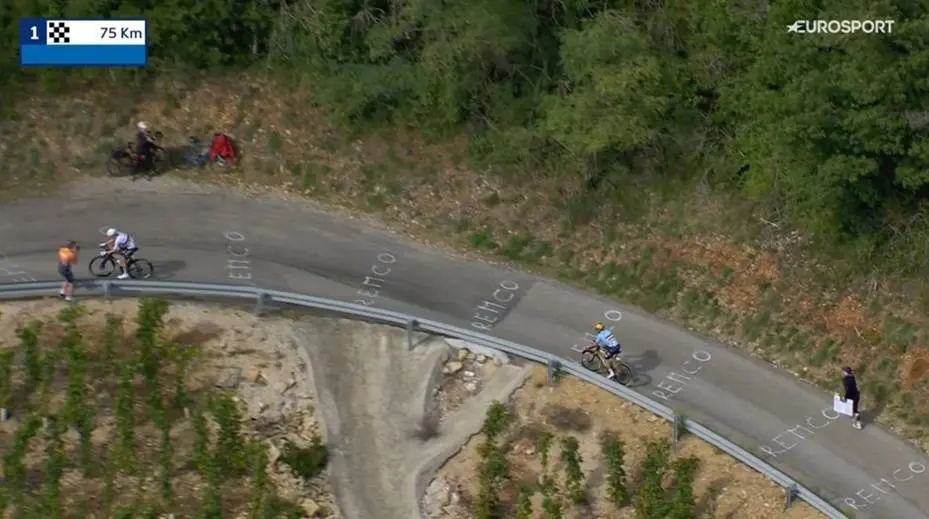
Then, with 75 kilometres to go, Pogacar made his move. On the approach to the Côte de Saint-Romain-de-Lerps for the third time, he launched a ferocious solo attack, immediately dropping Evenepoel, who briefly managed to claw his way back before being distanced again. Evenepoel eventually regrouped with Seixas in a two-man chase, but they found themselves 15 seconds behind the flying Slovenian. Behind them, Ayuso and Italy’s Christian Scaroni bridged across, forming a four-man pursuit at 30 seconds, while the peloton – over a minute back – looked increasingly out of the picture.
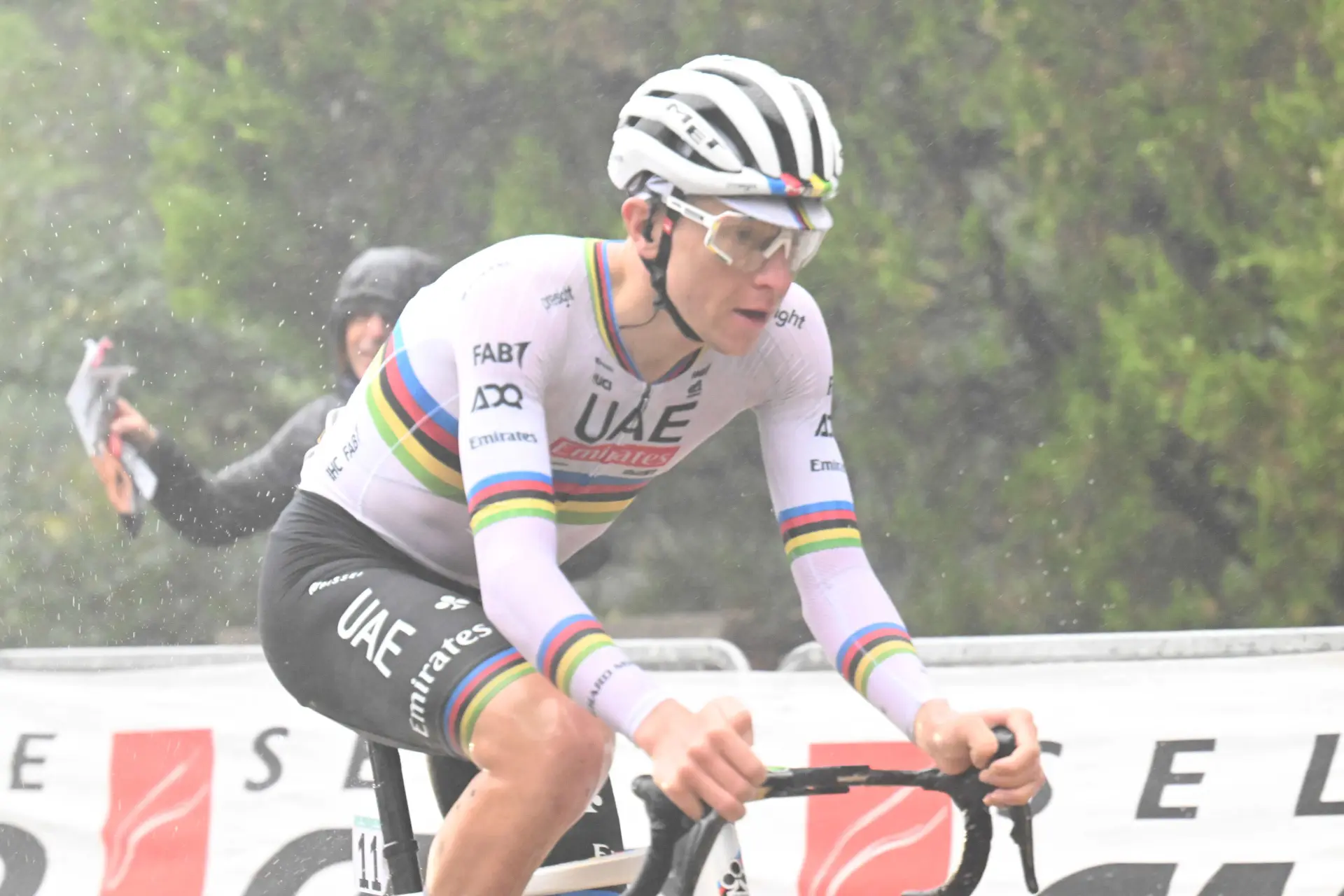
With 70 kilometres remaining, Pogacar led alone at the head of the race, his gap stable but his chasers organised. Evenepoel, Ayuso, Seixas and Scaroni collaborated effectively behind, while the remnants of the original break fell away one by one. As the riders entered the second and final circuit with 60 kilometres to go, the landscape of the race was set. Pogacar continued to hold a 30-second advantage as they began the Côte de Val d’Enfer (1.6km at 9.7%), an explosive climb that would be tackled four times before the finish. Behind him, the chasers hesitated – Evenepoel doing almost all of the work while the others refused to share the pace.
By the summit with 55 kilometres to go, Pogacar’s lead remained steady, the Slovenian cresting the climb 30 seconds ahead of the chase. Evenepoel was still the only rider taking turns on the front, while the rest of the group sat on his wheel. The peloton, now more than two minutes down, was out of contention. Only as the race ticked into its final hour did the chasing quartet finally start to relay properly – but by then, Pogacar’s rhythm on the climbs and descents looked almost unbreakable.
By 40 kilometres remaining, Pogacar had extended his advantage further. The gap over Evenepoel had grown to over a minute, while Ayuso, Seixas and Scaroni lagged 1:40 behind. The peloton was now three minutes adrift, effectively out of contention for the podium.
Evenepoel launched a determined attack in pursuit of silver, lifting the pace solo, but whilst he kicked clear of his fellow chasers, he was never able to close the gap to Pogacar, whose lead continued to grow steadily, 1:10 over Evenepoel with 30km to go, with Ayuso, Seixas and Scaroni now 1:40 back. With the situation pretty locked, by 20km to go, the only thing that had really changed was the time gap between Pogacar and the fight for bronze as the cat-and-mouse games began early, seeing Ayuso, Seixas and Scaroni get properly distanced.
With gold and silver long since decided, with around 5km to go, an attack from Seixas distanced Ayuso, making the battle for bronze a dual between two. Seixas wasn't done with his attacking there either as he repeatedly attempted to kick on afterwards. Scaroni however, was proving much more difficult to dislodge.
Results powered by FirstCycling.com
Félix SernaCycling Journalist
Félix Serna is a writer at CyclingUpToDate and has been part of the team since 2025. He covers professional cycling across both the men’s and women’s calendars, with a focus on UCI rankings, race developments, and rider performance. His work includes interview-based reports, liveblogs, and tournament coverage designed to provide clear, accurate context throughout the season.
In his reporting, Félix regularly uses ProCyclingStats for results, statistics, and historical reference. He places strong emphasis on careful sourcing, editorial accuracy, and updating articles promptly when new, verified information becomes available. He holds a bachelor’s degree in International Studies.
claps 3visitors 2
Just in
Popular news

Latest comments
- Zonneveld continues his "I hate Pogi rhetoric"slappers6607-10-2026
- Some tagline to his career.... If it wasn't for Pogislappers6607-10-2026
- The reason for that is that although the camera is recording at 1300 fromes per second it isn't capturing all the movement. The bicycles are travelling at such a high speed with the wheels spinng at a high revolution at the same time, that even 1300 frames per second does not capture all of the movement. The techy term for that is rolling shutter. It is further compounded by how the camera shoots each frame. Each single frame is scanned from top to bottom. That takes time even if done even at a high speed. Multiply that single frame time period by 1300 frames that have to be scanned and an overall time delay is happening. The bent spokes you see are a compounded image of the spoke movement being stopped on every frame at that moment. "rolling shutter." The cameras gubbins then creates an image showing this movement as best it can. To eliminate this issue would need a much faster camera shooting at many times the 1300 per second frame rate or use a camera with what is called a "global shutter" Global shutters eliminate much of that wubble you see in the spokes. Motion picture cameras have a global shutter. You will rarely see odd shaped moving images in high quality films.Prorodsandstuff07-10-2026
- yes I should have qualified the all continents. maybe they can do a TdF TT prologue there - it seems the TdF route planning committee is always looking for a novel and inconvenient place to start a race. then McEnremcoe could truly be an all continents winner.mij07-10-2026
- although he'll never be able to beat a healthy pogi in a grand tour, this year's tdf has demonstrated that in his absence he can probably win any grand tour...Ketterechts07-10-2026
- Nothing has changed, even after all these deaths. The UCI has blood on its hands.Pogboom07-10-2026
- I'm a retired pro photographer. We have been having a debate on this issue on a photography forum. Is the image we see that the ECF has issued accurate? In truth it is debatable. Why? What they are describing is basically high speed photography using a camera that shoots at 13000 frames per second. That is thirteen thousand single images every second. They are than using a process that most keen photographers know as "stacking." Each image taken within the set time period that the camera is set to shoot is then laid one on top of the other to get a single high resolution image. Does it tell the truth about the winning bikes position? Therein is the debate! My opinion is that unless you see the actual line on the road and its position relative to the actual finish line on the road and not a manufactured digital line purporting to be the finish line, there will always be questions on the accuracy of the image that the ECF has produced.Prorodsandstuff07-10-2026
- Take the thrown? Really?Trooph07-10-2026
- Maybe consider that it helps him work himself up into pushing his energy? A lot of people never start or do anything without some catalyst based on or created through negative feelings. Saying all continents is no longer acceptable without qualification, it must now be starred ;-) The amateur world of pioneers and seekers of thrills and fame has long since declared you have not been or won on all continents until you’ve included Antartica, to the great and sad loss of that place’s merit of having stayed more or less undiscovered by useless visitors.Jumpyjohn07-10-2026
- Now Hills33, don't you turn your back on me... you hear? They're all against me, because together they think, they have more power, but it ain't working for them. They keep losing out.PogiSloFans07-10-2026
Loading
2 Comments