"It is impossible to station an officer at every entry point" - Fin Tarling's passing likely explained by myriad of bad coincidences
CyclingSunday, 16 August 2026 at 11:49
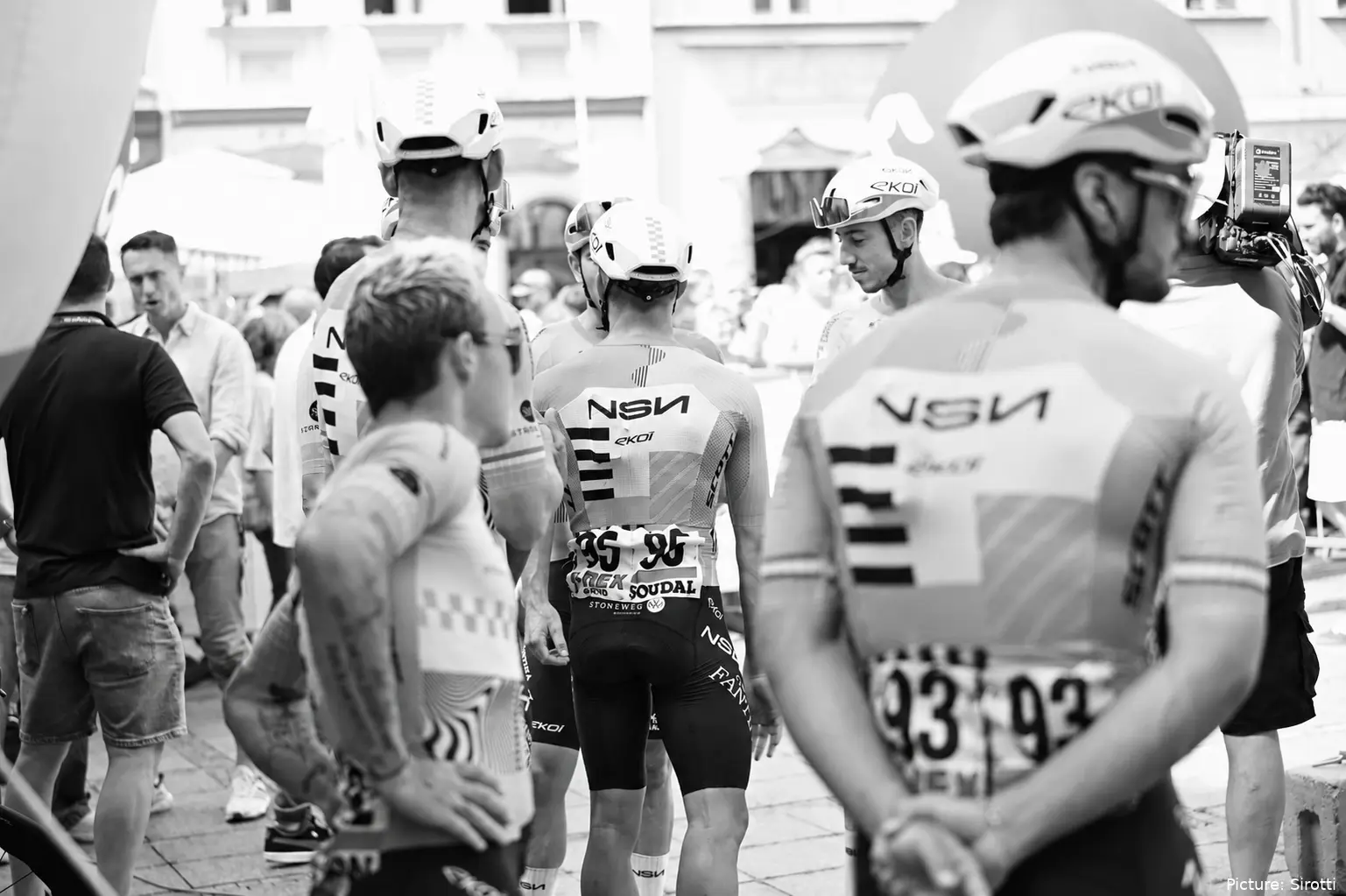
The tragic passing of Finlay Tarling has shocked the cycling world and has shaken it to its core this week. Discussions on race security are now at the forefront; whilst in Portugal, there is a race to understand the exact circumstances that have led a driver to enter the course at the moment that the British rider was crossing it.
More details on Fin Tarling's crash
“He was driving in his own lane, but in the opposite direction to the riders. The rider cut the corner in the left lane," Carlos Canatario, a representative for the national guard, said in an interview with RTP.
On stage 8 of the race, Tarling was racing at the back of the Volta a Portugal, isolated. It is understood that a driver broke through into the course and whilst the British rider tackled a blind corner, the two collided. The 19-year old passed away shortly after. Tarling was a rider for the NSN Development Team.
“We know that he stopped at the access road, saw the peloton pass, waited for a moment, and asked bystanders if the race was over yet. They reportedly said that the last riders had passed and that he could drive on," the GNR representative explained.
Most likely, the driver and the audience in the town of Arcozelo, Ponte de Lima, was unaware that the race convoy hadn't yet finished. Tarling was still to race by, with the few people on site not aware or unfamiliar with the concept of the broom wagon and that this vehicle signals the end of the race.
Every major point was covered by security, but the driver will have come from a smaller point of entry into the N306 road.
“It is impossible to station an officer at every entry point to the course. Priority is given to entry points where there is a greater chance of vehicles and people entering the course. This was a secondary entry point without officers, but with signage.”
It is believed the locals told the driver the race was over. Due to the amount on the road, the vehicles leading and following every rider were in constant change. At that moment Tarling did not have a motorbike in front of him, whilst the incident happened on one of the few treacherous corners in the area. It was a combination of several factor that led to the collision.
“It is important to understand this: throughout the entire race, the mobile security team must constantly adapt, because the composition of the peloton is constantly changing. At the broom wagon, we have a police car and two motorcycles to protect riders. Three riders, including Tarling, started dropping back from the peloton at intervals. The two motorcycles rode ahead to catch up with them.”
“The rider who died was, at a certain point when going uphill, next to his team's support vehicle. When the descent began, he suddenly picked up speed. He rode ahead of his support car, and the motorcycle could not immediately keep up with him. The rider cut the corner in the leftmost lane, and that is how the collision between the rider and the vehicle occurred.”

Finlay Tarling passed away after being hit by a car during stage 8 of the Volta a Portugal
Security costs skyrocket and pressure cycling events
It is a battle to ensure security in a race of 11 days, a difficult but possible mission. However the Volta a Portugal's budget is well below that of most races of similar or higher distance. This may have played a role in there not being a guard that spotted the driver's intrusion into the course at the moment of Tarling's passage through the area.
"What happened yesterday is tragic. I've been following this Tour of Portugal very closely, and it's a constant miracle," French pundit and former team manager Jerome Pineau said in words to RMC.
"The finishes are not worthy of a race of this caliber, the security is catastrophic. It's the result of incivility and, above all, the lack of resources to organize major cycling races, which are becoming increasingly expensive."
But the fight is also against an often uninformed and impatient audience, who are unaware of the logistics of professional cycling. In other instances this year, namely the Volta a Catalunya, cars have been seen driving in the opposite direction to the race near a tunnel. In Tarling's case, this happened on a narrow road with no time to react.
"All of this should primarily concern those in charge. They must implement approval processes, and if security isn't guaranteed, if the organizers aren't capable of it, they shouldn't be allowed to organize the event. It's not more complicated than that".
"It's becoming increasingly expensive to organize races, and some organizers are abandoning the safety principles that govern the entire cycling bubble. The Tour of Portugal is a second-tier race; they have to find race officials, staff to organize it, find funding for the police..."
Rúben SilvaEditor-in-Chief
A founding contributor to CyclingUpToDate since its launch in January 2022, Ruben Silva has played a central role in shaping the site’s editorial direction and long-term growth. Before joining the project, he built his experience through independent blogging at Echelons Hub and by producing race previews for Ciclismo Internacional, developing a strong analytical voice rooted in daily engagement with professional cycling.
Beyond editorial work, he has been closely involved in the expansion and coordination of CyclingUpToDate’s wider network, helping establish and support sister platforms across multiple languages. This includes ongoing collaboration with CiclismoAlDia (Spanish), CiclismoAtual (Portuguese), WielrennenUpToDate (Dutch), and RadsportAktuell (German), contributing to a shared editorial vision and consistent international coverage.
He also helps oversee editorial governance across the network, setting standards for accuracy and consistency and coordinating updates or corrections when needed.
Originally from the Porto metropolitan area in Portugal, he holds a bachelor’s degree in Geography. His path into cycling journalism was shaped not through formal media training, but through independent reporting, community engagement, and sustained on-the-ground involvement in the sport.
Over the course of his career, he has conducted approximately 100 interviews across road cycling and cyclocross, ranging from one-to-one conversations and online formats to press conferences and on-site pre- and post-race coverage. His interviews include leading riders, team managers, and prominent figures within cycling media: Tadej Pogacar, Jonas Vingegaard, Mathieu van der Poel, Primoz Roglic, Wout van Aert, Joao Almeida and Tom Pidcock; managers like Patrick Lefevere and Joxean Matxin; and YouTube personality Bryan Kennedy (BKXC)...
Within 18 months of launch, he helped grow CyclingUpToDate’s English-language platform into one of the most-read cycling news websites, built entirely from the ground up. As both a professional journalist and lifelong cycling enthusiast, his focus remains on delivering accurate, timely, and well-contextualized coverage.
claps 0visitors 0
Just in

Popular news
Latest comments
- Yes it does seems so. Unfortunately it also seems Jonas doesnt have the will to push anymore. I think hes mentaly over it. I dont expect him to compete vs the likes of Del Toro, seixas and co next year.miguel16-08-2026
- Dang you are true definition of 'get off my lawn guy' ! No wonder you have so much time to spread your Pogi love on this site!frieders316-08-2026
- Against weak competition ! Whenever he goes against the top tier he's not the old Jonas !frieders316-08-2026
- Kuss and Pidcock's crsahses had nothing to do with the UCI! Kuss was fortunate the city most likely had that netting up but downhills can't be covered in padding on every mile! Racers race!frieders316-08-2026
- I’ll tell you one very simple reason, because others like Bjarne, Mauro and dozens of others get even more to say in the sport. So unless you advocate to kick out the likes of those, it’s kind of cheap to only pick on easy targets.Mistermaumau16-08-2026
- As already suggested with asking riders/teams to contribute to safety budgets, one very simple effective method would be for each participating team to have to provide X safety staff or X pro number of riders to be allocated along the routeMistermaumau16-08-2026
- Leave the bias out of it, he's number two by a wide margin.awp16-08-2026
- Yawn. Why does CUTD insist on running stories from JB, LA and the rest of the Postal cheats?Crashjames16-08-2026
- JB trying to be relevant. He should do what he does best: dope, lie and cheat.Cyclingnut16-08-2026
- Movistar would be a good fit. The team is Spanish and Carapas speaks Spanish and understands the nuances of that language. He won the Giro with them. Cian Uijtdebroeks has not been the rider that they hoped he would be. I know there was a bit of falling out between Carapaz and Movistar. I doubt that would stop him signing.Cyclingsbestfan16-08-2026
Loading
5 Comments