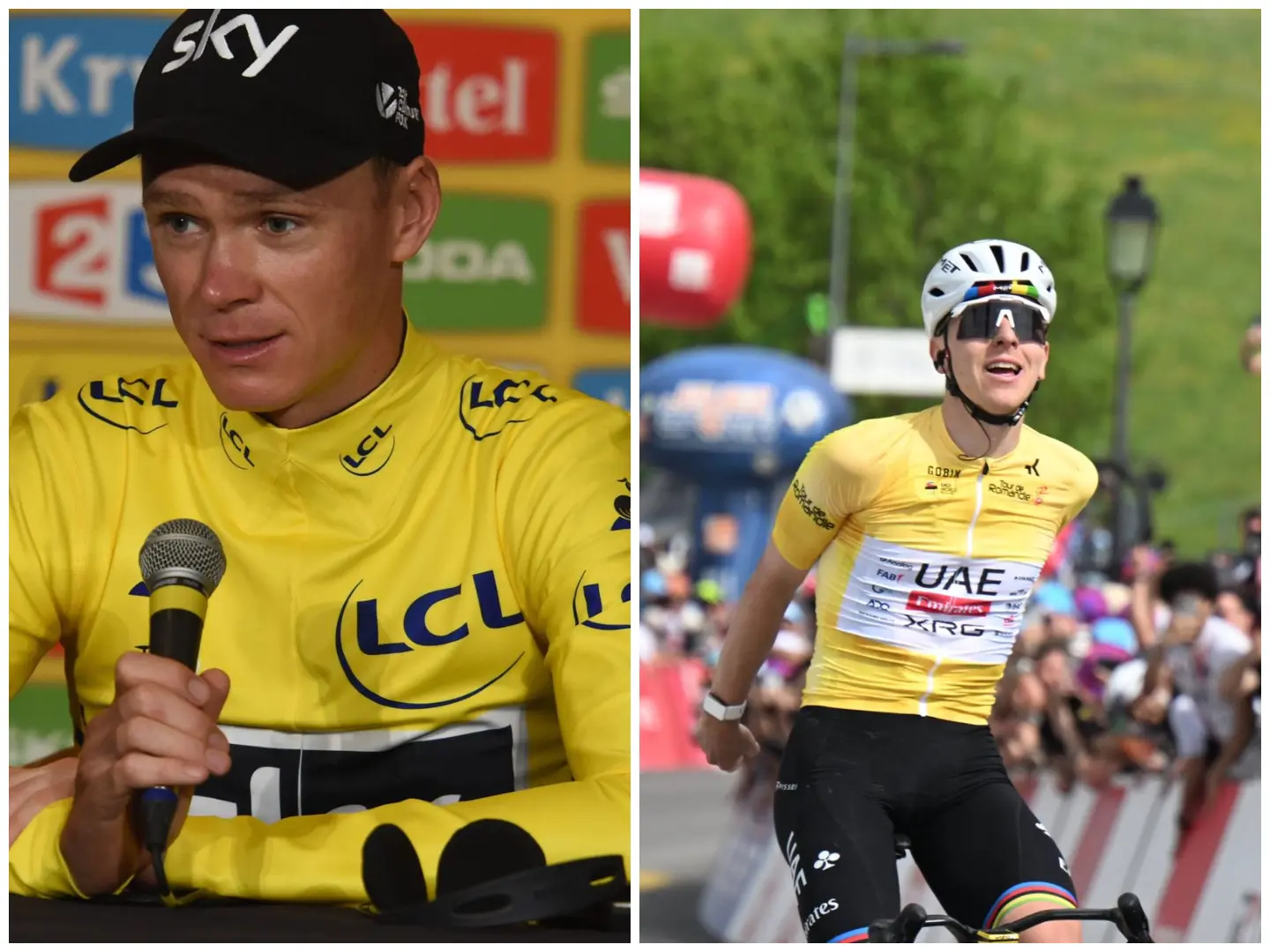
The decade spanning 2016 to 2026 has produced one of the most extraordinary generations in cycling history. Grand Tour contenders, Classics specialists, sprinters, and time trialists have shared a peloton packed with champions.
Picking the top ten is no easy task. The dominance of some riders has been concentrated in certain seasons, while others have sustained remarkable consistency over years. We also need to weigh each rider’s impact in Grand Tours, the Monuments, the Worlds, and the major Classics.
Above all stands Tadej Pogacar. The Slovenian has taken versatility to another level, stacking victories once thought incompatible for a single rider. His palmares and, above all, the way he has built it place him in a category of his own.
Behind him come names like Chris Froome, Primoz Roglic, Jonas Vingegaard, Mathieu van der Poel, and Peter Sagan, five riders who have decisively shaped this era and represent different faces of an extraordinary decade.
1. Tadej Pogacar: the undisputed number one
Pogacar needs little explanation to occupy top spot. Since his breakthrough in 2019, the Slovenian has won on several occasions the Tour de France, Giro d'Italia, World Championships, and Monuments, assembling a palmares that already invites comparison with the greats of history.
The difference is not just his wins, but his ability to contest victory almost anywhere. Mountains, time trials, Classics, punchy finishes, or one-day races: Pogacar has made versatility his sharpest weapon.
His dominance has also spanned several seasons. In 2026 he claimed his fifth Tour de France and again showed that, within this generation, there is a tier clearly reserved for him.
2. Chris Froome: the great force of the first half
Froome defined much of the decade’s opening phase. Between 2016 and 2017 he won two Tours de France and the Vuelta a España, and established himself as one of the dominant riders of three-week races.
His significance goes beyond titles. For years the Briton led the near-perfect machine of Sky and later Ineos, imposing a racing model based on control and relentless consistency.
His subsequent decline keeps him from the very top, but his years of supremacy were too important to leave him out of the leading positions.

Chris Froome during his victory on Mont Ventoux in 2013
3. Primoz Roglic: a decade of resilience
Roglic has built an extraordinarily long-lived career. A multiple Vuelta a España winner, Giro d’Italia champion, and Olympic time trial gold medallist, the Slovenian has been a fixture throughout almost the entire decade.
His ability to reinvent himself after defeats is part of his greatness. For years he chased a Tour victory without success, yet he never stopped fighting for Grand Tour general classifications.
His consistency, climbing strength, and outstanding time trial performance make him one of the standout riders of the post-Froome generation.
4. Jonas Vingegaard: Pogacar’s great rival
Vingegaard arrived later than others on this list, but his impact has been immense. The Dane won two consecutive Tours de France and became Pogacar’s main rival in the fight for Grand Tour supremacy.
His climbing prowess and ability to sustain long efforts allowed him to beat the Slovenian in 2022 and 2023, shaping one of the most important rivalries of recent times.
Though his career at the top is shorter, the magnitude of his results justifies his place among the best. If he maintains this level in the coming years, he could climb higher still.

Jonas Vingegaard in action during stage six of the 2026 Tour de France
5. Mathieu van der Poel: the king of the Monuments
Van der Poel has arguably been the most complete Classics rider of the decade. He has won several Monuments, World Championships, and major one-day races, showing an extraordinary ability to perform on very different terrain.
His rivalry with Wout van Aert has also defined much of recent cycling. Together they have raised the level of the Classics and cyclocross, turning each duel into a must-watch.
Victories at Paris-Roubaix, the Tour of Flanders, and the road Worlds sum up a career built on explosiveness and aggressive racing.
6. Peter Sagan: the phenomenon who changed the Classics
Sagan was one of the standout figures at the start of this decade. His three consecutive World titles between 2015 and 2017, seven Tour green jerseys, and wins in Flanders and Roubaix make him indispensable.
The Slovak was also much more than a winner. His personality, style, and flair for entertainment helped reshape the image of professional cycling and turned him into one of its defining icons.
Although his decline arrived earlier than that of other riders on this list, his competitive and media impact for much of the decade is impossible to ignore.

Peter Sagan and Mark Cavendish sprinting against each other
7. Remco Evenepoel: talent turned champion
Evenepoel burst through as one of the greatest talents in modern cycling and quickly converted that promise into results. He has won World Championships, Grand Tours, Monuments, and Olympic medals.
His time trial ability and power over long efforts make him an exceptionally complete rider. His Vuelta victory and Olympic successes also showed he can deliver in both stage races and one-day events.
He still has room to grow his palmarès. Precisely for that reason, seventh place may prove a provisional ranking in a career that is far from done.
8. Wout van Aert: the complete rider
Few cyclists have amassed such a range of abilities as Van Aert. He can win sprints, classics, time trials, and Grand Tour stages, while also working selflessly for his leaders.
His rivalry with Van der Poel has defined classics and cyclocross for years. On the road, he has also become one of the most valuable riders for any team.
He may be missing a major Monument or a road Worlds to lift his case even higher, but his consistency and versatility secure him a place among the greats.

Wout van Aert, one of the finest domestiques in memory
9. Julian Alaphilippe: two-time world champion
Alaphilippe enjoyed some of the brightest years of his career between 2018 and 2021. His back-to-back World titles, classics victories, and Tour stages and days in yellow sum up an extraordinary spell.
The Frenchman was also one of the peloton’s most charismatic riders. His attacking style and willingness to strike from distance made him a leading protagonist in one-day races.
Subsequent inconsistency and a dip in form push him down against others, but his competitive peak deserves recognition.
10. Filippo Ganna: power against the clock
Ganna rounds out the list thanks to sustained dominance in time trials. A world champion and double Olympic champion in pursuit, the Italian has turned raw power and aerodynamics into a craft.
Beyond his track and time trial success, he has shown he can compete in classics and Grand Tour stages, including victories of major prestige.
He may not have Pogačar’s versatility or the palmarès of the elite Grand Tour contenders, but his specialist dominance and his impact on the evolution of time trialling earn him a place among the decade’s top ten.
Javier RampeCycling Journalist
Javier Rampe is a sports analyst with more than 15 years of experience. He holds a degree in Economics from the University of Rome and a Diploma in Business Studies from the University of Cádiz. Despite coming from an academic background not particularly associated with cycling, his passion for both cycling and journalism was instilled in him from an early age. He grew up following Miguel Indurain and José María “El Chava” Jiménez. An admirer of Michael Robinson’s communication style and journalistic approach, he was inspired to pursue a degree in Journalism at the University of Buenos Aires, which he is currently completing.
He has always maintained close ties with the worlds of sport and culture, contributing from a young age to sports blogs and film and music review websites. His work has appeared in media outlets such as Cope, RAI, and Radio Con Vos. He is also the founder of the cycling-focused podcast El Contraanálisis and the football interview channel Días De Fútbol, dedicated to conversations with professional footballers.
In addition to his work at Ciclismoaldia, Javier has interviewed some of the most influential figures in modern cycling, including Alejandro Valverde and Tadej Pogačar, as well as key voices in anti-doping policy such as Alberto Yelmo, David Varillas, and Marcelo Milano. Marcos Maynar, in relation to the ‘Operación Ílex’ case, is also among the personalities he has interviewed. He enjoys conducting in-depth analysis of the cycling ecosystem and has attended major events such as Strade Bianche, the Vuelta a Andalucía, and Itzulia, as well as numerous national cyclo-cross races.
His background in economics, combined with extensive experience in marketing and corporate communications, drives his continuous study of positioning strategies and ensures that he always keeps his focus on crafting compelling and evocative headlines.
claps 15visitors 14
Just in
Popular news
Latest comments
- unpredictability is not an issue. Most riders not named Pogi have that. The excuses are and the blaming teammates and other riders for insufficient support and blocking are. if weight is an issue get a nutritionist. If aircon is not working switch rooms. Position yourself or get your teammates and DS to keep reminding you of basic stuff if it is difficult to remember in a long race. Dont whine about other riders not working with you, use tactics yourself or get your DS to develop the tactics. Dont talk about noballs when you yourself have no ballsabstractengineer16-10-2026
- It’s worth remembering that cycling journalism has entered it’s “Shit-Stirring Hot Takes Winter” now in order to keep the clicks and views trickling in.wrsty16-10-2026
- Well that would be a major disappointment. The last two years are the first times I have bothered watching the last day. Maybe at worst it could be the 2nd last day but two classic finishes and then wompWaranga16-10-2026
- Vingegaard was the one showing signs of weakness. He was looking more likely to lose a podium spot or two than to make inroads on Tadej.Papijan16-10-2026
- Disagree with Ardennes, he has never done well there, not even a top 10. Giro Vuelta, avoid the stacked TDF where crashes can derail the rest of the season and even if he avoid that, at best a top 5 is possible. He is 31, no more time left for testing/trying.abstractengineer16-10-2026
- Respectfully disagree. He and the team will want to qualify the result at the Tour against TP, JV, and the other GT specialists who weren't in Spain. And remember, the team is looking for a new title sponsor. Or, at least a co-sponsor. So a run at the TDF would go a long way in securing that! As a fan of the team dating back to the Indurain days, I would love to see it. But I do not think that he can really take it to them in July. But I do think he will try. I do agree that he can do good rides, if not win, in Belgium.coachjulianx16-10-2026
- Kid, you just had to keep your mouth shut, now you opened it and it's too late, everyone knows you're dumb.elosanjos16-10-2026
- “He looked less than brilliant” then Pogacar attacked and distanced all his rivals, again! I swear these support riders are purely doing pr for their leaders at this point.Pedalmasher16-10-2026
- PogiFanBoy just doesn't like you attacking his Tadej boy ! He's quite protective of him as you may have noticed. No one can say a bad thing about him or fear reprisal.frieders316-10-2026
- Remco won the European title against a weaker field and not as tough of course and mileage as the worlds RR ! Apples to oranges comparison !frieders316-10-2026
Loading
7 Comments