"I hope to be even better": Paul Seixas ramps up Tour preparation at Sierra Nevada altitude camp
Cycling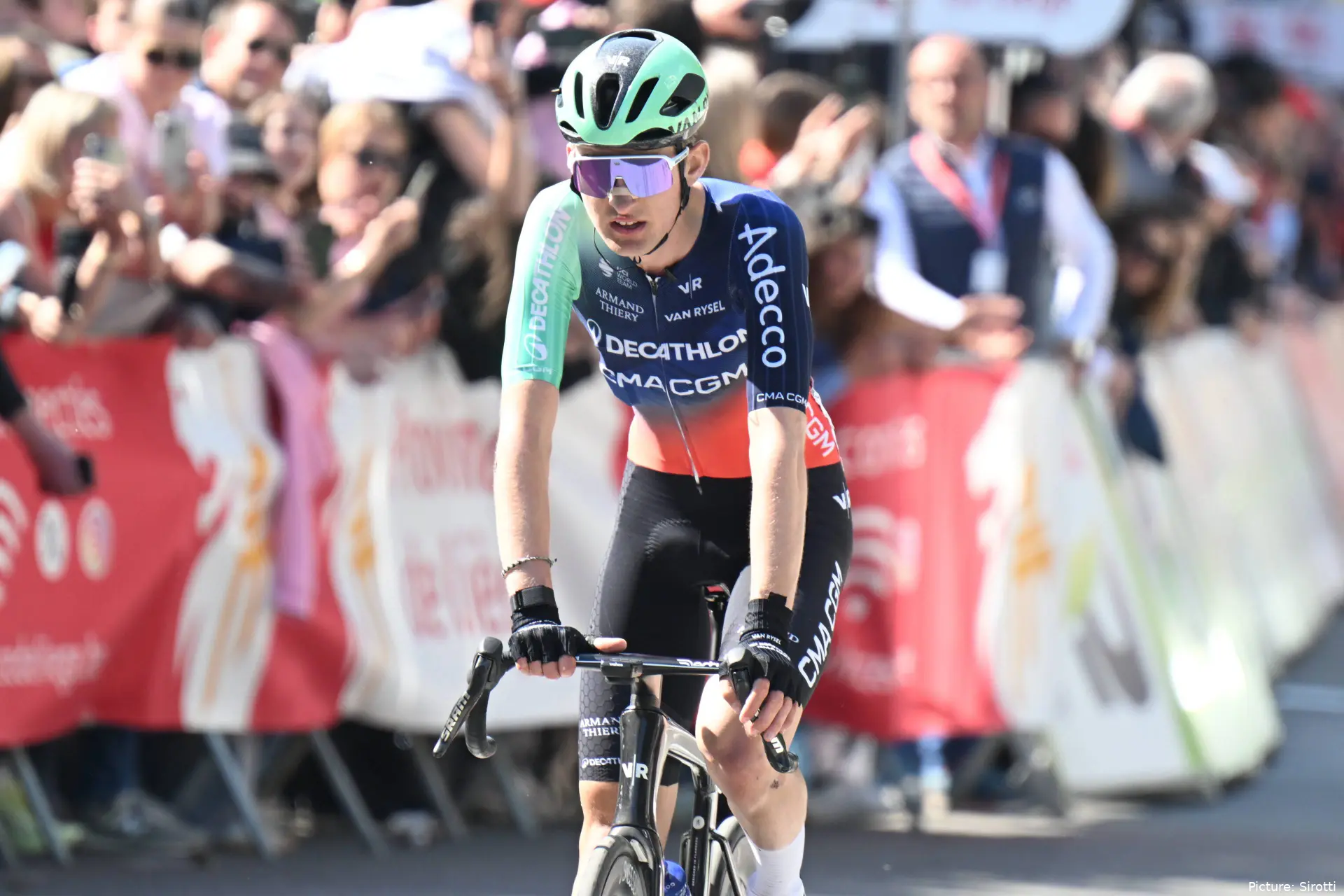
Paul Seixas and his Tour de France debut will be the main storyline of this summer, regardless of how the race goes for the Frenchman. At just 19 years of age, the Decathlon CMA CGM Team rider is listed among hottest podium prospects at the world's biggest cycling race, just behind Tadej Pogacar and Jonas Vingegaard. And most likely rightfully so.
Seixas is yet to finish worse than second in the final standings of a race this season. His year kicked off in style with a stage victory and second overall at Volta ao Algarve. And from there on, Seixas' form had only upward trajectory. Dominant victory at Faun-Ardeche Classic, Volta a Catalunya and La Fleche Wallonne, defeated only by Pogacar at Strade Bianche and Liege-Bastogne-Liege... the 2026 palmares of Seixas are nothing short of impressive.
His team denied for a long time whether Seixas would be nominated already for the 2026 Tour de France, until, under the pressure of his excellent performances, they finally made the call to bring Paul Seixas to Grande Boucle this summer. And the youngster intends to not underestimate a single detail, as he's been spotted exploring multiple of 2026 edition's key points.
And after reconnoitering the time trial course between Thonon-les-Bains and Évian-les-Bains and the stage to Le Markstein in the Vosges mountains, Paul Seixas arrived in southern Spain early last week.
Welcome to Sierra Nevada
Just like the vast majority of his Tour de France rivals, Seixas' destination was Sierra Nevada, and it's high-end facilities suited to the needs of top athletes at over 2,300 meters of altitude.
"Everyone goes to the same place for two reasons. First, because the Spanish weather is decent. And above all, up top, the center has the perfect infrastructure for sleeping well, eating well and recovering well," explains former cyclist Jérôme Coppel, now a consultant for RMC Sport.
Seixas is already in his second week at the altitude camp as we speak. His training sessions vary in length between one and six hours but have common denominator - plenty climbing.
"With all the accumulated data, the teams then know which point to work on," he continues. "During the May training camp, the riders do less volume than in December or January. We focus more on quality, really trying to activate levers such as PMA (maximum aerobic power), threshold, explosiveness…"
In early May, Paul Seixas revealed on the Super Moscato Show his desire to develop his threshold after having "worked on shorter efforts of the 4-5 minute type." "It's going to be a different kind of work in terms of threshold training. On longer efforts, I hope to be even better, and that will make a big difference, in terms of endurance as well."
Who else is going to the Tour?
Based on available information, we can assume that Nicolas Prodhomme, Aurélien Paret-Peintre, Dan Hoole, and Stefan Bissegger - all of them often seen alongside Seixas - are part of the Decathlon selection. Furthermore, lead-out men Cees Bol and Robbe Ghys are reportedly present in Spain even though the participation of their original leader Olav Kooij is uncertain. Finally, the other notable absentee Tiesj Benoot is also in Sierra Nevada, HLN reports, even though his schedule might be different.
"The training camps really help to bond the group because they live like monks for three weeks. Their days consist of sleeping, eating, riding, eating, sleeping," recalls former French time trial champion Jérôme Coppel, who retired in 2016. "At the start of the Tour, the eight riders need to get along as well as possible, firstly so they can sacrifice themselves for each other, and secondly, with all the pressure and fatigue, the smallest problem can become a major obstacle."
Ondrej ZhasilCycling Journalist
Ondřej Zhasil is a cycling journalist at CyclingUpToDate and has been part of the team since 2023. He is based in Ostrava, the third-largest city in the Czech Republic, and covers professional cycling across the main UCI competitions, including the Tour de France, the Giro d’Italia, and La Vuelta a España. A key focus of his work is startlist analysis and pre-race coverage, where he examines team selections, rider line-ups, and tactical scenarios ahead of major events.
Alongside WorldTour coverage, Ondřej has developed specific expertise in junior cycling and in racing across East Asia, including competitions in China and Japan. He also maintains a broad working knowledge of other disciplines and levels, including cyclocross, while continuing to expand his understanding of mountain bike racing.
Ondřej holds a bachelor’s degree in Mathematics and Physics, which supports his analytical, data-driven approach to performance and race analysis. In his reporting, he regularly uses ProCyclingStats for results, statistics, and historical context. He places strong emphasis on careful sourcing, editorial accuracy, and updating articles promptly when new, verified information becomes available.
claps 1visitors 1
Just in

Popular news
Latest comments
- You are blinded by your infatuation with Pogi. IdT has done crazy good stuff. One of the strongest ever first three years in the peloton. poor showing in his last couple of races btu I don't think he is quite washed up yetmobk11-10-2026
- Absolutely not. The guy has finished so many races 2nd to Pogi so absolutely not a shocker that when Pogi isn't there he wins a fewmobk11-10-2026
- GOATmij11-10-2026
- ugh god just leave the rest of the peloton with some riders heywrsty11-10-2026
- The next Tadej in a few years. Great job Paul!awp11-10-2026
- "I think today I also suffered from not knowing the route so well," i have no words, if you are racing for the win in a GT stage or a monument, your marginal gains comes from knowing the route. this is just unprofessional. It is also upto his team to ensure that their leader knows the finale and the tactics. Paul's team had already decided where to attack before the race. In contrast to Piddie, Mas did brilliantly remaining within limitsabstractengineer11-10-2026
- Mas was nowhere in the worlds, This also confirms that the Vuelta riders had the form but jet lag/non-acclimatization ruined their chancesabstractengineer11-10-2026
- Dont start Del Toro if he will not be a full domestique. Its just useless o watch Pogi slave for a weak Del toro and not take the stage win.abstractengineer11-10-2026
- What is funny is the Redbull's Insta post is celebrating 4th PLACE and Remco did not win. After the work that the team put in. This is what I said, when you put your team to work , at least make sure you have the legs and not make your team hurt yourself.abstractengineer11-10-2026
- Safety is everybody's responsibility. Riders too need to take responsibility for risky racing. Most incidents happen at the back of the race, no cameras, downhills. Once out of the peloton, slow down on the downhills and start obeying traffic rules to minimize risk.abstractengineer11-10-2026
Loading
Write a comment