"He can't climb, can't sprint, can't hold his own in the time trial" - De Vlaeminck's opinion on Mathieu van der Poel
CyclingSaturday, 15 November 2025 at 11:13
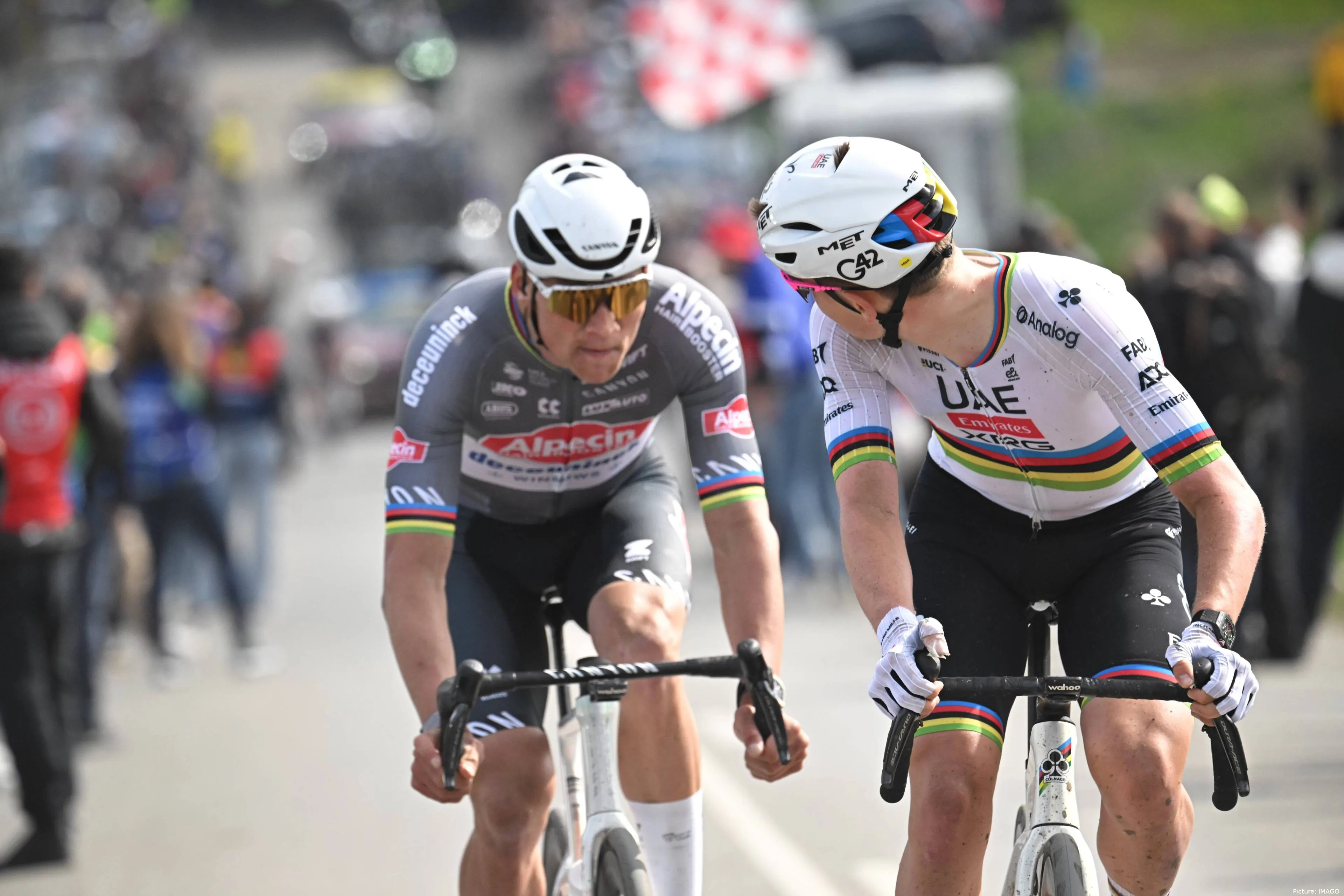
Roger De Vlaeminck, one of the most influential Classics riders in cycling history, is known for his unvarnished judgments. In one of his most recent interviews, one remark in particular made headlines: his comparison between Tadej Pogacar and Eddy Merckx - with the key sentence that Pogacar was not a new Merckx. However, the Belgian legend also had skeptical words pointed towards Mathieu van der Poel.
With this clarification, De Vlaeminck deliberately went against the hype that already puts Pogacar on a par with the Belgian icon, and because this statement dominated the attention, a second, even sharper quote almost faded into the background - his merciless analysis of Mathieu van der Poel: "He can't climb, he can't sprint, he can't hold his own in the time trial... there's not much left," he had said in words to Het Laatste Nieuws. This statement in particular shows much more clearly how harshly De Vlaeminck assesses the modern generation.
A classic hero with uncompromising standards
Roger De Vlaeminck epitomizes an era in which versatility was considered the highest virtue. He won Paris-Roubaix four times, triumphed in all five monuments and was notorious for his ability to compete on any terrain. Those who come from this tradition measure today's riders against an almost impossible ideal: strength in sprints, power in time trials, toughness in the mountains - and the ability to dominate all races.
De Vlaeminck's tough analysis of Van der Poel
In the same interview, he drew a clear line between what he calls a "complete racer" and what van der Poel embodies for him. His assessment was ruthless:
- Not a climber - not competitive on long climbs.
- Not a sprinter - not at world-class level in the bunch sprints.
- Not a time trialist - not strong enough for decisive solo performances.
In De Vlaeminck's view, this paints a clear picture: van der Poel is spectacular, explosive, technically brilliant - but not universal enough to make it into the top category of all-rounders.
Two generations, two definitions of greatness
The contrast between the first and second sentence in the interview marks the core of De Vlaeminck's attitude. He does not regard Pogacar and Merckx as riders who are equally proficient in all facets of the sport - on the contrary, he expressly emphasizes that Pogacar is not a new Merckx. Van der Poel, on the other hand, he sees as a modern specialist: outstanding in classic one-day races, in cyclocross or in explosive situations, but limited in the disciplines that De Vlaeminck considers true greatness - whilst not considering his titles on gravel and mountain biking as well.
This collision between the old and new definition of cycling characterizes his statements. What is considered specialization today appears to him as incompleteness.
The fact that van der Poel actually received the harsher criticism in this interview was obscured by the debate about Pogacar and Merckx. But the words show just how consistently De Vlaeminck pursues his line: What counts for him is not the spectacular attack, not the media-effective solo victory, not the cross triumph - but the universal mastery of all racing situations.
Roger De Vlaeminck remains true to his stance: only riders who excel in every discipline deserve the status of all-time greats. Pogacar and Merckx come closest to this ideal. Van der Poel, on the other hand, despite his exceptional abilities, does not fulfill the criterium of a complete racer for him.

Van der Poel could win his eighth cyclocross world title this winter. If he does, he ends the record of Roger's brother Erick de Vlaeminck. @Imago
claps 2visitors 2
Just in

Popular news
Latest comments
- It's not been changed at the whim, it's just like Pogačar's debut at Paris-Roubaix last year. The plan was always there, and it was always that dependant on how he recovers from Catalunya. While his climbing form is questionable (certainly not as bad as at the UAE) it's enough for Flanders, and as he showed on stage 1 and stage 7 his punch is there (last year he didn't have the punch), and his engine is obviously there too.
 Rafionain-Glas01-04-2026
 - Do you know what the fundamental difference is between Pogi and Jonas? Pogi is the first to be happy that Remco will compete in Flanders. He's a fan of that decision because he wants the best guys at Flanders. But Jonas on the other hand just wants to collect trophies against Lenny Martinez and Damiano Caruso. What a big difference in honesty and character between Pogi and Vinni. Remco doesn't need to be afraid that Pogi will sit on his wheel at Flanders like Jonas did in Catalunya. It's much more comfortable when you don't have a stalker on your back wheel the whole time. I want to see MVDP, Remco, Van Aert, Mads Pedersen and Pogi together after the 2. Kwaremont. It will be a cycling festival, and may the best man win.Mou-Cro-HR01-04-2026
- This is just stupid. Either focus on TT, Ardennes or stage races. This year the focus is TDF remain focused on that. Plans shouldn't be changed in a whim. Adding cobbles is unnecessary till you get exp in the lesser cobble races. Do it next year with a better planabstractengineer01-04-2026
- That Itzulia crash was a big deal...
 leedorney01-04-2026
 - "But the main reason Evenepoel joined this team is because he wants to race Tadej Pogacar at the Tour de France and try to beat him." What nonsense, Remco can't even make it to the podium. First he has to finish, and then he has to be better than Jonas, Florian...MajorPayne01-04-2026
- If the plan was already no to participate then dont. He will not be good on cobbles by the get go like Pogi.abstractengineer01-04-2026
- Oh don't get me wrong - I kinda wish the jerseys had armbands/markings for winning a GT or Monument. Not that you want them all to look like North Korean Generals/TGIF waiters, dripping in flare - but I guess it doesn't smack of a huge amount of humility when the rest of your Palmares isn't especially mind-blowing compared to other riders who don't ask for special jerseys. It just rubs me the wrong way a little. I really hope he sacks off this doomed GT fantasy and goes for more Classics and Monuments cuz clearly one-day races is where he gets his results. Besides staying on his bike while Roglic falls offantipodeanpedalfan01-04-2026
- "Vermeersch gets on extremely well with Van der Poel. That is also another consequence of not riding E3. If you see your colleagues every week, you automatically grow closer," Just pure speculation,. if they were he would have let him close up the gap.abstractengineer01-04-2026
- they have all won races, haven't seen Lipo win a race other than a stage of the Czech tour. that is why I rate the above Lipo.mij01-04-2026
- I hope Wout gets one, he is a super guy. I'd love to see it.mij01-04-2026
Loading
18 Comments