Discussion | Volta a Catalunya stage 2 - Dainese and Vernon run out of legs as Oliveira goes early, Uno-X seize the day
CyclingTuesday, 24 March 2026 at 21:30
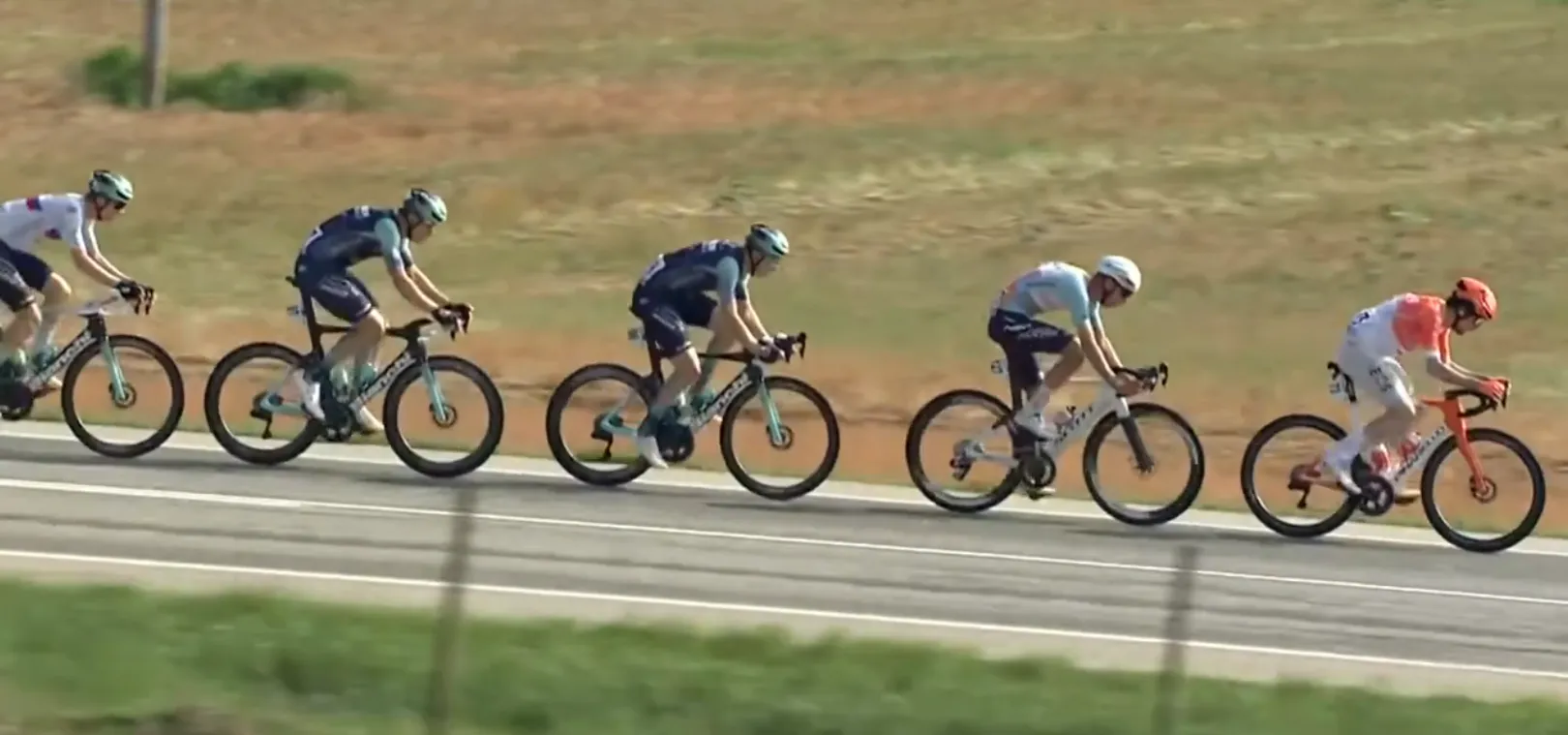
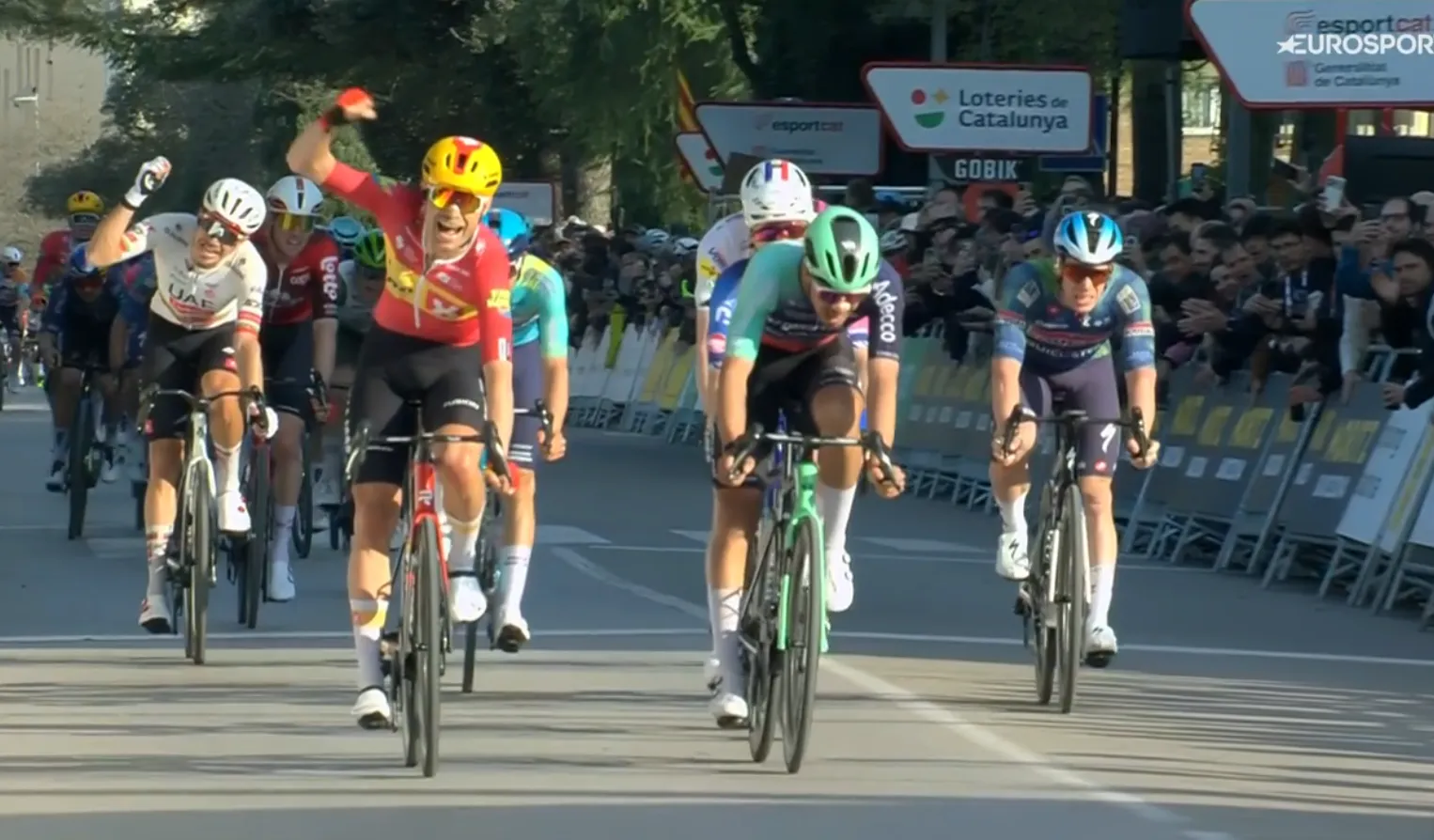
Magnus Cort (Uno-X Mobility) won stage 2 of the Volta a Catalunya in Banyoles after a bunch sprint, beating Noa Isidore (Decathlon-CMA CGM) and Francesco Busatto (Alpecin-Premier Tech).
The peloton caught the last breakaway rider, Liam Slock (Lotto-Intermarché), with one kilometre remaining, setting up a fast finish. Cort launched his sprint with 150 metres to go after a strong lead-out by Ivo Oliveira (UAE Team Emirates - XRG), securing the 35th victory of his career.
The 167.4 km stage from Figueres to Banyoles featured around 1,800 metres of climbing but was expected to end in a sprint. Five riders formed the early breakaway, including Slock, Baptiste Veistroffer, Julen Arriolabengoa, Samuel Fernández, and Diego Uriarte.
The group built a lead of about three minutes while teams such as Ineos Grenadiers, EF Education-EasyPost, and NSN controlled the peloton.
Veistroffer collected points on the day’s only classified climb and intermediate sprints, strengthening his lead in the mountains and points competitions.
Later in the stage, the break split, leaving Slock, Veistroffer, and Uriarte in front before Uriarte was dropped. The Lotto-Intermarché duo tried to hold off the peloton, but their advantage steadily decreased.
Inside the final kilometres, Veistroffer was dropped and Slock continued alone until the final kilometre, where the peloton finally caught him. Several teams then organised their lead-outs, with Uno-X in the best position. Ivo Oliveira opened the sprint early, but Magnus Cort came past in the final 150 metres to take the win, his first stage victory at the Volta a Catalunya.
Carlos Silva (CiclismoAtual)
There’s not much to say about today. INEOS and NSN took the initiative early on in chasing down the day’s breakaway, which formed right at the start of the stage.
Soudal Quick - Step and EF Education - EasyPost joined the chase later on, but added little or nothing to the pace of the peloton.
After all that work, NSN and INEOS… didn’t even factor into the final bunch sprint. Ethan Vernon and Alberto Dainese, they had a big opportunity to win today, but it never went beyond intention.
Magnus Kirt Nielsen took advantage of the slipstream of UAE Team Emirates’ Portuguese rider, Ivo Oliveira, who was the first man to launch the sprint while still a long way from the finish. Nielsen won this stage sitting on his backside.
He launched a powerful attack and nobody troubled him all the way to the finish line.
Ruben Silva (CyclingUpToDate
Bit of a calm day, it was to be expected, since most of the race consists of either high mountains or very explosive days.
Before even reading up on it, I knew Baptiste Veistroffer would be in the breakaway, and sure enough he was there. A massive engine but above all the actual desire to be in front and getting the job done, he has perhaps done more this year to keep Lotto in the headlines than any other team.
At the Tour of Oman he was rewarded with a stage win and a race lead, and I sure hope he gets the same outcome in other races, because he is making races interesting and legitimately has the legs to make an impact.
A sprint finale was to be expected however. Slightly uphill, not a pure sprint stage, but the only actual sprint stage of the. Hence it will come as a major disappointment for someone like Alberto Dainese, the strongest sprinter in the race, to not be in contention.
The same can be said of Sam Bennett, although the Irishman is mostly looking to improve his circulation. And what of NSN, with Ethan Vernon and a luxury leadout, no-one having the legs in the finale.
Uno-X set up the sprint perfectly, and took advantage of Ivo Oliveira's early sprint. Magnus Cort Nielsen is a rider that, in great form, is able to win a lot and this finale was perfect for him. I must say I wasn't expecting a comeback like this today here, but he sure delivered and it wasn't by luck.
Read also
Victor Gonzalez (CiclismoAlDia)
The second stage of the 2026 Volta a Catalunya, held between Figueres and Banyoles over a distance of 167.4 km, largely matched the expectations set by its profile: a relatively favorable day for sprinters, although with enough accumulated difficulty to introduce some uncertainty in its outcome.
In this sense, the stage combined predictable elements—such as peloton control—with less obvious factors, such as the role of the early breakaway and the challenge of positioning in the final section.
The race unfolded with an early breakaway of several riders that managed to build a significant advantage before being caught, which aligns with the typical pattern of this type of stage.
Although the route included only one categorized climb, the accumulated fatigue and the technical characteristics of the finale contributed to making the outcome less straightforward for the sprinters’ teams.
The victory went to Magnus Cort Nielsen, who won the sprint in Banyoles after a group finish. The outcome confirmed the general expectation of a fast stage, but also highlighted the importance of positioning and energy management in the final kilometers.
The recorded times show parity among the leading riders, reinforcing the idea of a mass finish without significant gaps in the general classification.
Overall, the stage can be considered transitional within the broader context of the race. It did not produce major differences in the general classification, but it did help consolidate positions and offered a clear opportunity for the fastest riders in the peloton.
Additionally, it maintained a certain competitive tension that anticipates later stages with a greater impact on the fight for the overall standings.
Read also
And you? What’s your opinion on Volta a Catalunya stage 2? Tell us what you think and join the discussion.
claps 0visitors 0
Just in
Popular news
Latest comments
- Not really sure what the point of Victor González's 'analysis' is. It's just a narration of what happened. But Carlos Silva's description the finish of the stage as "Cort launched his sprint with 150 metres to go after a strong lead-out by Ivo Oliveira (UAE Team Emirates - XRG)" is quite ironic because Oliveira's sprint was so early that he really did do a leadout for Cort Nielsen. And behind Cort, who raised an arm into the air, Oliveira was the only competitor to show a big reaction of disappointment. He banged his handlebars in a way that, if I had not been wearing my contacts, would've thought was a celebration. Indeed, if not for them wearing different jerseys, I'd have thought Oliveira actually did a leadout. Putting such crazy ideas aside I don't know why Oliveira would do that - he finished 7th and was out of the fight for the stage win with 150 m to go
 Rafionain-Glas24-03-2026
 - The "there is no tomorrow" attitude happens only in monuments or one-day classic races.FredMan24-03-2026
- Top GC guys normally avoid the chaos of a bunch sprint, since only a few bonus seconds are at stake that could be easily overhauled in a single mountaintop finish. Very sensible mindset for Vinny, who notably survivod a near career-threatening crash in the past.FredMan24-03-2026
- Don't go Maria! I enjoy your input and targeted cycling knowledge! You are one of the best!
 QPSQUANTUM24-03-2026
 - It's nice to hear Merckx say all these things - both praise for Pogacar in general and his San Remo race, as well as the clear statement that comparisons aren't possible. It's slightly interesting that he used to not say this, and is saying it now that Pogacar's numbers keep growing and growing, but that's not really a big deal to me. A bigger deal is that Pogacar seems to be in year 3 of his tear through the history books, where Merckx had 7 years (I'm thinking '69 to '75). Give Pogacar a few more years and he might actually reach 20 monument wins, all the grand tours, and (just to make a point) 6 Tours de France. He just has to stay healthy and hungry.RidesHills24-03-2026
- Good that Toon got into the top 10... he's looking to be quite well suited to this sort of final. Still it's not what Lotto deserved. Sorry, Lotto-Intermarché...Rafionain-Glas24-03-2026
- Why does CutD keep saying 'ahead of the classics'? If we're not in the classics season yet are the only classics De Ronde and Roubaix?Rafionain-Glas24-03-2026
- If Pogacar is doping it's a major undercover operation which the UCI is aware of but is intentionally allowing to continue. Putting those conspiracies aside, the reason why more lower level riders dope is because there simply are more of them. All the riders have biological passports so it's super hard to dope. Either everyone is doping and occasionally some are let out as sacrificial lambs [which I highly doubt] or very few are [far more likely]. Lower level riders don't have as much to lose by getting caught.Rafionain-Glas24-03-2026
- No De Kleijn and no Zijlaard. Anyone knows what is going on with both of them?petosagan2324-03-2026
- Seems to me that the likely dopers are the lower level riders who are less likely to be tested. Pogacar is tested continuously and I doubt he would risk taking anything and I doubt his team would survive if he did.PaulB8tson24-03-2026
Loading
1 Comments