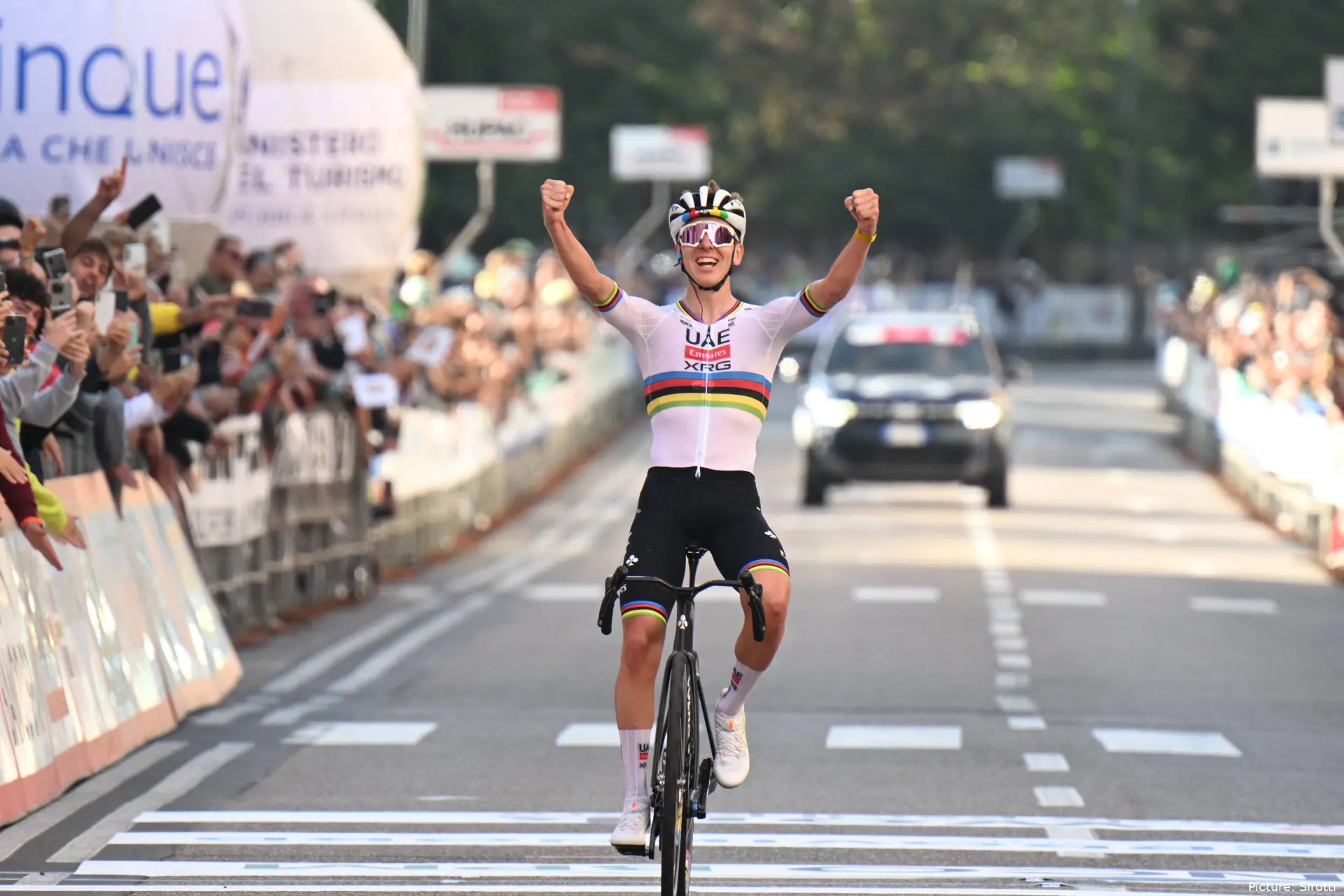
It’s finally team for Il Lombardia, the final Monument of
the cycling year. It arrives when the air is thinner, the leaves turn, and
fatigue hangs on every wheel. Yet somehow, the race still produces some of the
most emotional, chaotic, and transcendent moments in the sport. Across more
than a century, it has offered a stage for redemption and occasionally pure
poetry as the season comes to an end. Five editions, in particular, capture
everything that makes Lombardia not just a Classic, but the closing statement
of the season. So before the first pedal strokes are turned today, lets take a
look at some of the best editions of Il Lombardia to date.
The Coppi years
The story begins in 1946, the first race after the Second
World War. Italy was rebuilding, and Fausto Coppi, still only twenty-seven,
stood as a symbol of that restoration. That autumn, on the 231 kilometre course
from Milan, he attacked on the Madonna del Ghisallo climb, then again on the
Ghisolfa bridge, and arrived alone at the Vigorelli velodrome forty seconds
clear.
It was the start of a dynasty. He would go on to win
Lombardia four years in succession, from 1946 to 1949, inaugurating the legend
of the Campionissimo. In a sport emerging from scarcity and ruin, Coppi’s
attack was interpreted not merely as an athletic gesture but as national
catharsis. Lombardia had found its identity: a stage for renewal, set against
dying light.
Eight years later, Coppi returned for what would become his
fifth and final triumph. The 1954 edition did not deliver the sweeping solo of
earlier years. Instead, it demanded patience and guile. His great rival
Fiorenzo Magni was in the mix, and for once Coppi had to gamble on timing
rather than supremacy.
In the closing kilometres, the two Italians marked each
other so tightly that even the crowd in the Milan velodrome couldn’t predict
the outcome. Coppi found a narrow corridor in the sprint, edged ahead of Magni,
and sealed a record-extending fifth victory, still unmatched today (although
Tadej Pogacar can do so today).
By then Coppi’s private life had turned into national
scandal, his health was fading, and the great duels with Bartali were history.
Lombardia 1954 became his last moment of total command. It closed one of
cycling’s golden eras and set a benchmark that every modern champion, from
Merckx to Pogacar, has quietly measured himself against.

Two years later, the race wrote one of its strangest, most
human chapters. The 1956 edition is remembered less for the name of the winner,
André Darrigade, than for the theatre that unfolded on the road. Coppi attacked
the Ghisallo, trailed by Diego Ronchini. Behind them, Magni missed the move
and, legend has it, was overtaken on the road by a car carrying Giulia Occhini,
the “Dama Bianca,” Coppi’s lover and one of the most controversial figures in
post-war Italian sport. Her glance, or perhaps her laughter, lit a fire in
Magni.
Consumed by fury, he launched a one-man pursuit, bridging the gap almost
by willpower alone. For a few kilometres he appeared to have broken Coppi,
until Darrigade, perfectly timed, surged past both to steal the win. It was a
melodrama worthy of Italian cinema, passion, rivalry, betrayal, and the fine
line between vengeance and exhaustion. Lombardia, again, had proved itself the
most emotional of Monuments: a race where heart often trumps logic.
The 21st century
Fast-forward half a century, and the rain returned to
reclaim its role as antagonist. The 2010 edition unspooled under leaden skies,
the roads slick and treacherous. Philippe Gilbert, already emerging as a master
of the autumn calendar, broke away with Michele Scarponi on the slopes above
Lake Como.
On the final climb, San Fermo della Battaglia, Gilbert
attacked, carved the descent alone, and crossed the finish soaked and
trembling. Behind him the descent resembled a battlefield, riders sliding
across painted lines, dreams ended in a heartbeat. Two years later the script
flipped, when Gilbert, then world champion, crashed out himself on those same
wet roads.
Then comes 2024, the edition that already sits alongside the
Coppi vintages in cycling folklore. Tadej Pogacar, wearing his world champion’s
stripes, attacked on the Colma di Sormano with forty-eight kilometres still to
race. It was an audacious move, but not exactly surprising for him: long before
the final climbs, before the television helicopters had even settled.
But from that moment, he was gone. Evenepoel, the reigning
time-trial world champion and double Olympic champion, tried to chase and
watched the gap grow to over three minutes. By the time Pogacar reached Como,
the sun had dipped and the margin had become the largest since Merckx in 1971.
“Every victory is special,” Pogacar said that evening, “and
today also, because the team worked so hard all year for all the victories that
we achieved, and today is no different.” Can Pogacar repeat the feat today?
Five races, five eras, and yet a single pulse runs through
them. Lombardia rewards the solitary artist. The climber who dares early, the
descender who refuses to brake, the romantic who rides on emotion, they are the
ones history remembers.
There is a thematic pattern, too. Coppi’s wins framed the
race as a post-war resurrection; Magni’s revenge turned it into melodrama;
Gilbert’s storm and Pogacar’s solitude recast it as elemental struggle. Always,
the race reflects the character of its champion. Unlike the spring Monuments,
where the cobbles and cold forge collective battles, Lombardia isolates its
protagonists. It feels intimate, a duel between body and fatigue, will and
gravity.
Arriving at the tail end of the season, it serves as
cycling’s final confession. Riders carry months of form and failure into it:
those who have won Grand Tours come seeking closure, those who have missed
everything else come hunting redemption. It is the last chance before winter to
turn a year into a story worth remembering.
Its history also makes it uniquely elastic. The race has
changed start and finish towns repeatedly, Milan, Como, Bergamo, yet the
essence remains intact. Each route variation rearranges the same vocabulary of
climbs and lakes, of solitude and fatigue.
It’s also the Monument that best fuses Grand Tour strength
with Classic aggression. Milano-Sanremo favours puncheurs; Roubaix and Flanders
belong to the strongmen; Liège to the climbers who can sprint. Lombardia asks
for all of them at once, the capacity to go long, the technique to descend, the
nerve to attack early. That hybrid nature explains why so many Grand Tour
winners have excelled here.
Every October, as the peloton winds through Lombardy’s
chestnut forests and across the Ghisallo chapel’s steps, there’s a sense of
ritual. Fans lining the road don’t just cheer the current contenders; they
salute the ghost and legends of the past. The question is will Pogacar join
Coppi today?

Fin MajorCycling Journalist
Fin Major is a UK-based writer at CyclingUpToDate and has been part of the team since 2024. He is the site’s main writer for FAQs and evergreen explainers and has written around 2,000 pieces for the platform. Alongside this work, he focuses on in-depth analysis and covers the biggest races on the calendar, including the Tour de France, the Giro d’Italia, and La Vuelta a España, providing clear context around performance trends, tactics, and key storylines.
In his reporting, Fin uses reputable data sources such as ProCyclingStats for results, statistics, and historical context. He places strong emphasis on careful sourcing, editorial accuracy, and updating articles promptly when new, verified information becomes available. Outside of writing, Fin is an active cyclist, which supports his practical understanding of the sport and its demands.
claps 0visitors 0
Just in
Popular news

Latest comments
- Any idea why Remco wasn’t there, Lombardia?Jumpyjohn07-10-2026
- Thanks for your explanations but you got one detail wrong, it’s not 1300 but 13000, which means at 46.8km/h (to make it easy) a frame every mm. Even if it was only 1300, it would be extremely unlikely (but theoretically possible with bike throwing) that between 3 consecutive frames (nothing to do with the composite image shown) one rider might straddle back or forward by a few mm in the hidden moments in between frames but at 13000 that’s impossible as it would mean actually travelling backwards between 2 frames as you cannot otherwise recede 2mm during the time to travel forward 1 mm.Mistermaumau07-10-2026
- Clownboy come up from his parents basement retreat !frieders307-10-2026
- I think what he meant was, look where it got him, so if you’re suggesting Pogi should follow that advice in the same way, I have to question your Agenda coz we’re not far from recent ambiguous suggestions regarding 2 Californian cities.Mistermaumau07-10-2026
- He shone pre-Pogacar, now he's 1 of many Ineos' also-rans, for their budget, they aren't showing many results, you can only wonder if Brailsford can turn this around
 leedorney07-10-2026
 - We are not far from someone colonising it so probably one day yes. Some are colonising orbits, some have an eye on the moon, deep seas, even mars so who’s going to stop anyone, certainly not the guy grabbing Greenland by the pushies.Mistermaumau07-10-2026
- Hopefully not before he gets his 100... 7 more to go
 Rafionain-Glas07-10-2026
 - Good for her and to stop the Dutch dominance a little.Mistermaumau07-10-2026
- Really happy for him. Didn’t notice Remco had not entered but am sure that was a nice surprise and relief for Slovenia who otherwise would have no medals to show at all from WC & EC, unlike Spain who did their « powerhouse » description justice.Mistermaumau07-10-2026
- So great to see. The "old" guy still has some life left in the legs! Bravo Primoz!mobk07-10-2026
Loading
Write a comment