
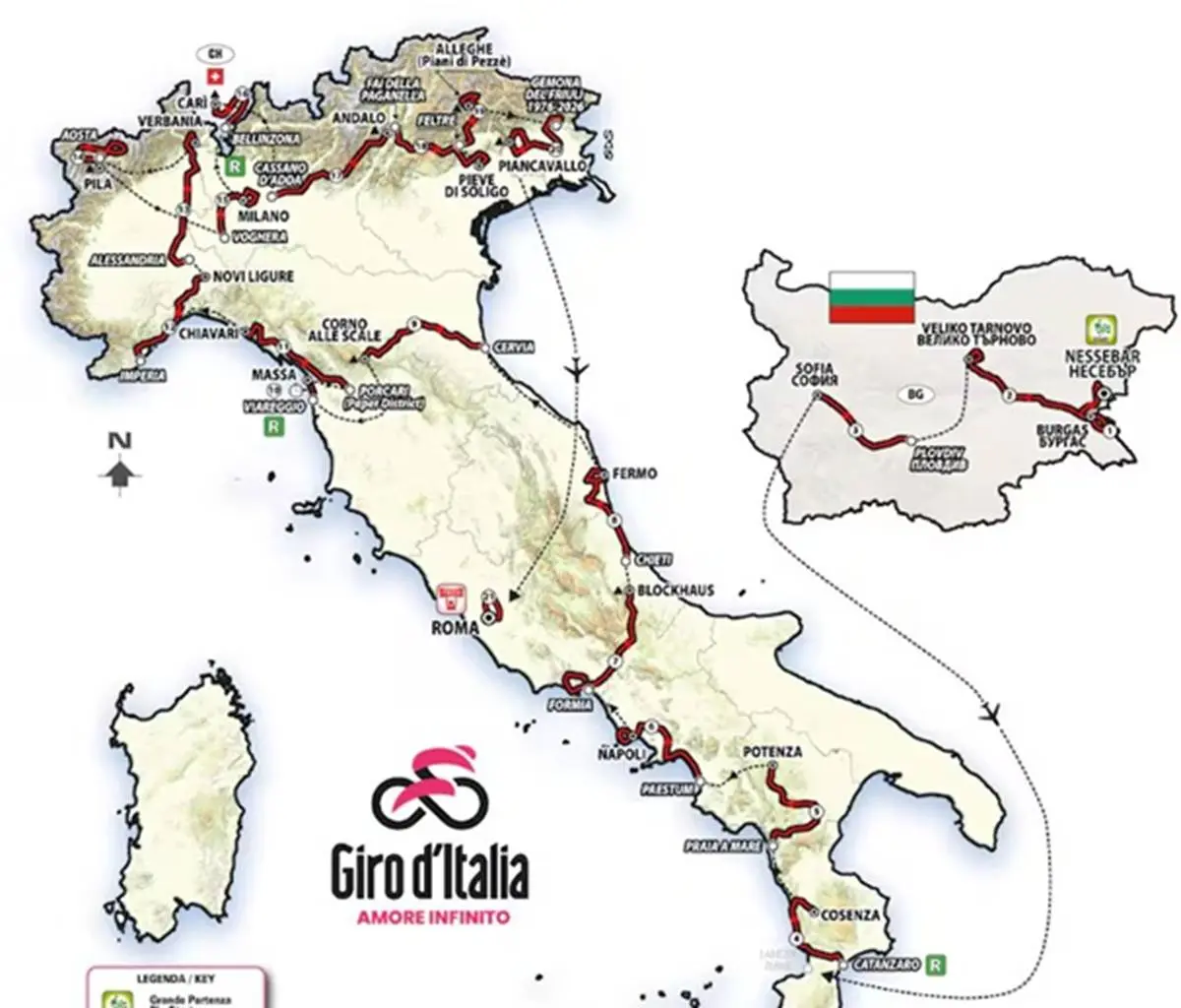
The 2026 Giro d’Italia is being billed as a classic, punishing edition, opening in Bulgaria and concluding in Rome after 3,459 kilometres and more than 50,000 metres of climbing. With long transfers, traditional summit finishes and a rare 40 km pan-flat time trial, it is a route built to expose flaws and reward resilience across three weeks.
Whether Jonas Vingegaard takes the start remains a central question — early indications suggest Tadej Pogacar will not — but the route itself already offers a clear blueprint for where the general classification could fracture. These are the five stages most likely to determine the outcome.
1. Blockhaus summit finish delivers the first major GC test (Stage 7)
The first summit finish arrives early, and brutally. Stage 7 (Formia → Blockhaus, 246 km) is not only the longest stage of the race, but ends with one of Italy’s most unforgiving climbs. The ascent from Roccamorice saves the worst for last: a final 10 km that grind relentlessly at or above 10%, coming after almost a quarter-thousand kilometres of attrition.
It is the earliest point in the race where genuine GC gaps could emerge, especially among riders who struggle to produce peak power so deep into a marathon stage.
2. A rare 40.2 km pan-flat time trial threatens major swings (Stage 10)
Stage 10 introduces a significant turning point: a 40.2 km individual time trial between Viareggio and Massa. The course is completely flat, favouring specialists capable of holding aerodynamic efficiency and high speed across long, uninterrupted stretches.
After a mountainous opening to the Giro, this stage could ruthlessly expose those with weaker time-trial capabilities. Any contender losing a minute or more here may find their GC ambitions severely compromised ahead of the Alps and Dolomites.

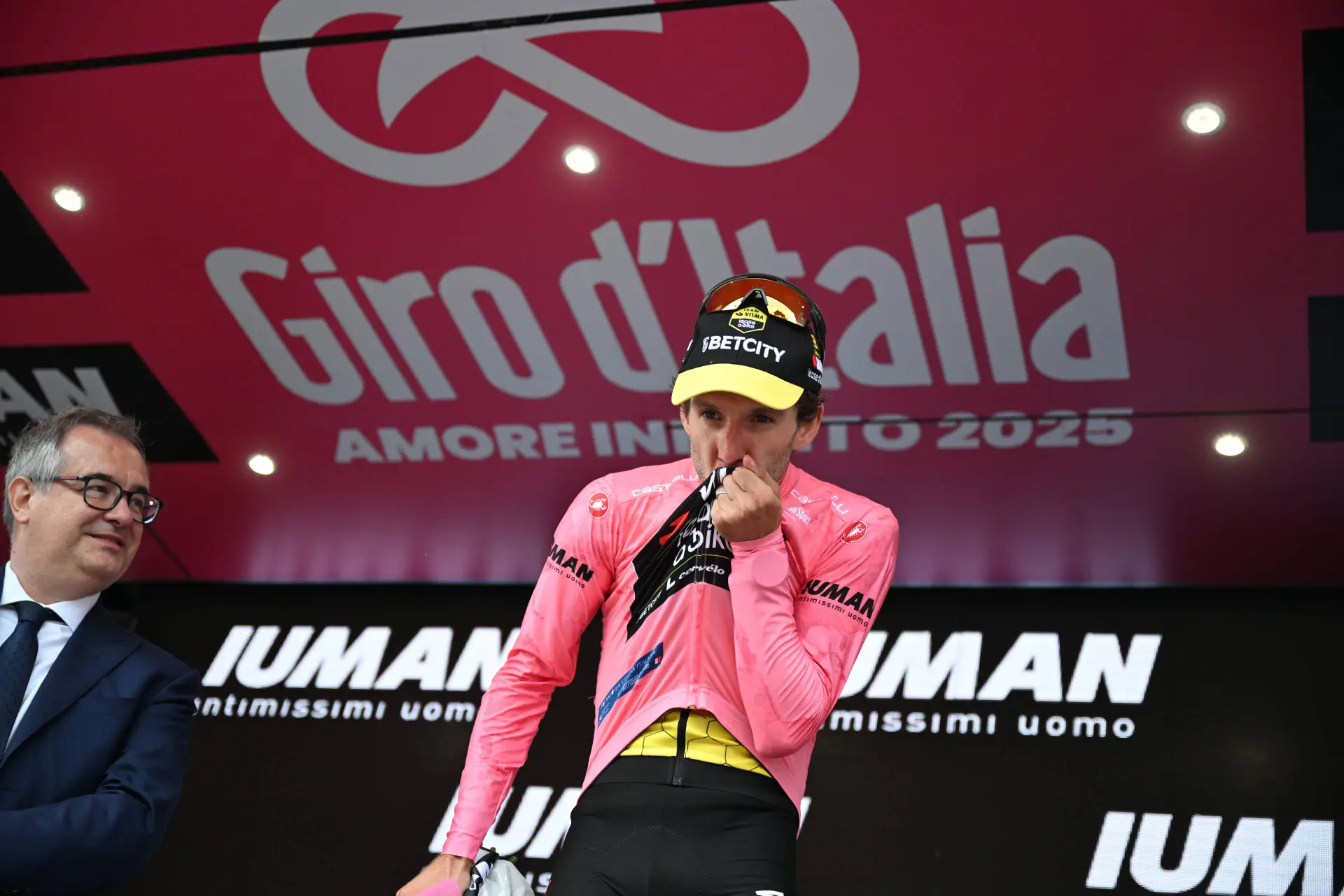
Simon Yates won the 2025 Giro d'Italia ahead of Isaac del Toro and Richard Carapaz
3. Aosta Valley punishes tired legs on the road to Pila (Stage 14)
At 133 km, Stage 14 (Aosta → Pila) is compact but intense, stacking multiple climbs before a steep summit finish in the Aosta Valley. With accumulated elevation exceeding 4,000 metres, it is a stage designed to sap energy and punish any GC rider showing even the slightest dip in form.
The final climb to Pila via Gressan is particularly demanding, placing huge stress on riders already fatigued by the time trial just days earlier. The contenders emerging strongest here will set the tone heading into the decisive final week.
4. The Dolomites “tappone” promises the race’s defining showdown (Stage 19)
Stage 19 is the undisputed queen stage of the 2026 Giro: 151 km and a staggering 5,000 metres of climbing across the Dolomites. The historic sequence of Passo Duran, Forcella Staulanza (Coi), Passo Giau — the Cima Coppi at 2,233 metres — and Passo Falzarego ensures an unrelenting day of high-mountain attrition.
The final climb to Piani di Pezze is short but steep, averaging around 10% with pitches hitting 15%. Coming deep into week three, this tappone is almost guaranteed to produce a seismic reshaping of the GC.
5. Double ascent of Piancavallo will decide any lingering battles (Stage 20)
The penultimate stage (Gemona del Friuli → Piancavallo, 199 km) presents the last chance to overturn the GC before the ceremonial finale in Rome. Two ascents of Piancavallo, linked by a looping course via the Barcis lake area, ensure a tense, tactical day where teams must monitor every move.
With three weeks of fatigue weighing heavily on the peloton, even small accelerations on the second climb could trigger decisive time gaps. Any rider still dreaming of pink must be flawless here.
Kieran WoodDeputy Editor-in-Chief
Kieran Wood is a sports journalist based in Wales and has been active in journalism since 2022. He regularly contributes to DartsNews.com and CyclingUpToDate.com, where he covers professional cycling and darts. In cycling, his work includes liveblogs from major races, including the Tour de France, the Giro d’Italia, and La Vuelta a España, alongside race reports and analysis. He has also conducted interviews with professional riders.
His reporting spans the full racing calendar, from one-day classics to stage races, with a focus on accurate, real-time coverage and clear contextual analysis. For statistics, results, and historical context, he regularly uses resources such as ProCyclingStats. To support reporting on rider activity and training context where relevant, he also references Strava.
In his work, Kieran places strong emphasis on careful sourcing, editorial accuracy, and updating articles as new, verified information becomes available.
claps 0visitors 0
Just in

Popular news
Latest comments
- Nothing. Against Pogi nothingabstractengineer18-10-2026
- He didn't even try to sprint all outvappaxbipmv18-10-2026
- Campenaerts looked like a rolling pumpkin with that all orange leaders skinsuit !frieders318-10-2026
- He can take his dumb a$$ politics somehwere else !frieders318-10-2026
- good to have her back. fingers crossed she‘ll be able to stay!Ketterechts17-10-2026
- A tenner and he wins the Tour next year, too 😂anonymouscyclist17-10-2026
- the answer is either stick to classics or GTs but not bothabstractengineer17-10-2026
- the exodus already stared with Ciccone. Already they were struggling with two sprinters, now there are three. Also Ganna will demand leadership. Gall is the most proven GC, Ayuso has the most potential. GC leadership for everybody will be impossible. Literally a UAE style mess without pogi.abstractengineer17-10-2026
- I raced as an amateur for 12 years, including six years on my country’s national road cycling team. I secured two national titles and competed in three World Championships plus more than 15 international stage races. At 23, we travelled to Italy for a training camp—or so I assumed. On a rest day, we watched a presentation about adopting a more “professional” training approach. It was crystal clear what “professional” meant. That moment first exposed me to this dilemma. After returning from Italy, I left cycling—at least at the competitive level I had known. Over the following two years, the whole team was caught doping. I hold that everyone is innocent until proven guilty. In my view, current stakeholders operate on a different scale, and the sums involved are vast. I am unsure whether any doping would ever be revealed. I try to stay positive and enjoy the show. My 2c.
 vannpelt17-10-2026
 - Fiver he wins 🤣
 leedorney17-10-2026
Loading
Write a comment