The sport we know and love today is all about endurance and
enduring spirit, but with the bonus of scientific performance analysis
and high-tech products. But that wasn’t always the case. Cycling didn’t arrive
as a fully formed sport; it took shape as technology, culture, and ambition
converged. Pinning down “when did cycling become a sport” means tracing the
moment when riding for transport and novelty tipped into organized competition.
That hinge sits in the late 1860s, when promoters, papers, and pioneers turned
new two-wheelers into a spectacle for fans. From there, purpose-built races,
governing bodies, and specialist riders made cycling a cornerstone of global
sport.
Lets go back to the very start. We also tackle some of the most burning questions on the topic and address the key points in the sport's history.
From running machines to bikes
Before anyone pinned on a number, the bicycle itself had to
be invented, reinvented, and made rideable at speed. In 1817, German inventor
Karl Drais unveiled the draisine, a steerable, two-wheeled “running machine”
propelled by the rider’s feet. It looked like a modern bike in outline, but
lacked pedals and brakes, momentum and hope did the rest. The leap to true
pedalled motion came in Paris in the early 1860s, when the Michaux workshop and
contemporaries fitted cranks to the front wheel, birthing the iron-and-wood
“boneshaker.”
The next leap was speed. By the 1870s and 1880s, high-wheel
“ordinaries” (penny-farthings) dominated, dangerous, direct-drive machines
whose giant front wheels covered more ground per turn. They were fast but
precarious, and they made racing both thrilling and risky to watch.
The true template for modern competition arrived with John
Kemp Starley’s chain-driven Rover “safety” bicycle in 1885 and, soon after,
John Boyd Dunlop’s practical pneumatic tire in 1888, which transformed road
comfort and control. Those two inventions made mass participation and sustained
racing plausible instead of an almost guaranteed accident. It is hard to imagine nowadays how one would be able to race in such a bike.
The first finish lines
Ask a historian for the birth certificate of competitive
cycling and you’ll likely get a date: 31 May 1868. That’s when a short,
1,200-metre race in Paris’s Saint-Cloud park, won by the English rider James
Moore, was staged as a formal contest.
While some details are debated, the event is widely
recognized as cycling’s first organized race. The following year brought the
first intercity road epic, Paris–Rouen (7 November 1869), promoted by Le
Vélocipède Illustré. Moore won again, covering 123 km in 10 hours and some,
walking the steepest climbs and riding a machine with pedals fixed to the front
wheel. This jump from park sprints to city-to-city endurance is the moment
cycling truly became a sport, and began the road to the sport we know today.
The 1890s multiplied the ambition. Bordeaux–Paris (first run
1891) stretched to roughly 560 km and often used pacing, tandems, then motorised
dernys, to keep speeds high, while Paris–Brest–Paris (1891) set a mythic 1,200
km (yes you read that correctly) out-and-back test that intertwined technology,
publicity, and human will. PBP’s first winner, Charles Terront, reportedly rode
on early Michelin pneumatic tires and became a national celebrity, proof that
cycling’s stars could capture the front page as well as the finish line. These
races were as much product trials and newspaper promotions as they were sport,
which helped money, media, and mass audiences flood in.

Maurice Garin, winner of the first Tour de France, photographed in 1903. @Imago
Rules, records, and a world stage
A sport matures when it standardises. In 1893, track cycling
held the first recognized world championships in Chicago under the
International Cycling Association, confirming that national federations and
world titles would govern who truly was “best.” By 1900, the Union Cycliste
Internationale (UCI) formed to regulate the sport, unify championships, and
oversee the growing portfolio of disciplines. Just three years later, Henri
Desgrange’s L’Auto launched the Tour de France to sell papers, creating a
grand-tour template that still frames the sport’s calendar.
Standards also came from the stopwatch. On 11 May 1893,
Desgrange set the first officially recognized hour record, 35.325 km on Paris’s
Buffalo velodrome. From there, the hour became cycling’s laboratory: as
equipment improved, distances crept upward, and every new mark reflected the
state of the art. The hour record’s existence, and the public obsession with it,
helped separate cycling-as-transport from cycling-as-sport in the public mind.

To this day, the 'Souvenir Henri Desgrange' is awarded to the first rider crossing the highest point of each Tour de France. @Sirotti
What the sport looked like at the start
Early riders raced on fixed-gear machines with narrow
handlebars, solid or pneumatic tires, and minimal braking. On the road, they
wore everyday wool and leather, fueled on whatever they could find, and
navigated appalling surfaces by lantern. On the track, six-day events and
motor-paced races packed velodromes, while amateur clubs paraded in uniforms
and staged time trials to measure themselves against neighbours.
Newspapers served as both promoters and referees, with
stopwatches and judges stationed at roadside cafés that doubled as control
points. Even then, debate over “technology versus purity” raged. The Tour de
France famously banned derailleur gears until 1937. When they were finally
allowed, the sport’s tactics (and speeds) changed overnight.
Not every “first” was clean. Pacing behind tandems, triples,
or motorcycles tilted some contests toward spectacle, and early “preparations” were
common enough to earn lore, not scandal. Yet the core experience, tactics in
crosswinds, breakaways on hills, etc, was already visible by the 1890s.
Watching Terront or Moore, or later Maurice Garin, you’d recognize the basic
grammar of racing: conserve, strike, suffer, and sprint.

The Col du Tourmalet, the Tour's most famous and used climb, was first raced up in 1910. @Imago
The tech evolution
Three milestones turned bicycles into racing tools: the
safety frame, the pneumatic tire, and the derailleur. Starley’s chain-driven
Rover made geometry stable and speeds predictable, Dunlop’s tire smoothed rough
roads and increased endurance, and, after years of resistance from purists,
derailleurs entered the Tour in 1937, letting riders shift without dismounting
or flipping wheels. The result was strategy. Climbs could be paced, descents
exploited, and entire stage races reimagined. That simple cable pull rewired
road racing from survival to chess at speed.
Track technology evolved in parallel. Steel frames stiffened
and pacer motorcycles dragged sprinters to astonishing top-end speed. Standardized
distances and events, for example pursuits and points races. created repeatable
showdowns. And in every era, equipment debates doubled as marketing, a feedback
loop between factories and finish lines that made cycling one of sport’s
earliest technology leaders.
Notable pioneers
James Moore, winner at Saint-Cloud (1868) and Paris–Rouen
(1869), stands at the sport’s creation myth. His name appears on the first
sprints and the first intercity race, linking the birth of event organization
to the rise of heroic individuals. Maurice Garin, a chimney sweep turned
champion, then delivered the Tour de France’s inaugural victory in 1903,
proving that a stage race could grip an entire country. Between them, you can
trace the arc from novelty to national obsession in France.
Across the Atlantic, Marshall “Major” Taylor broke barriers
and records as a Black world sprint champion in 1899, winning global titles
despite open hostility and bans in parts of the U.S. Taylor’s success, and the
racism he faced, reveals how cycling’s early boom intersected with broader
social struggles, and how European circuits sometimes offered fairer
opportunities than American ones. His story is cycling history and civil-rights
history at once, and perhaps one that to this very day does not receive enough
attention.
Women changed the sport’s meaning as much as its methods.
Susan B. Anthony famously said, “Let me tell you what I think of bicycling. I
think it has done more to emancipate women than anything else in the world…,” a
line that captured the freedom the safety bicycle gave women to move through
cities unchaperoned. A few years later, Annie Londonderry turned herself into a
global celebrity by circling the world with a bike as her calling card, and in
1924, Alfonsina Strada lined up at the men’s Giro d’Italia, finishing stages
alongside the era’s hard men. These feats redefined who cycling was for, and
what counted as possible, but it still took for too long for women to get
enough recognition in the sport.
Newspapers, promoters, and the business of cycling
Cycling didn’t become a sport just because riders raced, it
became a sport because promoters learned how to sell it. Paris–Brest–Paris was
conceived by a newspaper as a trial of bicycle reliability and human endurance,
and the Tour de France was created explicitly to boost circulation for L’Auto.
Even Bordeaux–Paris owed its early prestige to pacing rules
that turned an ultra-distance slog into a night-long drama. In short, the media
didn’t just cover cycling, it actually engineered it. That synergy fixed dates
on a calendar, created heroes, and attracted sponsors, everything a sport needs
to become self-sustaining, and a business itself.
Governing bodies (supposedly) then turned chaos into rules.
The UCI’s emergence in 1900 consolidated rules across nations and disciplines
and linked amateur clubs to world titles. Cycling was unique in the sense that,
with worlds on the track from 1893 and the Tour on the road from 1903, it both
a stadium showcase and an open-road show too. That dual identity still defines
the sport’s appeal, especially on the road where it is as accessible as sport
can be.

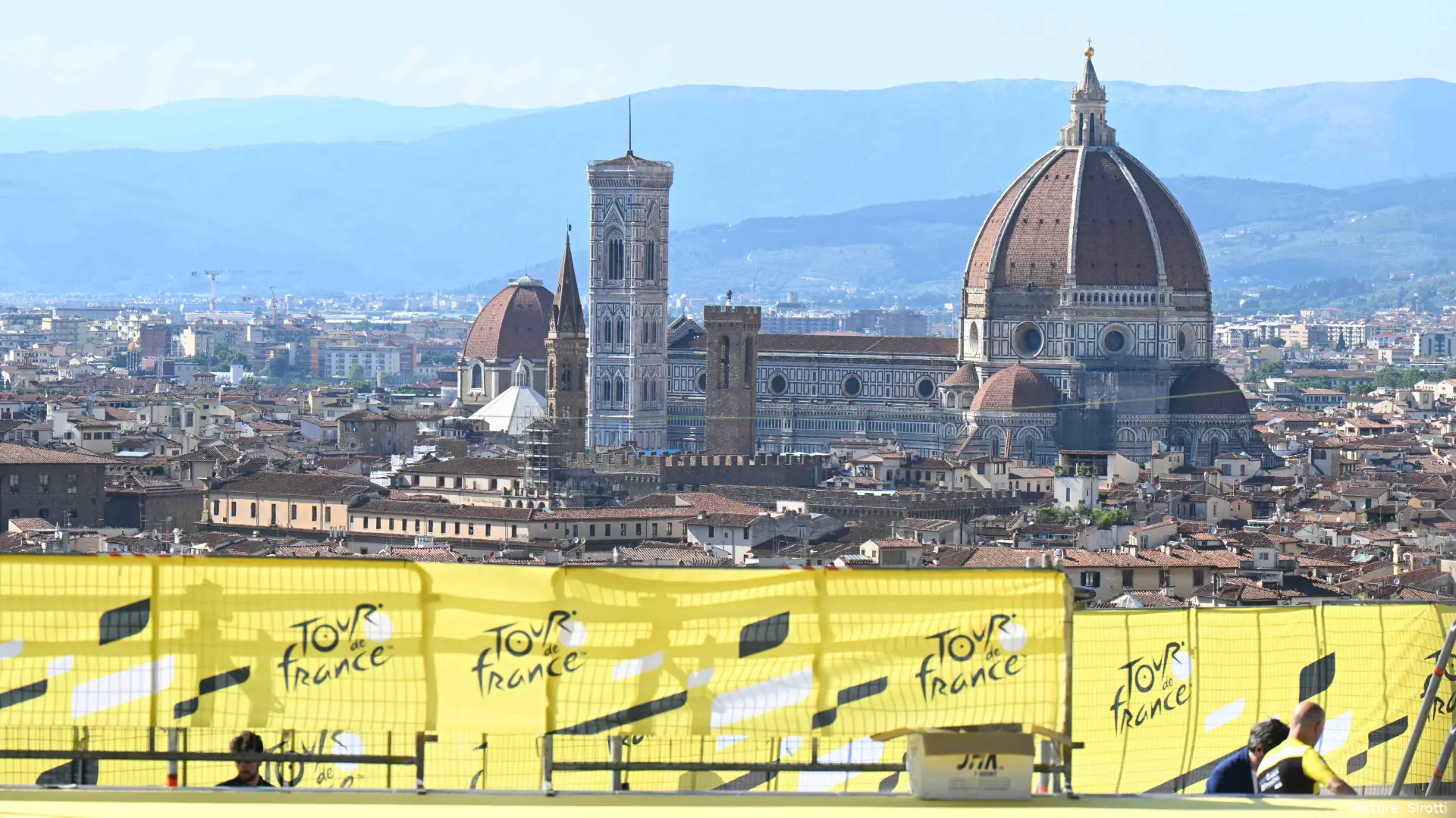
The Tour de France has become cycling's biggest event. It frequently hosts international starts, such as Florence 2024. @Sirotti
What early racing felt like
Picture a pre-dawn start outside a café, with lanterns
swinging and racers murmuring to each other. Riders in caps and wool roll into
the dark behind tandem pacers, taking turns at the front when the road rises
and eating in snatched gulps at controls. There are no team cars, mechanicals
are solved with pocket tools and stubbornness.
On the track, cycling was a cauldron of noise between the
whir of the wheels and the sound of the bell. That feeling is why the hour
record mattered so much. It compressed all the variables, into one clean number
that the public could grasp and debate. When Desgrange laid down 35.325 km, he
gave the sport a ruler it still uses to measure greatness. In the same way, the
Tour gave fans a map: six huge stages in 1903, but conceptually a simple loop
where the strongest rider would emerge over time and terrain.
Timeline: The Evolution of Cycling as a Sport
| Year | Event / Milestone | Significance |
| 1817 | Invention of the Draisine | Baron Karl von Drais creates the "Laufmaschine," the first steerable two-wheeled vehicle (no pedals). |
| 1868 | First Recorded Bicycle Race | Held on May 31 at Parc de Saint-Cloud, Paris; won by James Moore. |
| 1869 | First Intercity Race | The Paris–Rouen race (123km). James Moore wins again, proving cycling could be an endurance sport. |
| 1876 | Milano-Torino Inaugurated | The oldest professional race, still held today, marking the start of "Classics" culture. |
| 1885 | The "Safety Bicycle" | John Kemp Starley’s Rover is released. With equal-sized wheels and a chain drive, it makes racing safer and faster. |
| 1888 | Pneumatic Tire Patent | John Boyd Dunlop’s inflatable tires revolutionize speed and comfort on cobbled European roads. |
| 1896 | First Modern Olympics | Cycling is included in the first Athens Games, legitimizing it as a global athletic discipline. |
| 1900 | Founding of the UCI | The Union Cycliste Internationale is established in Paris to govern the sport globally. |
| 1903 | First Tour de France | Created by L’Auto magazine; Maurice Garin wins the first 6-stage "Grand Tour." |
| 1927 | First World Championships | The UCI holds the first professional Road World Championships at the Nürburgring, Germany. |
| 1958 | Women's Worlds Debut | The first UCI Road World Championship for women is held in Reims, France. |
| 1984 | Women’s Olympic Entry | Women’s road racing finally joins the Olympic program in Los Angeles. |
| 1996 | Mountain Biking Debut | Mountain biking is added to the Olympics (Atlanta), reflecting the sport's modern diversification. |
FAQ: When did cycling become a sport?
When did cycling become a sport?
It happened on 31 May
1868, when the Saint-Cloud race set a finish line and a stopwatch to two
wheels, and it was cemented on 7 November 1869, when Paris–Rouen proved that
road racing could grip the public over a full day’s struggle between cities.
Within a generation, world championships, grand tours, classics, and record
books made cycling unmistakably, institutionally sport. The technology and the
culture had finally met the urge to compete.
“Get a bicycle. You will not regret it, if you live,” Mark
Twain joked about the high-wheeler era. The line is comic, yes, but it captures
the hazard and thrill that drew crowds to those first races. Today, when sleek
carbon frames and electronic shifting feel worlds away from boneshakers and
ordinaries, the essence remains the same. Two wheels, one rider, the road,
nature, and the simple question that turned cycling into a sport in the first
place: who gets there first?
Where your finish line is the café, a bar, a mountain top,
or simply home, that’s the question that matters most regardless of your level.
When did organized bicycle racing start?
Most historians point to 31 May 1868 at Paris’s Saint-Cloud
park as the first formal race, followed by the first intercity road race,
Paris–Rouen, on 7 November 1869.
What were the first major cycling races?
Key 19th-century events included Paris–Rouen (1869),
Bordeaux–Paris (first run 1891), Paris–Brest–Paris (1891), and, by 1903, the
Tour de France.
What early tech made racing possible?
The safety bicycle (1885) and pneumatic tires (1888) made
long-distance racing feasible; the derailleur’s acceptance in the 1937 Tour
reshaped tactics and speed.
Who were notable early riders?
James Moore (Saint-Cloud, Paris–Rouen), Charles Terront
(first Paris–Brest–Paris), Maurice Garin (first Tour winner), Marshall “Major”
Taylor (1899 world sprint champion), Annie Londonderry (round-the-world
celebrity), and Alfonsina Strada (1924 Giro d’Italia starter).

Fin MajorCycling Journalist
Fin Major is a UK-based writer at CyclingUpToDate and has been part of the team since 2024. He is the site’s main writer for FAQs and evergreen explainers and has written around 2,000 pieces for the platform. Alongside this work, he focuses on in-depth analysis and covers the biggest races on the calendar, including the Tour de France, the Giro d’Italia, and La Vuelta a España, providing clear context around performance trends, tactics, and key storylines.
In his reporting, Fin uses reputable data sources such as ProCyclingStats for results, statistics, and historical context. He places strong emphasis on careful sourcing, editorial accuracy, and updating articles promptly when new, verified information becomes available. Outside of writing, Fin is an active cyclist, which supports his practical understanding of the sport and its demands.
claps 4visitors 4
Just in

Popular news
Latest comments
- He didn't even try to sprint all outvappaxbipmv18-10-2026
- Campenaerts looked like a rolling pumpkin with that all orange leaders skinsuit !frieders318-10-2026
- He can take his dumb a$$ politics somehwere else !frieders318-10-2026
- good to have her back. fingers crossed she‘ll be able to stay!Ketterechts17-10-2026
- A tenner and he wins the Tour next year, too 😂anonymouscyclist17-10-2026
- the answer is either stick to classics or GTs but not bothabstractengineer17-10-2026
- the exodus already stared with Ciccone. Already they were struggling with two sprinters, now there are three. Also Ganna will demand leadership. Gall is the most proven GC, Ayuso has the most potential. GC leadership for everybody will be impossible. Literally a UAE style mess without pogi.abstractengineer17-10-2026
- I raced as an amateur for 12 years, including six years on my country’s national road cycling team. I secured two national titles and competed in three World Championships plus more than 15 international stage races. At 23, we travelled to Italy for a training camp—or so I assumed. On a rest day, we watched a presentation about adopting a more “professional” training approach. It was crystal clear what “professional” meant. That moment first exposed me to this dilemma. After returning from Italy, I left cycling—at least at the competitive level I had known. Over the following two years, the whole team was caught doping. I hold that everyone is innocent until proven guilty. In my view, current stakeholders operate on a different scale, and the sums involved are vast. I am unsure whether any doping would ever be revealed. I try to stay positive and enjoy the show. My 2c.
 vannpelt17-10-2026
 - Fiver he wins 🤣
 leedorney17-10-2026
 - “…measures to reduce speeds.” Might as well shorten the race course to just 50km as well? ASO generates at minimum €300m a year and 30- 40% profit. Maybe stop being greedy and spend more of the profit to protect the riders instead.b3tlla17-10-2026
Loading
Write a comment