“The cold is having more impact on her femoral artery” - After Eli Iserbyt’s forced retirement, leading Belgian CX rider abandons National Championships with similar issues
CyclocrossMonday, 12 January 2026 at 10:34

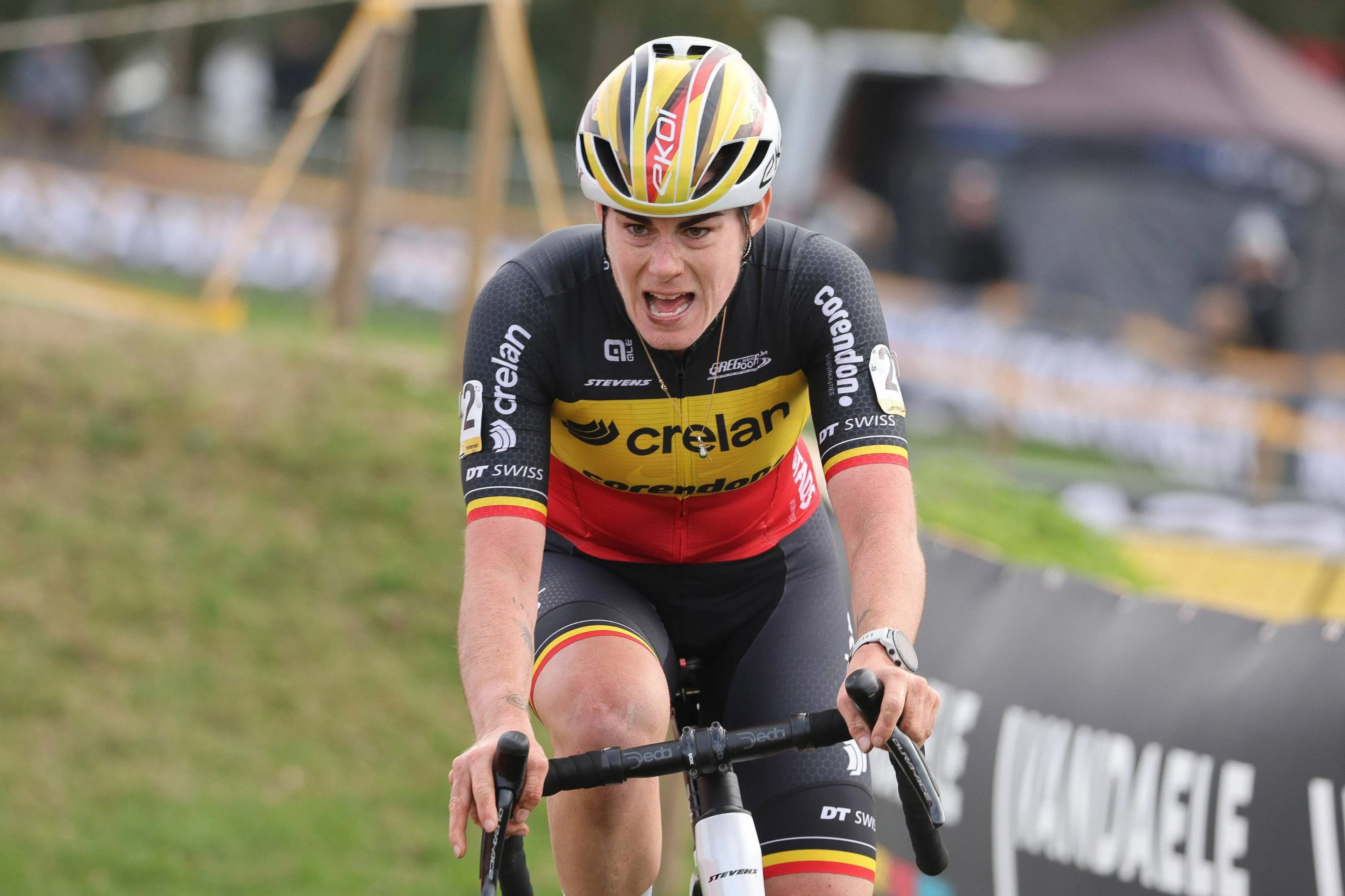
The women’s elite Belgian cyclocross championships ended early and painfully for Laura Verdonschot, who abandoned the race while riding outside the top ten, bringing her final appearance at a national championships to an abrupt close.
Verdonschot had hoped for one last strong ride on home soil in Beringen, but the race quickly slipped away from her. As the podium moved out of reach, she stepped off the bike in the cold conditions, ending what had been planned as a final Belgian championships appearance.
Team manager Tom De Kort pointed to a worrying physical issue behind the decision in quotes collected by Sporza post-race.
“We had hoped for a good day, but it’s been too up and down. In Hofstade we had hope because of her fourth place,” he said. “Now I have the feeling that the cold is having more impact on her femoral artery. This is really unfortunate for Laura, very bitter.”
A growing issue in cyclocross
De Kort’s words immediately struck a chord across the cyclocross world. Femoral artery problems have become one of the most feared medical issues in the sport, and only days earlier they had brought an entire career to an end.
Eli Iserbyt confirmed his retirement this week after receiving medical advice that he could no longer continue cycling, even recreationally. In a message shared on Instagram, the Belgian explained: “The past few weeks I have received the news from multiple doctors that it’s no longer medically advisable for me to ride my bike, recreationally or at a high level.” He added: “I’ve always shared the beautiful moments with you but now I wanted to share the bad ones, that unfortunately it is no longer possible for me to continue my career.”
Iserbyt’s decision followed a long struggle with a femoral artery problem that had already disrupted several seasons. After initially riding through the issue, he underwent surgery, returned to training, then required further operations when the problem kept coming back. Eventually he was told that continuing to race or even train seriously was no longer possible.
The injury reduced blood flow and sensation in his left leg and progressively limited his performance, until doctors advised that stopping completely was the only safe option.
Verdonschot’s situation is different, but the reference to her femoral artery immediately raised concern, especially given how quickly Iserbyt’s condition escalated from a performance issue into a career-ending diagnosis.
For Verdonschot, the timing made it even harder to take. This was meant to be her final Belgian championships, in her own province, and instead it ended with an early abandonment and unanswered medical questions.
Whether her issue proves temporary or more serious remains to be seen. What is clear is that, in a sport already shaken by Iserbyt’s retirement, any mention of femoral artery problems now carries heavy weight, and Verdonschot’s words and De Kort’s concern have added another uneasy chapter to that growing story.
claps 2visitors 2
Just in
Popular news
Latest comments
- Are you by chance Tadeg's daddy which is why you are so over the top here on this site with his promotion? No CAPISH !frieders303-04-2026
- It was the original plan to have Jasper Philipsen sprint for the win, it won't be that way in Flanders, MvdP will work to reel POGAČAR in.alsene03-04-2026
- The Godfather of Saunier DuvalMistermaumau02-04-2026
- We hardly have cat. 5 races anymore, too complicated for organisers, more and more they mix up plenty of categories which makes things far more dangerous, we were 180 at the start for an 8 circuitMistermaumau02-04-2026
- I gathered that but for some I was the equivalent so just a bit of fun. I gather he’s still around, maybe he just took my advice?Mistermaumau02-04-2026
- He doesn't have to quit cycling for that? And maybe they don't want kids, not everyone doesvampa02-04-2026
- Primož Roglič will be the best domestíque. In order to facilitate Pogačar's long range solo win, he will attack early to get rid of all of Team Slovenia's domestíques. Due to being such a valiantly hard working domestíque, he will pay for his selfless efforts and crack, so Pogačar can't use him anymore. This will mean that Pogačar will have to launch very early. In the chasing group behind, Roglič will have recovered. He'll disrupt the cooperation in the chase by attacking, in the form of long, powerful turns on the front. And of course Pogačar wants a challenge, he does not want it ti be easy, so Roglič will pull fir the chasers to do so. Meanwhile, 20 year old Jakob Omrzel will be tge perfect domestíque
 Rafionain-Glas02-04-2026
 - Pogačar won two years, lost two years and won two years — will he lose this year?Rafionain-Glas02-04-2026
- Pogačar to crash in a very rainy Roubaix, taking him out of the following races. Disclaimer: nit limited to this yearRafionain-Glas02-04-2026
- Oh you fool who doesn't understand anything, IF Pogi wins Flanders AND Roubaix, then yes... he will probably win all 5 Monuments. LBL and Lombardy are his races to lose. It will be tough, especially Roubaix, but Pogi is the Greatest Of All Time... maybe he can pull it off. CAPISH? CAPISH? CAPISH?Mou-Cro-HR02-04-2026
Loading

🇧🇪 Marion Norbert Riberolle a remporté son deuxième titre de championne de Belgique élite #cyclocross consécutif à Beringen. Fleur Moors a pris la 2e place devant Kiona Crabbé #cx #veldrijden
1 Comments