Results World Cup Hoogerheide | Mathieu van der Poel seals record-breaking 51st World Cup win after solo exhibition
Cyclocross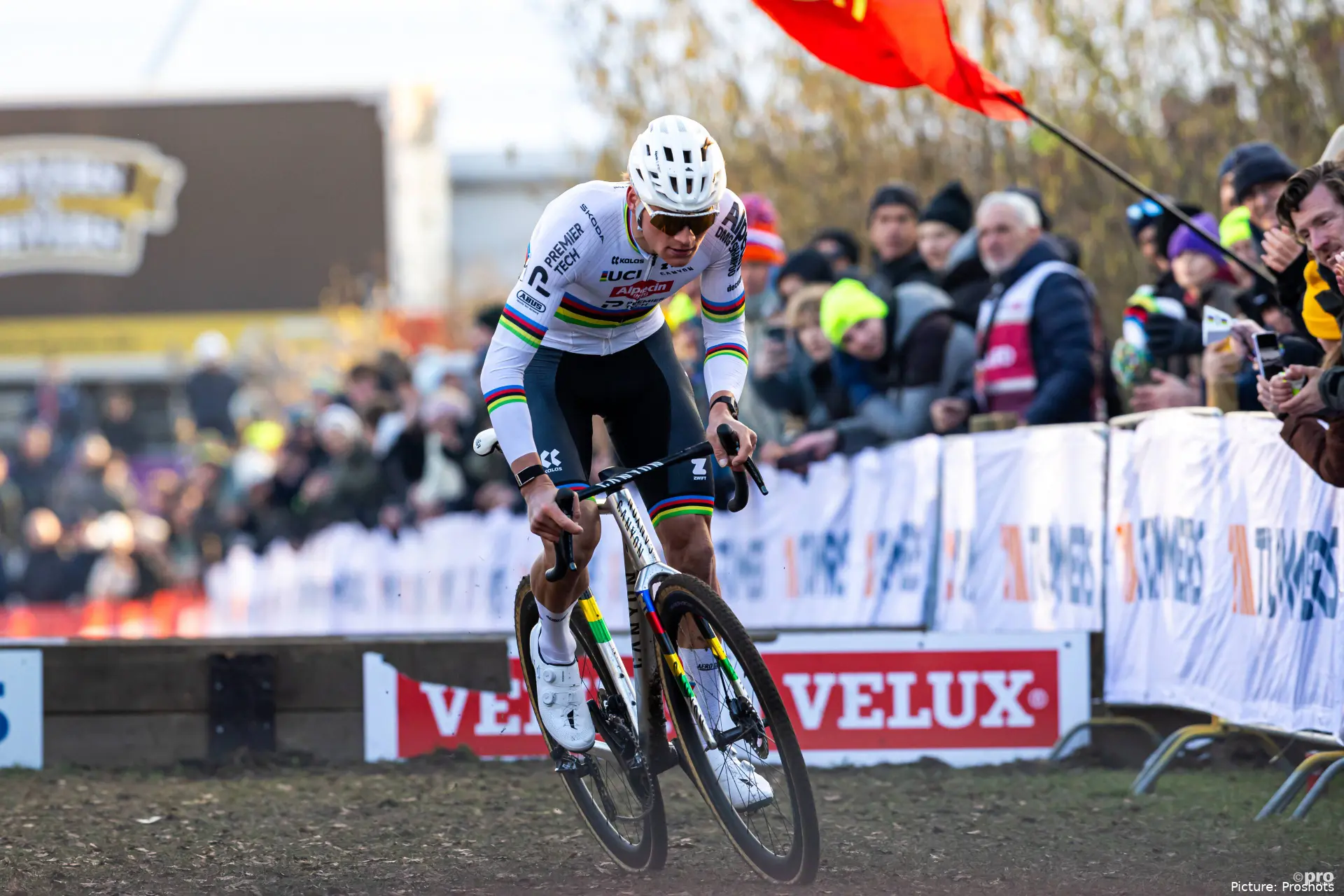
The men’s World Cup race in Hoogerheide concluded with a moment of history as Mathieu van der Poel powered to his 51st career World Cup victory, moving clear of Sven Nys to stand alone as the most successful rider in the competition’s history.
Van der Poel’s win was never in doubt once he made his move in the second lap. After allowing the opening exchanges to unfold, the world champion reacted instantly to an acceleration by Tibor Del Grosso, bridged across in seconds, and then rode decisively clear.
Within a lap, the race had taken on a familiar shape, with Van der Poel alone at the front and the rest of the field already forced into damage limitation.
From there, the contest became an exhibition. Van der Poel continued to extend his advantage almost without visible effort, floating through the technical sections and over the barriers as his lead passed forty seconds, then fifty, and eventually more than a minute. Even as the chase behind him repeatedly reorganised and collapsed, the gap at the front only grew.
Chaotic chase finally resolves late
While Van der Poel disappeared up the road, the fight for the remaining podium places remained unresolved for much of the race. A large chasing group repeatedly formed and reformed, with Thibau Nys, Toon Aerts, Niels Vandeputte, Joris Nieuwenhuis, Felipe Orts and others all taking turns near the front without managing to impose lasting order.
Only in the final lap did clarity begin to emerge. Del Grosso launched a committed attack, with Nieuwenhuis initially following, before Nys ignited the battle for second place with a long, early sprint. That effort briefly split the group, but the elastic snapped back once more, and Nys was reeled in before the line.
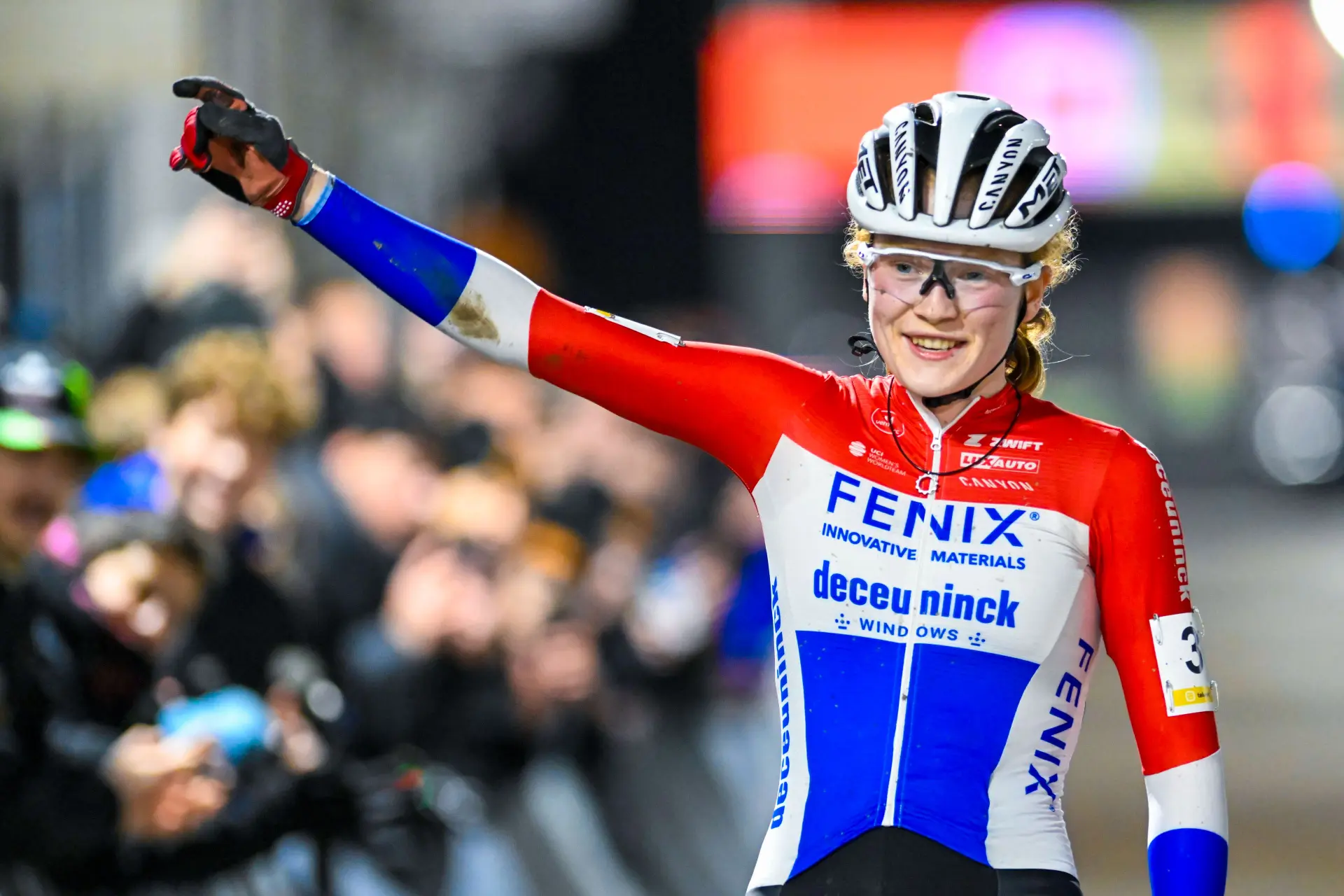
In the final metres, it was Del Grosso who timed his effort best, securing second place ahead of Aerts, while Nys was forced to settle just off the podium after animating much of the late fight.
A record ride, sealed in style
Up front, none of that mattered. Van der Poel crossed the line alone to complete a dominant display and secure a landmark victory. His 51st World Cup win moved him beyond Sven Nys, whose record of 50 victories had stood as the benchmark for a decade.
It was a fitting way to close the Hoogerheide World Cup and a season in which Van der Poel has repeatedly rewritten expectations. This time, the number itself told the story.

Results powered by FirstCycling.com

Kieran WoodDeputy Editor-in-Chief
Kieran Wood is a sports journalist based in Wales and has been active in journalism since 2022. He regularly contributes to DartsNews.com and CyclingUpToDate.com, where he covers professional cycling and darts. In cycling, his work includes liveblogs from major races, including the Tour de France, the Giro d’Italia, and La Vuelta a España, alongside race reports and analysis. He has also conducted interviews with professional riders.
His reporting spans the full racing calendar, from one-day classics to stage races, with a focus on accurate, real-time coverage and clear contextual analysis. For statistics, results, and historical context, he regularly uses resources such as ProCyclingStats. To support reporting on rider activity and training context where relevant, he also references Strava.
In his work, Kieran places strong emphasis on careful sourcing, editorial accuracy, and updating articles as new, verified information becomes available.
claps 3visitors 2
Just in

Popular news
Latest comments
- He didn't even try to sprint all outvappaxbipmv18-10-2026
- Campenaerts looked like a rolling pumpkin with that all orange leaders skinsuit !frieders318-10-2026
- He can take his dumb a$$ politics somehwere else !frieders318-10-2026
- good to have her back. fingers crossed she‘ll be able to stay!Ketterechts17-10-2026
- A tenner and he wins the Tour next year, too 😂anonymouscyclist17-10-2026
- the answer is either stick to classics or GTs but not bothabstractengineer17-10-2026
- the exodus already stared with Ciccone. Already they were struggling with two sprinters, now there are three. Also Ganna will demand leadership. Gall is the most proven GC, Ayuso has the most potential. GC leadership for everybody will be impossible. Literally a UAE style mess without pogi.abstractengineer17-10-2026
- I raced as an amateur for 12 years, including six years on my country’s national road cycling team. I secured two national titles and competed in three World Championships plus more than 15 international stage races. At 23, we travelled to Italy for a training camp—or so I assumed. On a rest day, we watched a presentation about adopting a more “professional” training approach. It was crystal clear what “professional” meant. That moment first exposed me to this dilemma. After returning from Italy, I left cycling—at least at the competitive level I had known. Over the following two years, the whole team was caught doping. I hold that everyone is innocent until proven guilty. In my view, current stakeholders operate on a different scale, and the sums involved are vast. I am unsure whether any doping would ever be revealed. I try to stay positive and enjoy the show. My 2c.
 vannpelt17-10-2026
 - Fiver he wins 🤣
 leedorney17-10-2026
 - “…measures to reduce speeds.” Might as well shorten the race course to just 50km as well? ASO generates at minimum €300m a year and 30- 40% profit. Maybe stop being greedy and spend more of the profit to protect the riders instead.b3tlla17-10-2026
Loading
1 Comments