“Women have fought to be seen for what they can do, not how they look” - Demi Vollering joins growing backlash to Sydney Sweeney's viral nude sports advert
CyclingWednesday, 16 September 2026 at 20:56

Sydney Sweeney’s viral nude sports advert has sparked a growing backlash across women’s sport, and one of cycling’s biggest stars has now joined the debate.
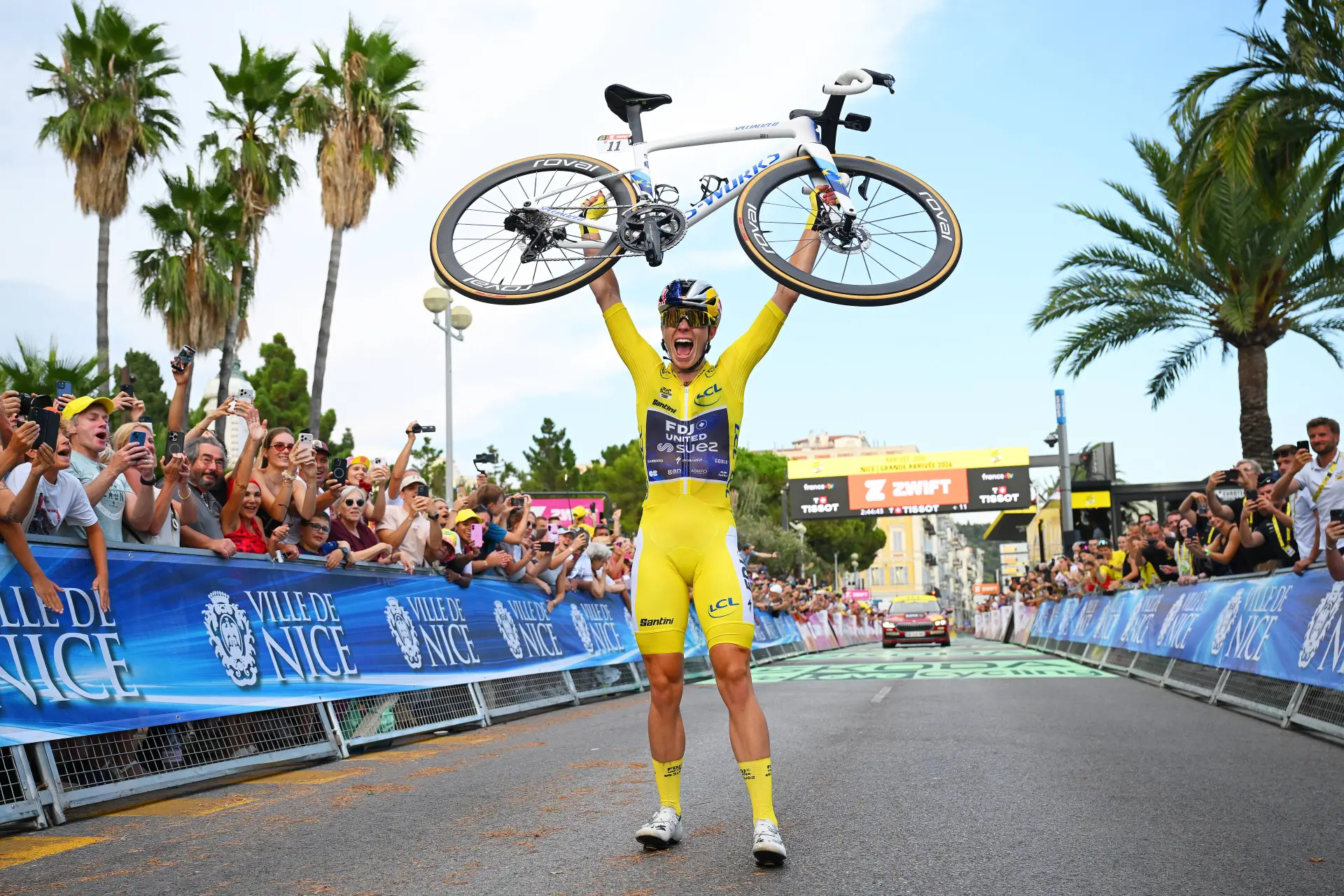
Demi Vollering, the reigning Tour de France Femmes and Giro d'Italia Women champion and arguably the leading figure in the current women’s peloton, says female athletes have spent years fighting to be judged for what their bodies can do rather than how they look.
The controversy surrounds Novig’s “Just Sports” campaign, which features Sweeney nude while covering herself with various pieces of sporting equipment. The advert was designed to promote the American sports prediction platform, but its imagery has instead become the focus of a much wider argument over the sexualisation of women around sport.
Sweeney was not simply brought in to front somebody else’s concept. Novig CEO Jacob Fortinsky has since said the actress approached the company herself and played a major role in shaping the campaign’s visuals and messaging. “One advert, and the internet went crazy,” Vollering wrote on Instagram. “Maybe it’s a good thing that it started a debate.”
The Dutchwoman also made clear, however, why she believes so many female athletes are tired of having that debate at all. “For a long time, women have fought to be seen for what they can do, not for how they look,” she said. “And I think a lot of women are simply tired of that. Especially in sport, because sport can teach us completely new things about our bodies.”
Vollering speaks from the very top of the sport
Vollering has spent the past few seasons establishing herself as one of the dominant riders of her generation. The Dutchwoman has won the Tour de France Femmes twice, added the Giro d'Italia Women and Vuelta Femenina to her palmares, and repeatedly delivered across the Ardennes Classics. “It’s not: how do I look? But: what can I do? How strong can I become? How fast can I go? What can I achieve with this body?”
Sweeney has meanwhile responded to part of the backlash by sharing previous nude or partially nude images of athletes including Serena Williams, Ronda Rousey and Megan Rapinoe.

Vollering won a second Tour de France Femmes title earlier this summer
Vollering drew a clear line between physical strength and femininity. “Being strong doesn’t make you any less feminine,” she said. “You can ride your bike until there’s nothing left in your legs and still enjoy putting on a beautiful dress. You can have muscles and be feminine. You can be strong and vulnerable.”
The Dutchwoman has never been shy about speaking publicly on issues beyond racing either, particularly around equality, body image and the wider position of women in elite sport.
“What do we want the next generation to see?”
Women’s cycling has transformed rapidly during Vollering’s career, with bigger races, more television coverage, stronger contracts and a far more visible group of stars at the top of the sport.
“Women’s sport is growing incredibly quickly,” she said. “That brings opportunities, but also responsibility. For athletes, brands, media and sporting organisations.”
Vollering also turned her attention to younger girls and the stage at which many begin becoming more conscious of their bodies. “I think it’s especially important for young girls,” she said. “During puberty, the body changes, periods begin, and many girls become aware of how other people look at them. At that age, I want sport to be a place where girls have to worry less about how they look and can discover what they can do.”
Read also
Her final point looked further ahead. “What do we want the next generation to see?” Vollering asked. “I know what I want to show one day: that your body is so much more than something to be looked at. It can take you to places you never dared to dream of.”
With women’s cycling still expanding on and off the road, Vollering is now one of the most visible riders shaping that next phase of the sport.
Kieran WoodDeputy Editor-in-Chief
Kieran Wood is a sports journalist based in Wales and has been active in journalism since 2022. He regularly contributes to DartsNews.com and CyclingUpToDate.com, where he covers professional cycling and darts. In cycling, his work includes liveblogs from major races, including the Tour de France, the Giro d’Italia, and La Vuelta a España, alongside race reports and analysis. He has also conducted interviews with professional riders.
His reporting spans the full racing calendar, from one-day classics to stage races, with a focus on accurate, real-time coverage and clear contextual analysis. For statistics, results, and historical context, he regularly uses resources such as ProCyclingStats. To support reporting on rider activity and training context where relevant, he also references Strava.
In his work, Kieran places strong emphasis on careful sourcing, editorial accuracy, and updating articles as new, verified information becomes available.
claps 1visitors 1
Just in
Popular news
Latest comments
- My man cannot stay away from his passion.Goats got to do GOAT things!
 Brucegel17-09-2026
 - Sydney Sweeney has a net worth of $50 million from what I just saw. Let me know what needs to be shown on national TV for $50 million, and I’m all in for the world to see. Besides, in looking at pictures of Demi and the FDJ team, they do their best to make themselves attractive. it sells. Sydney as a reminder is not trying to be a sportsperson, sell sports, or pretend to be an athlete. she is advertising for an online gambling platform. I'm not here to suggest online gambling is good, or salacious photos, but none of it is illegal so Sydney can show what she wants to show. one might see a woman showing herself off, but she owns a part of that platform. I see a shrewd business lady that is using every talent she has, physical and mental, to make a lot of money. good for her. it is also great to see a drop dead gorgeous woman that also has the brains to back it up in the business world. that is empowering too.mij17-09-2026
- That is a good question.awp16-09-2026
- Great for Demi to speak out, this stuff is utterly horrific
 Rafionain-Glas16-09-2026
 - Lol is this a MyWhoosh advert? Haven't they got Peter Sagan for thatRafionain-Glas16-09-2026
- Not very well liked in the peleton may be right or wrong but is not opinion. God exists or doesn’t exist but if you don’t know or have no facts you are just a believer or non-believer.Jumpyjohn16-09-2026
- The trouble is, if you take out anyone who’s ever doped, you have several missing generations which implies you have to get total outsiders to run the sport for quite a long time.Jumpyjohn16-09-2026
- Tweaking the turboJumpyjohn16-09-2026
- Ineos is probably the worst sports sponsor there has ever been, or can anyone name one that trumps it?Jumpyjohn16-09-2026
- Entitled to an opinion of course but without having raced against/with Remco no-one can say that he's not very well liked without evidenceRafionain-Glas16-09-2026
Loading
2 Comments