“We were not the most financially lucrative offer” – EF boss reveals Ben Healy chose loyalty over money in signing contract extension
Cycling
When Jonathan Vaughters admits that EF Education–EasyPost were not the strongest financial bidder for Ben Healy, he is not celebrating clever negotiation. He is acknowledging how fragile the team’s position has become in a WorldTour ecosystem increasingly shaped by super-team spending.
The Irishman’s decision to extend his contract until the end of 2029 came with real risk for EF. Healy was approaching the final year of his deal, had enjoyed a defining breakthrough at the highest level, and had become exactly the type of rider wealthier teams routinely target once development work is complete.
“We were not the most financially lucrative offer that he had kicking around,” Vaughters said in conversation with Domestique. “If I’m blunt, we got lucky with Ben Healy that he decided to stay.”
That admission frames the extension not as a victory lap, but as an exception in a market that rarely rewards loyalty.
Read also
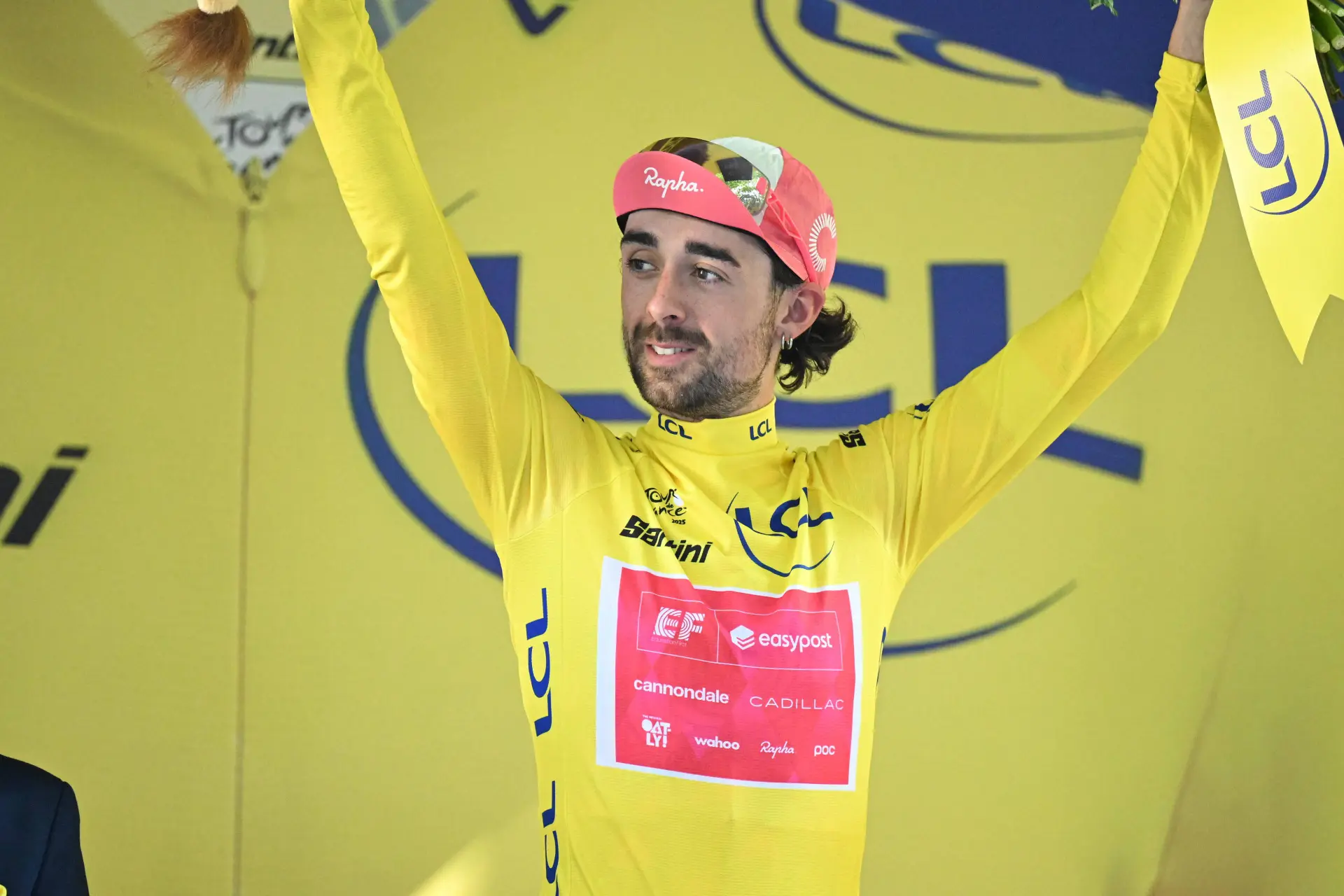
A rider EF built rather than bought
Ben Healy is not the archetypal blue-chip junior recruit. He arrived at EF in 2022 without the hype attached to many modern prodigies, developing instead into a rider defined by aggression, durability, and a willingness to animate races from distance.
That profile has since translated into results. A Giro d'Italia stage win announced his Grand Tour credentials, while repeated long-range attacks in the Ardennes classics and a standout Tour de France campaign elevated him into the upper tier of one-day and breakaway specialists. By 2025, he was no longer a curiosity or a project, but a proven WorldTour asset.
Vaughters was explicit about that trajectory. “Ben was not a super junior talent; no one really expected him to get to that level, but we have a history of getting guys to perform at a very high level that no one really expected.”
It is precisely that development success that now places EF in danger. Teams that invest heavily in youth are increasingly forced to sell the finished product to those with deeper pockets.
The budget gap EF cannot ignore
The Healy extension came as EF publicly acknowledged their willingness to sell naming rights across both men’s and women’s programmes in order to grow their budget. The reasoning is simple. Competing for talent is no longer just about scouting or coaching, but about who can absorb financial risk.
Vaughters illustrated the imbalance by referencing EF’s failed pursuit of Isaac del Toro, who ultimately signed with UAE Team Emirates - XRG. “We had identified him correctly, and it would have been the highest neo pro contract I’d ever given anyone in the history of this team,” he said. “But ultimately, I think our offer was less than half of what UAE’s was.”
For teams operating outside the top tier of budgets, that disparity is decisive. UAE’s ability to sign multiple young riders on long-term deals reflects a model built on volume and tolerance for failure. As Vaughters put it, “With super young talents, eight times out of ten, they don’t actually turn out that great. But the two that work out might be your Del Toro and your Pogacar.”
EF, by contrast, cannot afford to miss often. Each successful development case increases the likelihood of external interest, buyout attempts, or contract pressure.
Why Healy staying matters but changes little
Healy’s choice to remain offers EF short-term stability and a rare continuity win. It also underlines how unusual the decision was. “He decided to make a loyal and emotional decision versus like a purely financial one,” Vaughters said, before immediately tempering expectations. “That’s not going to happen every time. In fact, that’s barely ever going to happen.”
That realism matters. The Healy case is not a template EF can rely on, nor a sign that the system is correcting itself. It is a reminder that loyalty remains a variable, not a strategy.
For now, EF retain one of the most distinctive riders of his generation, a rider they shaped rather than purchased. Longer term, the interview reads less like a celebration and more like a warning: without structural change or financial reinforcement, holding on to the next Ben Healy may be harder still.


Kieran WoodDeputy Editor-in-Chief
Kieran Wood is a sports journalist based in Wales and has been active in journalism since 2022. He regularly contributes to DartsNews.com and CyclingUpToDate.com, where he covers professional cycling and darts. In cycling, his work includes liveblogs from major races, including the Tour de France, the Giro d’Italia, and La Vuelta a España, alongside race reports and analysis. He has also conducted interviews with professional riders.
His reporting spans the full racing calendar, from one-day classics to stage races, with a focus on accurate, real-time coverage and clear contextual analysis. For statistics, results, and historical context, he regularly uses resources such as ProCyclingStats. To support reporting on rider activity and training context where relevant, he also references Strava.
In his work, Kieran places strong emphasis on careful sourcing, editorial accuracy, and updating articles as new, verified information becomes available.
claps 8visitors 7
Just in
Popular news
Latest comments
- i think he can continue to race for maybe another 2 years till he drops out of podium contention. With his TT and his follow the leader in the Mountains,he should not need too many teammates too.abstractengineer14-10-2026
- Aren't they still shopping around for a main sponsor for next year?wrsty14-10-2026
- How broke is visma now? wtf they cant even fight moviestar and decathlon for riders and lose both their mid targets based on their budget and they cant even get those? Crazy...:/miguel13-10-2026
- TT But he won by a minute so he could have cut down on some of it
 Rafionain-Glas13-10-2026
 - weight is measurable. power is measurable. So why didn't he prepare that way from the TDF if he wanted to beat Pogi and after Pogi wasn't going to be there, to win.abstractengineer13-10-2026
- I hope Thibau and Tibor don't do the sameRafionain-Glas13-10-2026
- Seixas is exactly what I would like Pogi to be mentally and in his statements. Both come across as shy and who don't talk much but with Seixas, you can see that he enjoys success, that it boosts his ego, unlike Pogačar who seems to feel increasingly uncomfortable the more he wins. He's won so many times, people are saying he's boring. The french media hate him for winning so much, the french cycling fans are booing him... etc. etc. But remember one thing, Seixas will never physically reach Pogi's level. He's excellent, but he isn't at that level nor will ever be. His talking to the media, his relationship with people is already at a high level.PogiSloFans13-10-2026
- Paul Seixas is now the second-best rider in the world.megasmacky13-10-2026
- When will they start dropping Pogi? Oh yeah, when Pogi reaches 40+ years, that's when young cyclists will start dropping him. But until then... eat your hearts out and cry. Pogi will remain the G.O.A.T. for years to come. Capish?PogiSloFans13-10-2026
- I figure he would have found out how to outsprint Paul and take the win, maybe. He's 28 now but I would say he's right at the peak of his powers. It was great race though, Paul showed me something different about himself.awp13-10-2026
Loading
1 Comments