“This could have been it” - Gregor Muhlberger reveals career fears before helping Felix Gall to Giro d’Italia podium
Cycling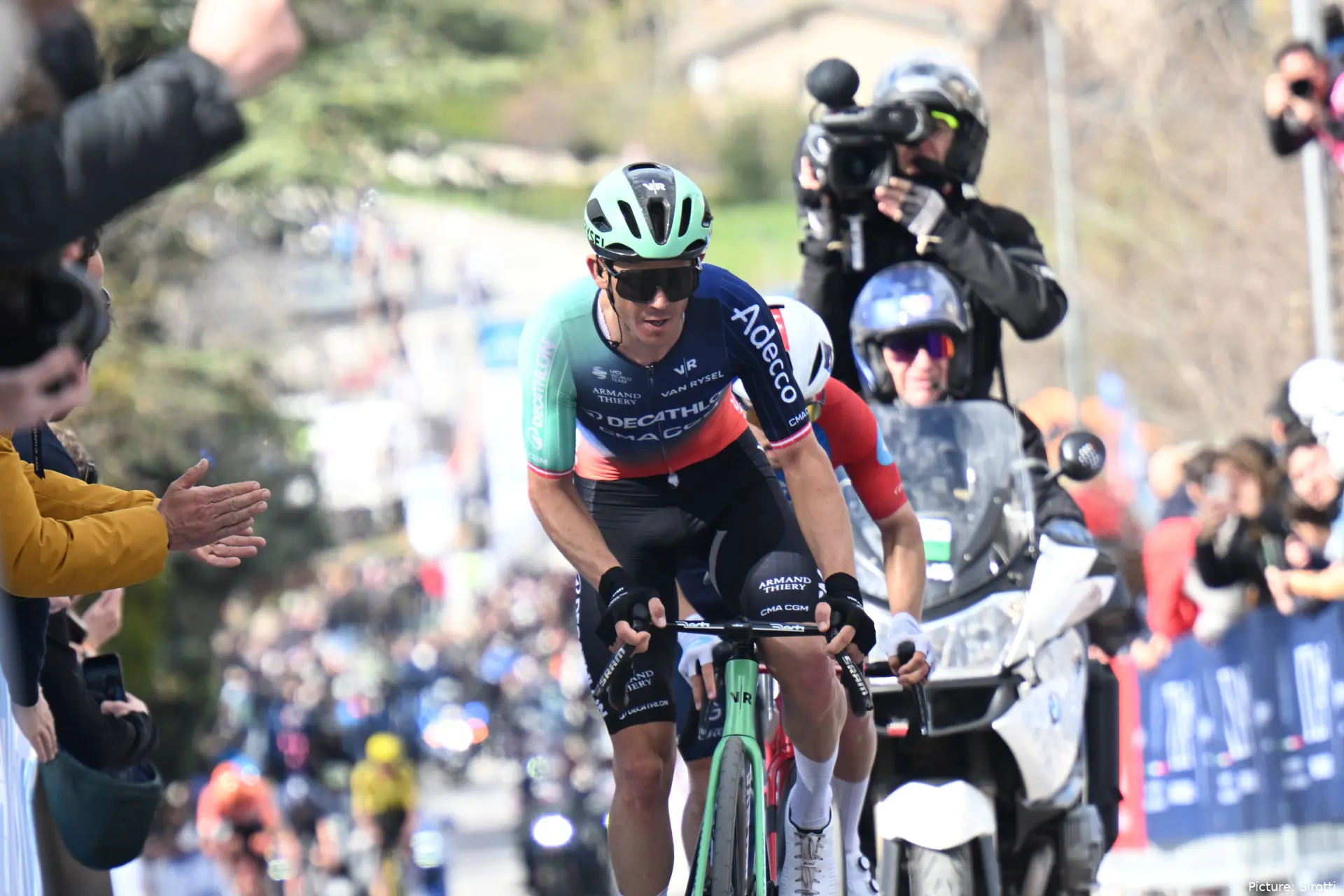
Two weeks after the Giro d’Italia, Gregor Muhlberger sat down in the Cycling Magazine podcast studio to look back on a month that reflected several sides of his career.
The Austrian did not only help compatriot Felix Gall to second overall at the Italian Grand Tour. He also delivered a surprise top-15 finish of his own, proving again why he has become one of the most reliable mountain domestiques in the peloton.
Speaking on the podcast, Muhlberger reflected on the work behind Gall’s podium, the setbacks that almost cost him his career, and how much cycling has changed since he first turned professional. There was no hesitation when he was asked what he would remember most from the Giro. “It is definitely Felix’s second place,” Muhlberger said.
The hardest mountain stages, including Stage 19, stayed with him most clearly. He was also proud of the way Decathlon CMA CGM Team came through the race, with the group largely healthy, the plan holding together and the atmosphere strong from start to finish.
From winner’s ambition to Gall’s key helper
Muhlberger was not always cast as an elite domestique. In his younger years with Tirol Cycling Team, Felbermayr - Simplon Wels and later Bora - hansgrohe, he was seen as a rider with his own winning ambitions.
At the Tour de l’Avenir, he once finished second on a stage behind Guillaume Martin and ahead of names such as Sergio Higuita and Dani Martinez.
His later move into a support role came partly through temperament. “I am more the type who accepts that,” he said. “He says: okay, I will give my best, I will try everything.”
Muhlberger admitted that he often told himself he would fight harder for his own victories, but rarely fully committed to that kind of elbows-out approach.
At the Giro, those qualities made him an ideal rider for Gall. He protected his leader in the wind, organised bottles, stayed close in the mountains and helped give Gall reassurance in more technical or nervous moments. “I think a lot of it is mental,” Muhlberger said of his role.
His view of that work is clear. “When you have a leader who can ride onto the Giro podium, that triggers even more in me,” he said. “For me, that simply stands above everything.”

Felix Gall, Jonas Vingegaard and Jai Hindley on the final podium of the 2026 Giro d'Italia
“This could have been it”
Muhlberger turned professional with Bora - hansgrohe in 2016 and spent five years there before moving to Movistar in 2021. That switch, he admitted, was difficult at first.
The Spanish-speaking environment brought a language barrier, and shortly after the move he suffered a serious case of meningitis. That came at a time when cycling was changing quickly during and after the Covid period, with teams pushing nutrition, training and recovery to new levels.
Muhlberger felt he missed part of that shift because of his health. “That was when I realised: this could have been it,” he said, recalling the period when he seriously doubted his future as a professional.
While other riders were moving into a more exact, controlled era of preparation, Muhlberger was trying to recover and rebuild.
A changing peloton
Now 32, Muhlberger looks at the sport with a different perspective. Young riders are entering the WorldTour with a level of professionalism that once arrived much later. Many are weighing every gram of food, tracking every session and living for performance from their teenage years.
Muhlberger sees the benefits, but also the risks. He always needed a degree of looseness to survive mentally, and wonders how the new generation will cope with their first major setbacks after building their lives around performance so early. For him, the support around a rider will be crucial.
At the Giro, Muhlberger showed again where his own place in the modern peloton now lies. Once a young climber with personal ambitions, he has become a rider who can bury himself for a bigger goal and find genuine satisfaction in the work.
Gall’s podium was the result he will remember. Muhlberger’s own race, finishing inside the top 15 while helping deliver that second place overall, showed why his value to a Grand Tour team is now so clear.
Kieran WoodDeputy Editor-in-Chief
Kieran Wood is a sports journalist based in Wales and has been active in journalism since 2022. He regularly contributes to DartsNews.com and CyclingUpToDate.com, where he covers professional cycling and darts. In cycling, his work includes liveblogs from major races, including the Tour de France, the Giro d’Italia, and La Vuelta a España, alongside race reports and analysis. He has also conducted interviews with professional riders.
His reporting spans the full racing calendar, from one-day classics to stage races, with a focus on accurate, real-time coverage and clear contextual analysis. For statistics, results, and historical context, he regularly uses resources such as ProCyclingStats. To support reporting on rider activity and training context where relevant, he also references Strava.
In his work, Kieran places strong emphasis on careful sourcing, editorial accuracy, and updating articles as new, verified information becomes available.
claps 1visitors 1
Just in
Popular news
Latest comments
- He didn't even try to sprint all outvappaxbipmv18-10-2026
- Campenaerts looked like a rolling pumpkin with that all orange leaders skinsuit !frieders318-10-2026
- He can take his dumb a$$ politics somehwere else !frieders318-10-2026
- good to have her back. fingers crossed she‘ll be able to stay!Ketterechts17-10-2026
- A tenner and he wins the Tour next year, too 😂anonymouscyclist17-10-2026
- the answer is either stick to classics or GTs but not bothabstractengineer17-10-2026
- the exodus already stared with Ciccone. Already they were struggling with two sprinters, now there are three. Also Ganna will demand leadership. Gall is the most proven GC, Ayuso has the most potential. GC leadership for everybody will be impossible. Literally a UAE style mess without pogi.abstractengineer17-10-2026
- I raced as an amateur for 12 years, including six years on my country’s national road cycling team. I secured two national titles and competed in three World Championships plus more than 15 international stage races. At 23, we travelled to Italy for a training camp—or so I assumed. On a rest day, we watched a presentation about adopting a more “professional” training approach. It was crystal clear what “professional” meant. That moment first exposed me to this dilemma. After returning from Italy, I left cycling—at least at the competitive level I had known. Over the following two years, the whole team was caught doping. I hold that everyone is innocent until proven guilty. In my view, current stakeholders operate on a different scale, and the sums involved are vast. I am unsure whether any doping would ever be revealed. I try to stay positive and enjoy the show. My 2c.
 vannpelt17-10-2026
 - Fiver he wins 🤣
 leedorney17-10-2026
 - “…measures to reduce speeds.” Might as well shorten the race course to just 50km as well? ASO generates at minimum €300m a year and 30- 40% profit. Maybe stop being greedy and spend more of the profit to protect the riders instead.b3tlla17-10-2026
Loading
Write a comment