"They absolutely do not deserve such backlash" - Adrie van der Poel believes Belgian fans put too much pressure on their stars
Cycling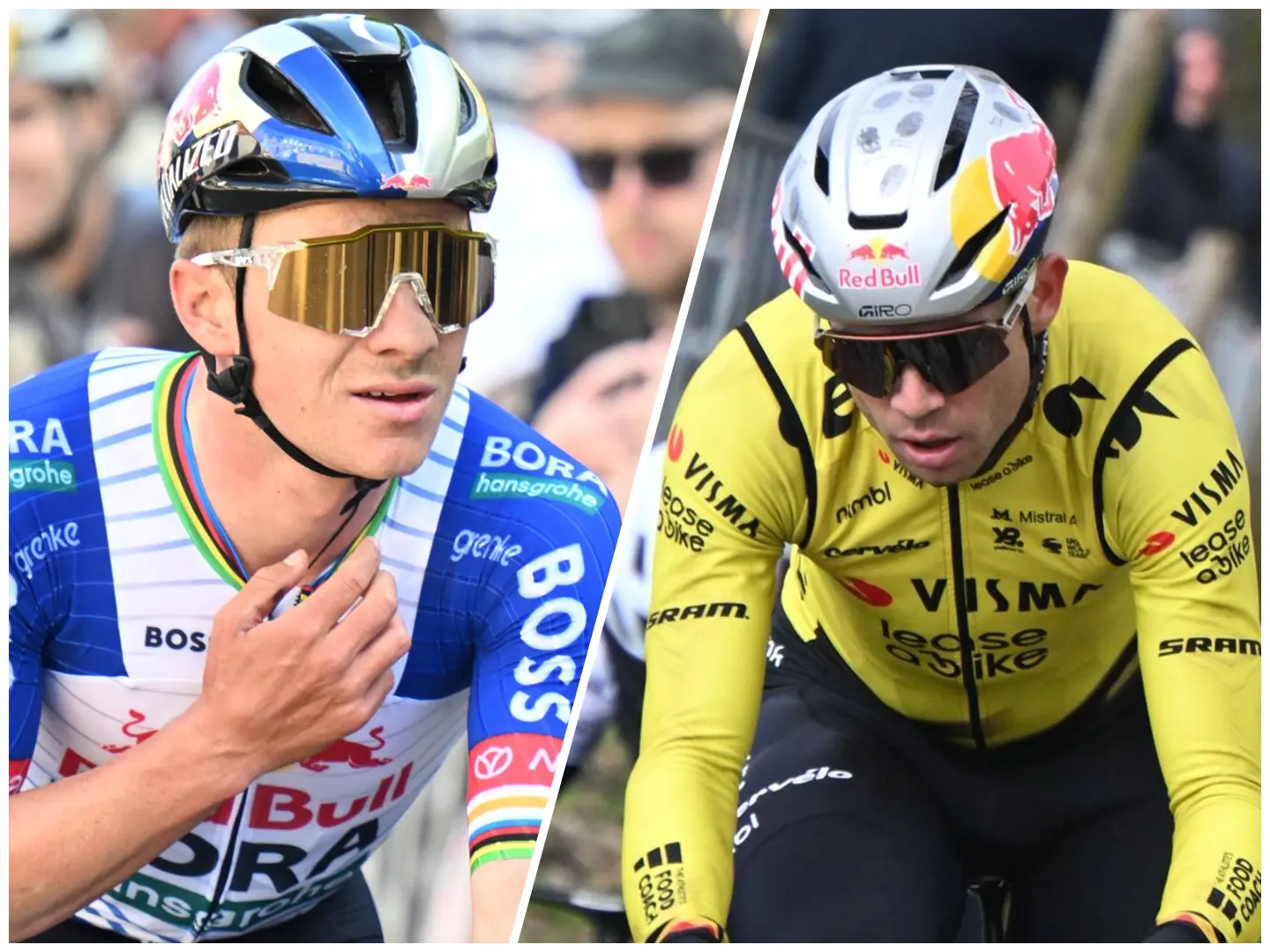
By any objective metrics, Remco Evenepoel and Wout Van Aert both represent the absolute pinnacle of the world of cycling of our generation. And yet, the general perception of the two stars seems to be quite underappreciated back home in Belgium.
Or at least that is the feeling of Adrie van der Poel, father of Mathieu and David, who has close ties to the country even though he lives in the Netherlands.
"Evenepoel and Van Aert have a palmares that most riders can only dream of," Adrie states in his analysis for Wieler Revue.
He notices that the metrics through which are both riders viewed have an unreasonably high standard which, if unmet, immediately triggers an avalanche of criticism. "If they are off for two weeks, people start looking for all sorts of things they did wrong."
Read also
Punished for greatness
That doesn't sit right with the Dutch ex-professional. He believes that the performances of these high-profile athletes are taken for granted far too quickly.
And when the expectations don't match reality, it makes the fallback even harder. "They absolutely do not deserve that," he adds resolutely.

Mathieu van der Poel is seemingly under much less pressure than his Belgian opponents
Secret weapon: Dutch passport
On contrary, Adrie's son Mathieu appears to be racing without a sign of pressure from the Dutch audience. Even though the expectations for seven-time cyclocross world champion are not the tiniest bit smaller.
"I think it helps that he has a Dutch passport," Adrie assesses. Born in Belgian Kapellen, Mathieu could've consider representing Belgian colours, or even race under French from his mother's side, but ultimately there was never a sliver of doubt that Van der Poel family name would remain connected to the Netherlands.

Wout Van Aert loses a sprint to Neilson Powless
The sport is too complex
Coming back to the racing side, Adrie is quite critical of those who believe they can crack the riders' tactical plans from the sidelines. According to him, what outsiders underestimate the most is the enormous complexity of a major cycling tour. Critics often forget that the race is not a straightforward sporting event.
"It's not football," he explains emphatically. "It's not A against B. There are twenty teams, all with their own interests. Every team has its goal," he adds. One team may be racing for overall victory, others for stage win, and another for sub-classifications. All of this contributes to sometimes chaotic action.
That tactical maneuvering also comes clearly to the fore when he looks at the different choices of the top riders. For instance, he compares the sprinting work of the absent Van Aert with that of Mathieu. "Wout also sprints in mass sprints and intermediate sprints," Adrie analyzes. "Mathieu doesn't do that anymore."
According to him, that is a very conscious decision to conserve energy in the modern, cutthroat peloton. "He thinks: why would I take a risk against guys like Milan? I’d rather save energy to try and win my own stage two days later."
Nevertheless, Adrie greatly enjoys the sheer class of the competition that does take such risks or dominates the general classification. He is particularly loud and clear about Tadej Pogacar: "What he does is incredibly impressive."
Ondrej ZhasilCycling Journalist
Ondřej Zhasil is a cycling journalist at CyclingUpToDate and has been part of the team since 2023. He is based in Ostrava, the third-largest city in the Czech Republic, and covers professional cycling across the main UCI competitions, including the Tour de France, the Giro d’Italia, and La Vuelta a España. A key focus of his work is startlist analysis and pre-race coverage, where he examines team selections, rider line-ups, and tactical scenarios ahead of major events.
Alongside WorldTour coverage, Ondřej has developed specific expertise in junior cycling and in racing across East Asia, including competitions in China and Japan. He also maintains a broad working knowledge of other disciplines and levels, including cyclocross, while continuing to expand his understanding of mountain bike racing.
Ondřej holds a bachelor’s degree in Mathematics and Physics, which supports his analytical, data-driven approach to performance and race analysis. In his reporting, he regularly uses ProCyclingStats for results, statistics, and historical context. He places strong emphasis on careful sourcing, editorial accuracy, and updating articles promptly when new, verified information becomes available.
claps 5visitors 3
Just in
Popular news
Latest comments
- what a demolition by Remcomij18-10-2026
- what are you saying, was Vine drafting off Remco? I didn't see it.mij18-10-2026
- There is nothing wrong with suspicion in this sense. It is not like any of those guys are on trial or paying for it, on the contrary, they are the ones reaping rewards whilst there is no proof. If you can’t be suspicious, you never search for proof or create pressure for it (and it never falls from the sky). Plenty of the older guys have either admitted or crossed the threshold of reasonable doubt. That creates a pattern which any thoughtful person or AI would consider as representative of some constant average reality. If I see young guys driving super sportscars in trashy neighbourhoods , I (and you) will suspect many things without specifically accusing anyone of anything because there is always some unlikely possibility it’s legit for a few but we can all assume most cases are not.Jumpyjohn18-10-2026
- MG is much worse than you describeJumpyjohn18-10-2026
- Ask the middle east to fund your sports and you can be rid of political interference ;-)Jumpyjohn18-10-2026
- Thank you for your experience which completely mirrors what my environment taught me. Obviously I wouldn’t be getting any secret admissions from those who made it to the very top (but the levels they fall back to post career is already quite revealing in itself) but almost all those who were on their way and stopped of their own accord tell the same story. And those who believe cycling is so well checked, easy to say when you compare to sports that hardly care but explain why so few are caught and banned in comparison to e.g. athletics (if you even know some of the numbers).Jumpyjohn18-10-2026
- Back to the boring and predictable.
 parisbound0018-10-2026
 - UAE is different level team than anything and everyone else. Best team weve ever witnessed and its not even close to be fair either..Completely crazy teammiguel18-10-2026
- The writing in this article is absolutely atrocious. Was it dictated and then immediately published without anyone bothering to proofread it?simon436018-10-2026
- PogiSlo is presumably part of the cult that says men can be pregnant and brainwash children to believe they’re the wrong sex. And people like you aren’t ashamed of yourselves? Of course not - cos you’re deep, deep, deep in the cult. As shown by bringing up Donald Trump in a discussion relating to a French former cyclist talking about doping in cycling. How servile to the zeitgeist does one have to be to bring Trump into the discussion? Absolutely pathetic.AndrewK18-10-2026
Loading
Write a comment