“The best example is Jonas Vingegaard’s famous time trial in 2023” - Visma coach pushes back against narrative modern cycling is all about numbers and data
Cycling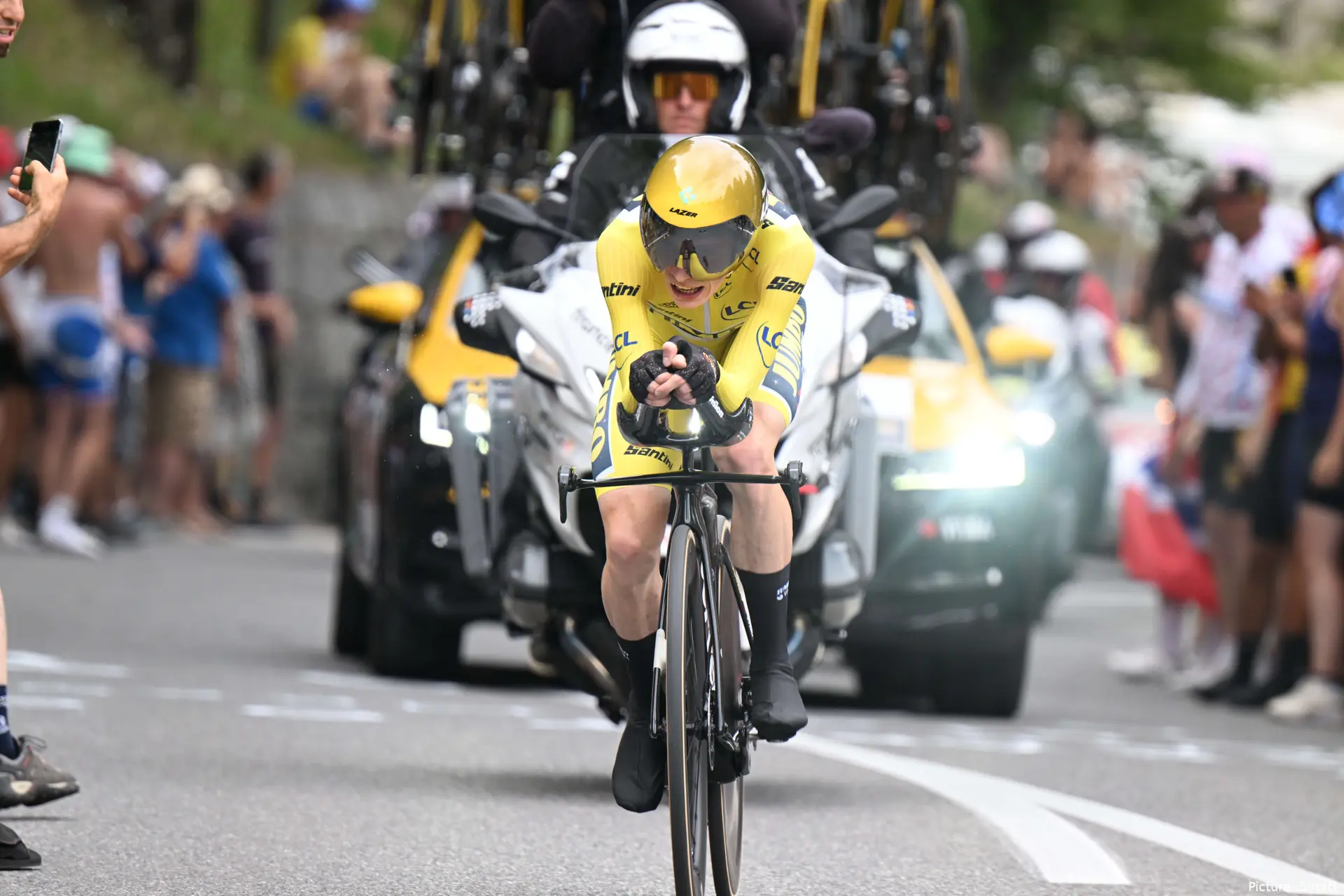
Modern cycling is often framed as a sport ruled by numbers, where power meters dictate decisions and riders are reduced to outputs and thresholds. For Mathieu Heijboer, that picture misses something fundamental.
The Team Visma | Lease a Bike coach, who works closely with both Wout van Aert and Jonas Vingegaard, insists that while data is essential, it cannot be allowed to define how riders perform in decisive moments.
“You’re not working with robots, you’re working with people,” he said on the In de Waaier podcast. “Based on a lot of historical data, you can assume that a rider can produce 350 watts for 20 minutes. But you hope that one day it’s 360 watts.”
That tension between expectation and possibility sits at the core of Visma’s approach. Data builds the framework, but it is the rider’s ability to interpret how they feel in the moment that ultimately determines the outcome.
Vingegaard’s Tour defining ride
“The best example is Jonas’s famous time trial in 2023,” Heijboer explained. “He decided the Tour that day. He looked at his power meter once and thought: this isn’t right, I’m going far too hard. But he felt good and just kept going. That comes from the guidance we give, where we say: ride the time trial on feel, but still think.”
That moment came on stage 16 of the 2023 Tour de France, a 22.4km test from Passy to Combloux that reshaped the race. Vingegaard began the day with just 10 seconds in hand over Tadej Pogacar, but ended it 1 minute and 38 seconds faster than his rival, turning a tight general classification battle into a decisive advantage.
The scale of the ride went beyond the final margin. Vingegaard was fastest at every intermediate check, not just on the closing climb, delivering a complete performance across technical sections, descents and the steep rise to Combloux. Pogacar still finished comfortably ahead of the rest of the field, which only reinforced how exceptional the gap between the two had been.
Heijboer’s point is not that the numbers were wrong. It is that Vingegaard’s willingness to trust how he felt, even when it appeared to contradict the data, allowed him to fully exploit a rare day where his level exceeded expectation.
More than just the numbers
That philosophy extends beyond a single race. Heijboer is clear that locking a rider into one predicted output carries its own risks. “Then I know it will either be disappointing, or he won’t get the maximum out of himself,” he said. “We also coach riders to go by feel. They even train without a power meter. You go into those training blocks based on a feeling, and then you learn what corresponds to that.”
For a team often associated with marginal gains and meticulous preparation, the emphasis on instinct may seem counterintuitive. In reality, it reflects a more complete approach. Data is used to inform decisions, guide training and refine performance over time, but not to restrict what a rider can do in the moment. “We only use the data as a background tool to learn from and to do things better in the future,” Heijboer added.
The broader narrative that modern cycling has become a sport defined purely by numbers is an easy one to tell. Vingegaard’s time trial in 2023 offers a more complicated answer. It was a performance built on preparation and precision, but ultimately decided by a rider willing to push beyond what the numbers suggested was possible.

Kieran WoodDeputy Editor-in-Chief
Kieran Wood is a sports journalist based in Wales and has been active in journalism since 2022. He regularly contributes to DartsNews.com and CyclingUpToDate.com, where he covers professional cycling and darts. In cycling, his work includes liveblogs from major races, including the Tour de France, the Giro d’Italia, and La Vuelta a España, alongside race reports and analysis. He has also conducted interviews with professional riders.
His reporting spans the full racing calendar, from one-day classics to stage races, with a focus on accurate, real-time coverage and clear contextual analysis. For statistics, results, and historical context, he regularly uses resources such as ProCyclingStats. To support reporting on rider activity and training context where relevant, he also references Strava.
In his work, Kieran places strong emphasis on careful sourcing, editorial accuracy, and updating articles as new, verified information becomes available.
claps 4visitors 4
Just in
Popular news
Latest comments
- Especially on a 212 km stage with 1794 m of climbing and 4 climbs in the final 60 km
 Rafionain-Glas15-10-2026
 - considering he went from not finishing stages to top 10, its pretty goodabstractengineer15-10-2026
- Nah , he lost, he could not make that upabstractengineer15-10-2026
- Its more of a teardown rather than a rebuild.abstractengineer15-10-2026
- Have you considered the impacts of his crash?Rafionain-Glas15-10-2026
- Sven is Belgian you twatRafionain-Glas15-10-2026
- 👍👍👍PogiSloFans15-10-2026
- First: If there has been a translation error then I gave you my answer... sarcasm. Second: The author knows nothing on the state of doping within the peleton. His guess is no better than yours or mine. Maybe he's having an illusion, his own misinterpretation of reality. PS: No, I didn't miss the point of your post.PogiSloFans15-10-2026
- hey, brother. well, it took some real jerry-rigging this time, but you found a way to talk about your hero in response to an article that’s 100% about cyclocross and has 0% to do with pogačar. a bit inelegant — “cyclocross doesnt matter so i’m going to just talk about tadej” — but you’ve certainly shown commitment.OCexile15-10-2026
- All very good, we know what the word means. But you missed the point of my post. There are two questions to answer. Quote: "Has there been a translation error, or is the author of the piece making a comment on the state of doping within the peleton?!Cyclingsbestfan15-10-2026
Loading
Write a comment