Tadej Pogacar at the Tour de France - How much protein and carbs does the World Champion consume on a mountain stage?
CyclingWednesday, 03 December 2025 at 18:14
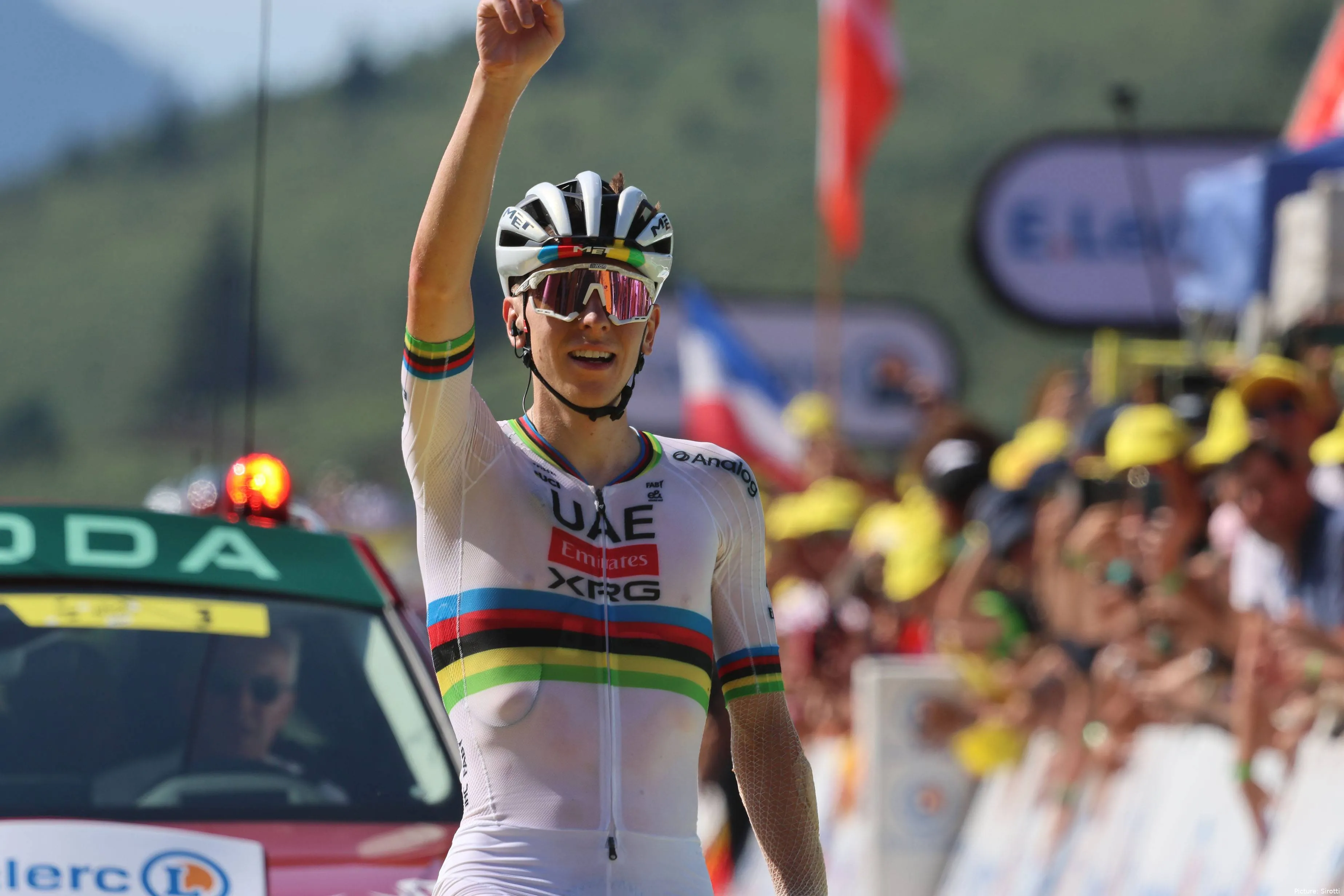
How much does a pro cyclist eat during the Tour de France? This is one of the most interesting questions that most sports fans in the world are interested in, and it varies widely depending on the rider and the day of the competition. Velon gathers some of this data from the riders throughout the race including Tadej Pogacar and they have revealed how many carbs and protein the World Champion consumes in a mountain stage.
More and more riders have nutrition as an absolutely key factor in cycling, as training the stomach to absorb high amounts of carbs aids in the energy reserves and is one of the biggest evolutions pro athletes have had in recent years. This does also mean that on the daily, the riders at the Tour consume an enormous amount of food, be it calories, carbs or protein, so as to sustain the performance day after day in an incredibly difficult environment.
The amount of food consumed depends on the stages. Much has been said about the 'magical' 120 number, which is the amount of carbohydrate grams riders are now able to digest per hour, but this is only reserved for specific days or moments of races, as it is difficult on the stomach on unsustainable in the long-term. Easier days on the bike lead to smaller energy expenditure. Nevertheless, riders can consume from 6000 to 8000 calories a day in the sport's biggest race - the same applying to other Grand Tours.
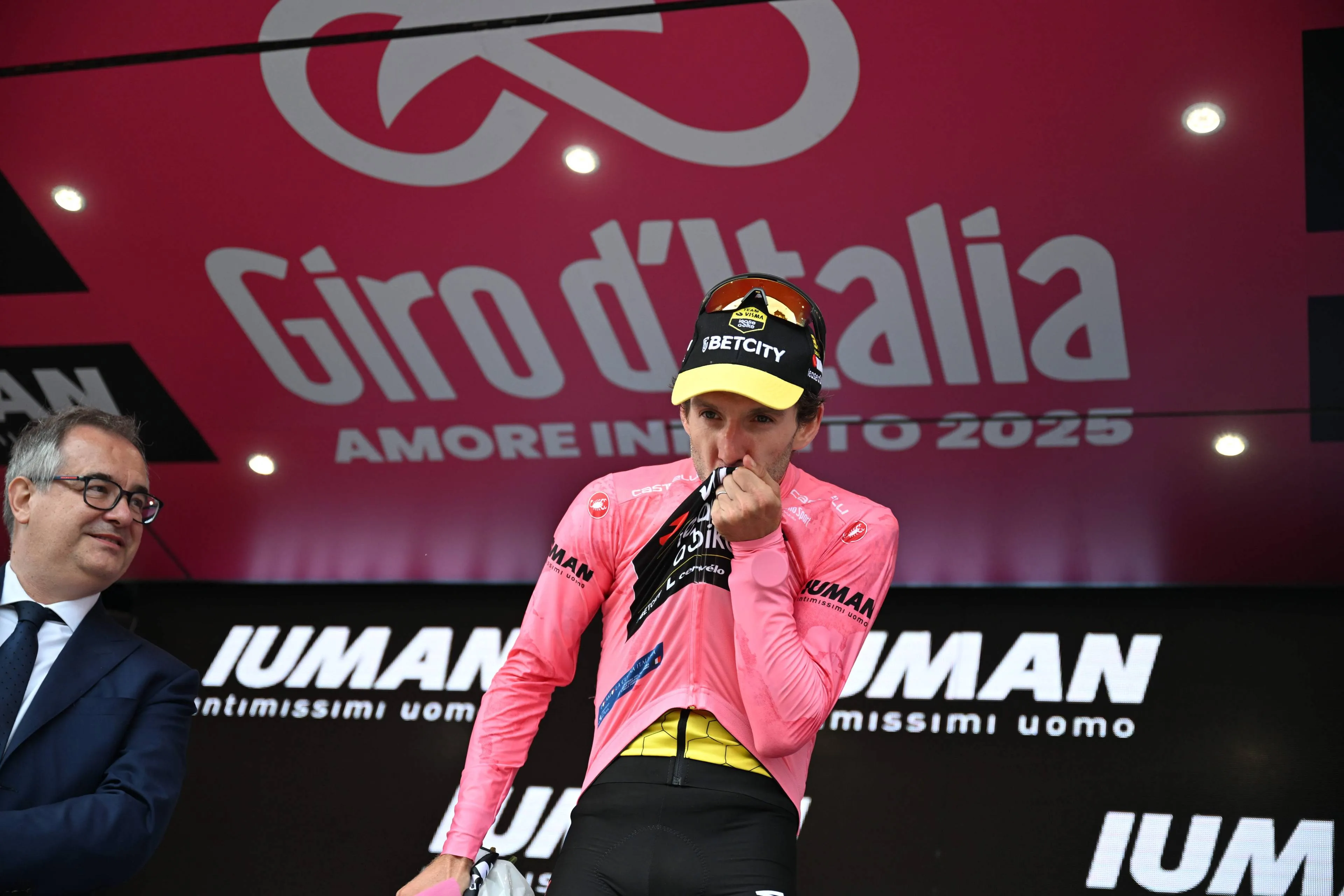
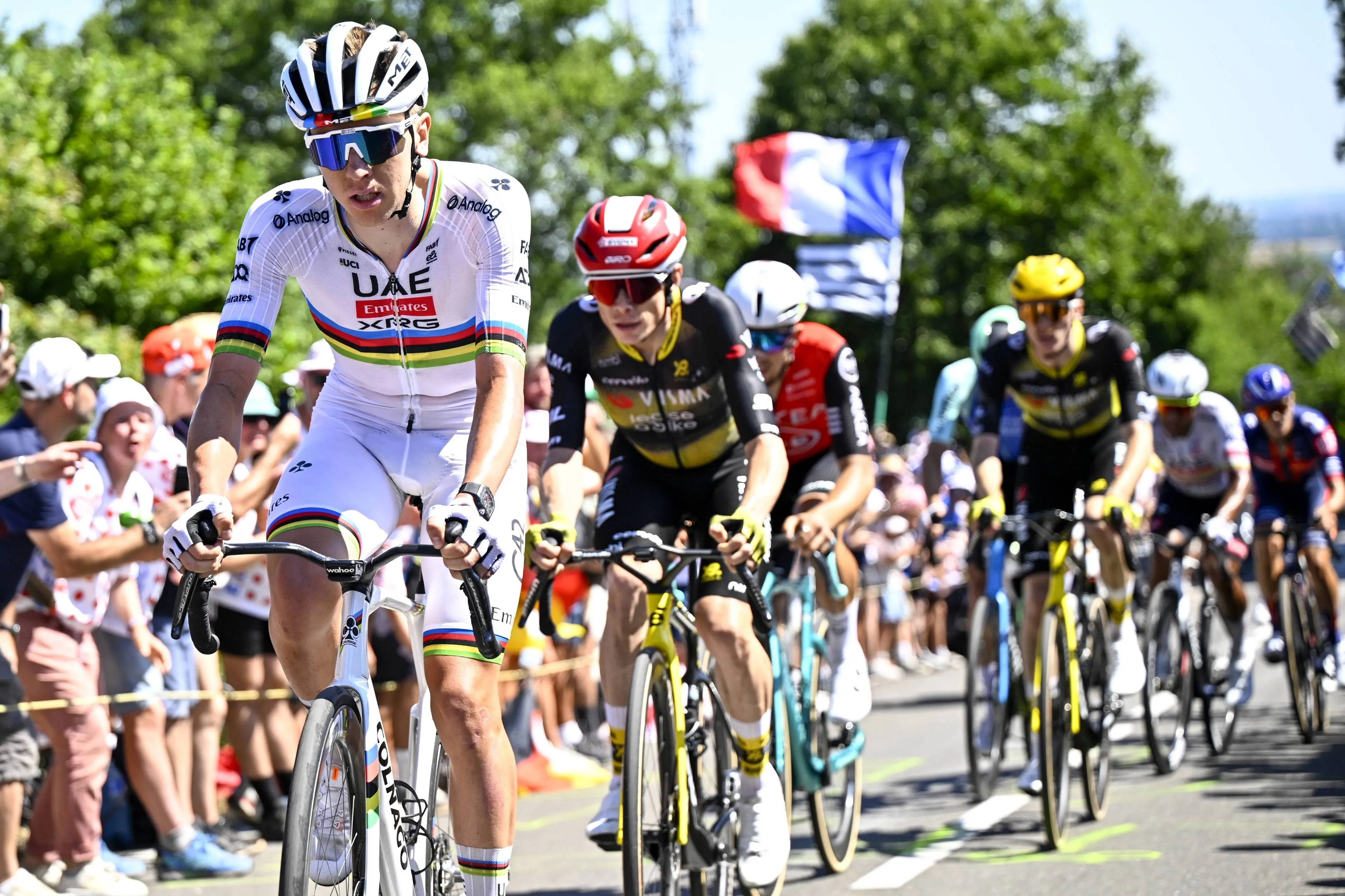
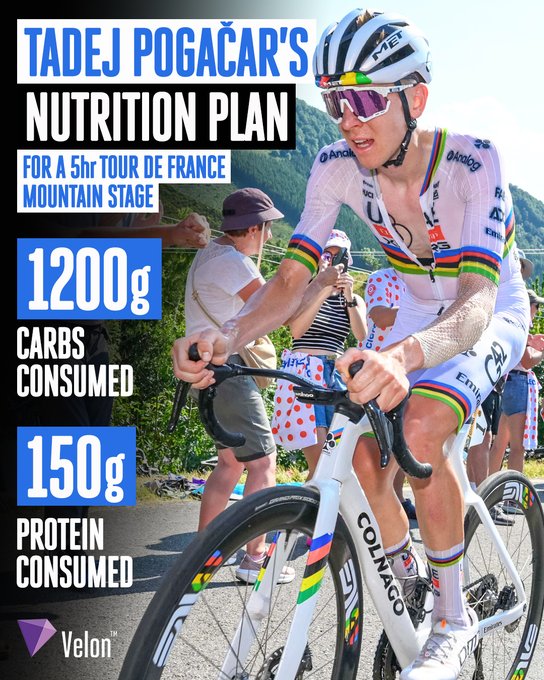
According to Velon, on a five-hour mountain stage at the Tour de France, Pogacar consumes around 1200 grams of carbs and 150 grams of protein. This has also been split according to the times of day:
Breakfast: 230g carbs; 25g protein
Pre-Race: 30g carbs; 1g protein
During Race: 460g carbs; 4g protein
Post-Race: 480g carbs; 120g protein
Pre-Race: 30g carbs; 1g protein
During Race: 460g carbs; 4g protein
Post-Race: 480g carbs; 120g protein
This insight first and foremost provides very interesting data on a rider that is at the absolute top of the sport, allowing fans to have an idea of what it takes to be able to fuel the body at the top sport. Athletes have to be able to do this on the daily too with feeding, which in itself is a key part of training that is rarely discussed.
Coaches of rival teams will be aware of these numbers and implement them on their own riders, naturally, but there are a few interesting conclusions to be taken from it. Breakfast is typically the most fat-dense meal of the day; right before and during the race the riders opt for food that has very little to no protein whilst focusing almost exclusively in the content of carbs. 460 carbs in a 5-hour race will also equal to an average of 92 grams of carbs per hour.
Post-race there is the need for immediate feeding after the finish line, a post-race meal, and a hefty dinner, which see the grand majority of all the protein consumed in a day, which aids in recovery in the great part. These nutrition plans are trained during the year and also tested and implemented in smaller stage-races throughout the year, which is one of the reasons why it is important for Grand Tour contenders to participate in stage-races all-year round even if they thrive in other aspects of the sport.
claps 0visitors 0
Just in

Popular news
Latest comments
- yep, not a good way to put pressure on a rider. I do hope the kid succeeds and climbs to the top in his career. But, as with any prediction, hindsight is always 20-20 and we'll see how well Madiot's over-the-top claim ages.b3tlla03-03-2026
- Wow! A rider with two wins ( impressive in both ) is now THE MESSIAH! Cannot wait for Saturday! I wonder if Pogi even needs to show up! See you all in the comment section on Saturday. I will be there watching!
 QPSQUANTUM03-03-2026
 - Sometimes the weight of an entire nation can be quite overwhelming. What would be best is if they just let Paul Seixas be Paul Seixas.
 santiagobenites03-03-2026
 - So between LBL (129 in 2025) and Strade (98 in 2025) there is a 24% loss. Between Brugge-De Panne (153 in 2025) and P-R (116 in 2025, excluding last place, who was a certain fella named Oier) there is also a 24% loss. Putting aside all the inaccuracies (different lengths, different proportionsof rough terrain, different riders etc.) it shows that the effect of rough terrain is somewhat similar in both. What is more significant is the change in the race dynamics - Brugge-De Panne is a pure sprinters race but Paris-Roubaix is one blown wide open, while Liège is already blown wide open and Strade is merely a crueller version.
 Rafionain-Glas03-03-2026
 - Next time van Dijke does that, van der Poel will go out of his way to drop him and then continue riding with Vermeersch (or whichever rider it is who is foolishly working with him) until he decides to drop him too. Van Dijke would then get caught by the chasing group and maybe dropped, which would be van der Poel's way of saying 'I warned you and you did not listen'. It is conformity (Vermeersch) vs resistance (van Dijke).Rafionain-Glas03-03-2026
- Unless you are Pogi (which would be very sad, not least because he wouldn’t get basic facts so embarrassingly wrong) he has never done such a thing but feel free to quote him.Mistermaumau02-03-2026
- Strange then how many liked it, some must understand more than you imagine but not as much as you hope.Mistermaumau02-03-2026
- That’s the one reason they don’t need it but it will increase interest.Mistermaumau02-03-2026
- Wouldn’t care even IF it was the hardest, any type of race will always be advantageous to certain riders and not others so always using one race as a reference shows a complete disrespect to the sport and riders. Also, quoting finisher figures for selected years is a very unprofessional way of stating a point. But, seeing as your data is completely Trumpian anyway there’s no point in going into detail is there? PCS lists 98 in 25 and well over 100 the year before, no idea what you’re trying here but after Kigali and the ECs and some famous bad weather Belgians, it’s a bad time to harp on about finisher percentages to support your point.Mistermaumau02-03-2026
- Who are buddies?Mistermaumau02-03-2026
Loading

How Pogi fuels for a big mountain day 🚵 World champion Tadej Pogačar consumes 1200g of carbs and 150g of protein on the day of a five-hour Alpine or Pyrenean stage at the Tour de France. 📸 Sprint Cycling
1 Comments