Results Giro d'Italia 2026 stage 2 - Jonas Vingegaard's late attack falls short as Guillermo Thomas Silva stuns peloton on day marred by mass crash
Cycling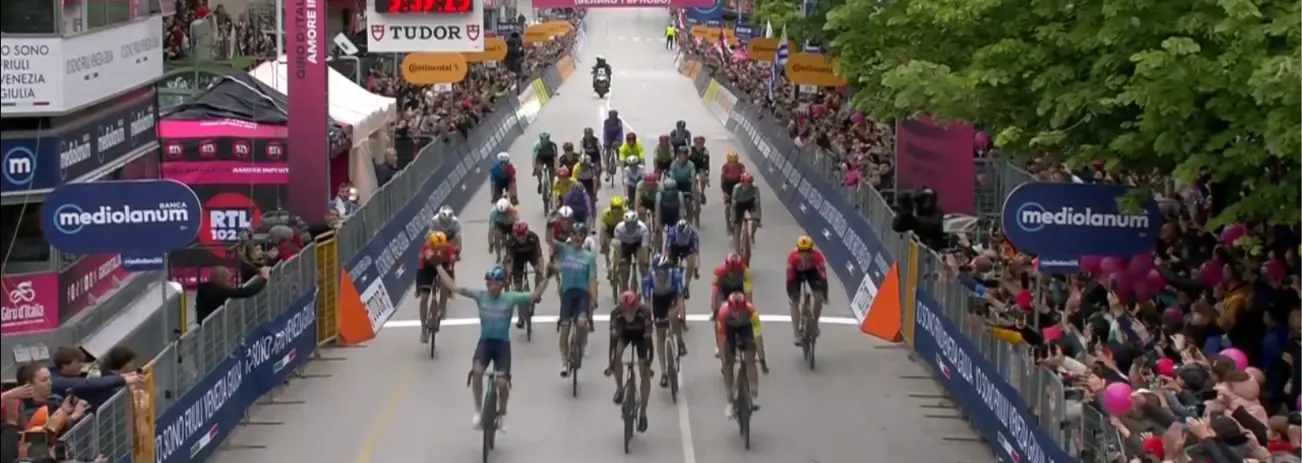
Guillermo Thomas Silva won Stage 2 of the 2026 Giro d’Italia after a brutal, rain-hit day in Bulgaria that saw the race neutralised following a huge crash, Jay Vine abandon in an ambulance, Adam Yates and Derek Gee-West delayed, and Jonas Vingegaard launch an early attack on the Lyaskovets Monastery Pass.
The XDS Astana rider came through late to take victory in Veliko Tarnovo, ahead of Florian Stork of Tudor Pro Cycling Team and Giulio Ciccone of Lidl-Trek. The result came after Vingegaard, Giulio Pellizzari and Lennert Van Eetvelt had gone clear over the final climb, only for hesitation in the closing kilometre to allow the chasers back into contention. Paul Magnier was dropped on the final climb after beginning the day in pink, meaning the Giro d’Italia also moved into a new leadership phase after another chaotic stage in Bulgaria.
Polti - VisitMalta animate calm opening
The second stage of the Giro began in familiar fashion as Diego Pablo Sevilla went straight back on the attack, this time wearing the blue mountains jersey after his aggressive ride on the opening day. Sevilla was joined by Polti - VisitMalta team-mate Mirco Maestri, with the pair forming the day’s early break shortly after the official start in Burgas. Despite the stage offering more difficult terrain than the sprint opener, no other riders joined the move, leaving Polti as the only team represented out front.
The peloton allowed the gap to grow quickly during a calm opening phase, with Sevilla and Maestri moving around five minutes clear while the bunch settled into a controlled rhythm behind. NSN Cycling took up much of the early responsibility at the front of the peloton, with Corbin Strong one of the riders expected to be suited by the more complicated finish in Veliko Tarnovo.
The pace remained modest during the opening hours, with the average speed sitting below the slowest projected schedule as the race left the Black Sea behind and headed inland across flatter roads before the more demanding terrain later in the stage.
At the intermediate sprint in Sliven, Sevilla was allowed to take the maximum reward ahead of Maestri. Behind, Lidl-Trek moved up for Jonathan Milan, but it was Magnier who beat the Italian in the sprint from the peloton, strengthening his early hold on the points classification after his Stage 1 win in Burgas.
Rain changes the tone of the stage
Jonas Vingegaard had a brief interruption during the first half of the stage after twice dropping back with mechanical issues, but the Giro favourite returned to the peloton without difficulty as the bunch continued at a steady tempo.
As dark clouds gathered over the mountains, the first climb of the day brought a visible shift in how Visma approached the stage compared to the opener. Rather than sitting collectively near the rear as they had done in Burgas, Vingegaard and most of his team moved closer to the front behind the lone NSN Cycling worker Ryan Mullen.
Rain jackets began to appear throughout the peloton on the Byala Pass as the weather deteriorated, with the race entering a more awkward phase after the calm opening hours. Sevilla added maximum mountains points over the top without a contest from Maestri, further strengthening his grip on the blue jersey before the road dropped into a wet descent. The peloton came through the descent without major incident, but the pressure to hold position before the wet roads and second climb brought the gap down to just over three minutes.
The Vratnik Pass, a longer climb of just over nine kilometres at an average of 4.4%, then introduced the first more sustained increase in pace from the bunch, with Netcompany Ineos among the teams helping to stretch the peloton as the road climbed toward the highest point of the day. Sevilla again took maximum mountains points at the summit, moving to 24 points and establishing a commanding lead in the classification.
Behind, the higher tempo began to bite for some of the faster riders already carrying issues into Stage 2. Arnaud De Lie, who came into the Giro after illness disrupted Lotto-Intermarche’s build-up, was dropped from the peloton along with Erlend Blikra, while Dylan Groenewegen also began to struggle soon afterwards. Blikra and Groenewegen had both been caught up in the mass crash on the opening stage.
De Lie later made it back to the rear of the peloton after a tense descent that almost produced another dangerous moment when he came close to colliding with a stationary Netcompany Ineos team car in a corner.

Arnaud de Lie crosses the line on stage 1 of the 2026 Giro d'Italia
Huge crash forces race neutralisation
Inside the final 30 kilometres, the long chase finally closed in on Sevilla and Maestri. Mullen continued to work for NSN Cycling, but fresh legs also began to appear at the front as the finale drew closer.
Mikkel Bjerg moved up for UAE Team Emirates - XRG as the gap dropped under one minute, before Visma, UAE and Netcompany Ineos all became more prominent in the bunch. Filippo Ganna was among those contributing to the pace as the race shifted from long, controlled pursuit into final approach mode.
Sevilla and Maestri were eventually caught after almost five hours in the breakaway. Their move was never likely to survive once the peloton organised, but Polti - VisitMalta had already taken a major haul from the day, with Sevilla reinforcing his blue jersey and the pair collecting the intermediate prizes across the stage.
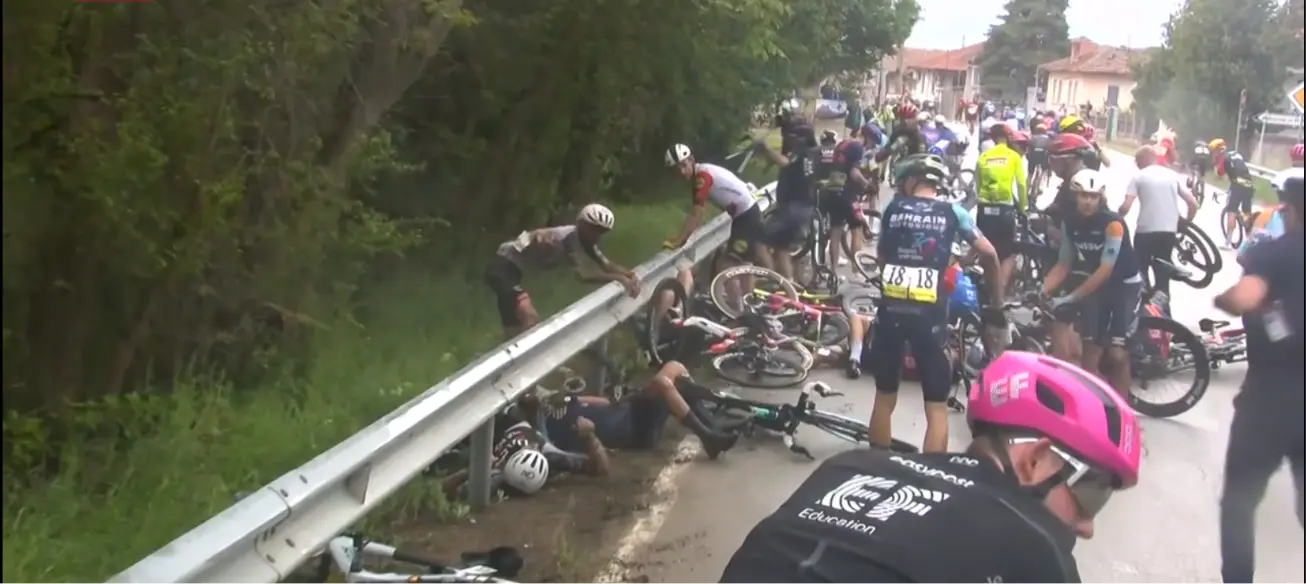
The race had barely reset before disaster struck on the wet roads. A large crash brought down numerous riders on the slippery surface, with several UAE Team Emirates - XRG riders caught up in the fall.
Adam Yates was among those to hit the deck, the UAE leader left covered in mud and blood as he remounted and tried to manage the damage. White jersey wearer Antonio Morgado also needed a new bike after the crash, while Derek Gee-West was another GC-relevant name delayed and waiting for a replacement machine.
Corbin Strong and Edoardo Zambanini were also among those confirmed on the ground, turning what had been a largely controlled stage into a potentially significant moment before the final climb.
The scale of the crash forced organisers to temporarily neutralise the stage, with ambulances and medical vehicles occupied by the number of fallen riders. Jay Vine was the most serious UAE casualty, with the Australian taken away from the race on a stretcher and loaded into the back of an ambulance before his abandon was confirmed.
It was a major blow for UAE on a stage where Yates and Morgado had also been caught up in the same incident. Remi Cavagna initially appeared in serious difficulty and held his collarbone area after going down, but the Groupama-FDJ rider later remounted. Andrea Vendrame was also delayed heavily and looked unlikely to continue at first, before eventually getting back on his bike.
The race resumed with several riders still chasing back. Strong and Zambanini had not yet fully regained contact when racing restarted, while Yates was also still behind after his crash.

Adam Yates was left bloodied and muddied by his crash
Vingegaard lights up the final climb
The race returned to full speed almost immediately before the Red Bull kilometre, where Netcompany Ineos moved smartly to collect valuable bonus seconds. Egan Bernal sprinted to the maximum six seconds, while team-mate Thymen Arensman followed for four more, both already well positioned before the decisive climb.
The Lyaskovets Monastery Pass then brought the race properly alive. XDS Astana were among the first teams to increase the pressure on the lower slopes for Christian Scaroni, while Bardiani CSF - 7 Saber also tried to move forward through Martin Marcellusi.
Morgado and Gee-West, both caught up in the earlier crash, were quickly distanced from the peloton as the pace lifted. For UAE, the damage from the crash was still unfolding, with Bjerg having paced a group that had seen much of the team slide into the roadside barriers.
Visma had also been touched by the crash through Wilco Kelderman, but Vingegaard avoided the incident and was guided onto the climb near the front. Davide Piganzoli then took over the pace-making for the Danish favourite, stretching the group and putting the Maglia Rosa into trouble.
Magnier was unable to hold the tempo as the lead group was reduced to around 50 riders, ensuring the Giro would have a new race leader by the end of the stage.
Vingegaard then attacked around 700 metres from the top of the climb, just as the road steepened. Jan Christen briefly followed, but the UAE rider could not hold the Dane’s wheel. Pellizzari and Van Eetvelt were the only riders able to bridge back, forming a dangerous front trio as the race crested the climb.
The trio entered the final 10 kilometres with an advantage of around 10 seconds, which soon stretched toward 20 seconds as the chasers behind struggled to organise. Counter-attacks from the chase only strengthened the leaders’ position.
Front trio caught after late hesitation
Vingegaard, Pellizzari and Van Eetvelt continued to work toward the technical finale in Veliko Tarnovo, where the road climbed again through wet cobbled sections and gradients touching 9%.
Van Eetvelt, with less obligation to contribute than the GC-focused riders alongside him, began skipping turns before later coming through as the final kilometres approached. Vingegaard encouraged the group to keep riding as the road ramped up inside the final two kilometres, with the chasers still close enough to threaten the stage win.
Inside the flamme rouge, Van Eetvelt appeared to wait rather than lead out the sprint, hoping to force the others to open first. That hesitation proved costly. Jan Christen and the rest of the chasing group were closing fast, and Van Eetvelt launched again with around 800 metres to go as the leaders’ advantage began to vanish.
The move was not enough to save the front trio. The chasers swept back into contention in the final run to the line, and Silva timed his effort best to win the stage for XDS Astana.
Stork took second for Tudor, with Ciccone third for Lidl-Trek, while Vingegaard’s early attack still gave the general classification battle its first clear signal of intent. After a day shaped by rain, crashes, a neutralisation and a late tactical stall, Stage 2 delivered the first major shake-up of the 2026 Giro.
Carlos Silva is a writer for CyclingUpToDate.com, where he contributes race reports, interviews, analysis pieces, and live coverage of the international cycling calendar. Holding a degree in Sports from the Jean Piaget Institute, he combines academic knowledge of performance, training, and competition with hands-on journalism experience in professional cycling.
Throughout his career, Carlos has conducted interviews with leading figures in the sport, including Alberto Contador, Joaquim Rodríguez, Óscar Pereiro, João Almeida, Isaac del Toro, Derek Gee, John Degenkolb and Geraint Thomas. These conversations reflect direct engagement with Grand Tour winners, Classics specialists, and emerging talents.
He has provided on-site coverage at major events ranging from the Vuelta a España to the Tour de France, alongside stage races such as Vuelta a Andalucía, Volta ao Algarve, Volta a Portugal and O Gran Camiño. Covering the mythical climbs of the Giro d'Italia remains one of his professional ambitions.
Carlos is responsible for liveblog coverage of all major WorldTour races and beyond, including the Tour de France, Giro d'Italia and Vuelta a España. His reporting integrates verified data from ProCyclingStats to ensure statistical accuracy, contextual depth, and analytical precision.
A lifelong cycling enthusiast, he approaches storytelling across written, photographic, and video formats with a focus on credibility, tactical insight, and informed race interpretation.
claps 3visitors 3
Just in

Popular news
Latest comments
- He didn't even try to sprint all outvappaxbipmv18-10-2026
- Campenaerts looked like a rolling pumpkin with that all orange leaders skinsuit !frieders318-10-2026
- He can take his dumb a$$ politics somehwere else !frieders318-10-2026
- good to have her back. fingers crossed she‘ll be able to stay!Ketterechts17-10-2026
- A tenner and he wins the Tour next year, too 😂anonymouscyclist17-10-2026
- the answer is either stick to classics or GTs but not bothabstractengineer17-10-2026
- the exodus already stared with Ciccone. Already they were struggling with two sprinters, now there are three. Also Ganna will demand leadership. Gall is the most proven GC, Ayuso has the most potential. GC leadership for everybody will be impossible. Literally a UAE style mess without pogi.abstractengineer17-10-2026
- I raced as an amateur for 12 years, including six years on my country’s national road cycling team. I secured two national titles and competed in three World Championships plus more than 15 international stage races. At 23, we travelled to Italy for a training camp—or so I assumed. On a rest day, we watched a presentation about adopting a more “professional” training approach. It was crystal clear what “professional” meant. That moment first exposed me to this dilemma. After returning from Italy, I left cycling—at least at the competitive level I had known. Over the following two years, the whole team was caught doping. I hold that everyone is innocent until proven guilty. In my view, current stakeholders operate on a different scale, and the sums involved are vast. I am unsure whether any doping would ever be revealed. I try to stay positive and enjoy the show. My 2c.
 vannpelt17-10-2026
 - Fiver he wins 🤣
 leedorney17-10-2026
 - “…measures to reduce speeds.” Might as well shorten the race course to just 50km as well? ASO generates at minimum €300m a year and 30- 40% profit. Maybe stop being greedy and spend more of the profit to protect the riders instead.b3tlla17-10-2026
Loading
5 Comments