Tirreno-Adriatico 2026 preview, profile, favourites & predictions - Isaac del Toro versus Visma and Bahrain
Cycling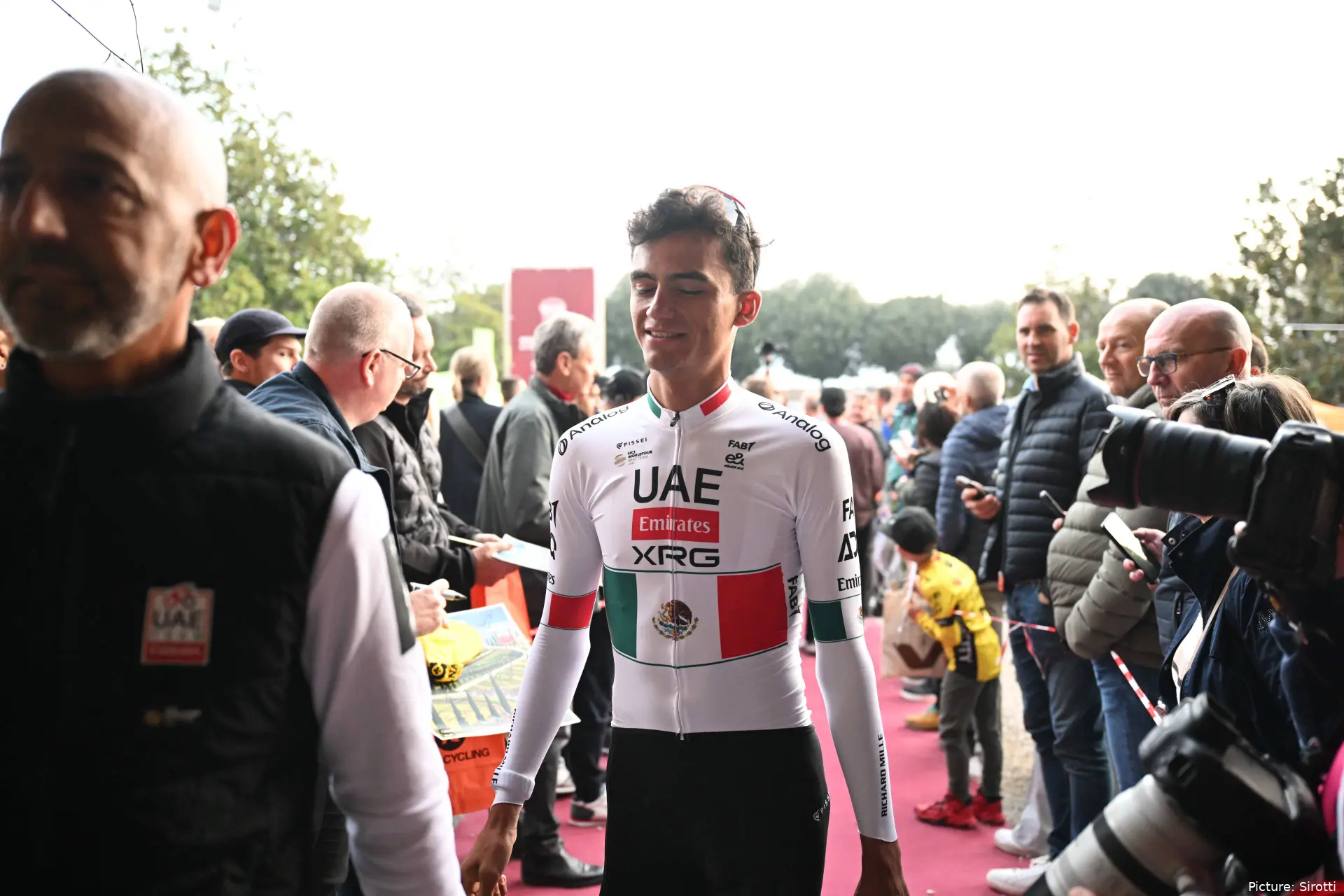
Tirreno-Adriatico 2026 is taking place from the 9th to the 15th of March and is, as is the case every year, one of the most important races of the spring. It not only provides sprinters, time trialists and climbers with golden opportunities in one of Italy's top events; but also provides the classics specialists with ideal races to prepare for their big goals. We take a look at its profiles.
The race was created back in 1966 and as the name suggests, it takes rider riders from the Tyrrhenian sea all the way to the Adriatic; crossing central Italy from west to east with a variety of stages that suits all types of riders. Dino Zandegù won the first edition, but it didn't take long for big international names to join the race; even if Paris-Nice was always in the same slot, calendar-wise. The six consecutive GC wins of Roger de Vlaeminck from 1972 to 1977 boosted the race to the highest of levels possible, and lots of legends have cemented their name in the week-long stage-race.
Francesco Moser, Giuseppe Saronni, Joop Zoetemelk and Tony Rominger are riders who won throughout the 20th century; whilst this century a few editions did not have mountain stages which increased the variety of overall winners. Classics specialists such as Paolo Bettini and Óscar Freire won it at their prime; Fabian Cancellara won it back in 2008 and even Greg Van Avermaet took the title in 2016 most recently...
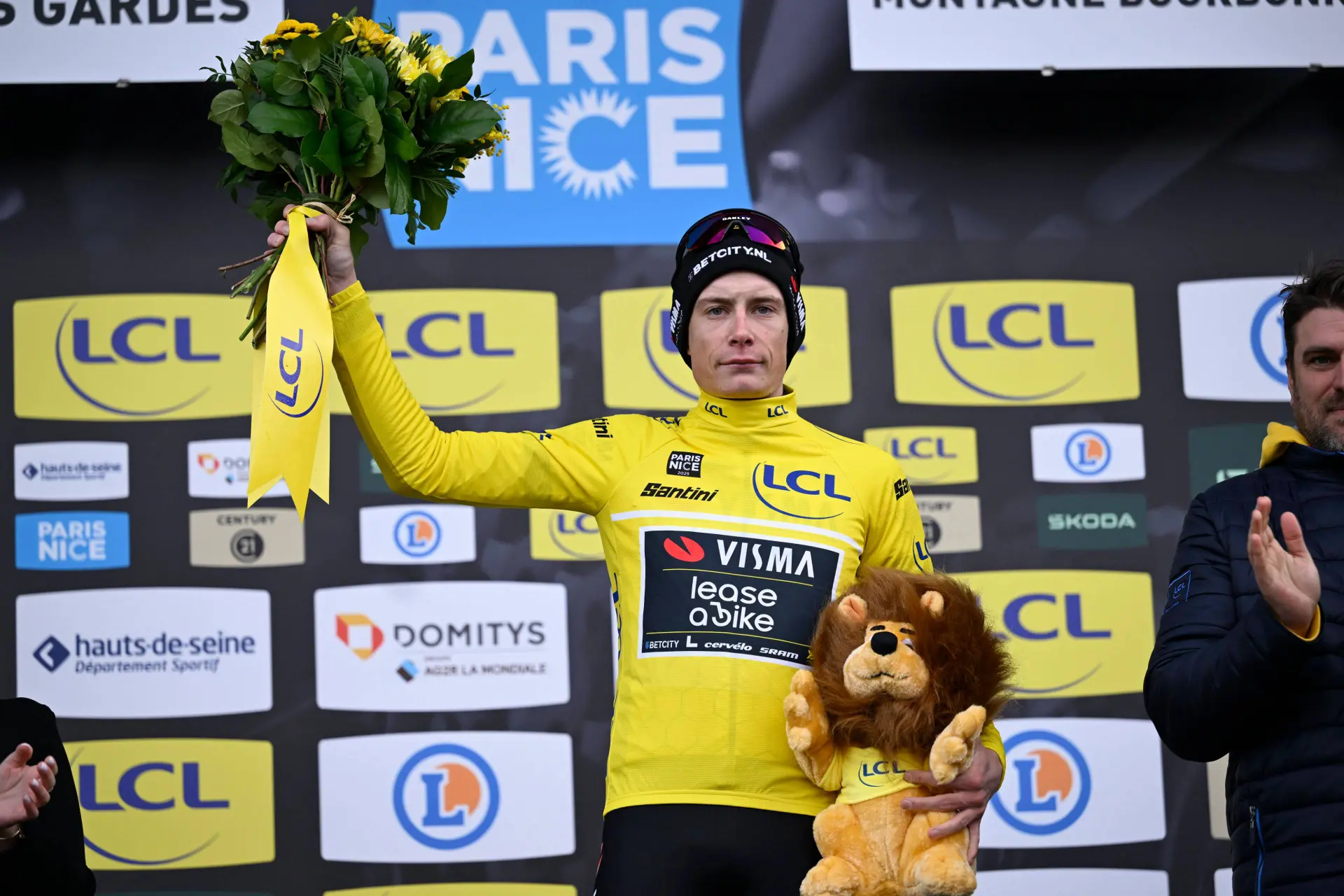
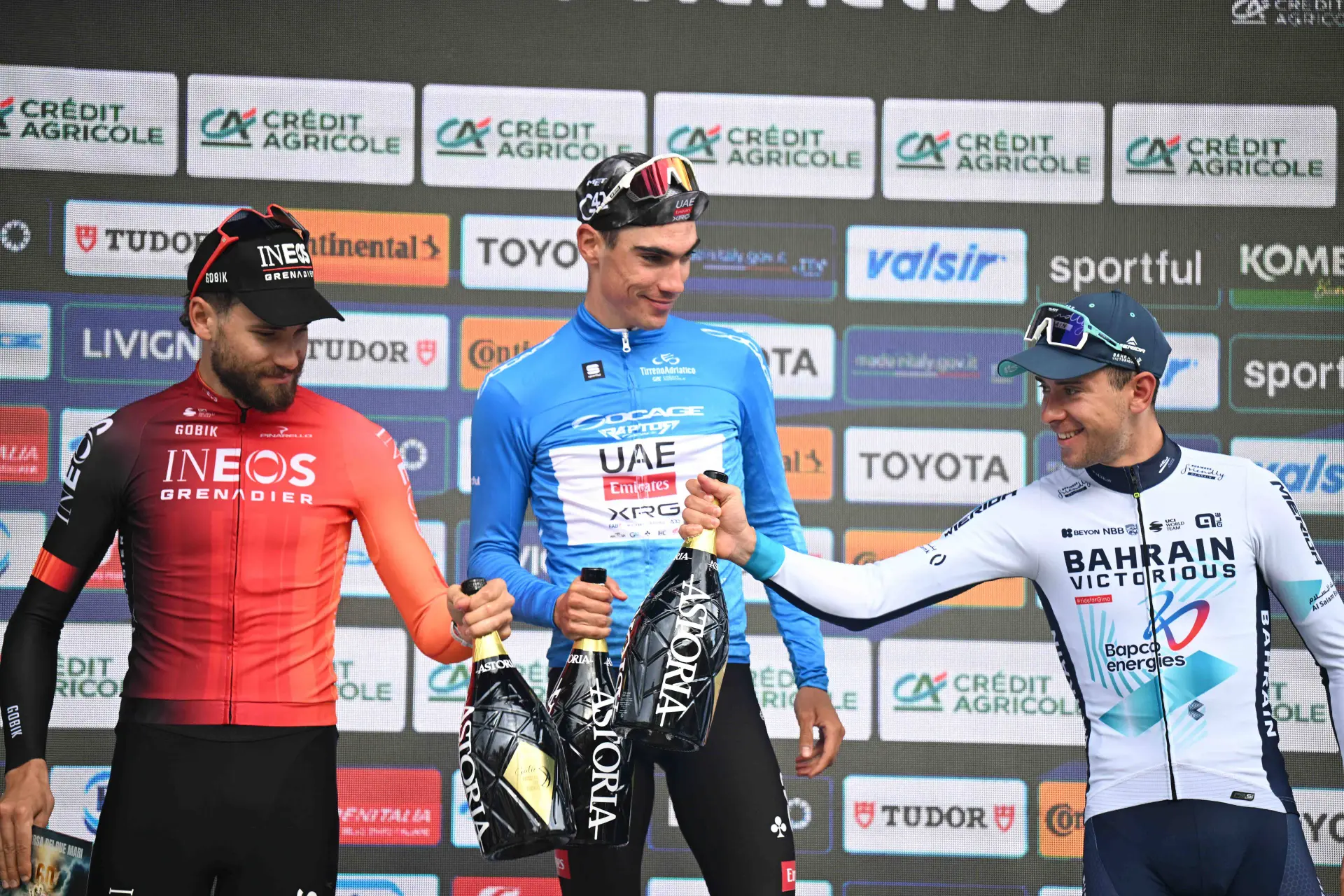
However the quality of the winners over the past 15 years is outerwordly, with many of the world's very best climbers winning the overall classification at the prime of their career. Cadel Evans, Vincenzo Nibali, Alberto Contador, Nairo Quintana, Primoz Roglic, Simon Yates, Tadej Pogacar, Jonas Vingegaard... It's hard to image a better list. In 2025 Juan Ayuso inserted his name amongst the greats, winning the overall classification after winning the queen stage, dethrnoing a Filippo Ganna who showed the very best climbing legs of his career.
Profiles Tirreno-Adriatico 2026
Profile stage 1 (ITT): Lido di Camaiore - Lido di Camaiore

Stage 1 (ITT): Lido di Camaiore - Lido di Camaiore, 11.5 kilometers
The race starts off as usual right by the Tirreno sea coast and it is with an 11.5-kilometer long time trial. This provides the specialists with an opportunity right from the get go; and simultaneously the GC riders have a key day in the fight for the blue jersey.
The course is pan-flat and very fast, however, in these 11 kilometers it is possible to open up visible gaps that will not be easy to close down. A day for everyone to go at their maximum, as the blue jersey is also within reach in the next few explosive days.
Profile stage 2: Camaiore - San Gimignano

Stage 2: Camaiore - San Gimignano, 206 kilometers
As soon as stage 2 of the Italian race begins, there is a small climb. 206 kilometers on the menu starting off in Camaiore with a small hilltop; which then gives away to a very long flat transitional section that will leave the riders at the foot of a stage finale can be very treacherous.
The last 80 kilometers will be a constant up and down, and a very tense couple hours of racing as it features several rolling climbs, a few steep ones, and plenty descents. Tricky roads, in which positioning is crucial and splits can certainly happen.
None of the climbs are overly hard however, and so it's not likely for the peloton to explode. Instead, there should be a full-on leadout to the base of the hilltop finish in San Gimignano. The climb, in total, is 7 kilometers long, and is a finale that is very different from what pro cycling usually has.
The first 1.3 kilometers are at 7.6% and are fully in a sterrato sector. This sector is over 5 kilometers long and will leave the riders with just under 2 kilometers to go; with the off-road sector including uphill and flat areas. After coming off the gravel the riders face a 1.2-kilometer hilltop finish at just over 7% where the puncheurs and climbers will fight for the stage win. However, it is quite likely that we will see important gaps on this finale; whilst the off-road nature can provide unexpected circumstances as well.
Profile stage 3: Cortona - Magliano de' Marsi

Stage 3: Cortona - Magliano de' Marsi, 221 kilometers
Stage 3 is a day for the sprinters but by no means is it an easy or simple one - far from that. In fact it is quite the opposite, perhaps the hardest stage the organizers could design whilst maintaining the stance that it is a pure sprint.
The riders face 221 kilometers on the menu, a long distance which provides some sort of preparation for Milano-Sanremo. The start of the stage is flat, however the roads all throughout the final two third are quite rolling. There are 2400 climbing meters on the day; not a ton but this and the distance will weight on the legs of many by the time they have to do an all-out effort and a sprint.
The final meaningful climb ends with 40 kilometers to go, it is 7 kilometers long at 4%, where we can see some teams pushing the pace with good reasoning behind it. Later on, the arrival to Magliano de' Marsi is not technical in any way, a very long finishing straight into town where the experienced leadouts can do their thing.
Profile stage 4: Tagliacozzo - Mariniscuro

Stage 4: Tagliacozzo - Maritniscuro, 213 kilometers
Stage 4 of the race is a stage that can be very tricky, and it is designed to be chaotic. The distance factor is once again added to the equation, with 213 kilometers on the menu. The high-altitude start in Tagliacozzo will also provide for an unusual downhill trend for the stage, finishing 700 meters below the start; but providing a lot of climbing nevertheless.
At the start there will be two climbs, both of which around 12 kilometers in distance and 5% in gradient. Hard enough to create a very strong group up front with climbers and potential GC contenders; but "easy" enough that non-pure climbers can also find themselves in front. It can give way to a dangerous mix of riders in this stage that features 2800 meters of climbing.
Four climbs then dictate the decisive part of the stage. 7.6Km at 4.5% (49Km to go); 3.1Km at 3.8% (28Km to go); 1.2Km at 5.3% (19Km to go); and these will likely give way to the hilltop that most riders will be looking out for, to attack or to prevent time losses.
It is 1.5 kilometers long at 8.4 kilometers and ends with just over 12 kilometers to go. Most of the way into Martiniscuro then is flat, allowing for tactical attacks in an arrival that should be quite fast.
Profile stage 5: Marotta-Mondolfo - Mombaroccio

Stage 5: Marotta-Mondolfo - Mobaroccio, 184 kilometers
Another explosive stage on the menu, a Tirreno-Adriatico classic as it features climbing from start to finish, most of them slight, not overly hard; and with an explosive circuit finish. The Monte delle Ceane does provide for a proper climbing challenge, averaging over 7% for over 7 kilometers, but it does end with over 80 kilometers to go and there is an enormous amount of climbs still to follow.
So it is a day where the race can explode at any moment; and it may also not explode and lead to a GC battle up the final one. 3800 meters of climbing mean that by the time the riders begin to ascent the Santurario del Beato Sante, they will not be fresh. After the large amount of small climbs, here the climbers can legitimately have a saying with the gradients averaging just over 6% for 4.2 kilometers.
It is a very open day, with the profile not favouring either climbers or puncheurs, but instead the pace and the riders' attitudes will decide where the balance will lean towards. The final climb ends with a mere 1.5 kilometers to go and the riders then descent back into Mombaroccio for the finish line.
Profile stage 6: San Severino Marche - Camerino

Stage 6: San Severino Marche - Camerino, 188 kilometers
It is hard to describe stage 6, as it features the type of profile that is not easy for race organizers to plan out, outside the Abbruzo mountains in Italy. A day where the climbers have their terrain, and so do the puncheurs. But this is the queen stage, starting out with an explosive hilltop once again (good for breakaway formation) right out of San Severino in the Marche region.
The climbers will have here a golden opportunity to destroy the race early on, with the climb to Sassoletto averaging 7% for 13 kilometers. The race can explode, after several days where the climbers didn't have the upper hand in terms of route.
If not however, there are over 4000 meters of climbing on the day, so there is no shortage of opportunities. The riders will take on four laps of a circuit that includes a final steep climb to Camerino, which is 3.2 kilometers long at 9%.
With 85, 59 and 30 kilometers to go the riders will already go up the climb and learn what they will deal with towards the finish; but this isn't child's play, as in each ascent the GC battle can explode. However not only can this happen there but also in the following kilometers, where there are several peaks where the teams can use their numbers to create tactical moves. It is very dangerous terrain which should lead to very difficult racing.
Profile stage 7: Civitanova Marche - San Benedetto del Tronto

Stage 7: Civitanova Marche - San Benedetto del Tronto, 142 kilometers
The race finishes off with the traditional circuit in San Benedetto del Tronto, after a stage that can see the breakaway become quite dangerous. That is because, unlike all other stages, this one is quite short - only 142 kilometers in length - and has an explosive start.
Two small climbs provide the classics specialists and those looking to make one more bid for success to attack; and the pan-flat final hours of racing will be extremely fast, which allows any escapee group to ride quite fast and try to prevent the peloton from coming back.
The finale is not overly technical, and the chances are that a bunch sprint will end up deciding the outcome of the stage.
The Favourites
Isaac del Toro is the man to beat in this race, the only rider who is typically above the rest of the competition here. The UAE man is not a time trial expert but isn't facing them either; and on the several hilly stages he both has the explosivity and the climbing legs to search for bonus seconds, wins and time on every difficult stage.
His main contenders consist of Bahrain - Victorious, led by Antonio Tiberi who gave the Mexican a great battle at the UAE Tour. The short climbs don't favour the Italian, but the team have an in-form Santiago Buitrago and also Pello Bilbao to play for in a race that can be quite tactical. BORA are also co-led by Primoz Roglic who starts his season here, and Giulio Pellizzari who isn't having his main terrain in this race but can nevertheless be a very dangerous rider for the climbs.
Matteo Jorgenson is leading Visma with a different calendar this year, and he is a very strong podium candidate after showing strong form over the past few years. Michael Storer, Richard Carapaz, Ben Healy and Ilan van Wilder are men to watch and potential podium candidates if having good form; Astana have Christian Scaroni, Lorenzo Fortunato and Clément Champoussin forming an important trio; and Filippo Ganna can also do what he achieved last year and really put the pressure on everyone with the early time trial.
Prediction Tirreno-Adriatico 2026 overall classification:
*** Isaac del Toro, Antonio Tiberi
** Matteo Jorgenson, Primoz Roglic, Santiago Buitrago
* Michael Storer, Filippo Ganna, Christian Scaroni, Lorenzo Fortunato, Giulio Pellizzari, Richard Carapaz, Ben Healy, Ilan van Wilder
** Matteo Jorgenson, Primoz Roglic, Santiago Buitrago
* Michael Storer, Filippo Ganna, Christian Scaroni, Lorenzo Fortunato, Giulio Pellizzari, Richard Carapaz, Ben Healy, Ilan van Wilder
Pick: Isaac del Toro
Original: Rúben Silva
Rúben SilvaEditor-in-Chief
A founding contributor to CyclingUpToDate since its launch in January 2022, Ruben Silva has played a central role in shaping the site’s editorial direction and long-term growth. Before joining the project, he built his experience through independent blogging at Echelons Hub and by producing race previews for Ciclismo Internacional, developing a strong analytical voice rooted in daily engagement with professional cycling.
Beyond editorial work, he has been closely involved in the expansion and coordination of CyclingUpToDate’s wider network, helping establish and support sister platforms across multiple languages. This includes ongoing collaboration with CiclismoAlDia (Spanish), CiclismoAtual (Portuguese), WielrennenUpToDate (Dutch), and RadsportAktuell (German), contributing to a shared editorial vision and consistent international coverage.
He also helps oversee editorial governance across the network, setting standards for accuracy and consistency and coordinating updates or corrections when needed.
Originally from the Porto metropolitan area in Portugal, he holds a bachelor’s degree in Geography. His path into cycling journalism was shaped not through formal media training, but through independent reporting, community engagement, and sustained on-the-ground involvement in the sport.
Over the course of his career, he has conducted approximately 100 interviews across road cycling and cyclocross, ranging from one-to-one conversations and online formats to press conferences and on-site pre- and post-race coverage. His interviews include leading riders, team managers, and prominent figures within cycling media: Tadej Pogacar, Jonas Vingegaard, Mathieu van der Poel, Primoz Roglic, Wout van Aert, Joao Almeida and Tom Pidcock; managers like Patrick Lefevere and Joxean Matxin; and YouTube personality Bryan Kennedy (BKXC)...
Within 18 months of launch, he helped grow CyclingUpToDate’s English-language platform into one of the most-read cycling news websites, built entirely from the ground up. As both a professional journalist and lifelong cycling enthusiast, his focus remains on delivering accurate, timely, and well-contextualized coverage.
claps 0visitors 0
Just in
Popular news
Latest comments
- Dumb?! Only you!MajorPayne16-10-2026
- Let’s hope it stays in!Lozza16-10-2026
- The words... “Remco, on certain days, will just destroy everyone”... don't hold water. Not EVERYONE, most of them, it all depends on the quality of the riders.PogiSloFans16-10-2026
- "The Tour remains at the centre of Simmons' plans". as long as this is the plan, it is unlikely he will succeed. First his team is stacked with leaders for all terrains so opportunity is less. 2nd the TDF is stacked with other top leaders who have more freedom. 3rd the battle between UAE, Visma, Red Bull is so intense that their leaders will win most of the stages with heir team pulling back most breaks.abstractengineer16-10-2026
- Quinn Simmons: “Maybe I’ll never reach the top level.” I also hope he doesn't. I don't care what he looks like, his religion or sexual preference... but when he's a rascist against black people, a Maga Trump voter, that's where I pull the line. The whole world hates Trump, we all know why, but he keeps voting for him. A person that thinks like Trump is ...????. Make your own decision. PS: Trek-Segafredo (today Lidl Trek) suspended him following the controversy over his pro-Trump comments and his use of a dark-skinned waving-hand emoji. The team said the suspension concerned his racist conduct online, not his political views themselves.PogiSloFans16-10-2026
- Denmarks coach reveals 2027 Rainbow Jersey has been targeted by Jonas for years !?!?!? PS: What??? No one believes this meaningless babbling. It's like saying: "The 2027 Monument - Il Lombardia has been targeted by Jonas for years."PogiSloFans16-10-2026
- I made a mistake and already fixed it. Hey twat, thanks.PogiSloFans16-10-2026
- Davide Piganzoli said: "Pogacar looked less brilliant at TDF than usual." We all see how stupid this comment is. What is happening to his brain cells? ... Hey Piganzoli, Tadej Pogačar’s record breaking ascent of Alpe d’Huez was one of the standout performances in the history of the Tour de France. Pantani's 1995 ascent stood for 31 years. Pogi went more than a minute faster. He accelerated near the foot of the climb, despite the leading breakaway being around three and a half minutes ahead. But in your delusional brain Pogi looked less brilliant???? .... Why don't you go find a corner and bang your head against a wall for about 10 minutes. Everyone is making fun of you.PogiSloFans16-10-2026
- MTB WC ? If he doesnt compete maybe allows MvDP to have a crack
 Davide16-10-2026
 - Jonas is declining now. A podium next year would be a good result for him.Renz16-10-2026
Loading
1 Comments