PRESS CONFERENCE: "It’s the price you pay when you ride in a big team" - Jonathan Milan denied chance to defend Green Jersey at Tour de France
Cycling
Jonathan Milan spoke to the media at Lidl Trek’s press conference about his revised Grand Tour programme, his decision to target the Giro d’Italia, his sprint ambitions, the evolving demands of modern sprinting, and how he approaches pressure and risk in the fast finishes. CyclingUpToDate was present as the Italian sprinter answered questions in an extended back and forth.
How difficult was it for you to change your programme and go to the Giro instead of the Tour?
It’s not difficult for me. It’s time to change the programme a bit. Of course it would be nice to go to the Tour, but why not go to the Giro?
It’s not difficult for me. It’s time to change the programme a bit. Of course it would be nice to go to the Tour, but why not go to the Giro?
I’m really happy to go to the Giro because we have some nice opportunities there for us sprinters. I will go with a team that is committed to helping me in different kinds of sprints, to try to do more or less what we did in the last years.
I wouldn’t say it’s difficult. It’s the price you pay when you ride in a big team. Everybody has to be happy at the end, and I’m happy with the decision to go to the Giro.
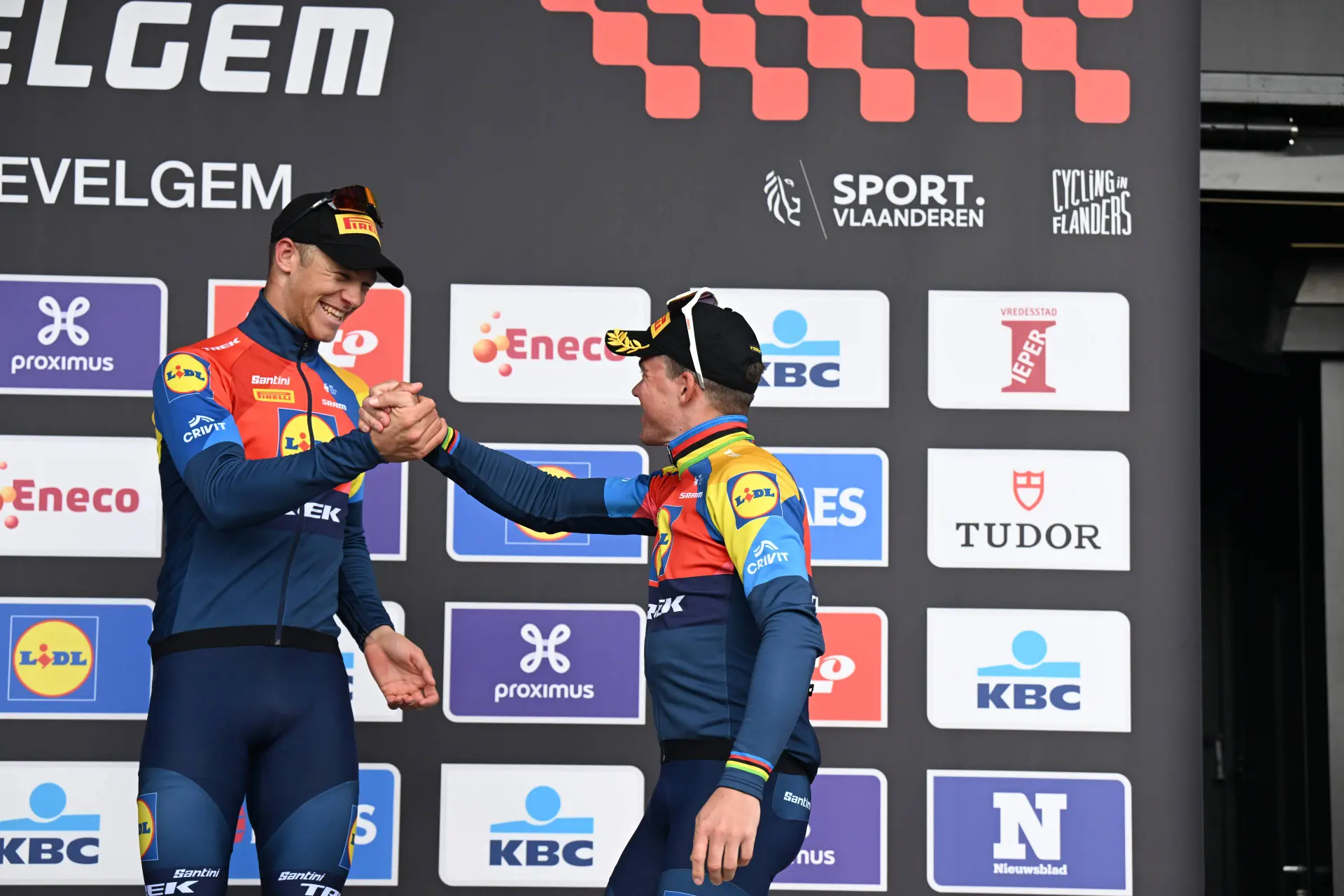
You had a very strong Tour de France this year. How do you look back on it?
I had a really wonderful Tour. Not only because of the victories, but also because of how we did it.
I had a really wonderful Tour. Not only because of the victories, but also because of how we did it.
For me it was really special how we went through every stage, every day. We had such a beautiful atmosphere in the team. I really had fun with all of them. That’s what I take home more than the victories.
Can you explain how a new programme is decided? Is it your initiative or the team’s?
In the end we are coming from the same big goals.
In the end we are coming from the same big goals.
After the holidays, I spoke with my coach. We had a phone call where we talked about the beginning of the year, how to start, where to try to achieve as many victories as possible, and then of course we spoke about the Grand Tours.
This year I saw that the Giro had some nice opportunities, especially at the start. It looks good. And it also gives opportunities because the European and World Championships are not suited for sprinters this year.
Is there a chance you will also ride the Vuelta after the summer?
This has to wait a few days, and then I’ll let you know.
This has to wait a few days, and then I’ll let you know.
I think the Vuelta may have more mountains than this year. When we see the full route, we’ll decide with the team if it makes sense or not. Maybe one or two sprint opportunities, I don’t know. But it’s still a possibility.
What about your Spring Classics programme?
Will it be similar to previous years? I’ll tell you a bit more. I will start in Saudi Arabia. We will have some nice sprint opportunities there. Then UAE, the same. Tirreno-Adriatico, and then after Tirreno.
Will it be similar to previous years? I’ll tell you a bit more. I will start in Saudi Arabia. We will have some nice sprint opportunities there. Then UAE, the same. Tirreno-Adriatico, and then after Tirreno.
I’m only speaking about the main programme now. There could still be some changes.
At the beginning of the year I will focus a lot on the sprints, especially Saudi Arabia and UAE. Then I will have to grow a bit more for the Classics. We need to decide where to go north, not too many Classics, but be really focused.
Last year after Tirreno I was already not feeling 50-50. I was a bit tired. Everyone knows how it went, and for me it was super difficult. We are trying to take small steps every year.
Milano-Sanremo has changed a lot in recent years. Do you see yourself having chances there in the future?
Maybe in the future-future.
Maybe in the future-future.
For sure Sanremo is changing a lot. I will try my best to improve and be in the best shape I can there. It’s a special race for me.
But the approach to the Cipressa and the Poggio is completely changing. It’s already been changing in the last years. It will be super tough.
Everyone knows I will do more this year than maybe expected. We will just try to be ready to suffer.
There are some new recruits in the Classics squad. How does that change things for you?
For me the most important thing is that we become smooth when changing positions. That’s what we did well again this year, and that was our strength.
For me the most important thing is that we become smooth when changing positions. That’s what we did well again this year, and that was our strength.
I’m really happy to have him with me. He’s a really strong rider. We’ve already done some training together, and we’ll keep training in December and January.
We will try different setups during spring training and decide what works best. This will grow through Saudi Arabia and UAE, and then we’ll know the final setup.
Before the Tour you spoke about the benefits of your lead-out. Could new combinations also bring benefits?
We will try everything here in the training camps.
We will try everything here in the training camps.
All these guys have strong kick power, and they know how to deliver me at the right speed. They all have the experience to do it.
For me it’s not only about the last lead-out man. The third-last and second-last riders are just as important. We all have to work together.
Sometimes one rider is on one side of the road and others are on the other side. We need to understand how to work together in all situations. That’s the most important thing.
Sprint competition seems very tight at the top level. How do you see the current sprint hierarchy?
Of course the level is very close.
Of course the level is very close.
We are always there, and I like to compete against them. It’s about positioning. Some start earlier, some later. Everyone has their own style.
The Giro will start in Bulgaria, where you won your first European track medal. Does that have special meaning?
Yes, that’s true. Now I remember that.
Yes, that’s true. Now I remember that.
Yes, it’s 100 percent a target. It’s a really nice possibility and a big opportunity. For sure we will try to arrive there and stay there. But you never know how it will go.
Was that one of the reasons you chose the Giro?
Yes, it was also one of the reasons.
Yes, it was also one of the reasons.
Do you already see the Giro stages in detail?
Will teams work with you more in sprint stages? Sometimes teams collaborate, sometimes not. It’s normal.
Will teams work with you more in sprint stages? Sometimes teams collaborate, sometimes not. It’s normal.
We have strong helpers, and they also help each other until the last kilometre. Sometimes it’s tactical. Some teams need to save energy for GC riders.
For us it’s not a big problem. We know how to work.
You are now Italy’s top sprinter. Do you stay in contact with former stars like Cipollini?
I hear from him sometimes. He sends messages, usually compliments.
I hear from him sometimes. He sends messages, usually compliments.
When I was young, I really watched cycling with my father. Sitting on the sofa for hours. One rider attacking, the other chasing. It was exciting.
Those riders gave me adrenaline. They were big examples for me.
How do you cope with sprint finishes becoming faster and more dangerous?
We try to be as careful as possible.
We try to be as careful as possible.
The races are getting faster and faster, and of course that makes them more dangerous. I see that organisers are taking safety more seriously now.
As a sprinter, you have to take risks, but crashing is never a compromise you want. Every sprint is different. The speed, the road, the positioning, everything changes.
With the evolution of equipment, we are getting faster every year. We are all trying to reduce dangerous moments as much as possible.
Do you think the UCI will introduce gear restrictions?
I don’t know. They are already thinking about it.
I don’t know. They are already thinking about it.
For me, above 75 or 76 kilometres per hour, it’s already extremely fast. It’s not just about bigger gears. You don’t simply go faster because you have a bigger chainring.
It’s more complicated than that.
Which team has the best lead-out in the peloton?
Us.
Us.
We show it every time. We are committed, organised, and experienced. Of course sometimes we lose positions, but then we regroup.
Is it frustrating when your team does most of the work and others wait?
No. It happens sometimes, but other sprint trains also help.
No. It happens sometimes, but other sprint trains also help.
If only one team works and the break gets four minutes, there is no sprint. Everyone understands that. Sometimes teams have their own plans, and you have to accept it.
Do you ever get angry when rivals don’t work with you?
No. In the end they have their plan and they respect it.
No. In the end they have their plan and they respect it.
I say congratulations when they win. That’s cycling.


Kieran WoodDeputy Editor-in-Chief
Kieran Wood is a sports journalist based in Wales and has been active in journalism since 2022. He regularly contributes to DartsNews.com and CyclingUpToDate.com, where he covers professional cycling and darts. In cycling, his work includes liveblogs from major races, including the Tour de France, the Giro d’Italia, and La Vuelta a España, alongside race reports and analysis. He has also conducted interviews with professional riders.
His reporting spans the full racing calendar, from one-day classics to stage races, with a focus on accurate, real-time coverage and clear contextual analysis. For statistics, results, and historical context, he regularly uses resources such as ProCyclingStats. To support reporting on rider activity and training context where relevant, he also references Strava.
In his work, Kieran places strong emphasis on careful sourcing, editorial accuracy, and updating articles as new, verified information becomes available.
claps 3visitors 3
Just in
Popular news
Latest comments
- I figure he would have found out how to outsprint Paul and take the win, maybe. He's 28 now but I would say he's right at the peak of his powers. It was great race though, Paul showed me something different about himself.awp13-10-2026
- Slowly, very slowly... 5-7 yrs. ;)MajorPayne13-10-2026
- Up to this point: "It is just not yet at the level of Vingegaard and Pogacar." First Jonas, and then level of Tadej. Period!MajorPayne13-10-2026
- The sport has long had a divide between the more diesel-like riders and the more explosive riders. Where does Pogačar fit? His explosive attacks are followed by a high speed diesel climb and he's rarely been caught in the past 5 years (people can name the moments, it's so rare). Seixas is young and we have no idea where his body will end up on this spectrum (just like we didn't with Pogačar when he was 20 and being a diesel up the Vuelta mountains of 2019). Speculation is fun, being a fan while it unfolds is going to be more fun.RidesHills13-10-2026
- yeah it'll be an epoch shift when Pog can't drop people, and/or when they start dropping him.wrsty13-10-2026
- Yes, he won't ride away yet, but he will and that day will be notable
 leedorney13-10-2026
 - Expect the young French rider to slowly asphyxiate the Slovenian into retirement.
 Front24213-10-2026
 - My thinking is that Pog's experience and strength would have outweighed any fatigue in Il Lombardia. But the sad thing is, we'll never see peak Pog (call it Pog 2) go head to head with Seixas. However well he recovers from his crash, he'll return as Pog 3, with the shadow of severe concussion always there.Hills3313-10-2026
- Some speculation and opinion. Had Tadej not crashed out of the Vuelta he would have been less fresh and I'm not sure he would have beaten Seixas in this race. Maybe he would have been able to contest the race in a sprint and maybe not. Believe me when I say I keep up with many of Tadej's climbing feats and records and I understand how great he is but the Paul we just saw at Il Lombardia was not that far behind Tadej.awp13-10-2026
- Firstly, someone who says parenting is babysitting is delusional and shouldn't be taken seriously. Secondly, with pro athletes it is not the same as a normal worker. They are being rewarded for doing something for which they have a talent which doesn't actually help people (besides inspiration). It's quite a different dynamic
 Rafionain-Glas12-10-2026
Loading
3 Comments