“Only after the finish did we realise…” – Tadej Pogacar battled to historic Milano-Sanremo win on cracked frame after crash
CyclingTuesday, 24 March 2026 at 10:30
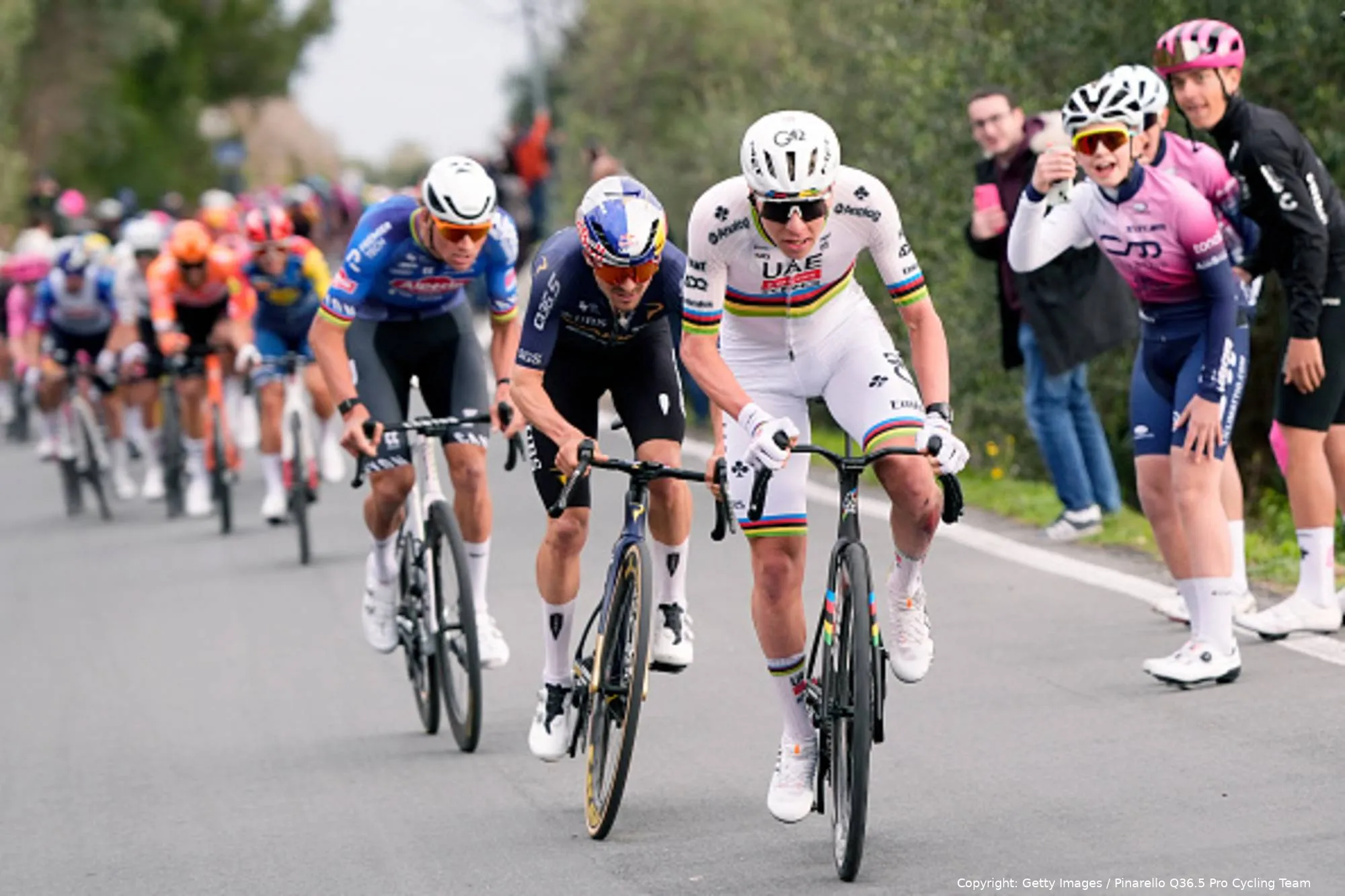
Tadej Pogacar’s long-awaited Milano-Sanremo victory was already one of the most dramatic of his career. A crash just before the Cipressa, a frantic chase back into position, a searing attack on the climb and a full-gas run over the Poggio all built towards a head-to-head sprint with Tom Pidcock on the Via Roma.
He won it in the final metres. Only later did the full scale of that ride begin to emerge. “Only after the finish did we realise Tadej had ridden the finale on a cracked frame,” his mechanic, Bostjan Kavcnik, revealed to Delo, adding an extraordinary detail to an already remarkable performance.
Crash, chase and a hidden problem
The defining sequence of the race came on the approach to the Cipressa, where Pogacar hit the ground at a moment when positioning was everything. For a brief instant, his chances appeared to unravel.
Instead, he was quickly back on the bike and driving through the convoy, with his teammates guiding him back towards the front just in time for the decisive phase.
What nobody realised at that point was that the crash had already compromised his bike. “The rear fork was damaged, but fortunately it held together,” Kavcnik explained. “Had Tadej known the true condition of the bike, he would never have descended so aggressively, as he even attacked on the descent and when he tried to push Tom Pidcock to the limit.”
That descent off the Cipressa was one of the key moments of the race. Pogacar did not simply survive it; he used it to apply pressure, stretching the front group and keeping the pace high heading towards the Poggio.
No hesitation in the decisive moves
From there, the race moved into its familiar final act, but with an unusually small and elite group. Pogacar continued to drive the pace, forcing the selection on the Poggio and ensuring only the strongest could remain. Pidcock was the only rider able to stay with him over the top.
Despite the earlier crash and the unseen damage to his bike, Pogacar committed fully to every move, never hesitating in the moments that would decide the race.
That was made possible by the fact that neither he nor the team were aware of the issue. “Tadej crashed on his left side, where there’s no gear shifter, but the crash mode was still triggered,” Kavcnik said. “He reset it himself and didn’t notice anything else wrong, so we didn’t change the bike.”
A bike change at that point would almost certainly have ended his chances. Instead, he stayed in position, stayed in the race, and ultimately rode to victory.

Tadej Pogacar and Tom Pidcock embrace after crossing the line at Milano-Sanremo 2026
A sprint to seal a Monument
After the Poggio, the race came down to a direct duel. Pogacar and Pidcock worked together just enough to hold off the chasers before turning onto the Via Roma to decide the Monument between them.
Pogacar led out the sprint and held on to the line, finally securing the one Monument that had consistently eluded him. That effort, already extraordinary in its own right, now carries an added layer of context.
Marginal gains and a broken bike
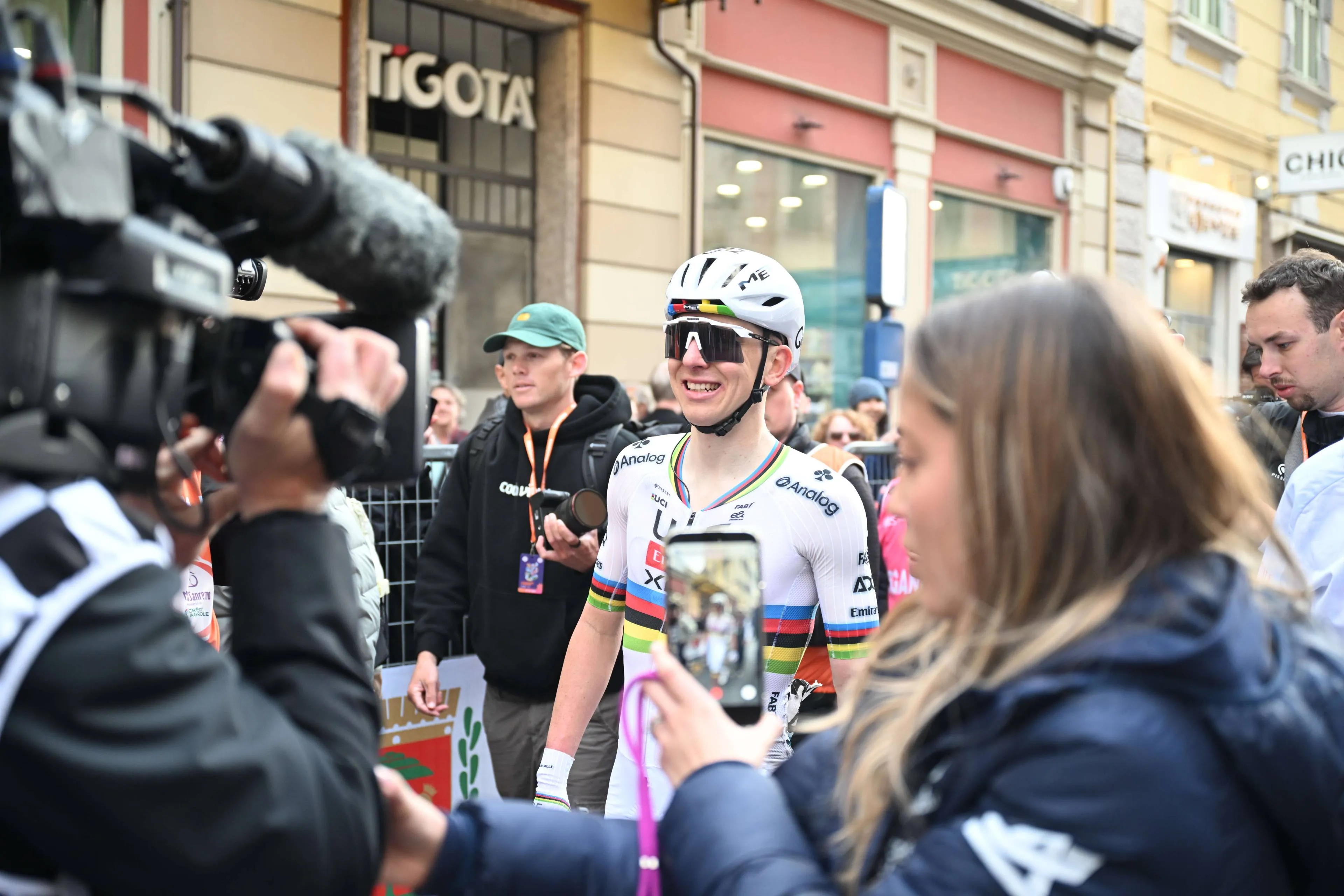
The bike itself had been carefully prepared for the demands of Milano-Sanremo, a race defined by speed and efficiency. “By the way, it was also the first time he opted for a single front chainring,” Kavcnik added. “By removing the front derailleur and extra chainring, we saved weight and improved aerodynamics.”
Further refinements were made to maximise performance on the fast coastal roads. “He also used taller wheels with narrower tyres: 28 mm this year compared to 30 mm last year. Our performance team calculated that this setup would be optimal for such a fast race.”
Those marginal gains were part of the plan. The damaged frame was not.
A bike that becomes part of the story
In the end, the machine that carried Pogacar to victory will not be used again. “This bike will now go into his special collection; it cannot be used anymore.”
For Pogacar, it becomes part of a defining chapter in his career.
A crash, a comeback, a Monument finally secured, and, as it turns out, all of it achieved on a bike that should never have made it to the finish in the condition it was in.
claps 7visitors 7
Just in
Popular news
Latest comments
- No De Kleijn and no Zijlaard. Anyone knows what is going on with both of them?petosagan2324-03-2026
- Seems to me that the likely dopers are the lower level riders who are less likely to be tested. Pogacar is tested continuously and I doubt he would risk taking anything and I doubt his team would survive if he did.PaulB8tson24-03-2026
- The Emiratis and their Slovenian guinea pig are carrying out the most complex cycling fraud in history. Even worse, it's celebrated. It's just sad...
 vannpelt24-03-2026
 - What is it you are trying so say about Vin? He is a cowered or what? Say it outright don't infer it. That's just sleazy.Cyclingsbestfan24-03-2026
- We are discussing Vin. but Vin isn't looking to do that is he? That fortune thing may be true mij for Pog, but If that frame had collapsed where would fortune have got brave Pogacar?Cyclingsbestfan24-03-2026
- No don't go. Your posts make us smile at times..Cyclingsbestfan24-03-2026
- I don't think Tadej would have known about the cracked frame during the race. He wouldn't have taken the risk if he knew the condition of the bike.PogiFan2Day24-03-2026
- The phrase “To take into account” means to deal with factual information. What you mean is “let’s imagine,” because the things you say all didn’t happen. Your favorite rider won, and you still engage in fantasy. Why is that?RidesHills24-03-2026
- you're right, I'm stupid. No more.
 maria2024202424-03-2026
 - Unless you’ve won all the GTs you’ve raced so far and were going for immortality with a monument sweep. Fortune favors the bold.mij24-03-2026
Loading
12 Comments