"Limit the number of photographers": Flanders Classics organizer proposes a solution to motorcycles' influence of races
Cycling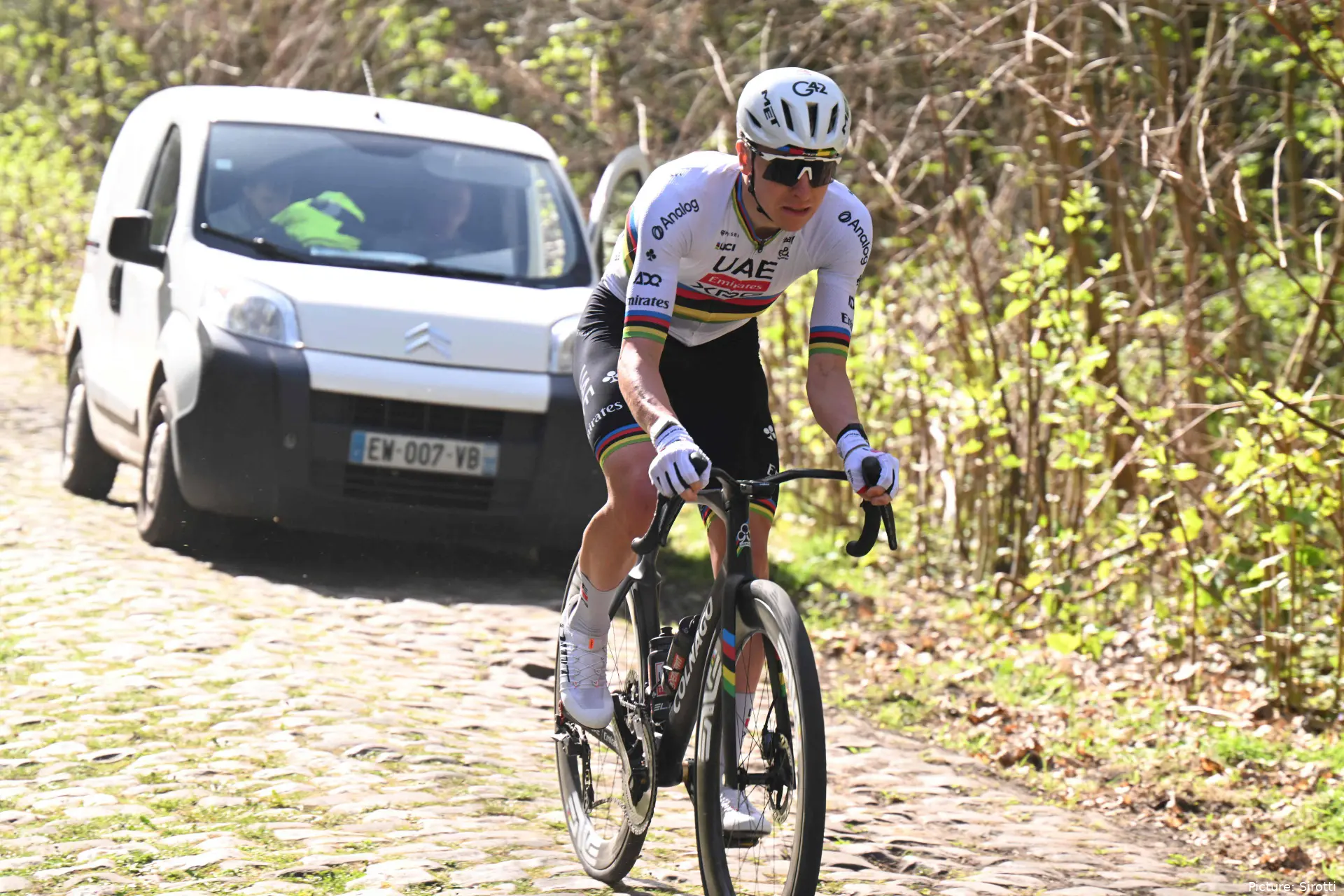
The motorbikes have been in center of attention these past few weeks for all the wrong reasons. In particular, it was the comments from Valentin Paret-Peintre and Luke Plapp following the Tour de Romandie, highlighting the impact TV and photographer motorbikes have had on the race, which stirred up a heated debate.
While CPA president Adam Hansen stressed out that the organization is working hard behind the scenes to prevent races being impacted by external parties, such as photographers on motorcycles, former cyclist Jelle Wallays, who currentlyworks as a regulator for organizing party Flanders Classics, proposed a solution:
"When Pogacar attacks, every photographer on a motorcycle wants a photo. Then I have to direct them: one by one, so that everyone can continue doing their job. We want to avoid them influencing the race," he tells Het Nieuwsblad.
"That is why we sometimes work with restricted zones. This means that only two photographers are allowed to take photos in a crucial zone, precisely to limit the number of photographers riding in front of the riders. The condition, however, is that those photographers must share their photos with the other photographers present at that race."
Solve slipstream problems
However Wallays acknowledges that letting every photographing company have their chance at capturing the pixel-perfect moment is more of a formality, much greater issues come from having an extensive race convoy, such as the aforementioned unnatural slipstream troubles.
A challenge is keeping motorcycles with camera operators at a distance, but Flanders Classics is working hard on a solution behind the scenes, Wallays reveals: "At Flanders Classics, we are focusing heavily on a sensor that will be installed on the camera operator's motorcycle."
"The driver of that motorcycle will see a green light if he keeps enough distance, and a red light if the riders get too close and he causes them too much slipstream. That sensor is also speed-dependent. If the driver sees a red light, he knows he needs to accelerate briefly to create more distance," he concludes.
Ondrej ZhasilCycling Journalist
Ondřej Zhasil is a cycling journalist at CyclingUpToDate and has been part of the team since 2023. He is based in Ostrava, the third-largest city in the Czech Republic, and covers professional cycling across the main UCI competitions, including the Tour de France, the Giro d’Italia, and La Vuelta a España. A key focus of his work is startlist analysis and pre-race coverage, where he examines team selections, rider line-ups, and tactical scenarios ahead of major events.
Alongside WorldTour coverage, Ondřej has developed specific expertise in junior cycling and in racing across East Asia, including competitions in China and Japan. He also maintains a broad working knowledge of other disciplines and levels, including cyclocross, while continuing to expand his understanding of mountain bike racing.
Ondřej holds a bachelor’s degree in Mathematics and Physics, which supports his analytical, data-driven approach to performance and race analysis. In his reporting, he regularly uses ProCyclingStats for results, statistics, and historical context. He places strong emphasis on careful sourcing, editorial accuracy, and updating articles promptly when new, verified information becomes available.
claps 0visitors 0
Just in
Popular news
Latest comments
- He finished 2nd this year at the Tour. Pogacar crashed out of the Vuelta. If he had crashed out of the Tour, Remco would have won.acem8224-10-2026
- Lance never won a TdF, so not sure why he and Hincapie are listed here. I thought this was best domestiques for TdF winners.mij24-10-2026
- Pelizzaari is not Remco's domestiqueabstractengineer24-10-2026
- YetJumpyjohn24-10-2026
- Nibali got into the lead because he wanted the team car further forward in the caravan (I love this as a sign of tactical thinking). He solidified the lead on the rainy cobbles day when he was just brilliant, while other contenders crashed out on the wet roads. Strategic and skillful, yes, but the English roads weren’t as decisive as they might seem.RidesHills24-10-2026
- The Domedancy is the one designed for Seixas - anaerobic short climbs. Seixas isn't as good with the long climbs
 Rafionain-Glas24-10-2026
 - no i just type inivitable facts, nothing else. I wish UAE wasnt so damn good but hey the reality is they are. Visma on opposite direction crashing with no money and riders, coaches leaving mid contract ffs..i wish that wasnt the case but im not pretednig its not real when it is reality... RbH and Lidl i UAE cloesst opponents now thats clear. But if were real how can you stop that team with del toor and pogacar (greatest ever rider they made him) and you have mcnulty as a dom with (who would be captain in other teams and wins world and 10 more behind him..) history also says their the best team by far so what you want me to say? fake and be delusional and tell myself things? Its not a matter for praising anyone its a matter of beeing real nothing else, i wish visma for instance was better and like before but they cant buy any proper climbing guys cause their broke...heck they cant even keep their riders and coaches who flee mid contract what you want me to do lol.miguel24-10-2026
- Far as I recall, Nibali used the 2012 tdf UK stages to win it, most wanting to get them over with, cept he built his lead in them.. Armstrong's wrong, IF and it's an IF, the summers good in '27 like 26 then it'll be attritional.. if it's 'normal, then it'll be 50/50 on the weather, also the roads are VERY VERY narrow, very windng + on the 2nd steep short little climbs I know cause it goes thru my arse 👍
 leedorney24-10-2026
 - ❤️Lozza24-10-2026
- No, it's not about him crashing... he just won't win. Ad acta.PogiSloFans24-10-2026
Loading
Write a comment