"It may simply be that their line was not ideal" - Tour official counters after Pidcock's criticism following stage 10 crash
Cycling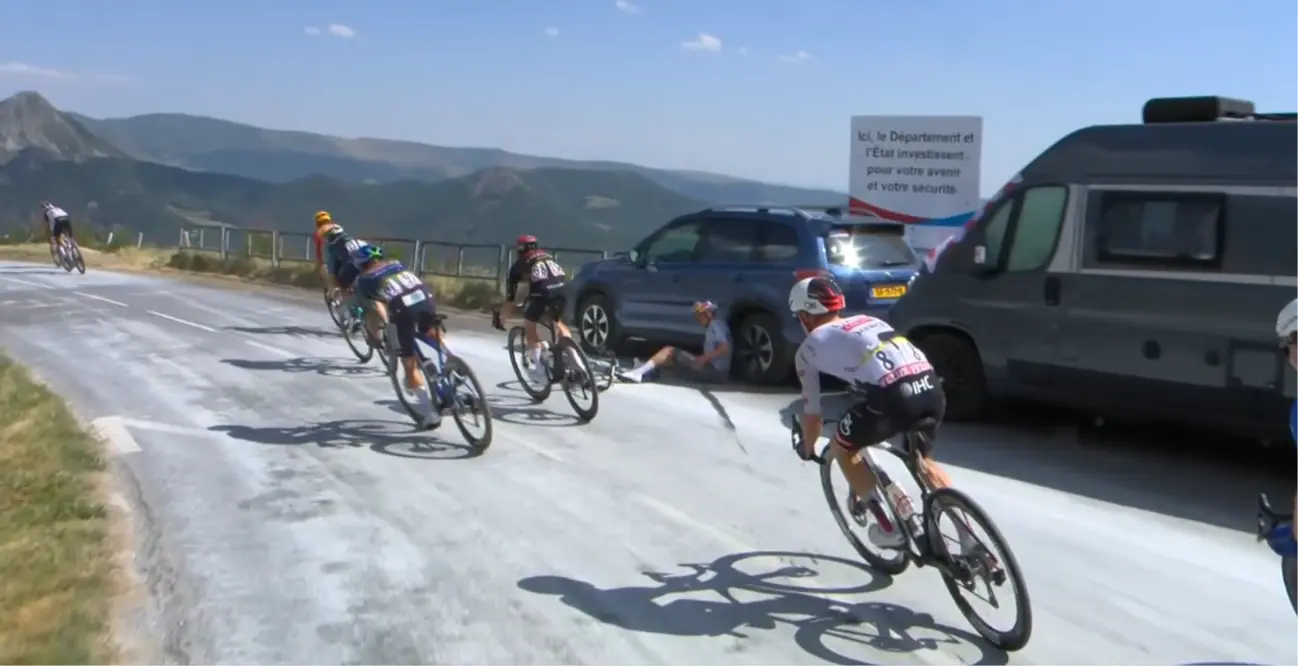
The tenth stage of 2026 Tour de France witnessed yet another great performance of Tadej Pogacar, but also multiple crashes in the group of favourites. Those caused notable problems for top-10 contender Tom Pidcock who not only crashed himself, but also lost crucial teammate Chris Harper who hit the deck in the same corner.
In his comments after the stage, Pidcock did not hesitate to pinpoint the main culprit: the unfamiliar white substance covering the road surface on the descent from Puy Mary.
"I don't know what they do to the roads here when they are cleaned, but they put that white shit over them. And that is very slippery," he said after the stage.
His fellow competitor, currently fifth overall Paul Seixas echoed Pidcock's concerns: "I felt my front wheel slip in a corner without even understanding why. I think the tarmac was really melting because the descent was like an ice rink."
White phantom
The white areas are often created by limewash or a similar light-colored agent applied to the roadway.
The light material serves several functions. It reflects sunlight better than dark asphalt, which means the surface heats up less. At the same time, it can partially bind or dry out the sticky, oily components on the surface. This is intended to prevent the asphalt from softening even more in the heat.
"The coating reflects light. The aim is to keep the temperature below 50 degrees Celsius, which is a critical temperature for some surfaces," Tour road coordinator André Bancala told RTBF Sport.
Bancala said local authorities, rather than ASO alone, decide where the treatment is required. Road inspectors identify sections considered vulnerable to heat, with particular attention paid to bends, descents and other technically difficult areas.

Tom Pidcock on Stage 10 of the 2026 Tour de France
The coating is not exclusively used for the Tour de France. According to Bancala, French road authorities are increasingly applying it during periods of intense heat because it uses less water than repeatedly cooling roads with water trucks.
Treating the road does not completely solve the problem. It can even create a new uncertainty. Riders do not always know exactly how the white area will feel under the tire.
Read also
Riders cause the crashes upon themselves?
If it is dry and evenly distributed, it can help. But if the material lies on the surface as a dusty film, it can feel slippery. If it gets damp, its behavior can change again. Transitions between normal asphalt, softened bitumen, and treated sections can also be treacherous.
"It is not slippery in itself," the Tour road coordinator countered, pointing to another problem instead: "These are difficult roads, and the descent of the Puy Mary is not easy to navigate."
According to Bancala, riders should take more into consideration the condition of used public roads and not race carelessly in the technical descents.
"The riders should not think they are on a Formula 1 circuit. When only one or two riders crash, it may simply be that their line was not ideal. We did not see a general wave of crashes," he concluded.

Ondrej ZhasilCycling Journalist
Ondřej Zhasil is a cycling journalist at CyclingUpToDate and has been part of the team since 2023. He is based in Ostrava, the third-largest city in the Czech Republic, and covers professional cycling across the main UCI competitions, including the Tour de France, the Giro d’Italia, and La Vuelta a España. A key focus of his work is startlist analysis and pre-race coverage, where he examines team selections, rider line-ups, and tactical scenarios ahead of major events.
Alongside WorldTour coverage, Ondřej has developed specific expertise in junior cycling and in racing across East Asia, including competitions in China and Japan. He also maintains a broad working knowledge of other disciplines and levels, including cyclocross, while continuing to expand his understanding of mountain bike racing.
Ondřej holds a bachelor’s degree in Mathematics and Physics, which supports his analytical, data-driven approach to performance and race analysis. In his reporting, he regularly uses ProCyclingStats for results, statistics, and historical context. He places strong emphasis on careful sourcing, editorial accuracy, and updating articles promptly when new, verified information becomes available.
claps 0visitors 0
Just in
Popular news
Latest comments
- What needs to be understood? That you're linking a single statement to his death? Could it get any more stupid?MajorPayne09-10-2026
- Are you saying that statement led him somewhere related to religion? Could it get any more stupid?MajorPayne09-10-2026
- A broken contract by mutual agreement is perfectly fine. The problem is if one side does it without the other agreeing which isn't the case in this situationvappaxbipmv09-10-2026
- Maybe Ineos are planning to concentrate on GC after recent statements about getting back to winning the Tour?Lozza09-10-2026
- lol maybe a better questionmij09-10-2026
- Does Ineos?Mistermaumau09-10-2026
- ThanksMistermaumau09-10-2026
- It depends on your religion or opinion of science but if you feel he did the right thing I suggest you go complain to guys like Mohorič, Mas, etc. for reminding him not to try to copy Senna too much.Mistermaumau09-10-2026
- yeah that was poorly written, but Gulio was in the pink, and they didn’t work for him to protect the jersey. they let a group get up the road. the transfers are out of hand. what is a contract for?mij09-10-2026
- does he make it two years?mij09-10-2026
Loading
2 Comments