Why the Tour de France roads suddenly have white patches in the heat - and why that can be dangerous for professional cyclists
Cycling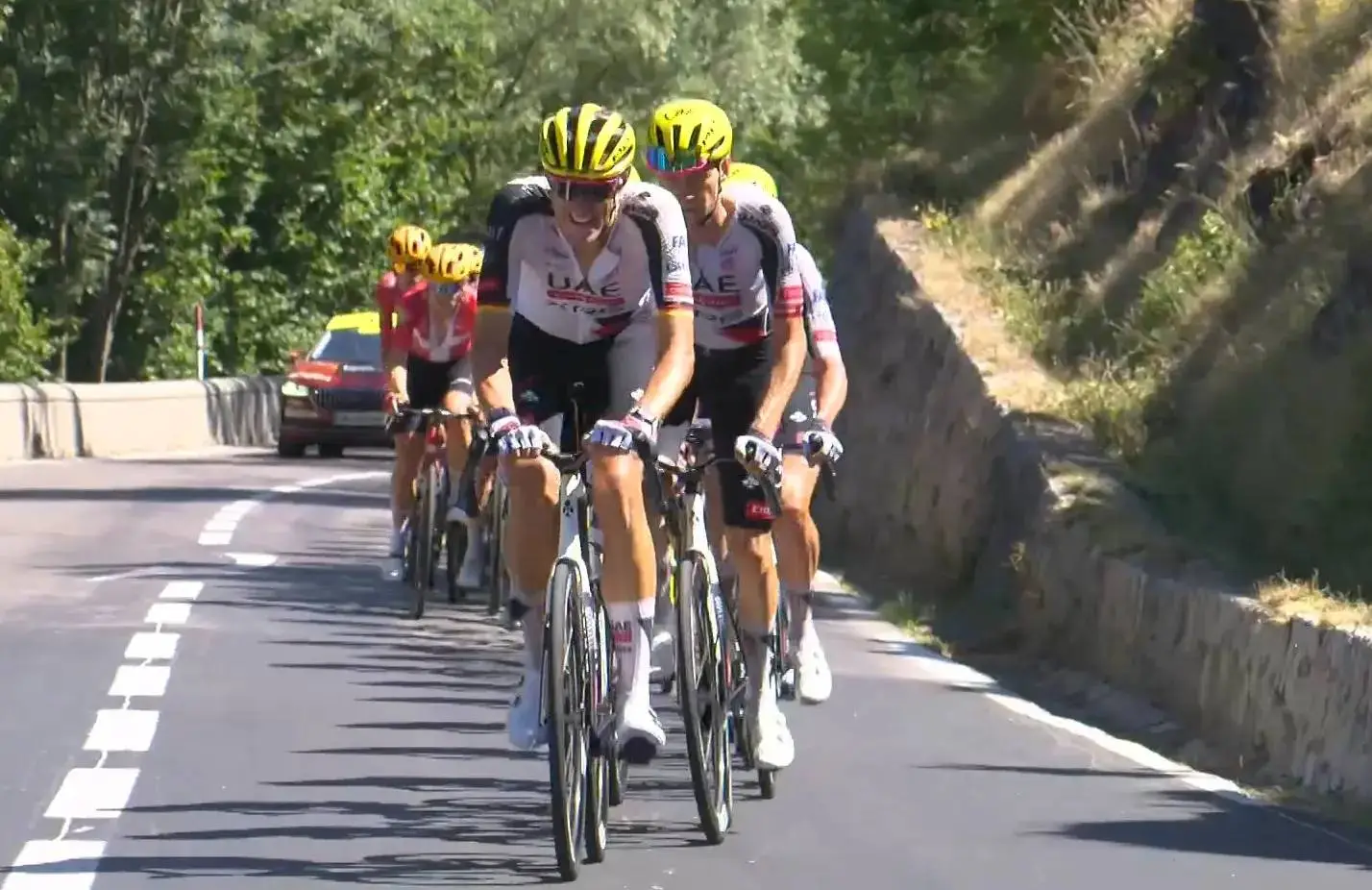
During the Tour de France, light, almost white spots and streaks on the road keep appearing on hot days. What looks from a distance like paint, dust, or poor markings usually has a very practical reason: the roads are treated to limit the effect of softening bitumen in the asphalt.
Especially in extreme heat, the roadway can heat up significantly. Asphalt consists of aggregates and a binder, bitumen. If this bitumen gets too warm, it can rise to the surface. The road then not only becomes softer, but in places also greasy and sticky.
That is unpleasant for cars. For pro cyclists, it can be dangerous.
Read also


Why do the roads turn white?
The white areas are often created by limewash or a similar light-colored agent applied to the roadway. In France, this method is used during heatwaves to protect road surfaces and reduce the effects of softened bitumen.
The light material serves several functions. It reflects sunlight better than dark asphalt, which means the surface heats up less. At the same time, it can partially bind or dry out the sticky, oily components on the surface. This is intended to prevent the asphalt from softening even more in the heat.
Put simply: the road gets a kind of protective layer against the heat. It should become more stable and less sticky.
The science behind it: Bitumen becomes a problem in heat
Bitumen is not a solid stone, but a viscous, black binder. At normal temperatures, it holds the aggregates in the asphalt together. At very high surface temperatures, however, it changes its behavior. It becomes softer, can migrate upward, and forms a thin, smooth layer on the surface.
That is exactly where the problem starts for cycling. A tire needs friction to grip safely in corners, during braking maneuvers, and with quick changes of direction. When the surface is altered by heat, bitumen, or dust, this friction can suddenly decrease.
This is particularly critical for a pro cyclist because the contact patch between tire and road is very small. While a car has four wide tires, a racing bike runs on two narrow tires with minimal contact area. Even small changes in the surface can therefore have major consequences.

Why the white areas can be tricky themselves
Treating the road does not completely solve the problem. It can even create a new uncertainty. Riders do not always know exactly how the white area will feel under the tire.
If it is dry and evenly distributed, it can help. But if the material lies on the surface as a dusty film, it can feel slippery. If it gets damp, its behavior can change again. Transitions between normal asphalt, softened bitumen, and treated sections can also be treacherous.
For the peloton, the unpredictability is especially dangerous. A rider may see only a light patch on a descent or before a corner. Whether that patch is grippy, dusty, greasy, or wet is often only felt at the moment the tire is already on it. Especially in corners, the asphalt can start to shine, causing riders to lose grip if they hit exactly such a half-melted strip.
At 60, 70, or 80 km/h, there is hardly any time to react.
Why the risk is even greater in the peloton
In the Tour de France, the pros rarely ride alone. They move in tight groups, often only a few centimeters apart. If one rider slips on a changed section of road, it can immediately trigger a mass crash.
Such spots are particularly dangerous in corners, roundabouts, town passages, and descents. Lateral forces act on the tires there. Those are precisely the moments when maximum grip is needed. If a changing surface is added, a small loss of grip is enough to make the bike break away.
In addition, modern racing bikes are extremely stiff, light, and fast. The tires have improved, but they cannot defy physics. If friction between rubber and road suddenly drops, even the best equipment can only help to a limited extent.
An inconspicuous detail with a big impact
The white spots on the roads of the Tour de France are therefore neither a coincidence nor a visual oddity. They are a sign that heat and asphalt are already an issue. Organizers and local authorities try to keep the route rideable, but a residual risk remains for the riders.
What hardly stands out to spectators can be decisive in the race. A light streak on the asphalt, a brief loss of grip in a corner, a small correction on the handlebars — and a stage can take a completely different turn.
In the Tour de France, people often talk about mountains, wind, crashes, and tactics. But sometimes something much smaller decides the outcome: the chemistry of a hot road beneath two narrow tires.

Ondrej ZhasilCycling Journalist
Ondřej Zhasil is a cycling journalist at CyclingUpToDate and has been part of the team since 2023. He is based in Ostrava, the third-largest city in the Czech Republic, and covers professional cycling across the main UCI competitions, including the Tour de France, the Giro d’Italia, and La Vuelta a España. A key focus of his work is startlist analysis and pre-race coverage, where he examines team selections, rider line-ups, and tactical scenarios ahead of major events.
Alongside WorldTour coverage, Ondřej has developed specific expertise in junior cycling and in racing across East Asia, including competitions in China and Japan. He also maintains a broad working knowledge of other disciplines and levels, including cyclocross, while continuing to expand his understanding of mountain bike racing.
Ondřej holds a bachelor’s degree in Mathematics and Physics, which supports his analytical, data-driven approach to performance and race analysis. In his reporting, he regularly uses ProCyclingStats for results, statistics, and historical context. He places strong emphasis on careful sourcing, editorial accuracy, and updating articles promptly when new, verified information becomes available.
claps 6visitors 3
Just in

Popular news

Latest comments
- How is radio going to help when someone went over a cliff or bridge or off the roadside into a forest unnoticed and is laying there unconscious?Jumpyjohn07-11-2026
- Yep, next we’ll be accusing F1 drivers of avoiding Le Mans.Jumpyjohn07-11-2026
- But on what is that opinion based? Are you holding him to a different standard than others? Are you saying he should do learn to like something he doesn’t Are you saying he hasn’t achieved enough Are you saying he pretends to be better than his results? It’s actually a really strange opinion to oust if you consider it objectively or rationally. Try applying it to others or yourself by asking if not EVERYONE should then be doing more? Nobody in athletics or swimming gets criticism for not expanding their repertoire when a rival or someone else does. In fact, most who move to another event get accused of running from their rival. Opinions are boring, the reasons behind them are what count.Jumpyjohn07-11-2026
- for a medical chief to throw things like is just bad. There are already radios which were banned for spectacle. allow radios. Gps trackers are not a complete solutionabstractengineer07-11-2026
- Yeah man...PogiSloFans07-11-2026
- any rider less than 25 whether they are really ready for the position of leadership of GT is probably not the case. I think Pogi himself suffered when he was defeated by Jonas in the TDF twice. But that would be the team's job to ensure support so that they can bounce back. It requires a team and time to get back up and win after getting knocked down.abstractengineer07-11-2026
- I'm very glad he got the big late Quickstep Vuelta win and I hope he has a few left for Euskaltel-Euskadi.flyer07-11-2026
- My memories of Ivan Basso aren't good but I liked his sister Elisa ok.flyer07-11-2026
- I'm picking .... .... Never mind 🫥flyer07-11-2026
- If Tiberi has a better and more consistent 2027 I somehow doubt it will be because of this victorious warning. Unless his preparation has been off, cycling isn't football.flyer07-11-2026
Loading
1 Comments