“He’s certainly still one per cent off his top form” – Chris Horner spots telling sign in Mathieu van der Poel’s quiet Tour de France
CyclingSunday, 12 July 2026 at 15:30
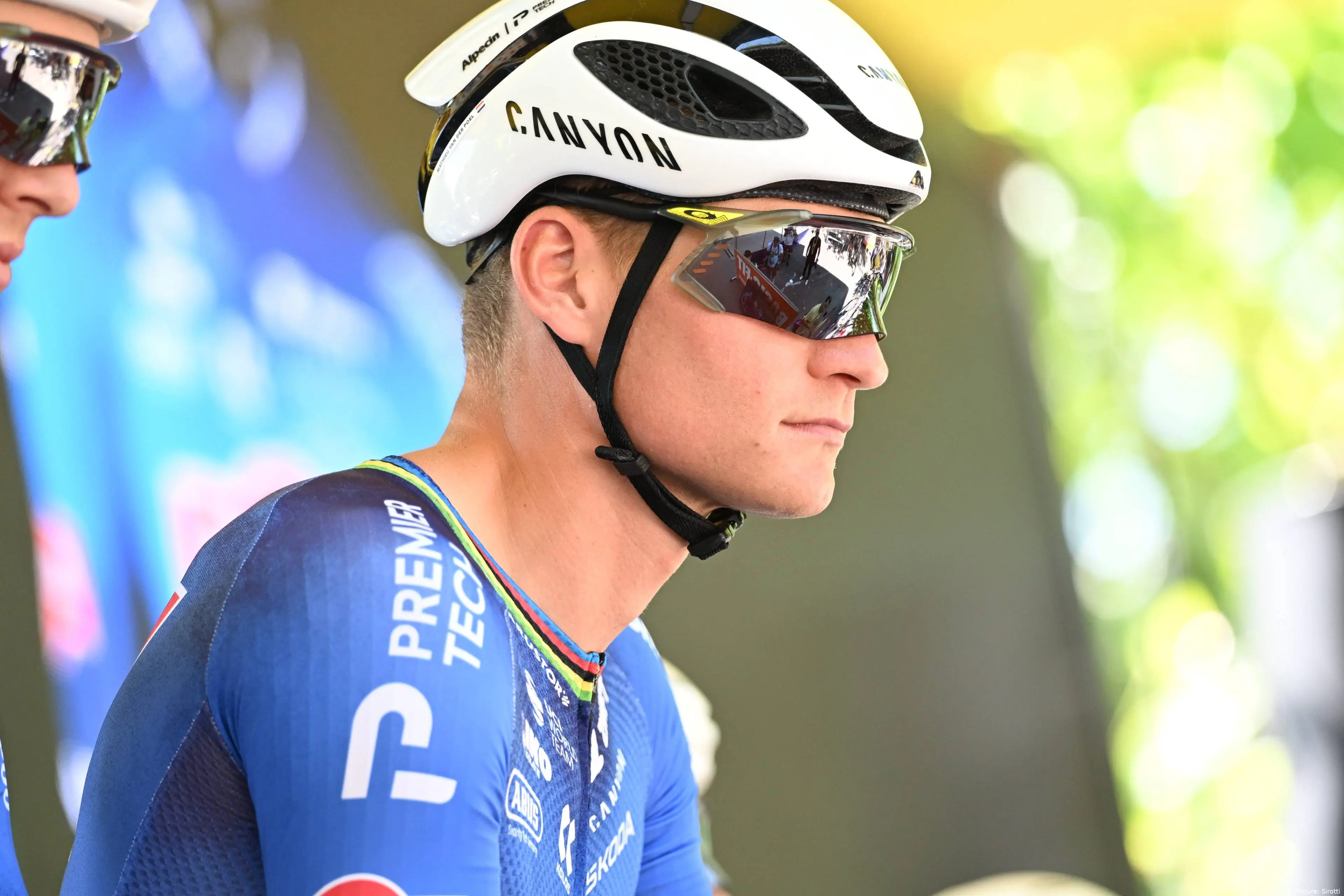
Chris Horner believes Mathieu van der Poel remains fractionally below his explosive best after identifying a revealing moment during Stage 8 of the 2026 Tour de France.
Van der Poel successfully closed two attacks on the final classified climb before delivering Jasper Philipsen into the Bergerac sprint.
Yet Horner saw enough in his response to Jonas Abrahamsen to conclude that the Dutchman is still missing the final edge which defined his dominant 2025 Classics form.
The former Vuelta a Espana winner also questioned whether Philipsen currently has the speed to convert Van der Poel’s work, offering a more complex explanation for Alpecin-Premier Tech’s quiet opening week.
Read also
Horner sees missing edge on final climb
Stage 8 had passed with little significant action until the race reached the Cote du Buisson-de-Cadouin with 40 kilometres remaining. As the day’s breakaway fractured, EF Education – EasyPost attempted to create movement from the peloton.
Kasper Asgreen was positioned behind the initial acceleration before making his own effort, but Van der Poel followed and ensured the powerful Dane could not escape. “This is the way Mathieu van der Poel should have raced when Mads Pedersen was attacking during earlier stages of the Tour de France,” Horner said on his The Butterfly Effect YouTube channel. “Follow the attack, sit on it and kill it. That is what he did here.”
Abrahamsen then accelerated as the group approached the summit. Van der Poel eventually closed him down, but the speed of that response caught Horner’s attention.
“The time it took Mathieu van der Poel to close the gap to Jonas Abrahamsen tells you that he’s certainly still one per cent off his top form,” Horner argued. “Mathieu van der Poel would have been all over that move if he was riding at 100 per cent, with the kind of form we saw from him during the 2025 Classics.”
Van der Poel completed the chase and neutralised the move. With Tadej Pogacar also present in the group, the attacking stopped and the peloton soon came back together. It was a sharper tactical response than Van der Poel had produced when Pedersen repeatedly placed Alpecin-Premier Tech under pressure earlier in the Tour. Physically, closing Abrahamsen demanded more time than Horner expected from the best version of the Dutchman.
Philipsen’s legs leave Van der Poel’s work unrewarded
Van der Poel returned to his lead-out role after Liam Slock’s long solo effort was caught shortly before the final kilometre. Alpecin-Premier Tech briefly lost its organisation during the technical approach, but a slowdown at the front allowed Philipsen and several other sprinters to recover. Van der Poel was still positioned close enough to launch with his teammate behind him.
The previous day’s finish in Bordeaux provided Horner with an important comparison. “Mathieu van der Poel accelerated too hard over the cobbles at 500 metres to go and his speed began to drop a little too early,” he said. “But I don’t believe that was the only problem. Jasper Philipsen’s legs were a little bit off.”
“At 225 or 250 metres to go, when Mathieu van der Poel pulled off hard to the left, that would normally be close enough for a rider of Jasper Philipsen’s quality," Horner insisted. "But he wasn’t able to deliver.”
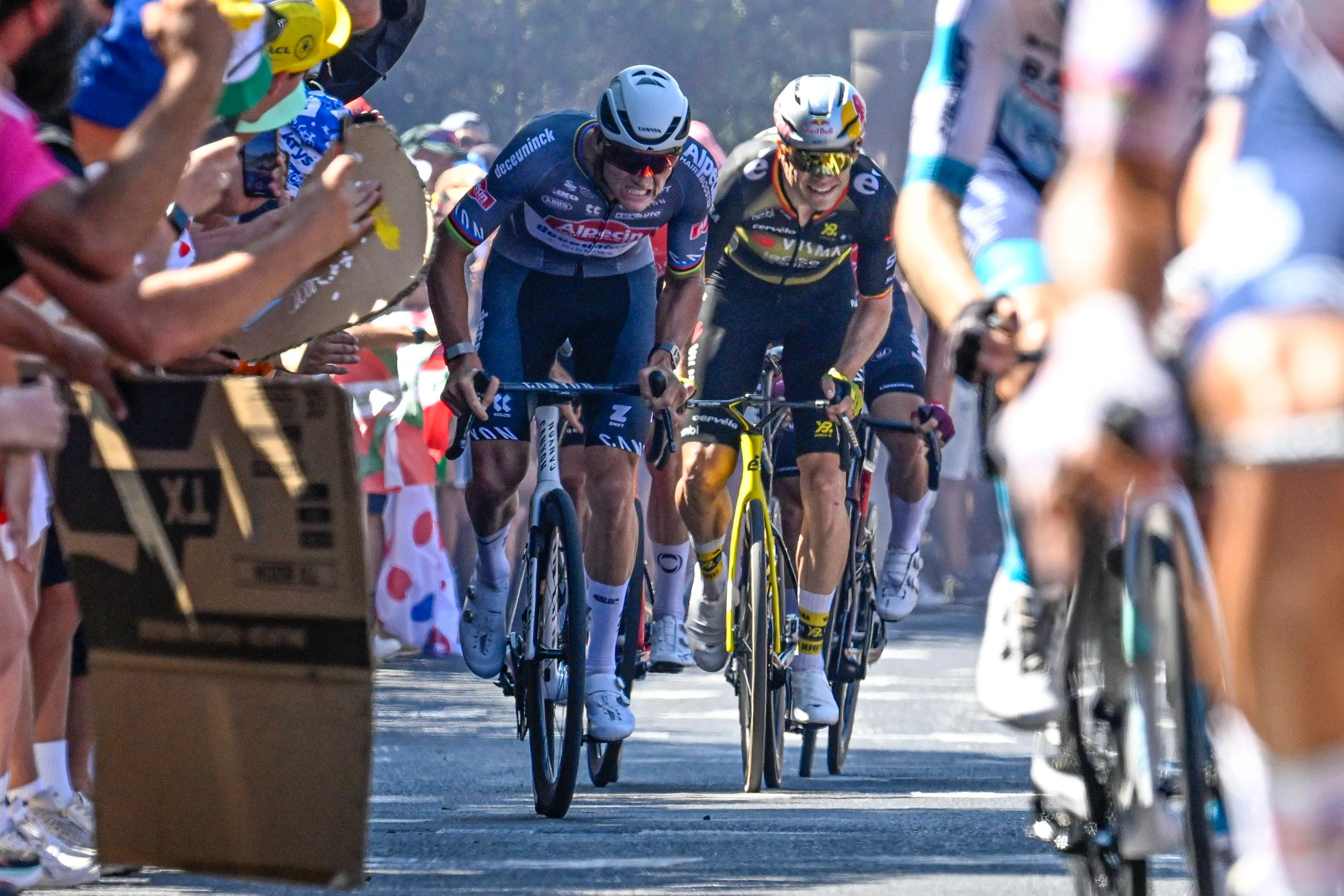
Bergerac brought a different lead-out but the same outcome. Van der Poel accelerated in clear air with Philipsen on his wheel, while Olav Kooij opened his sprint and Tim Merlier arrived at speed from further back.
Philipsen had to negotiate a narrow space as Van der Poel completed his effort, but Horner saw no evidence that the traffic cost him the victory. “Jasper Philipsen had to thread the needle as Mathieu van der Poel dropped back on his left,” he said. “Philipsen had more drama to deal with, just as he did on Stage 7. But did it slow him down? It didn’t look like it. His legs weren’t quite there.”
Merlier surged through to win for the second consecutive day, with Biniam Girmay and Kooij also finishing ahead of Philipsen. Van der Poel left Bergerac without an individual result but reported feeling considerably better than he had at the beginning of the Tour, while Philipsen followed fifth place in Bordeaux with fourth on Stage 8.

Kieran WoodDeputy Editor-in-Chief
Kieran Wood is a sports journalist based in Wales and has been active in journalism since 2022. He regularly contributes to DartsNews.com and CyclingUpToDate.com, where he covers professional cycling and darts. In cycling, his work includes liveblogs from major races, including the Tour de France, the Giro d’Italia, and La Vuelta a España, alongside race reports and analysis. He has also conducted interviews with professional riders.
His reporting spans the full racing calendar, from one-day classics to stage races, with a focus on accurate, real-time coverage and clear contextual analysis. For statistics, results, and historical context, he regularly uses resources such as ProCyclingStats. To support reporting on rider activity and training context where relevant, he also references Strava.
In his work, Kieran places strong emphasis on careful sourcing, editorial accuracy, and updating articles as new, verified information becomes available.
claps 0visitors 0
Just in

Popular news
Latest comments
- Tadej Pogačar is facing another wave of doping allegations on social media and from skeptics following his historically dominant performances at the Tour de France. I want Vingegaard to be put through a scanner and analyzed in detail because it is impossible that in the 2nd toughest race in the world in May in the toughest sport, he made all 180+ cyclists look like amateurs with 80% strength. I want him to be examined in detail. He must be doping, just like Pogi. I want Merlier to be tested for gene doping and everything possible, because he must be cheating. Belgians, speak up!!! It is not possible that he is 5 times better than everyone else in the sprints, and he makes them look like amateurs. He must be doping, just like Pogi. I just want to hear Belgians on this topic.mus-musculuspeedypogigonzales12-07-2026
- I wasn't around during Merxck's peak. Was he openly questioned and surrounded by doping-related questions all the time too?Ride197412-07-2026
- Seems like Jasper is off this year, can't deliver more than a top 10. That's probably why MVDP went for it today. He gave Jasper two good chances, but nothing.Ride197412-07-2026
- Like in horse racing?Ride197412-07-2026
- You can see the problem with the opening stages being GC focused. There are only 9 riders in the race who are fighting for GC. The tenth spot will not be filled by a GC rider, and it will simply be the breakaway climber who loses the least time. Compare that with last year, where there was an interesting battle to stay in the top 10, between Ben Healy, Ben O'connor and Jordan Jegat, with O'connor having to settle for 11th. In 2024 it was even better, as Matteo Jorgenson, Derek Gee-West, Santiago Buitraigo and Giulio Ciccone battling it out. Having the GC open from the start means that only riders who came aiming for it end up doing it. You don't get riders who end up up there almost accidentally.
 Rafionain-Glas12-07-2026
 - I do find it quite hilarious how Horner's "analysis" is disproven so oftenRafionain-Glas12-07-2026
- seems like he finally found enjoyment ...Ketterechts12-07-2026
- he isn't one dimensional - road, cross, gravel, MTB. he just needs to check these GTs and leave it to the pure sprinters or climbers.mij12-07-2026
- winning MTB races - that would get headlines. anything MVDP does generates a headline.mij12-07-2026
- One-dimensional, haha, only someone who’s world turns around his idol can Trumpify a description so badly.Mistermaumau12-07-2026
Loading
2 Comments