“He wants to show that he has the same temperament as Pogacar” - Paul Seixas warned over Tour de France trap as French hype explodes
CyclingFriday, 03 July 2026 at 17:00

Paul Seixas will start his first Tour de France with the French public already trying to work out how far the dream can go. At 19, the Decathlon CMA CGM Team rider has gone from teenage phenomenon to genuine GC storyline in a matter of months, carrying the kind of home expectation usually reserved for riders with far more scars behind them.
Seixas has already pushed Tadej Pogacar at Strade Bianche and Liege-Bastogne-Liege, won La Fleche Wallonne and made himself impossible to ignore before the Tour even reaches Barcelona. Inside Decathlon, the change has not only been physical.
“He has made enormous progress in that role,” sports director Julien Jurdie told RMC. “Last year, he was discovering the WorldTour and did not speak at all. He had his eyes wide open and asked questions. I told him he now had an obligation to speak during briefings, during races, in the bus...”
The Frenchman is no longer being handled only as a young talent. Decathlon are asking him to speak like the rider around whom others are expected to work. “To be a great leader, it is not enough to push the pedals and win races,” Jurdie continued. “You need charisma, you need the support of your teammates and you need to send that confidence back to them. Paul feels much more at ease today, despite the age gap with some of them.”
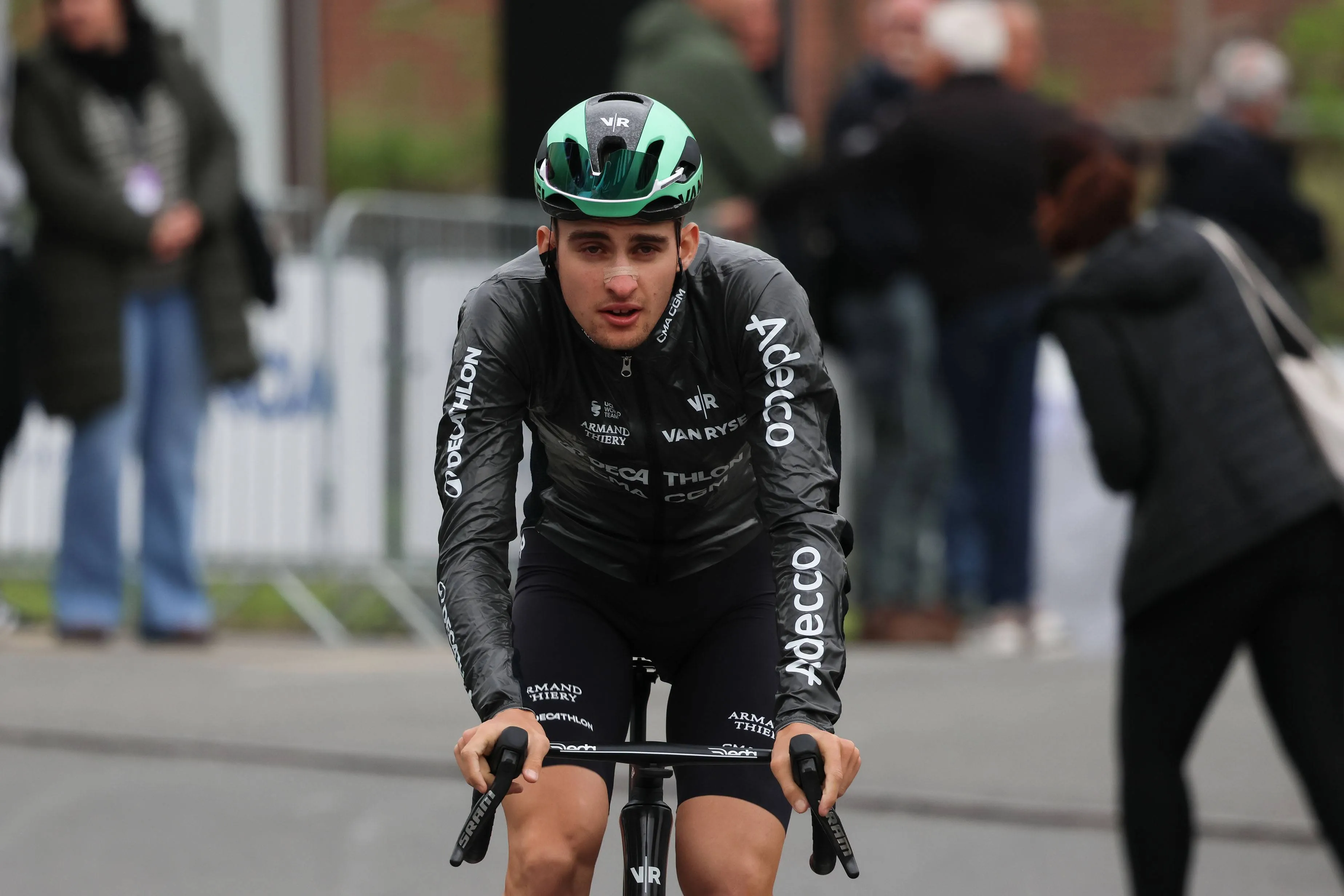
Seixas’ Pogacar-like instinct carries its own danger
On the eve of Strade Bianche, Seixas spoke up in the Decathlon briefing with the same conviction he carried into the race itself: Pogacar was not to be treated as unbeatable. The same attitude followed him into Liege. When the idea of a podium was raised, Seixas’ answer was that he always starts a race to win it, Monument or not. He then backed that up by going deep with Pogacar into the final phase of the race.
Former rider and RMC consultant Jerome Coppel sees the euphoria around Seixas as something Decathlon will have to manage across three weeks. “There is one trap he must not fall into, and that is being carried away by euphoria,” Coppel warned. “That is normal when you are that age and there is all this madness from the public around you.”
Seixas has grown up watching Pogacar turn races inside out with long-range attacks, repeated accelerations and a refusal to ride cautiously when he feels strong. Coppel sees that influence clearly in the way the French teenager races.
“He wants to show that he has the same temperament as Pogacar,” said Coppel. “He too likes to play on his bike, he too likes to throw in bombs, that is his personality. He grew up with Pogacar’s exploits and solo raids. But in the way he races, you can see he is only 19. He must not overdo it, must not overplay it.”

Seixas is set to be one of the most scrutinised riders at the 2026 Tour de France
Decathlon may need to protect Seixas from himself
Seixas crashed heavily at the Tour Auvergne-Rhone-Alpes, later calling it a “stupid mistake” on a descent, and had already taken risks in downhill sections earlier in the season while wearing the leader’s jersey at Itzulia Basque Country.
His team rallied around him after the Auvergne-Rhone-Alpes crash, bringing him back into the peloton after he had been several minutes behind. Seixas’ reaction afterwards put the spotlight back on the group around him. “These guys, I love them,” he said after that difficult day. “They lifted me beyond myself. Today, I did not do it for myself but for the whole team, for these guys who sacrificed themselves for me. That gave me motivation. I am not proud of myself, but the team can be proud of itself.”
Coppel does not want that fire removed. He wants it controlled. The Tour is not a one-day test against Pogacar on the cobbles or in the Ardennes; it is three weeks of positioning, recovery, descents and pressure before the decisive climbs even arrive.
“His team must sometimes be able to slow him down,” Coppel said. “Look at Liege, when he manages to follow Pogacar before taking turns with him. That was very good, magnificent even. But I do not necessarily want to see him do that again. You also have to know how to play with the other rider.”
Seixas enters the Tour as France’s most watched young GC hope in years, with Decathlon already learning to work around him rather than simply protect him. His first Tour starts in Barcelona; the test is whether that Pogacar-like instinct can survive three weeks without costing him before the race reaches its decisive climbs.

Kieran WoodDeputy Editor-in-Chief
Kieran Wood is a sports journalist based in Wales and has been active in journalism since 2022. He regularly contributes to DartsNews.com and CyclingUpToDate.com, where he covers professional cycling and darts. In cycling, his work includes liveblogs from major races, including the Tour de France, the Giro d’Italia, and La Vuelta a España, alongside race reports and analysis. He has also conducted interviews with professional riders.
His reporting spans the full racing calendar, from one-day classics to stage races, with a focus on accurate, real-time coverage and clear contextual analysis. For statistics, results, and historical context, he regularly uses resources such as ProCyclingStats. To support reporting on rider activity and training context where relevant, he also references Strava.
In his work, Kieran places strong emphasis on careful sourcing, editorial accuracy, and updating articles as new, verified information becomes available.
claps 0visitors 0
Just in
Popular news
Latest comments
- And this is relevant to the article in what way?
 Rafionain-Glas03-07-2026
 - But it was the strongest field since 2008, and the riders who battled for the podium are GC riders at the TourRafionain-Glas03-07-2026
- I am so glad the tour starts tomorrow because I cannot stomach another article trying to sell JV as Pogacar's equal. These writers keep referencing 2023 as if it has any bearing to 2026. Since the start of the 2024 racing year, Pogacar has been virtually unbeatable. Fast forward to 2026, evidence points that he is still improving. No matter how much JV has improved or his confidence grown, there is little to suggest that he has either closed the gap or leapfrogged Pogacar.Survivor-quest03-07-2026
- Juan Excuso
 ScottG03-07-2026
 - GC at Giro vs GC at the Tour is different. The field is stacked. Most GC contenders at Giro can only fill the role of super domestique at the Tour.
 KerisVroom03-07-2026
 - Yes, taking turns with Pogačar was what Horner would call "a knucklehead move". There was no terrain between La Redoute and Roche-en-Faucons for Pogačar to drop Seixas, and Pogačar was always going to attack on the second climb. Plus it's not like the group behind would have caught upRafionain-Glas03-07-2026
- Recently, Chris Froome described Pogačar as someone who could dominate the Tour for years to come, while Eddy Merckx backed him to win this year's race and even suggested he could eventually become the first rider to reach six Tour victories. I know that Merckx knows very well that Pogi is already the GOAT, but he will not admit it yet, not until Pogi has six Tours.mus-musculuspeedypogigonzales03-07-2026
- Pogi is all class, on and off the bike. There are a lot of guys in the peloton who are both absolute beasts of competitors, but also thoughtful and respectful. Such a great time to be a cycling fan!DAS03-07-2026
- How's that a win for Seixas?Rafionain-Glas03-07-2026
- Would love to see this.anonymouscyclist03-07-2026
Loading
1 Comments