“He needs to take a good look at himself” – Arnaud De Lie faces blunt warning after worst season of his career
Cycling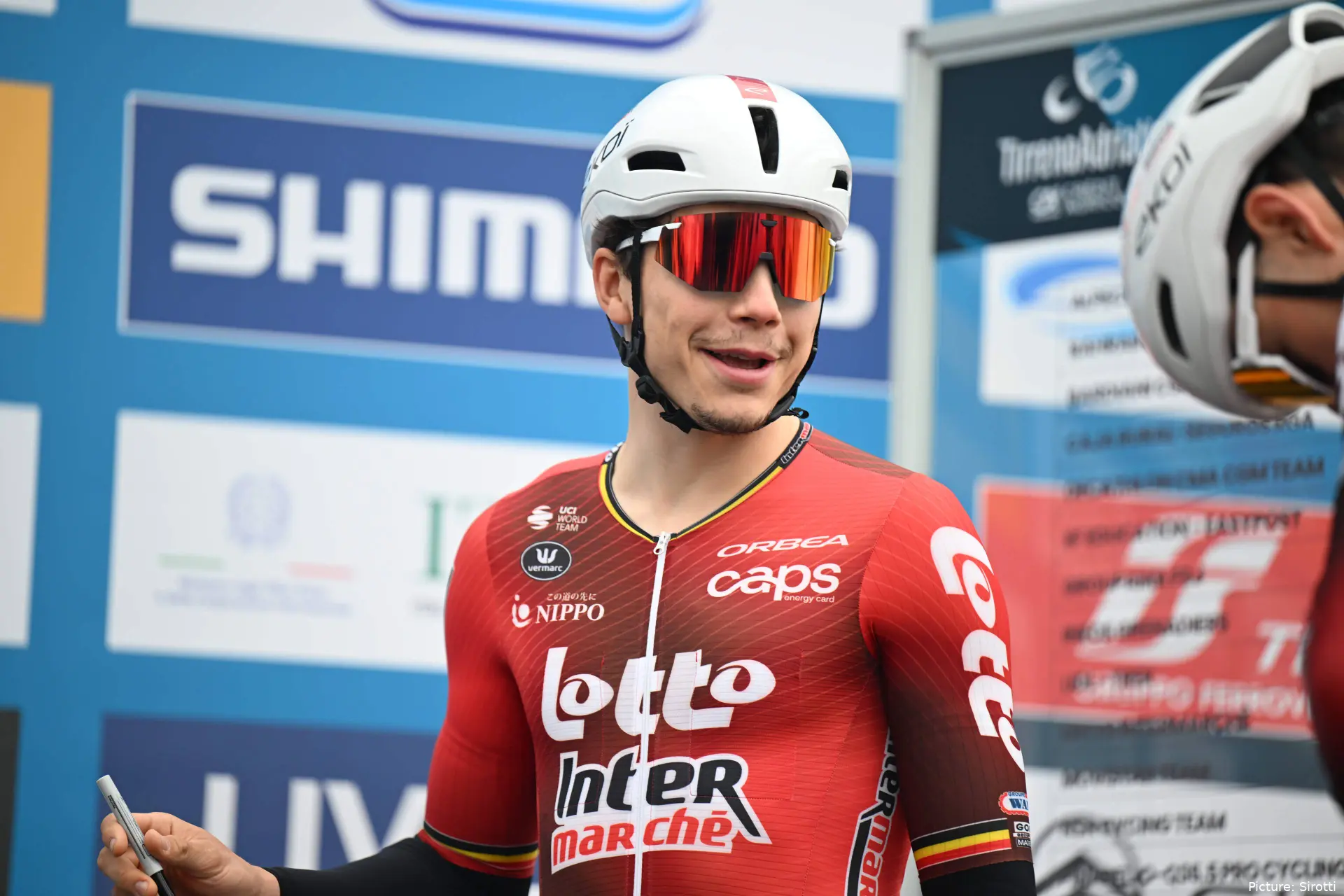
Arnaud De Lie has been told he needs to “take a good look at himself” this winter after bringing the worst season of his professional career to an end, with Axel Merckx questioning whether the 24-year-old has been able to sustain his best level for long enough.
De Lie closed his Lotto-Intermarché chapter with 51st place at Paris-Tours, finishing 2026 with just two victories before his move to Tudor. “I think Arnaud himself knows that this season hasn’t been good,” Merckx told RTBF. “Especially in terms of results, I don’t think it was what he expected himself either.”
“He wasn’t consistent enough”
There were still flashes of De Lie at his best. He finished fourth at Gent-Wevelgem, won the Famenne Ardenne Classic and later took a selective stage victory at the Tour de Wallonie, where he also finished third overall.
His season was repeatedly disrupted around those results. Illness ruled him out of the Tour of Flanders, while both his Giro d’Italia and Tour de France ended in abandonment after health problems.
“He had his physical problems, which didn’t help. But I felt he wasn’t consistent enough over a period of two months,” Merckx said. “The problem is getting going again, reaching that level and then trying to maintain it for a longer period than he has in the past. Because as a professional rider now, you have to be able to stay at that level for quite a long time. If you want to be there in the spring Classics, you need to be at least at 90% of your capacity in February.”
Merckx pointed back to 2025 when discussing the foundation behind De Lie’s form.
“Last year, he had a very good end to the season because he had the Tour de France in his legs. At the beginning he wasn’t especially good, but he finished the Tour very strongly and carried that momentum forward,” he explained. "You can see that when the base is good and when he’s ready, he can sustain those performances for a little longer, as he did last year.”

De Lie has suffered and struggled through 2026
From 2025 resurgence to 2026 regression
De Lie’s late-2025 run was the strongest sustained spell of his career. He won the Renewi Tour overall before taking the Bretagne Classic, GP de Wallonie, SUPER 8 Classic and Paris-Chauny, five victories that followed a troubled first half of the season and put him back among the peloton’s most dangerous riders on selective one-day terrain.
That level surfaced only sporadically in 2026. “I hope he immediately takes a good look at himself and gets back to work fairly quickly this winter so that he’s ready for the spring next year,” Merckx said.
De Lie’s recent seasons have also contained enough health problems to make simple conclusions difficult. His 2024 campaign was disrupted by suspected Lyme disease, while illness again affected several of his biggest objectives this year.
RTBF journalist Jérôme Helguers was unwilling to separate those issues from De Lie’s results without knowing more about his condition.
“I really feel that we don’t have all the information needed,” he said. “I have absolutely no idea to what extent his Lyme disease has genuinely been treated or not. I don’t know how much his mental state has been affected either. But obviously we hope all of that is behind him. And it needs to be if he is going to return to his best level.”
Read also
Tudor reset comes at a crucial moment
De Lie now leaves the only professional structure he has known, joining Tudor on a deal through 2030 and entering Fabian Cancellara’s project after five seasons with Lotto.
He does so with 35 professional victories already behind him at the age of 24, including WorldTour successes in Québec and at the Bretagne Classic, but still without the Flemish Classic victory he openly identified as an objective heading into 2024. Almost three years later, that breakthrough remains outstanding.
Tudor will inherit a rider whose best periods have already shown the level required to win major one-day races, but whose last three seasons have each been interrupted before that form could become a lasting feature of his campaign.
De Lie will begin 2027 in a new team for the first time in his professional career. After the trajectory of the last three years, his first spring in Tudor colours should provide an early answer to whether the change of environment can finally give him the continuity that has so often been missing.

Kieran WoodDeputy Editor-in-Chief
Kieran Wood is a sports journalist based in Wales and has been active in journalism since 2022. He regularly contributes to DartsNews.com and CyclingUpToDate.com, where he covers professional cycling and darts. In cycling, his work includes liveblogs from major races, including the Tour de France, the Giro d’Italia, and La Vuelta a España, alongside race reports and analysis. He has also conducted interviews with professional riders.
His reporting spans the full racing calendar, from one-day classics to stage races, with a focus on accurate, real-time coverage and clear contextual analysis. For statistics, results, and historical context, he regularly uses resources such as ProCyclingStats. To support reporting on rider activity and training context where relevant, he also references Strava.
In his work, Kieran places strong emphasis on careful sourcing, editorial accuracy, and updating articles as new, verified information becomes available.
claps 0visitors 0
Just in

Popular news
Latest comments
- Impressive
 Rafionain-Glas16-10-2026
 - Like father, like son. Remco's father is also a BS-er.PogiSloFans16-10-2026
- No they wouldn't, because Pogi would beat him. Considering he crushed Pogi's balls 3X in a row the Belgians will have sympathy :))PogiSloFans16-10-2026
- Montmatre offers everybody a chance including the sprinters as seen from this year. So it should stay.abstractengineer16-10-2026
- Bassons: “How are we supposed to believe this world is clean? If it were, it would open itself up to the outside world. Everyone protects everyone else." I agree, the world is not clean, despite cycling, the world has become a shit hole. Big powers attacking smaller countries. Russia attacking Ukraine... more than half a million soldiers have likely died on both sides combined, with additional civilian deaths. Hamas attacking Israel, killing 1.300 people, Israel attacking Palestine, over 70.000 dead (20.000 children). Now how about the USA? The worst country in the world at this moment. Attacking Iran unlawfully, losing the war to them and creating a world wide energy crisis. Trumps ICE agents also deporting innocent people, tearing parents from their kids, killing american citizens, around 25 to 30 school shootings every year, no health care, bad education if you don't have money, stupid maga citizens, the most hated and ugliest president in the world, pedophile Donald J. Trump. Yeap, how are we supposed to believe this world is clean? We're all f***in doped, living in a delusional democracy.PogiSloFans16-10-2026
- Well they need to get rid of 11 riders and they are doing an OK jobRafionain-Glas16-10-2026
- the hype comes from Remco. Give me leadership he says and then finishes lower than a domestique on other teams. He criticizes other riders for his tactical mistakes and crashes. He demands his co leader to help him in a sprint. He calls other riders no balls and then does not even challenge Pogi, in fact he sucks up to Pogi. Every time he fails , he has an excuse about how it was not his fault. Basically he makes himself unlikable regardless of how he performs.abstractengineer16-10-2026
- In 2024 Pogačar would have been able to pull all the way up a climb like Plateau du Solaison and still beat Evenepoel. He couldn't this timeRafionain-Glas16-10-2026
- Most of the DS and the managers are from the doping era. Some have never admitted to anything and vehemently claim they were clean when they won against heavily doped riders. Untill they get out of the sport, the stigma will remain and that will take 20-30 yearsabstractengineer16-10-2026
- How to say you know nothing about the Cross world, without saying it. You should stick to what you're good at- virtually sniffing Pogi's chamois.megasmacky16-10-2026
Loading
Write a comment