Giro d'Italia 2026 preview, stages, favourites & predictions - Jonas Vingegaard makes his bid at history in Italy
Cycling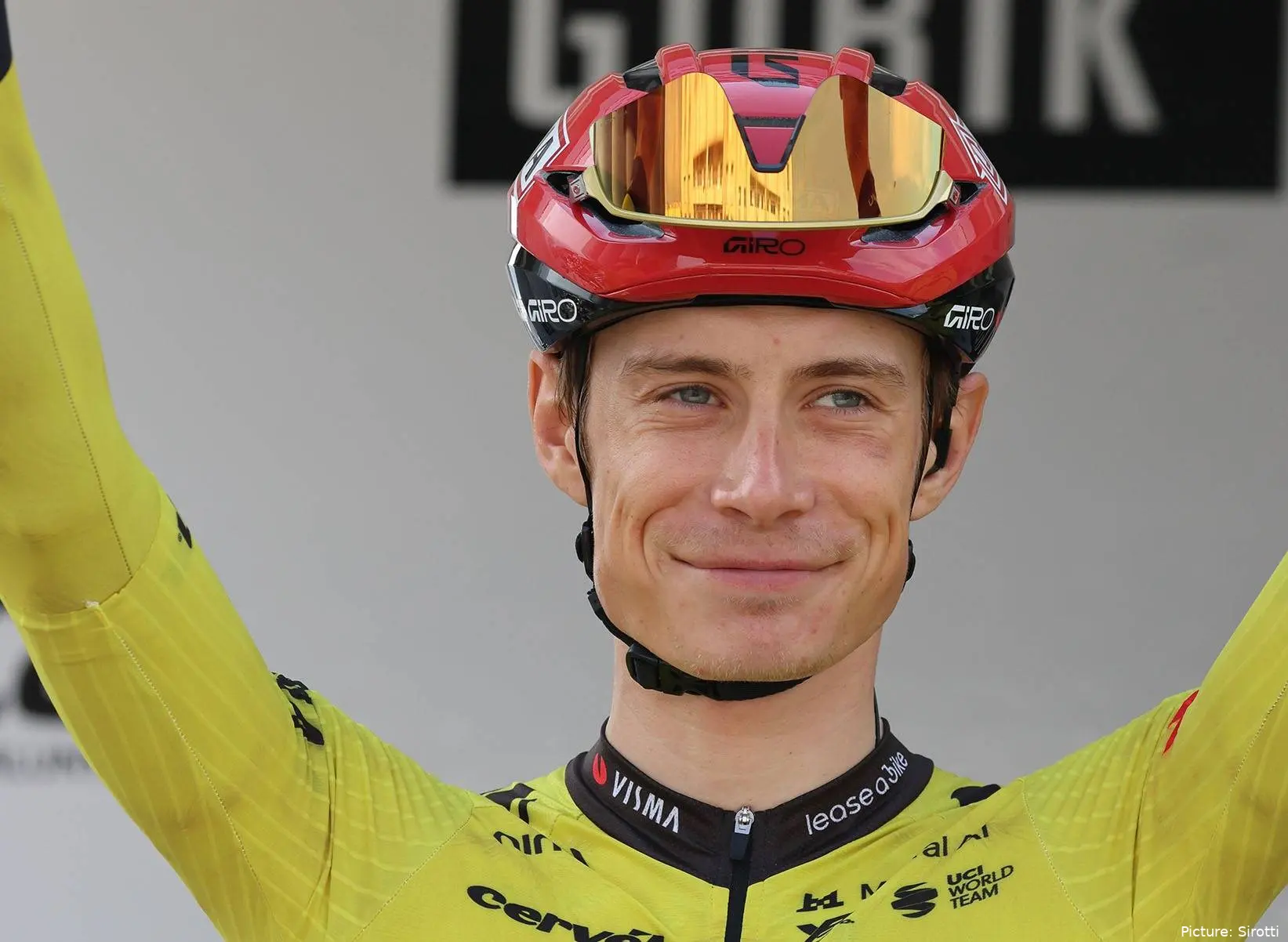
The 2026 Giro d'Italia will take place from the 8th to the 31st of May. It is the first Grand Tour of the season, and everything is set for the first-ever Grande Partenza in Italy. Ahead, there are 21 stages that will take the riders through many of Italy's iconic cities, the mythical Alps, and many treacherous stages - each one can end the climber's chances of winning. Will Jonas Vingegaard be able to make his own history and become the winner of all three Grand Tours before Tadej Pogacar?
The race starts off in Bulgaria with a sprint stage, and the sprinters will be blessed with a few opportunities during the race. There are six opportunities for the purists including finales in Napoli, Milano and Rome. There is one 40-kilometers time trial finishing in Massa and it is pan-flat.
There are six mountain stages, and every single one of them has a summit finish. These include Blockhaus, Corno alle Scale, Pila, Cari, Pieve di Soligo, and Piancavallo. This leaves eight stages that are mixed, which will serve the breakaway opportunists, puncheurs, and some of them could end in a reduced bunch sprint as well.
Read also
Stages 2026 Giro d'Italia
| Date | Day | Stage | Kilometers |
| 08/05 | Friday | Stage 1 | Nessebar - Burgas | 147 |
| 09/05 | Saturday | Stage 2 | Burgas - Veliko Tarnovo | 221 |
| 10/05 | Sunday | Stage 3 | Plovdiv - Sofia | 175 |
| 11/05 | Restday | ||
| 12/05 | Tuesday | Stage 4 | Catanzaro - Cosenza | 138 |
| 13/05 | Wednesday | Stage 5 | Praia a Mare - Potenza | 203 |
| 14/05 | Thursday | Stage 6 | Paestum - Naples | 141 |
| 15/05 | Friday | Stage 7 | Formia - Blockhaus | 244 |
| 16/05 | Saturday | Stage 8 | Chieti - Fermo | 156 |
| 17/05 | Sunday | Stage 9 | Cervia - Corno alle Scale | 184 |
| 18/05 | Restday | ||
| 19/05 | Tuesday | Stage 10 (ITT) | Viareggio - Massa | 42 |
| 20/05 | Wednesday | Stage 11 | Porcari (Paper District) - Chiavari | 195 |
| 21/05 | Thursday | Stage 12 | Imperia - Novi Ligure | 175 |
| 22/05 | Friday | Stage 13 | Alessandria - Verbania | 189 |
| 23/05 | Saturday | Stage 14 | Aosta - Pila (Gressan) | 133 |
| 24/05 | Sunday | Stage 15 | Voghera - Milan | 157 |
| 25/05 | Restday | ||
| 26/05 | Tuesday | Stage 16 | Bellinzona - Carì | 113 |
| 27/05 | Wednesday | Stage 17 | Cassano d'Adda - Andalo | 202 |
| 28/05 | Thursday | Stage 18 | Fai della Paganella - Pieve di Soligo | 171 |
| 29/05 | Friday | Stage 19 | Feltre - Alleghe (Piani di Pezzè) | 151 |
| 30/05 | Saturday | Stage 20 | Gemona del Friuli 1976-2026 - Piancavallo | 200 |
| 31/05 | Sunday | Stage 21 | Rome - Rome | 131 |
Profile Stage 1: Nessebar - Burgas

Stage 1: Nessebar - Burgas, 146 kilometers
The race starts off in Bulgaria and the Grande Partenza takes place in the city of Nessebar. The opening stage of the race and the first pink jersey should be attributed to a sprinter after a flat day and a finale in Burgas right by the Black Sea.
This is a fairly simple stage and one where surprises are hard to come by. The whole day will be spent by the Black Sea coast and the riders will head south towards Sozopol where they will then ride a small circuit. This will include the day's only KOM, which isn't actually a climb, but will crown the first leader of the race.
The riders then return back north through the same road they previously rode by and return to Burgas, but this time around to finish the stage. It is not a technical finale, with only a small left-hand corner inside the final kilometer providing the need for early positioning. We can expect a very fast finale, with a fresh peloton having no orographic challenges during the day.
Profile Stage 2: Burgas - Valiko Tarnovo

Stage 2: Burgas - Valiko Tarnovo, 221 kilometers
The second day of racing offers up opportunities to many riders. It's a long day on the bike, 220 kilometers long and with a punchy finish. The first portion of the stage is rather simple and flat, with the riders leaving from Burgas into mainland Bulgardia. There will be two small climbs which, this time around, are actual ascents that provide a challenge. The averages are in the 4% however, so they will not be a location to drop any riders.
But the final kilometers are not easy by any means. There is a 3-kilometer climb close to the finish that averages 7%, and ends very close to the finish in Valiko Tarnovo. The kilometers going into the climb are a constant up-and-down and include the Red Bull Kilometer, meaning the pace will be high and the riders will already enter the climb with some fatigue present.
The ascent is hard enough for serious attacks, although the GC riders should neutralize themselves. We can have a group of GC riders, some climbers and puncheurs surviving; which can lead to a small peloton sprint or a late attack succeeding.
The climb ends with 11 kilometers to go and then in the final 2 kilometers there is a small ascent from the river into the center of Valiko Tarnovo. The final kilometer is flat but by no means will the riders be fresh when they get there, opening opportunities for lots of scenarios.
Profile Stage 3: Plovdiv - Sofia

Stage 3: Plovdiv - Sofia, 175 kilometers
Stage 3 is another opportunity for the sprinters. There is a small climb halfway through the day but it's not too difficult and the remainder of the day is pan-flat which means the fast men shouldn't be too bothered.
175 kilometers from Plovdiv to Sofia, with a 9-kilometer long climb at 5% halfway through. The finale is as simple as you could possibly imagine, as the run-in to the Bulgarian capital is not only completely flat but a complete straight line. The riders will in fact ride in a straight line for dozens of kilometers, directly into the finish line which will crown a sprinter. It will bring memories of the UAE Tour, only in an Eastern European landscape.
Profile Stage 4: Catanzaro - Cosenza

Stage 4: Catanzaro - Cosenza, 138 kilometers
The riders arrive to Italy with a short stage, and one that is tricky to guess how it will end. The start off from Catanzaro in Calabria is flat and it's going to begin the rider's move up north. But it's a tricky day on the bike, with the Giro organizers throwing in an obstacle in the way of the sprinters and creating that tension.
A sprint is indeed the most likely scenario, but there is a 14.5-kilometer long climb that averages around 6%. Don't be mistaken, this is a serious climb. No, it's not an Alpine pass, but the Cozzo Tunno climb will take quite some time to ascend and the sprinters did not particularly train this sort of effort.
The climb ends with 43 kilometers to go, so just short of an hour to the finish. With certainty, the teams that want to put the pure sprinters under difficulty have the terrain to do so, definitively, whilst having a short distance to keep up the work and prevent them from coming back.
Equally, we may see some attacks here, not only to chase KOM points but to create the opportunity to win a stage or even go for the pink jersey. The sprinter teams, even those that can climb well, can't afford to push too hard or they will isolate their leaders quickly. Hence, an all-out attack from a few riders may create a gap that is then hard to close back down.
This should see a reduced peloton sprint into Cosenza. The finale is flat, so we can't be mistaken into believing it's likely that we won't see a sprint, but it is fair to suspect not everyone will arrive to the finish in contention for a good result.
Profile Stage 5: Praia a Mare - Potenza

Stage 5: Praia a Mare - Potenza, 203 kilometers
A stage for the 'baroudeaurs'. The Giro d'Italia has never been fond of preventing the breakaway specialists from having their opportunities, and here there is an ideal one. There is a long history of riders benefitting from week 1 breakaways to jump into the race lead; and that could be the center topic of the day.
Out from Praia a Mare, the first hour of racing could be very hard. There is a third-category climb into Prestieri which is 13 kilometers long at 4.6%, which allows the climbers to attack and get ahead of the peloton. It's not steep enough, at the same time, to prevent classics specialists and rouleurs from doing the same.
The stage is too hard for the sprinters, but the hard climbs are usually too far away from the finish for main GC men to be taking big risks. We should see a strong breakaway form, which could then not be caught again. With over 200 kilometers on the menu, any chase will be difficult, and undergo a lot of flat terrain whilst also throwing in a very difficult climb into the mix.
The climb to Monte Grande de Viggiani is 6 kilometers long at 9%. If it was a summit finish, we could expect serious differences. But usually, not many men want to take risks in the first week of a Grand Tour, and with 48 kilometers to the finish, some may hesitate to make moves.
What follows is terrain that is favourable for attackers however, regardless of where they stand in the race. We have got rolling climbs, a Red Bull Kilometer with 31 kilometers to go; and the final 25 kilometers are mostly downhill.
However, the final kilometers again have a few climbs in the mix, ideal for the classics specialists. There is a 1.3-kilometer long climb at 7%, with 12% ramps at the bottom, that ends with a mere 4 kilometers to go.
The riders climb into the town center and then descend back down again, with technical roads; before a slight climb to the finish in a larger avenue. But it's not likely that there will be much of a sprint finish at the end of the stage for that to be crucial.
Profile Stage 6: Paestum - Napoli

Stage 6: Paestum - Napoli, 142 kilometers
The Giro d'Italia returns to Napoli once again after a start in Paestum. A city that has hosted multiple finishes over the past few years, always for sprint stages. It does not come as a surprise, as it is one of the major southern cities in the country and one that has also had fantastic finales over the past few years.
This time around, the riders face no climbs on their way to the 'home' of Diego Maradona. The stage underwent late changes to ensure that the sprinters would have their way, and for a high-speed dramatic finale to be held on the Piazza del Piebiscito - a change in comparison to the sea-side avenue that has hosted the last sprints.
The pure sprinters can't afford to waste such an opportunity, on what is also the last day before the race truly reaches the mountains.
Profile Stage 7: Formia - Blockhaus

Stage 7: Formia - Blockhaus, 245 kilometers
The longest stage of the race and the Giro has offered up something that is rare: A 200Km+ mountain stage. The Tour and Vuelta have completely left this stage template behind, but the Giro reignites a traditional formula.
Certainly, it's not a brutal stage, but in the Apennines there aren't many flat roads and the final half of the stage is quite difficult even before reaching Blockhaus. The start from Formia immediately provides some climbing terrain, which allows for a strong breakaway to form.
But it's a long stage, where endurance plays a role, and where saving as much as possible towards the final climb is key. The differences can certainly be made bigger due to that. There are 4400 meters of climbing on this stage, the toughest so far in the Corsa Rosa. Much of that comes on the last 110 kilometers, which feature four climbs - only one of them categorized - ahead of the final ascent.
And that is the mythical Blockhaus, perhaps the hardest of all mountains in the Appenines. Whilst not the longest side, the 13-kilometer long climb is very steep and constant and will create very meaningful differences.
The average gradient is of 8.6%, quite similar to the Alpe d'Huez, however on a much more exposed road, where the wind can also play more of a role. This, the first mountain stage, is also certain to separate those who will fight for the race win and those who won't; and will create a clear order in the race.
Profile Stage 8: Chieti - Fermo

Stage 8: Chieti - Fermo, 155 kilometers
A typical explosive Giro stage, it is one that many have to pay attention to. After the riders leave the mountains of central Italy behind, they enter the coast of Abbruzo and Marche where the climbs into the small towns are usually treacherous and quite explosive.
Experience is key at the Giro, every region has its own particular challenges, and suit different types of riders. At Tirreno-Adriatico, we have gotten used to seeing the hilly stages create meaningful differences. The Giro organizers have attempted to bring that dynamic into the three-week race as one of the final stages in the first week.
The riders begin in Chieti, with a slight uphill start suited to rouleurs; but the truth is the riders have 95 kilometers that are almost fully pan-flat through the coast. But as soon as the riders pass the intermediate sprint and head inland, a new stage begins.
Two categorized climbs will open things up; whilst with 24 kilometers to go the peloton faces a Red Bull Kilometer on an 11% uphill climb - the Muro del Ferro in Fermo. The riders leave the town back down to the sea, and will then come up once again.
They will ascend to Capodarco first, 2.5 kilometers at 6% which ends with a mere 7 kilometers to go. But this climb won't be used for attacks, instead, the GC favourites and stage contenders will try to stay in the front of the peloton, in order to get to the descent well positioned and, respectively, the same towards the final climb.
For avid watchers of Tirreno-Adriatico, this finale won't be a surprise. It has to be well studied beforehand. Fermo has hosted finales in 2017 and 2022, with Peter Sagan and Warren Barguil (the latter from a breakaway) winning stages in an explosive finale. The climb begins with a 800 meters at almost 14% which max out at a whole 22%. A gruesome ramp where attacks are possible, but above all the riders will attempt not to go beyond their limits.
The road flattens out, and then the final 1.2 kilometers average 8%, with several right-hand corners that allow riders ahead to briefly go out of sight - and a corner very close to the finish. It's one where the pure puncheurs can thrive, but the strongest riders will mostly be the GC men.
As a whole, the climb is 3.7 kilometers long at 5.7%, and culminate an explosive stage.
Profile Stage 9: Cervia - Corno alle Scale

Stage 9: Cervia - Corno alle Scale, 183 kilometers
The final day of the first week will be tricky, and are an unusual sight at the Giro. Stage 9 will take place fully in the Emilia-Romagna region and have an 'unipuerto' profile, something very common at the Vuelta a España but rather unusual in the Corsa Rosa.
The first 105 kilometers of the stage are virtually pan-flat, running from Cervia up until the outskirts of Bologna. The riders then head back into the Appenines - this time, the 'Settentrionale', an area not frequently visited by the Corsa Rosa.
On the menu is a summit finish at Corno alle Scale. To get there, the riders will first take on the climb to Querciola, which is just over 11 kilometers long at 4.2% - although the first kilometers are almost flat and lower the average significantly.
There is a very small descent inbetween climbs, and Corno alle Scale is around 13 kilometers long at 6%. There is a Red Bull Kilometer interestingly placed 1.5 kilometers into the climb, which could shake things up if the breakaway is caught by that point.
The climb however has a few relatively flat sections, and the attacks should only come after passing through the Madonna dell'Acero with 3 kilometers to go.
That is because those 3 kilometers average 10% in gradient, terrain that allows for big differences to be made and for teammates to not be of much use. Here, the GC riders have no alternative to going head-to-head, and with this being the final day of week 1, it is unlikely that anyone will hold back.
Profile Stage 10 (ITT): Viareggio - Massa

Stage 10 (ITT): Viareggio - Massa, 42 kilometers
The 10th stage - which is also the opening day of the second week - is the race's sole time trial. This takes place from Viareggio to Massa, as the riders traverse back into the western coast of Italy, straight into the Tirreno sea.
it is pan-flat and 40 kilometers long which favours the specialists and gives them an opportunity to take a stage win. There is not a single - even small - climb, it is purely a day for those who specialize in the discipline to show their worth.
However the GC fight is always going to be the main story of the day, with this route providing enough kilometers to truly create differences. There is nowhere to hide as the route is not technical, and will take place fully by the coast which also allows the wind to play a role.
Profile Stage 11: Porcari - Chiavari

Stage 11: Porcari - Chiavari, 195 kilometers
The Giro heads into Liguria on stage 11, a coastal stage however on with plenty traps. Some will see an opportunity for a breakaway win; some GC riders may see it as terrain to try and surprise; whilst others will see it as dangerous roads where they have to stay safe and well positioned at all times.
The start takes place in Porcari, and gives way to a 195-kilometer long stage that has a mostly flat first half. But the second is the complete opposite, with three categorized climbs and plenty other that the riders will feel in the legs.
2.6Km at 6.8%; 98Km to go
2Km at 7%; 89Km to go
7.4Km at 4.9%; 79Km to go
9.9Km at 6.2%; 59Km to go
5.7Km at 6.3%; 28Km to go
4.6Km at 6.4%; 12Km to go
2Km at 7%; 89Km to go
7.4Km at 4.9%; 79Km to go
9.9Km at 6.2%; 59Km to go
5.7Km at 6.3%; 28Km to go
4.6Km at 6.4%; 12Km to go
It's another day for the breakaway specialists. This is terrain that is hard, but the climbs are not brutal to make a big difference. Climbers can win here; puncheurs can win here; form on the day, fatigue management entering the second half of the Grand Tour, and tactical knowhow can all be key in the fight for the stage win.
It's a classic Giro day where the riders make the race, and the terrain is simply too treacherous to know for sure what outcome to expect. The climbs have different durations and gradients, whilst none takes the spotlight, meaning the winning attack can come anywhere.
For the GC men, it's not easy to create gaps in these climbs, but it's a day where one risks losing a lot. The final ascent with 12 kilometers to go has a Red Bull Kilometer in it, meaning we can see attacks in pursuit of the bonus seconds.
The riders then have an extremely technical descent back into the sea, and the riders tackle an urban finale in Chiavari where there is still an uphill ramp with 4 kilometers to go where we may see more attacks before the flat finale.
Profile Stage 12: Imperia - Novi Ligure

Stage 12: Imperia - Novi Ligure, 175 kilometers
The riders take on a day where a sprint is very likely to decide the outcome of the day. The profile is not fully flat, but the climbs are not overly hard and still come very far away from the finish to make a true impact.
The last of the climb ends with still 52 kilometers to go and the gradients are simply not hard enough to truly put the sprinters into difficulty with definitive effect, meaning a bunch sprint is quite likely.
In Novi Ligure, the sprinters return to the spotlight, with a non-technical finale that will provide the leadout trains with a golden opportunity before the race reaches the Alps.
Profile Stage 13: Alessandria - Verbania

Stage 13: Alessandria - Verbania, 189 kilometers
Another tricky stage, with a completely flat profile all the way until the final kilometers. The stage doesn't seem to be designed for any type of rider in particular. Again it is too hard for the sprinters whilst seemingly not hard enough to create differences for the GC.
A breakaway day, but also one that is easy to control... We could see interesting dynamics on this 13th day which is held from Alessandria into Verbania, crossing the Po valley and entering the Alps in a gentle manner.
The first 165 kilometers, four hours of racing, will be done on mostly pan-flat roads with nothing to note. The riders head north in what is a transition stage, where it's easy to control a breakaway group. But who will want to do so?
There are two climbs to note then, before the stage finale. One is 2.4 kilometers long at 5.8% and ends with 31 kilometers to go; and the second is 4.7Km at 7% which ends with 13 kilometers to go. The first half of the final climb has a Red Bull Kilometer, whilst the second half averages almost 10%, and so we could see an all-out GC battle on more explosive terrain.
It's a tricky finale, but attacks are quite possible anywhere. There is a descent and a few flat kilometers, meaning teams do have reasons to have men in front and then potentially try to benefit from their presence tactically in the final flat kilometers to extend their gap.
Profile Stage 14: Aosta - Pila
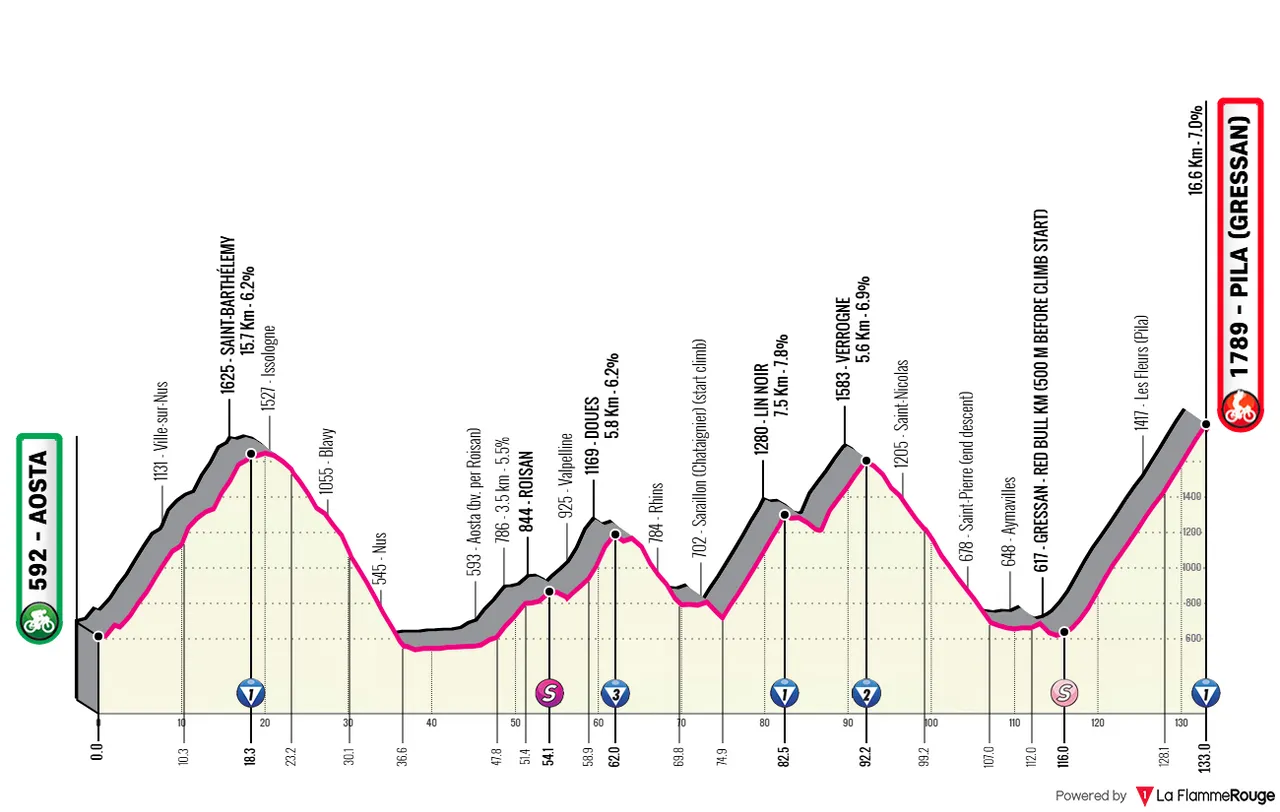
Stage 14: Aosta - Pila, 133 kilometers
One of the most important stages of the race. The riders start in the city of Aosta and will spend the whole day in a radius of just a few kilometers, going up five climbs in the Valle d'Aosta which can be considered the first queen stage of the race, with 4200 meters of climbing packed ina very short distance.
It is a very short mountain stage with only 133 kilometers on the menu, but the organizers have designed the stage in a way that its short distance might actually have an influence. They have inserted a very difficult climb at the start of the day, something the Tour and Vuelta very rarely risk doing anymore. This is Saint-Barthelémy, which is 15.7 kilometers long at 6.2%.
This means we can see GC raids, or very serious attacks right from the start. Most of the GC men will save themselves for the final climb, but that does not mean there isn't terrain to attack beforehand. All descents in the region are extremely technical and require the utmost attention, as the peloton can split at any moment.
5.8Km at 6.2% (71Km to go) will be the second climb; whilst then there is a two-climb combination that is quite difficult and closely united: Lin Noir and Verrogne. The first is 7.5 kilometers long at 7.8%; and the second 5.6Km at 6.9%.
They end with 50 and 41 kilometers to go respectively. The descent from the latter is very long, technical and steep. There will only be a few kilometers back into the outskirts of Aosta, where the riders will ascend into the final climb.
This will take the peloton up to Pila, one of the many mountain towns that are spread throughout the valley. A true Alpe d'Huez, only longer. 20 hairpins on a climb that is 16.6 kilometers long and averages 7%.
This is a brutal summit finish at the end of a brutal stage, where the fatigue of two weeks of racing can also begin to be a key factor. Only the pure climbers can battle for such a stage, where the GC will take further shape.
Profile Stage 15: Voghera - Milano

Stage 15: Voghera - Milano, 157 kilometers
The final stage of the second week is an unusual sight, as the riders head into Milano for a sprint finish. The main city in the north of Italy often hosts time trials to end the race, but this time around the scenario is different, and the penultimate Sunday of the race sees a day for the sprinters, with many expected to follow the stage roadside.
The riders begin in Voghera and for many it can even be considered a rest day, with 157 pan-flat kilometers leading to Milano, where we will see a circuit finish where the sprinters will have a golden opportunity to show what they're worth.
Profile Stage 16: Bellinzona - Cari

Stage 16: Bellinzona - Cari, 113 kilometers
The stage that takes place fully within Switzerland - the small Italian-speaking portion of it. Road work forced the organizers to change the stage's original format, and instead we have a very odd mountain stage as a result.
But different means that there is a land of opportunity. The first day of the final week of racing sees a flat start and then a hilly circuit with two climbs present. One is 4.7Km long at 5.6% and the other 3 kilometers long at 8.3%.
We can see the breakaway form here, as the stage is very short at a mere 113 kilometers in distance, or we can see some teams impose a strong pace right away in order to prepare attacks on the final climb to Carí.
Both climbs will be tackled twice; the last of which with 48 kilometers to go. A short descent will follow, before the riders change valleys. The final climb will be preceded by quite a lot of false-flat uphill kilometers, which mean the riders can enter the final climb already with quite some fatigue. There is a Red Bull Kilometer right before the base of the climb, which is then 11.6 kilometers long.
it's a hard climb, another Alpe d'Huez lookalike, with 19 hairpins. The climb is almost 12 kilometers long averaging 8% and it is just steep, right from the base to the summit in the ski resort. The final kilometer averages 10%, pointing towards an effort that has to be measured perfectly, as riders can explode and lose massive amounts of time in the finale.
Profile Stage 17: Cassano d'Adda - Andalo

Stage 17: Cassano d'Adda - Andalo, 201 kilometers
An odd stage, one for the breakaway to certainly succeed in, however with a flat start. The Giro has designed another stage suited to the breakway specialists, the classics riders and puncheurs, whilst some climbers can also be in the mix.
It is a stage that features 55 pan-flat kilometers at its start, and is then packed with small climbs, despite being inserted in the middle of the Alps. There is no climb that is overly long or steep, meaning you can make differences, but the race is to be made on the valley roads inbetween.
The GC riders can't make the difference on these roads and a sprint isn't realistic. In the third week, many are looking to save their race and can do so here with plenty of their cards. The final hours of racing feature several rolling climbs and a mostly uphill trajectory.
Then, the Red Bull Kilometer is on a difficult climb with 15 kilometers to go, uncategorized yet one where differences can be made. In total, that one ends with 10Km to go and is 8.3 kilometers long at 3.6%.
The riders reach Andalo, descend from it, and then climb back up to it. A very fast approach to the final 2 kilometers which feature a hilltop finish, which is 2.3 kilometers long at 6.8%.
In the GC fight, this isn't terrain to win time, but you still need good legs to prevent losing seconds in the finish - which could also be interpreted as blood in the water for any rider's rivals ahead of key days in the race.
Profile Stage 18: Fai della Paganella - Pieve di Soligo

Stage 18: Fai della Paganella - Pieve di Soligo, 168 kilometers
The 18th stage is another odd stage, a day that almost looks fully flat, but then has one 'shark tooth' close to the finish. It is another breakaway stage, not hard enough for the climbers, but too hard for a sprint. With lots of opportunists looking for a shot and several rolling climbs at the start of the day, it's impossible to prevent a strong group from going up the road.
The riders follow a southeastern trajectory into Pieve di Soligo which hosts the stage finale. The grand feature of the stage is the Muro di ca'del Poggio. This is a climb that cannot be confused with the Poggio di Sanremo, which marks Milano-Sanremo.
Instead, it's a short but incredibly steep climb that summits with just under 10 kilometers to go, averaging 11% and maximum gradients quite above it. Climbers can make the difference, not only puncheurs, here.
In the breakaway, we should see riders anticipating it, whilst others save their legs for the decisive effort there they mean to carry all the way to the line. In the peloton, the GC men will need their utmost attention to enter it well positioned.
Ahead of the queen stage, not many should want to spend a lot of energy with attacks, but they have to spend whatever is necessary to secure their positions. More explosive riders can certainly attack and try to make alliances and extend gaps in those final 10 kilometers, on a day where having teammates in the breakaway can also assist in this mission.
Profile Stage 19: Feltre - Allege (Piani di Pezzè)

Stage 19: Feltre - Allege (Piani di Pezzè), 151 kilometers
Stage 19 of the Giro is the queen stage, with 151 kilometers on the menu in the Dolomites. The stage is short, yes, but so difficult that there is no getting around it. Not only are the climbs very difficult, but they come in quick succession and also see altitude enter the picture.
The first kilometers are rolling, allowing riders to jump in the breakaway, although no categorized climb means that we can see a wide variety of figures trying to anticipate the peloton in to the mountains. 4900 meters of climbing, and they mostly begin with the Passo Duran.
The first climb of the day is equivalent to the Alpe d'Huez, featuring 12 kilometers at over 8%. A short descent leads directly into Coi which is 5.8Km at 9.3%; and another short descent leads directly onto the third climb of the day which is the Forcela Staulanza (6.3Km; 6.7%).
But these climbs, despite their difficulty, will likely only be used to create fatigue into the fourth one. The mythical Passo Giau returns, and will be climbed from Selva di Cadora, it's hardest side. The climb is 9.8 kilometers long, averages 9.3% and summits at 2226 meters of altitude, bring in every aspect of what makes a climb hard.
The weather in the region is also often instable, with the temperatures being inevitably cold at the summit. The riders take on a very fast descent and go directly into the Passo Falzarego, which is 10 kilometers long at 5.4%.
But the climb can make bigger gaps than one could expect, taking into consideration the fatigue factor, right after the Giau specially; and also its altitude with over 2100 meters at the summit.
The riders descend back down over 1000 meters but the stage does not end there. Instead, there is still a summit finish at Piani di Pezzé, a shorter climb but one that is incredibly steep. 5 kilometers at 9.6% will bring the stage to a proper end.
Profile Stage 20: Germona del Friuli - Piancavallo

Stage 20: Germona del Friuli - Piancavallo, 200 kilometers
The final mountain stage of the race starts off completely flat and it's a day where the breakaway is unlikely to succeed, as when the race goes uphill, we're going straight into action. The start is flat and it's a stage that is not hard to control.
Following the 2024 format, the final climb will be ascended on two occasions, and this time around it is Piancavallo - which will correspond with a summit finish.
The climb is 14.5 kilometers long, averaging 7.8% - with the first half being steeper than what these numbers suggest. In any case, a brutal climb, which is summited the first time with 53 kilometers to go, and inbetween is mostly flat.
Profile Stage 21: Rome - Rome

Stage 21: Rome - Rome, 133 kilometers
The race finishes off once again in Rome, with a stage that is suited to the sprinters and will be featuring a circuit around the Italian capital to wrap off the three-week race. Rome hosts the finale of the Giro d'Italia.
The stage will start in the capital, move out of it, and then return for a final circuit that will see the riders go through some of its most iconic monuments. There is going to be an intermediate sprint by the Colosseum; whilst the sprint finish will take place next to the Circo Massimo.
The Favourites
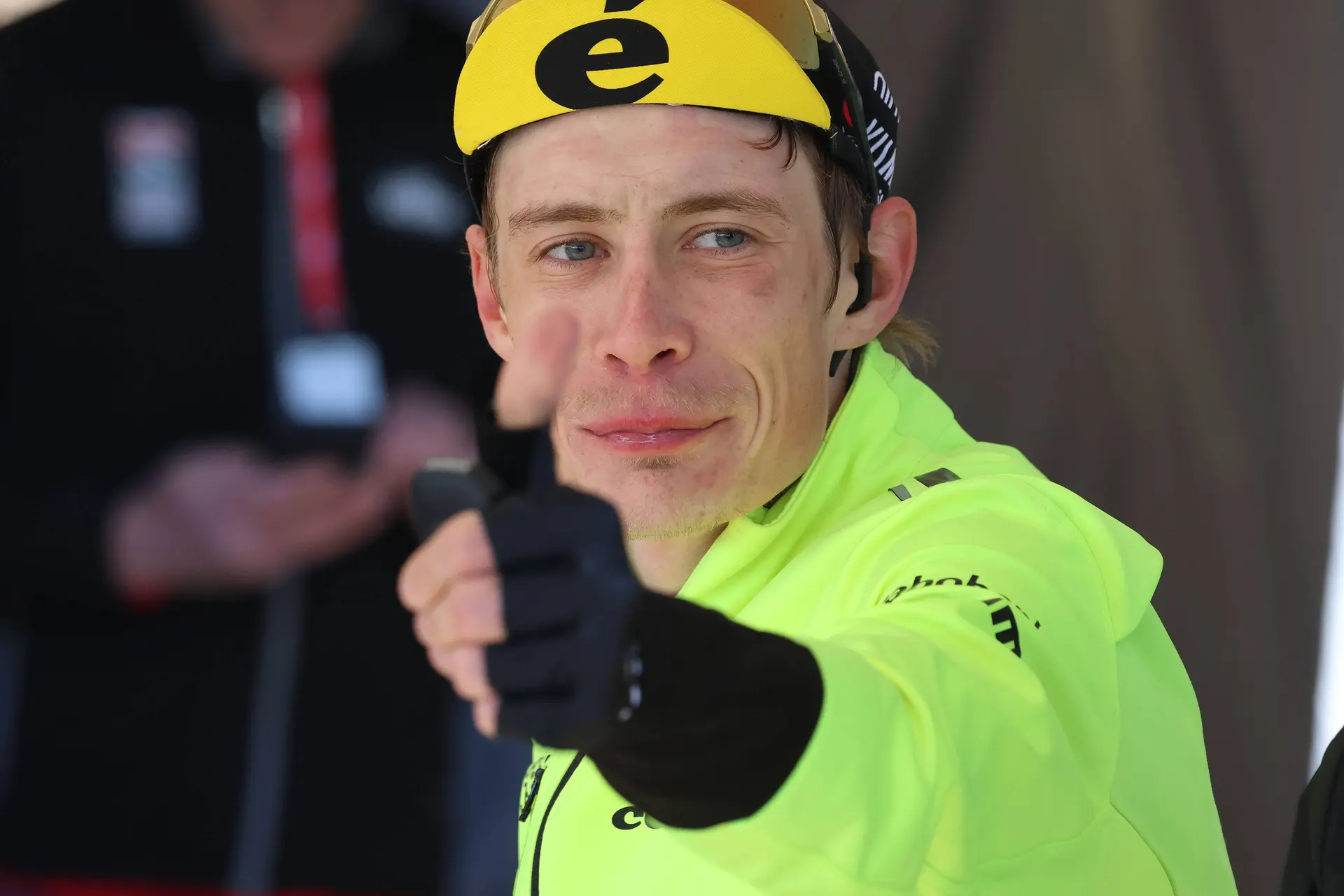
Jonas Vingegaard - The Team Visma | Lease a Bike is the man to beat at this Corsa Rosa, it is unanimously agreed. The Dane won the Vuelta a España last summer and his main rival, João Almeida, had to withdraw from the race. Visma does not have their best team in Italy but with the experienced likes of Victor Campenaerts and Sepp Kuss, he will have his right-hand men that can cover for him in key terrains.
His wins at Paris-Nice and Volta a Catalunya put forward the evidence for good form this spring whilst his motivation heading into the Giro is very high. The Danish climber can complete his Grand Tour setlist here and he will be eager to win his first Giro d'Italia before Tadej Pogacar can win all three.
Giulio Pellizzari - His main competitor surges in the form of Giulio Pellizzari, who has evolved dramatically since joining Red Bull - BORA - hansgrohe. Last year, after Primoz Roglic's withdrawal, the Italian has put in an incredible final week in the mountains where in some instances he was as strong as the victory contenders. Fast forward a year, he is just as strong of a climber, but a more experienced leader. off the back of a podium at Tirreno-Adriatico and an overall win at the Tour of the Alps, Pellizzari carries the ambitions of BORA and the dreams of the home crowd which can provide him that little extra. After a successful partnership at last year's Vuelta, Jai Hindley is also aiming for the Giro GC, providing BORA with cards in a lineup that is very climber-heavy.
INEOS Grenadiers - The British team can for the first time in quite a while begin a Grand Tour with legitimate ambitions of finishing on the podium. Egan Bernal has been having a good run of form over the past few weeks after a late start to his European campaign; both he and Thymen Arensman joined Giulio Pellizzari on the podium of the Tour of the Alps. Arensman is the real 'danger man' however, after his two stage wins at last year's Tour de France. The Dutchman is excellent for the long mountains of the Giro, often his problem is in the first week. But after a stupendous Tour of the Alps, the signs are good that he will be able to remain consistent throughout the three weeks of the race.
Adam Yates - With João Almeida out of the UAE lineup, it has become a stage-hunting lineup with the likes of Jhonatan Narváez, Jan Christen and Jay Vine all likely to have their freedom. However, altogether, they can support Adam Yates very well. UAE has a very strong team for all terrains and in the head of the GC ambitions is Adam Yates, who takes up the opportunity and perhaps the last chance to lead a Grand Tour in his career. The Briton has recently won O Gran Camiño and has talked about numbers that are around his best ever. The 2023 Tour podium finisher still has it in him and is an experienced Grand Tour contender, stepping up for the family after his twin brother Simon won last year's edition.
Felix Gall - The Decathlon rider has a few support riders for the mountains but the French team is in the midst of an historic run of exposure due to Paul Seixas. On one side that means the team's leaders are certainly benefiting from good behind-the-scenes work, and on the other it may be the edge Felix Gall needs to try and prove his spot at the top of the team's climber scene.
Expecting a victory would be a tough ask for the Austrian, with a 42-kilometer flat time trial on course; but in the mountains he remains as strong as in 2023 when he had his breakthrough. At last year's Tour de France he finished fifth, and is the ideal type of rider for the Giro's brutal mountain marathons and the race's history of having its harder days right by the end of the route.

Felix Gall during stage 5 of the 2026 Volta a Catalunya
Michael Storer - The Tudor man is perhaps the most underated GC contender on the startlist. The Australian was 10th in the past two editions, but his 2025 result is deceiving, coming as a result of four crashes. That year he won the Tour of the Alps with a spectacular set of climbing performances and in October he joined Tadej Pogacar and Remco Evenepoel on the podium of Il Lombardia. Tudor's mountain group is strong, and his more modest spring is a sign of a potentially better planned fitness peak. At the Corsa Rosa he is a clear podium contender, something a non-World Tour rider does not often achieve. Mathys Rondel is also going to be an interesting figure for Tudor, a potential Top10 finisher if he is able to prove himself in a three-week race.
Santiago Buitrago - Bahrain - Victorious are a team with tremendous depth for the mountains, featuring Santiago Buitrago whose goal is of a Top5 at the Corsa Rosa. The Colombian had a strong spring in 2025 but his Grand Tour campaign went down the drain after a fall at the Tour de France. He is once again trying his luck; but is backed up by last year's fifth place Damiano Caruso (he himself an outsider for GC) and Afonso Eulálio who is a climber that has taken a truly massive step since joining the team.
Derek Gee - Lidl-Trek have Giulio Ciccone in their lineup, but the home favourite will most likely not be aiming for the overall classification. Instead, the German team's hopes will lie on the shoulders of Derek Gee, a signing of the team in January, although in December he had already been 'snuck in' the team's training camp in Spain. His preparation was rocky, with an illness in March coming in the way of reaching his planned form. A 12th place at the Tour of the Alps showed small signs of improvement and that he can aim for GC, but most likely he will hope for a very conservative first half of the race so he has the possibility of contesting or improving on last year's fourth place.

Derek Gee in action at Milano-Torino 2026
Enric Mas - Movistar have a deceivingly strong team for the mountains at this year's Giro, and a very strong lineup overall. The Spanish team has put its GC chips for the Corsa Rosa, with Enric Mas in the lead. The 31-year old had a crash and injury at last year's Tour de France which took him off the bike for several months. In December, he was just getting started with his base training. Hence, his form throughout the entire spring has been very modest, and it is by no means certain that the three-time Vuelta podium finisher can reach his best level. However, in his absence, the team can rely on Einer Rubio, Top10 on the past two editions, to chase a meaningful result for the Spanish team.
The withdrawals of a few central figures in the expected GC fight, such as João Almeida, Richard Carapaz and Mikel Landa can certainly increase the hopes of many to reach the Top10 and give it a shot in the Italian Grand Tour. It is also a race where breakaways can dramatically impact the bottom of the Top10 standings, meaning there is much more than just climbing ability to define the overall classification.
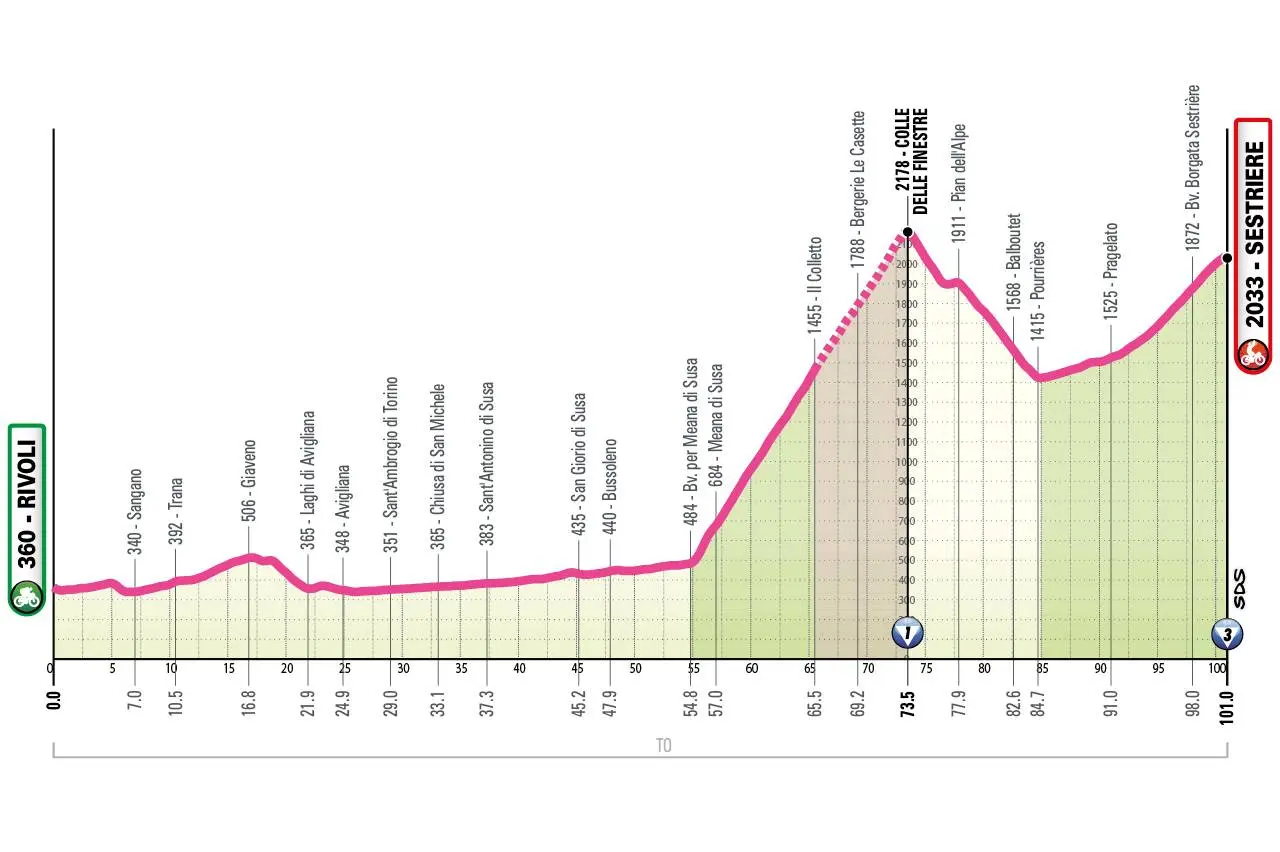
Ben O'Connor has not shown good form during the spring but during his last presence, the Team Jayco AlUla rider finished fourth in the overall classification two years ago. His former teammate Chris Harper leads the way for Pinarello Q36.5 and after a seventh place at the Tour of the Alps, last year's Sestriere winner can give it a go with his new leader role.
Lennert van Eetvelt is a wildcard that deserves attention in the three-week race, although he hasn't proven himself in the past over such distance; whilst youngsters such as Alessandro Pinarello and Johannes Kulset begin the race with the ambition of a Top10 and should have the freedom to make moves throughout the race which will improve their chances of achieving it.
Prediction Giro d'Italia overall classification:
*** Jonas Vingegaard
** Giulio Pellizzari, Adam Yates, Thymen Arensman
* Jai Hindley, Egan Bernal, Felix Gall, Michael Storer, Santiago Buitrago, Derek Gee, Ben O'Connor
Pick: Jonas Vingegaard
The Sprinters
The fight for the points classification is perhaps going to be closer than that for the pink jersey. The Maglia Ciclamino puts the best sprinters in the race to the test, and there the depth is much greater. Jonathan Milan makes his return to the Corsa Rosa with a strong leadout backing him up for Lidl-Trek; and the Italian train is set to face off the 'new threat' on the block: Tobias Lund Andresen. The Dane has had a stellar debut season with Decathlon, thriving in the bunch sprints and having a consistent run in the cobbled classics which showed off a new level from Andresen.
The two men are perhaps above the rest when it comes to the fight for the points classification, but there are two other riders who certainly stand good chances of succeeding as well. One is Paul Magnier, who started off his season better than ever in the pure sprints, and is a rider who can handle the short climbs quite well. The Soudal - Quick-Step leader is perhaps evenly matched by Alpecin-Premier Tech's Kaden Groves, who will also have full support from his team to battle for the sprints. All four riders can, at their best level, beat the other three - which can create a very interesting battle.
Dylan Groenewegen is going to be a very interesting addition to the pure sprints, having his best form in years after joining Unibet Rose Rockets, having Marcel Kittel in the car backing him up, and carrying the hopes of a team that is making its Grand Tour debut. NSN's Ethan Vernon, Casper van Uden - a winner 12 months ago at the Giro - and Arnaud de Lie (who is planning on withdrawing after the first week) are serious contenders to take into consideration as well.
Giovanni Lonardi, Erlend Blikra, Matteo Moschetti, Pascal Ackermann, Orluis Aular, Paul Penhoët and Astana's Matteo Malucelli and Davide Ballerini are all riders to be expected near the front on these days.
Prediction Giro d'Italia points classification:
*** Jonathan Milan, Tobias Lund Andresen
** Paul Magnier, Kaden Groves
* Jonas Vingegaard, Dylan Groenewegen, Ethan Vernon, Casper van Uden
Pick: Tobias Lund Andresen

Jonathan Milan makes his return to the Giro d'Italia after winning the Maglia Ciclamino in 2024
Rúben SilvaEditor-in-Chief
A founding contributor to CyclingUpToDate since its launch in January 2022, Ruben Silva has played a central role in shaping the site’s editorial direction and long-term growth. Before joining the project, he built his experience through independent blogging at Echelons Hub and by producing race previews for Ciclismo Internacional, developing a strong analytical voice rooted in daily engagement with professional cycling.
Beyond editorial work, he has been closely involved in the expansion and coordination of CyclingUpToDate’s wider network, helping establish and support sister platforms across multiple languages. This includes ongoing collaboration with CiclismoAlDia (Spanish), CiclismoAtual (Portuguese), WielrennenUpToDate (Dutch), and RadsportAktuell (German), contributing to a shared editorial vision and consistent international coverage.
He also helps oversee editorial governance across the network, setting standards for accuracy and consistency and coordinating updates or corrections when needed.
Originally from the Porto metropolitan area in Portugal, he holds a bachelor’s degree in Geography. His path into cycling journalism was shaped not through formal media training, but through independent reporting, community engagement, and sustained on-the-ground involvement in the sport.
Over the course of his career, he has conducted approximately 100 interviews across road cycling and cyclocross, ranging from one-to-one conversations and online formats to press conferences and on-site pre- and post-race coverage. His interviews include leading riders, team managers, and prominent figures within cycling media: Tadej Pogacar, Jonas Vingegaard, Mathieu van der Poel, Primoz Roglic, Wout van Aert, Joao Almeida and Tom Pidcock; managers like Patrick Lefevere and Joxean Matxin; and YouTube personality Bryan Kennedy (BKXC)...
Within 18 months of launch, he helped grow CyclingUpToDate’s English-language platform into one of the most-read cycling news websites, built entirely from the ground up. As both a professional journalist and lifelong cycling enthusiast, his focus remains on delivering accurate, timely, and well-contextualized coverage.
claps 5visitors 4
Just in
Popular news
Latest comments
- Very surprised del toro couldn't beat everyone here against lesser competition. He's well on his way to being top 5 in the worldbruins3008-10-2026
- Being the best rider left in the race is pretty much the only way to win in any edition, surely? Seems reductive to say "they only won because the entire peloton wasn't as absolutely stacked as it could've been" - you can only beat who is in front of you.wrsty08-10-2026
- I’m sorry but generally the coverage on your site is first class but this incident highlights something I just don’t get with cycling journalism. This accident should never have been allowed to happen, it comes uncomfortably close to the Finlay Tarling tragedy and two other incidents took place within days of this. I checked all of the cycling websites and you all put out basically the same story. Pidcock gave journalists the perfect opening to blow this sky high, what has the UCI got to say? What is Adam Hansen doing? What do the organisers say? Nothing, you all trot out the same easy quotes taken from Pidcocks interview after the race but do nothing to follow it up. I see it time and time again, journalists taking the easy way out but being outraged when it happens again as it surely will. Riders can’t do this but journalists should be independent and should be able to raise these uncomfortable questions but cyclinguptodate and every other on line publication prefer to take the easy way out. That’s the real tragedy here.Paul53108-10-2026
- Happy to help :-)Mistermaumau08-10-2026
- Well, ok but, it’s also a structural, team, budgeting, direction and all sorts of other issueMistermaumau08-10-2026
- I wouldn’t call it an analogy but maybe his criticism is a little unfair. On the other hand, the fact Cicco made a public affair out of it despite having received all the explanations and proof makes me feel he now deserves being criticised for not accepting there is nothing to discuss.Mistermaumau08-10-2026
- Much as I like him (one of my favourites), I do want to attract a little attention to the coincidence of his recent performances in the current context. Not the first time a rider improves noticeably when there’s a job interview to prepare. In the same lighthearted humour of his, i hope the UCI will let him wear it at home as the rules quite strictly state you can only wear it during participation in the discipline you won in, and we all know how capable they are of interpreting rule interpretation ;-) Also, if it’s going to be retirement (please not), I wouldn’t call that an agreement as somebody will probably feel they didn’t get what they wanted.Mistermaumau08-10-2026
- Agreed. There used to be a team willing to pay though. I take all these figures (that vary enormously according to who is publishing) with handfuls of salt. We don’t know how salaries are treated (especially between a UK employer and Andorran resident), we don’t know how numbers are derived and from where, if deductions have been taken into consideration, etc. but if he returns to Colombia, he’s going to need quite a bit in protection money.Mistermaumau08-10-2026
- And another one gone, another one gone, another one bites the dust. Ah gonna get you too…Mistermaumau08-10-2026
- Top marks RidesHills. A great post that sums up exactly Egan Bernals situation.Cyclingsbestfan08-10-2026
Loading
1 Comments