"For riders like Wout van Aert or Mads Pedersen, it’s a great Giro" – Experts question if “modern” Giro route reveal will tempt stars away from the Tour de France in 2026
Cycling
The unveiling of the 2026 Giro d’Italia route has triggered an immediate round of speculation on Eurosport’s Kop over Kop podcast, where analysts suggested the profile is unusually inviting for classic-style riders — even those more commonly associated with the Tour de France.
With a spread of punchy finales, rolling terrain and a long time trial, the question now hovering in the background is whether some of the sport’s most versatile stars might actually consider shifting focus towards Italy.
That conversation kicked off when Jeroen Vanbelleghem singled out the unusual number of opportunities available to bigger, more explosive all-rounders. Speaking on the programme, he argued: “For a type of rider like Wout van Aert or Mads Pedersen, it’s a great Giro if they’re in doubt.”
It was the clearest suggestion yet that the route could — at least theoretically — persuade riders who usually build their entire season around the Tour.
A “modern and even” Giro that broadens the field
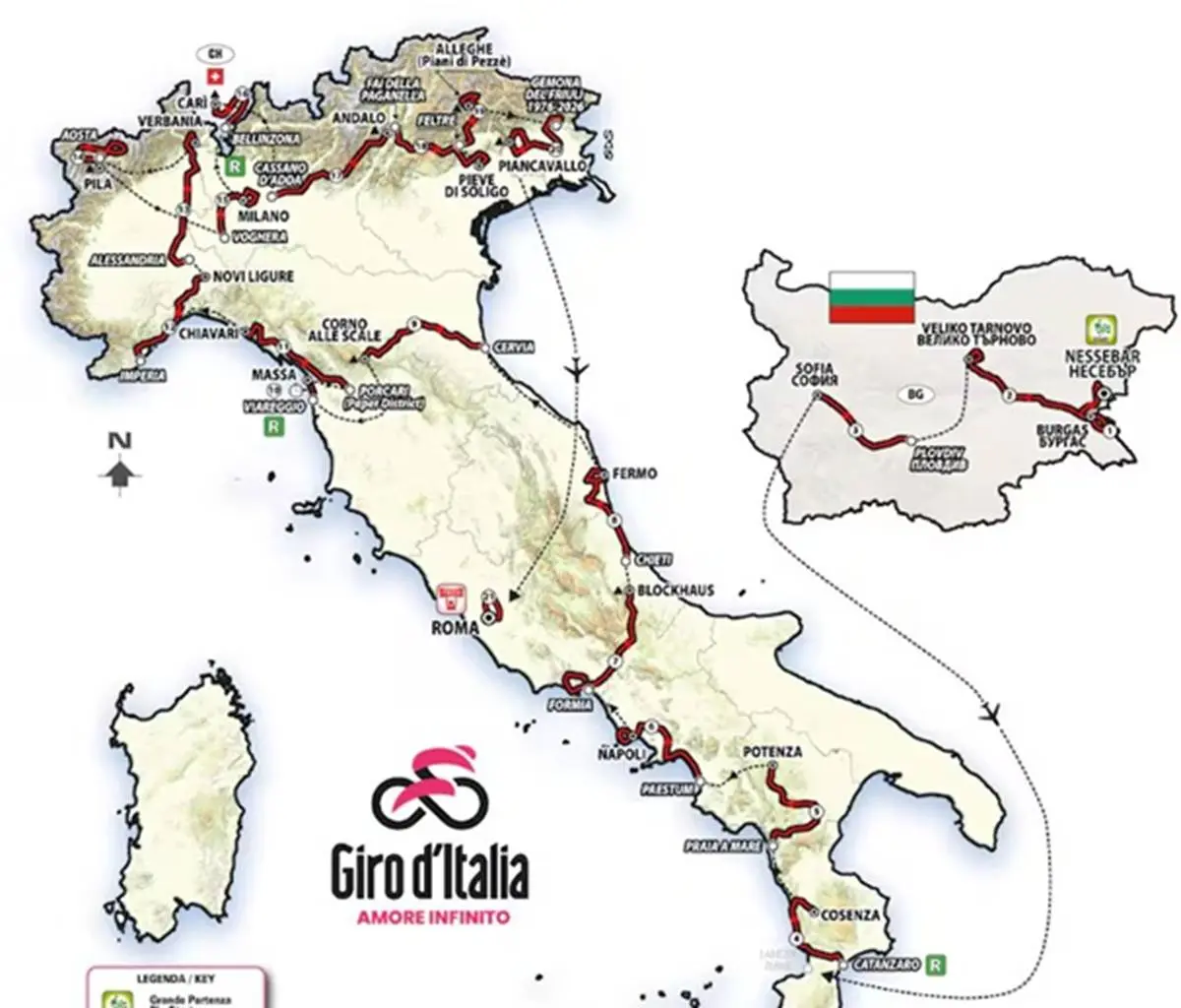
As the panel dug into the parcours, Sander Valentijn pointed straight at how unusually open this edition feels — and Jeroen Vanbelleghem didn’t hesitate to label it a “modern Giro” and “even” in its design. He stressed that the race offers something across the board: “There is a bit of everything and for different types of riders.”
Crucially, he connected that directly to the classic-style all-rounders who might normally find a Grand Tour too restrictive. Vanbelleghem mapped out a wide spread of opportunities — citing “stage 2”, followed by stages “4, 5, 8 and 9”, and then highlighting “13… and 11 actually also already” as terrain that suits riders with punch and power. Later weeks, he added, continue the trend: “Stage 17 I find a very nice one for them and in stage 18 you have a steep finale with a little wall.”
His verdict summed up how unusually open the race appears: “In every week you have a couple of opportunities for all types, including the sprinters.”
That balance stands in clear contrast to what awaits at the Tour de France, where the same rider profile faces fewer natural chances. As Valentijn put it bluntly, compared with the Tour of this year, riders like Van Aert and Van der Poel “come away with much less.”
Could big names really turn away from the Tour? “They’d need deep pockets”
If the route itself made the analysts enthusiastic, the feasibility of tempting global stars to Italy sparked a more sceptical response. Valentijn openly hoped that 2026 might lure more headline names to the Giro, but Jan Hermsen was unflinching in his appraisal of the likelihood: “I don’t think that will be their choice.”
He added that two-race ambitions could only be made realistic if RCS made a serious financial push: “It should be possible to combine it, but then the organisation would have to open the money bags.” He doubted they would, arguing that the organisers will “put all the money into Vingegaard.”
Vanbelleghem backed that up with fresh information of his own, saying: “I’ve heard today that it is almost certain Vingegaard is going to the Giro.”
And with the Dane’s versatility, he made clear that the route characteristics matter far less at that level: “Riders like Vingegaard can handle all types of parcours.”
A Giro built for attackers — but who will take the gamble?
Across the discussion, one theme kept resurfacing: this is the most welcoming Giro in years for riders who blend classics power with Grand Tour resilience. With nine stages singled out by Vanbelleghem as genuine opportunities, the 2026 edition is tailor-made for aggressive racing.
What remains uncertain is who dares to walk through that door. Tradition, sponsor demands and the gravitational pull of the Tour de France still define the choices of the sport’s biggest stars. The panel recognised the allure of this Giro — but also the reality that breaking from the Tour-first model is a bold, financially complicated decision.
Still, for the likes of Van Aert, Pedersen and Van der Poel, the Giro has rarely looked more inviting. Whether anyone ultimately makes that pivot may determine not just the character of the 2026 race, but the direction Grand Tour planning takes in the year ahead.

Kieran WoodDeputy Editor-in-Chief
Kieran Wood is a sports journalist based in Wales and has been active in journalism since 2022. He regularly contributes to DartsNews.com and CyclingUpToDate.com, where he covers professional cycling and darts. In cycling, his work includes liveblogs from major races, including the Tour de France, the Giro d’Italia, and La Vuelta a España, alongside race reports and analysis. He has also conducted interviews with professional riders.
His reporting spans the full racing calendar, from one-day classics to stage races, with a focus on accurate, real-time coverage and clear contextual analysis. For statistics, results, and historical context, he regularly uses resources such as ProCyclingStats. To support reporting on rider activity and training context where relevant, he also references Strava.
In his work, Kieran places strong emphasis on careful sourcing, editorial accuracy, and updating articles as new, verified information becomes available.
claps 6visitors 1
Just in
Popular news
Latest comments
- Ahem, stage 16 of the 2025 Giro
 Rafionain-Glas11-10-2026
 - Can we get a comment from the UCI on this. The silence from Aigle is deafening! Come on cycling journalists , start annoying them to get a comment please.Paul53111-10-2026
- A shame to see him retire, I really liked him as a rider. His dignified tribute along with Matej Mohorovic to Gino Mader after his death was class and will always live in my memory. Enjoy your retirement.GregT11-10-2026
- A shame to see him retire, I really liked him as a rider. His dignified tribute along with Matej Mohorovic to Gino Mader after his death was class and will always live in my memory. Enjoy your retirement.GregT11-10-2026
- I thought Seixas had hit the end of the road from a fatigue standpoint, after the WC meltdown - and he still finished ok. This was impressive and an amazing return.mij11-10-2026
- totally, eating crow for breakfast this morning. after the world championships I thought we were looking at a late season fade from fatigue. way to go Paul!mij11-10-2026
- Well if UAE the best team in history comes knocking their the only team in the world who can get Seixas. Seixas will become unbeatable and incredible there. Lets see if he stays at decathlon or goes to UAE.miguel11-10-2026
- Pogi would have won the Vuelta at around 10 min. But it would have been boring for fools like you. Capish?PogiSloFans11-10-2026
- Rather than me describing the technology at length on here, If you google. Line-scan cameras. They are also sometimes called Slit-Scan cameras. Either search will fill you in. You can read all about how they. work. Enjoy! Just to be clear the cyclist is saying he wants to see exactly where the digital finish line is in relation to the actual physical finish. At this point we only have the word of the authority that the digital line corresponds to the exact starting edge of the physical finish line. That seems like a reasonable request to me.Prorodsandstuff11-10-2026
- 100% @Jumpyjohn, good point well raised.anonymouscyclist11-10-2026
Loading
Write a comment