Results Nokere Koerse 2026 | Jasper Philipsen denies heroic Alec Segaert to bag first win of the season after dramatic late chase
Cycling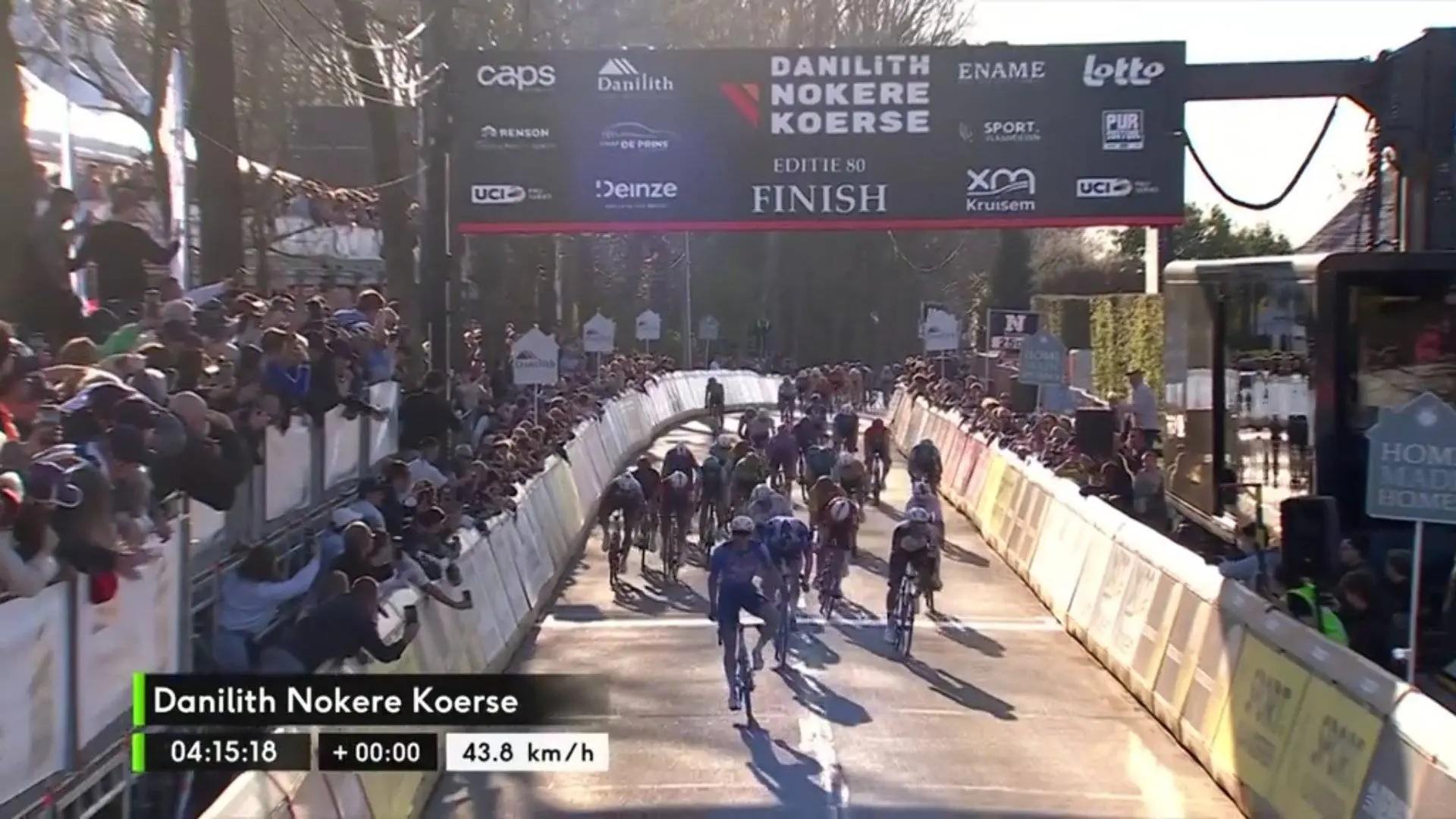
Jasper Philipsen sprinted to victory at Nokere Koerse 2026, denying a courageous late solo effort from Alec Segaert in a dramatic uphill finish that saw the attacker caught inside the final metres.
What had long looked like a controlled build towards a sprint was turned on its head in the closing phase, as repeated attacks, crashes and tactical hesitation fractured the peloton and created the conditions for a late ambush. In the end, however, the race snapped back into a familiar pattern at the last possible moment, with Philipsen delivering a powerful and perfectly timed sprint to claim his first win of the 2026 season.
Early break and controlled build towards the finale
The race followed a familiar Nokere Koerse script in its early phases, with a four-rider breakaway featuring Lionel Taminiaux, Jelle Harteel, Sean Christian and Jonah Killy establishing a steady advantage over a largely controlled peloton.
Sprint-focused teams, most notably Alpecin-Premier Tech and Red Bull - BORA - hansgrohe, kept the gap in check without committing fully to the chase, ensuring the race remained within reach heading into the decisive final laps around Nokere.
Despite the presence of wind and multiple cobbled sectors, the peloton resisted splitting in the middle phase of the race, with positioning battles intensifying but no move proving decisive. Several riders hit trouble along the way, including Hugo Hofstetter, who crashed more than once, and Pascal Ackermann, who was eventually distanced and ruled out of contention before the finale.
Attacks increase, but sprint teams hold firm
As the race moved inside the final 50 kilometres, the intensity began to rise. Teams without a clear sprint option attempted to force the race open, with repeated accelerations on sections such as the Lange Ast and Nokereberg.
However, those efforts were consistently neutralised. Riders like Gianni Vermeersch played a key role in shutting down moves, while the sprint teams maintained a strong presence at the front, preventing any group from establishing a meaningful advantage.
Even as the race began to thin out and fatigue set in, the underlying pattern remained unchanged. Attacks came and went, but the lack of cooperation between riders with differing objectives ensured that the peloton, although reduced, remained largely intact.
Segaert blows the race apart in late solo move
The race finally exploded inside the final 15 kilometres, when Alec Segaert launched a decisive solo attack that immediately disrupted the balance of the race.
Riding in a low, aerodynamic position, the Belgian quickly built a significant gap, at one stage approaching half a minute, as the peloton hesitated behind him. Bahrain’s presence in the group further complicated the chase, with teammates disrupting the rhythm and making it difficult for the sprint teams to organise an effective response.
Behind, the race became increasingly fragmented. Small groups formed and merged repeatedly, but a lack of cohesion prevented a structured chase from developing. Riders looked to each other for responsibility, and crucial seconds slipped away as Segaert pressed on alone.
Late hesitation proves costly for chasing peloton
As the race entered the final kilometres, the dynamic remained finely balanced. Segaert began to show signs of fatigue, forced out of the saddle on the cobbles as the effort took its toll, but the chasing group continued to struggle with organisation.
More teams eventually committed riders to the front, and the gap began to fall, but the delay in forming a coherent chase would prove decisive in shaping the finale.
The uphill finish added further complexity. For Segaert, it offered a chance to resist the charge from behind if he could carry enough speed into the final kilometre. For the sprinters, it meant the effort would favour those capable of producing power after a long and chaotic build-up.
Philipsen delivers decisive sprint after last-gasp catch
In the end, the catch came at the last possible moment.
Inside the final metres, Segaert’s advantage finally disappeared as the peloton surged past, transforming the race from a solo bid into a reduced sprint on the rising finish.
Philipsen reacted instantly. Well-positioned in the decisive moments, he launched his sprint with authority and powered clear of his rivals, securing a convincing victory ahead of Sebastian Molano. A late crash added further disorder behind him, but did nothing to affect the outcome at the front.
For Segaert, it was a brutal conclusion to one of the rides of the day, caught within sight of the line after committing fully to his attack. For Philipsen, it was a statement success, controlled, patient, and ultimately decisive when it mattered most.

Results powered by FirstCycling.com
Carlos Silva is a writer for CyclingUpToDate.com, where he contributes race reports, interviews, analysis pieces, and live coverage of the international cycling calendar. Holding a degree in Sports from the Jean Piaget Institute, he combines academic knowledge of performance, training, and competition with hands-on journalism experience in professional cycling.
Throughout his career, Carlos has conducted interviews with leading figures in the sport, including Alberto Contador, Joaquim Rodríguez, Óscar Pereiro, João Almeida, Isaac del Toro, Derek Gee, John Degenkolb and Geraint Thomas. These conversations reflect direct engagement with Grand Tour winners, Classics specialists, and emerging talents.
He has provided on-site coverage at major events ranging from the Vuelta a España to the Tour de France, alongside stage races such as Vuelta a Andalucía, Volta ao Algarve, Volta a Portugal and O Gran Camiño. Covering the mythical climbs of the Giro d'Italia remains one of his professional ambitions.
Carlos is responsible for liveblog coverage of all major WorldTour races and beyond, including the Tour de France, Giro d'Italia and Vuelta a España. His reporting integrates verified data from ProCyclingStats to ensure statistical accuracy, contextual depth, and analytical precision.
A lifelong cycling enthusiast, he approaches storytelling across written, photographic, and video formats with a focus on credibility, tactical insight, and informed race interpretation.
claps 0visitors 0
Just in
Popular news

Latest comments
- Bernal won the Tour because his attack stuck after Thomas’s was reeled in, and then they ended the stage due to the landslide - a deserved win, but contingent on many things. He won the Giro with quality and skill. And then, like so often happens for the cruelest of reasons, his injuries left him an incomplete version of his former self. He’s had a great career, what a great GC rider (8 of his 23 wins are GC, including 2 grand tours and 2 of the 7 major GC races), but already was struggling after COVID. I wish him the best, and if he retires, he should retire with pride for a career well done!RidesHills07-10-2026
- Roglič? In an interview he’ll continue to be hilariously dry about his goals, emphasize that he’s still having fun, and keep churning along until he doesn’t want to do this anymore. “Ah, you know, 100 wins would be nice, but eh - it’s just a number. I have fun, you know?” I can almost hear him saying those words. He’s not heading for low rank races to get the wins, he continues to race the major races (and I suspect would have won the Vuelta again were it not for that awful accident and that disgusting purple leg right before racing began).RidesHills07-10-2026
- BTW the list of classics you gave from PCS is participation, not winning
 Rafionain-Glas07-10-2026
 - Yes, though we saw that last week already.Jumpyjohn07-10-2026
- Or that riders get out in time.Jumpyjohn07-10-2026
- Hope he doesn’t stick with it just for that, would hate to see him exhibiting any has been footballer behaviour.Jumpyjohn07-10-2026
- Yep, that’s about it, couldn’t imagine someone wouldn’t get that.Jumpyjohn07-10-2026
- Time for your meds I thinkJumpyjohn07-10-2026
- No surprise here. Nice the oldies are having success, not the first discipline where you expect age to be an advantageJumpyjohn07-10-2026
- Any idea why Remco wasn’t there, Lombardia?Jumpyjohn07-10-2026
Loading
Write a comment