DISCUSSION - Tour de France Stage 11 - Philipsen's curse lives on? Cipollini’s record falls after 26 years
Cycling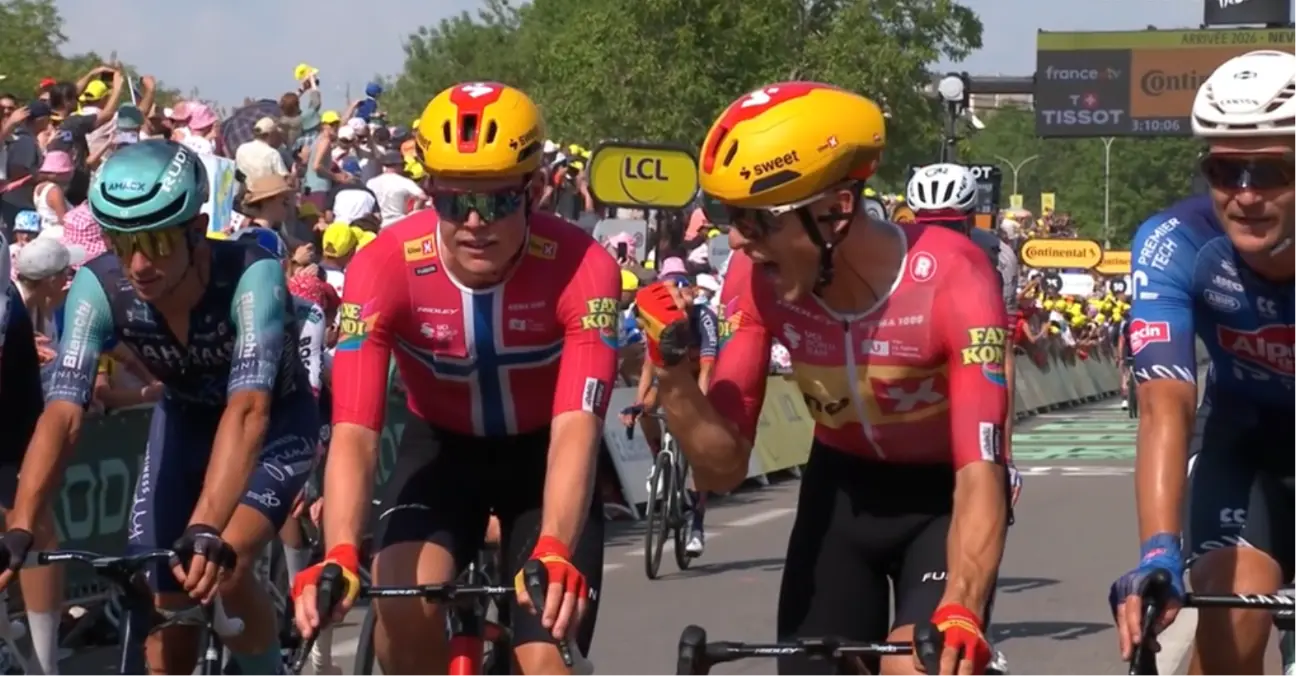
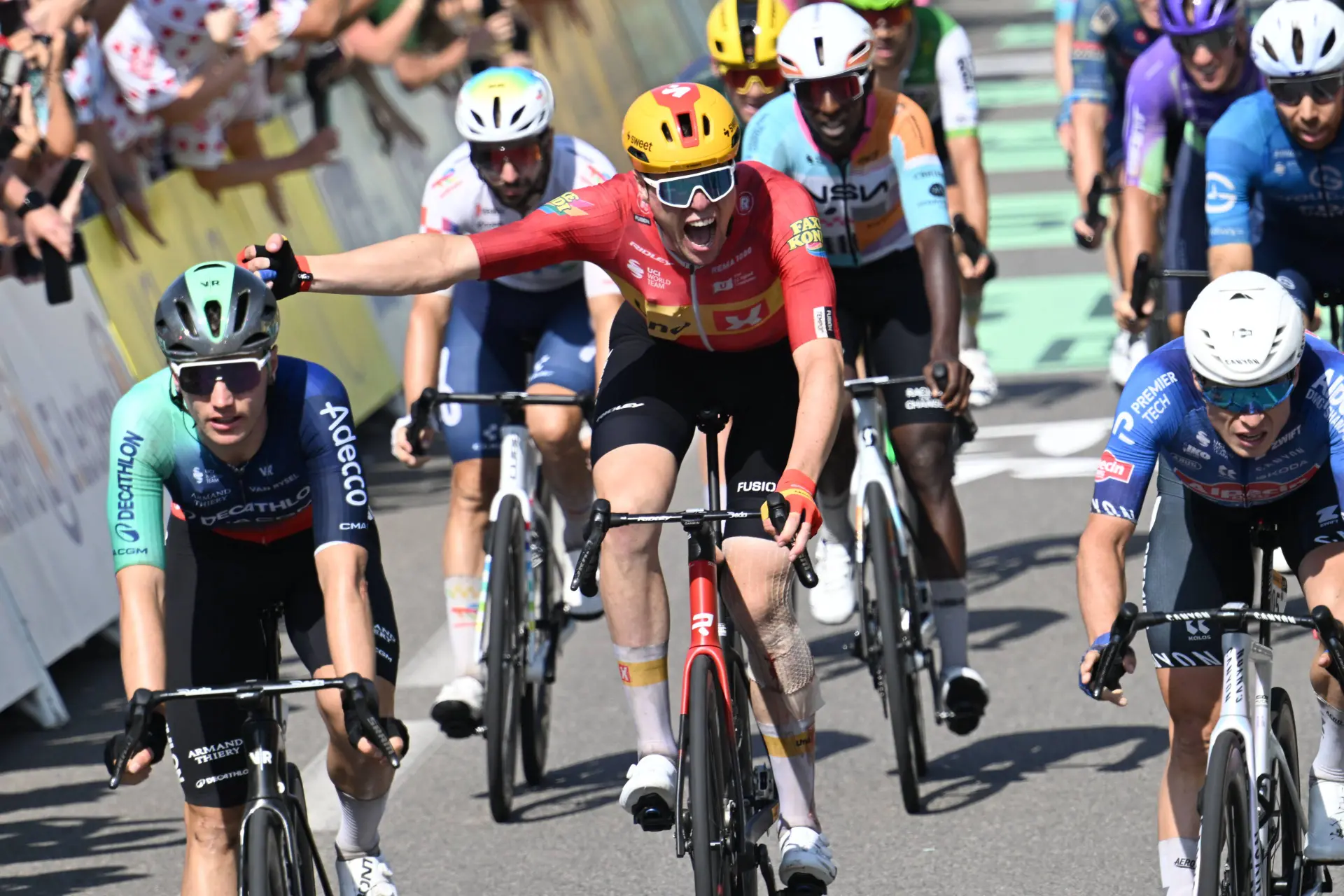
Soren Waerenskjold produced one of the biggest surprises of this year's Tour de France by winning stage 11 in Nevers. The Norwegian outsprinted the likes of Olav Kooij and Jasper Philipsen after launching a long sprint in a chaotic finale, while pre-stage favourite Tim Merlier was unable to contest the finish.
Following the demanding stage through the Massif Central, the 161.3 km route from Vichy to Nevers was expected to end in a bunch sprint. Aside from two fourth-category climbs, the parcours offered few opportunities for attackers, making it an ideal day for the fast men.
Van der Poel sparks aggressive start
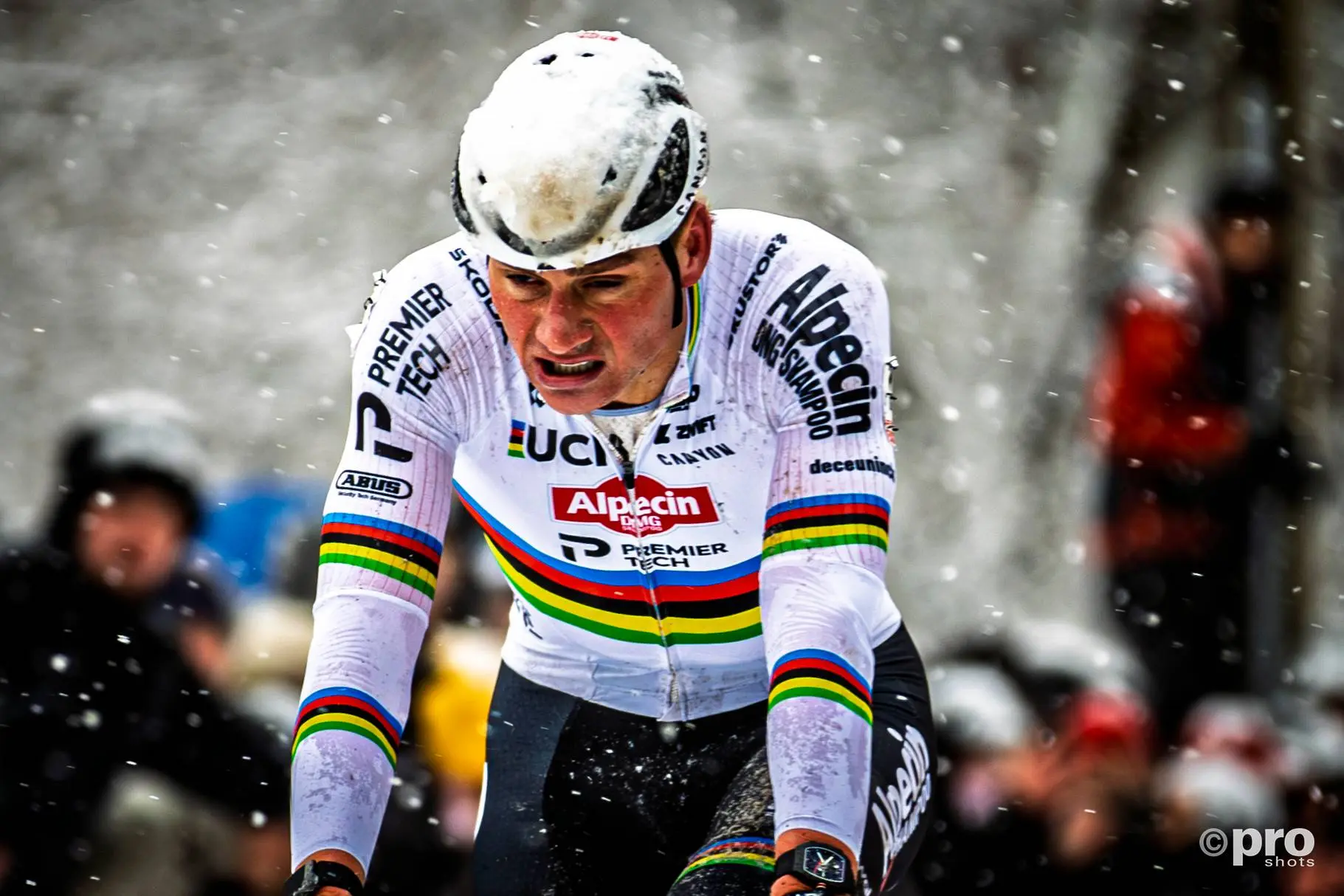
Mathieu van der Poel animated the opening kilometres by attacking almost immediately after the start despite having Jasper Philipsen as Alpecin-Premier Tech's designated sprinter. Although his moves were quickly neutralised, they sparked an aggressive opening phase before a four-man breakaway finally established itself.
Julian Alaphilippe, Anthon Charmig, Nelson Oliveira and Mathis Le Berre built a modest advantage that never exceeded around one and a half minutes as the sprint teams kept the escape under control.
At the intermediate sprint in Saint-Pourçain-sur-Sioule, Le Berre collected maximum points. Behind, Philipsen edged Mads Pedersen in the battle for the remaining points, gaining two valuable points in the fight for the green jersey.
Breakaway caught before tense finale
The breakaway continued to work well together, although Alaphilippe was dropped on the Côte de Billy Chevannes. Nelson Oliveira, Charmig and Le Berre resisted until the final six kilometres before being reeled in by the peloton.
The narrow roads into Nevers made positioning extremely difficult, creating a nervous but unusually controlled run-in. The peloton only fully accelerated inside the final two kilometres.
Waerenskjold surprises the favourites
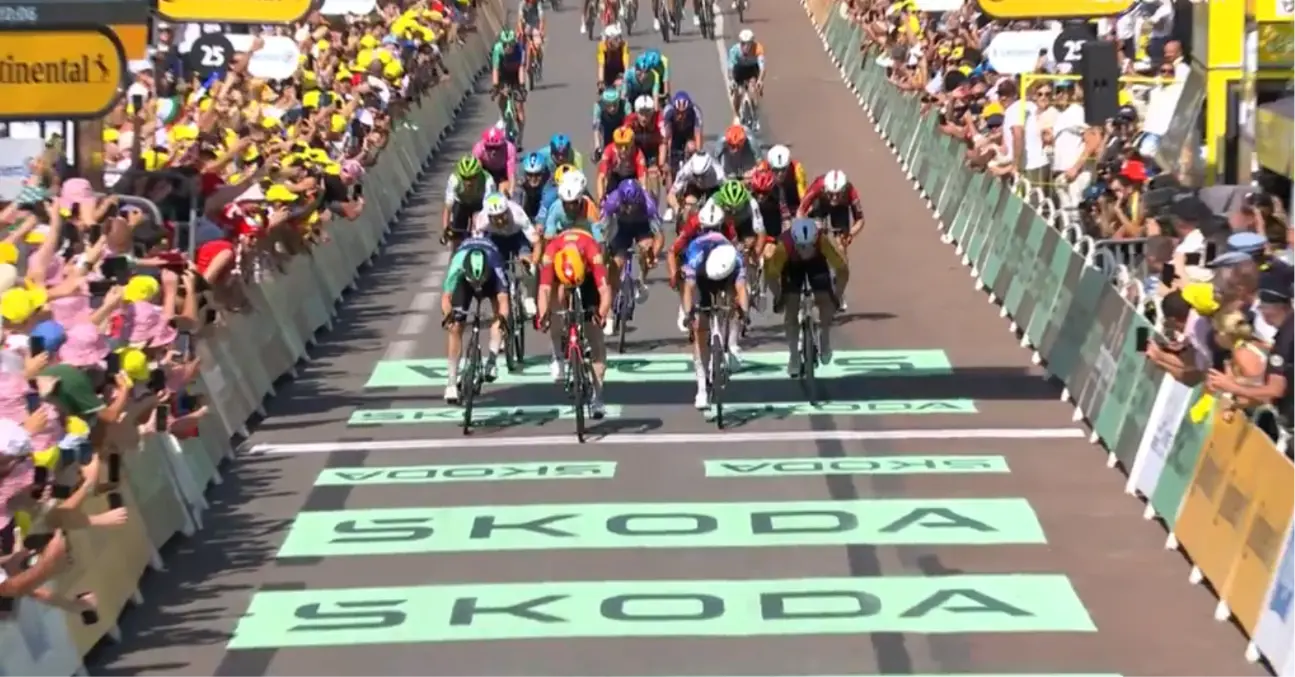
The expected lead-out trains never fully materialised. Cees Bol briefly opened a gap in the closing metres before Waerenskjold reacted instantly, launching his sprint from distance.
Olav Kooij and Japer Philipsen closed rapidly in the final metres but were unable to catch the Norwegian, who celebrated the biggest victory of his career with his first Tour de France stage win. Kooij finished second, Philipsen crossed the line in third, while Merlier could only manage 15th place.
After the finish, Philipsen was briefly relegated for an irregular sprint, but following an appeal from Alpecin-Premier Tech the race jury overturned the decision, restoring the Belgian to third place.

Mathieu van der Poel and Valentin Paret-Peintre were the first to attack from the peloton, quickly opening up a small gap over the bunch.
One record falls, another pattern continues
Carlos Silva from CyclingUpToDate, followed every moment of Stage 11 of the Tour de France and shared his thoughts after witnessing a record-breaking day on the roads of France.
Records are made to be broken: the fastest Tour stage in history and a sprint that confirmed the inevitable. For a long time, the cycling world waited for Mark Cavendish to surpass Eddy Merckx's record for the most Tour de France stage victories. Today, however, another record fell, one that had stood since the 1990s, when Mario Cipollini set the fastest average speed ever recorded in a road stage of the race.
A huge share of the credit belongs to the day's four breakaway riders: Anthon Charmig, Nelson Oliveira, Julian Alaphilippe and Mathis Le Berre. It was a strong move, and the peloton quickly realised it could not afford to give them too much freedom. With favourable tailwind conditions for much of the stage, the average speed remained incredibly high, while the bunch, led for most of the day by NSN Cycling Team, XDS Astana Team and Soudal Quick-Step, kept the pressure on with relentless turns at the front.
The stage eventually produced a winner who was far from unexpected. Soren Waerenskjold of Uno-X Mobility took full advantage of an acceleration from a Decathlon CMA CGM Team rider to launch his sprint from long range and write his name into the history of the 113th edition of the Tour de France.
Olav Kooij came up just short once again, finishing second, while Jasper Philipsen, who had won the intermediate sprint contested by the peloton earlier in the day, manage sixth place, one position ahead of Mads Pedersen. Despite entering the final kilometre with a six-man lead-out train, Philipsen still could not deliver the victory.
At this point, it is hard to escape the conclusion: no matter how many times he tries, Jasper Philipsen simply is not going to win a stage at this year's Tour de France.

Nelson Oliveira, Anthon Charmig and Mathis Le Berre were the driving forces behind the breakaway for most of the stage. Julian Alaphilippe was also among the escapees, but he was dropped on the day's final climb before being reeled in by the peloton.
Soren Waerenskjold reminded us why sprinting is about more than speed
Pascal Michiels of RadsportAktuell followed every kilometre of the day of the Tour de France before giving his take on a truly historic day in France.
This is exactly why cycling fans should never reduce sprinting to watts, lead-outs and top speed. On paper, Soren Waerenskjold should not have won in Nevers. Olav Kooij had the better train, Jasper Philipsen had the pedigree and Tim Merlier had looked like the fastest man in the race.
But sprinting is not decided on paper. It is decided in a few chaotic seconds, when courage and instinct matter just as much as raw power. Waerenskjold read those seconds better than anyone.
When Cees Bol launched and Philipsen failed to follow, the Norwegian did not wait for permission. He jumped onto the wheel, recovered for a fraction of a second and then committed to a sprint that looked far too long. That was not luck. That was racing intelligence.
It also made the victory even more satisfying. Wærenskjold has never pretended that he wants to live like a priest for twelve months of the year. He allows himself to switch off completely now and then.
Some riders live every hour according to a training plan. Waerenskjold does not want cycling to swallow his entire life. There is something refreshing about that, because when it truly mattered today, he was fully switched on.
His decisive move said everything. Wærenskjold squeezed through the smallest possible gap between the Nadar barriers and the peloton. Most riders would have hesitated. At that speed, hesitation would have been understandable.
He saw the space, trusted his bike handling and forced his way through. That is the kind of move cycling fans remember. Waerenskjold was not merely the strongest sprinter today. He was the smartest and the bravest. On the fastest Tour stage ever, the winner was the man willing to take the impossible path. A truly remarkable victory.

Soren Waerenskjold won the fastest road stage in Tour de France history, setting a new record for the highest average speed. The celebrations at Uno-X Mobility must have become even bigger once the Norwegian team's achievement was confirmed.
Waerenskjold's intelligence triumphed on the fastest day in Tour history
Javier Rampe from CiclismoAlDia enjoyed another day of cycling at the highest level and was captivated by the drama of a breathtaking finish
It was a tense stage with an equally tense finale. Soren Waerenskjold may not have been the fastest sprinter in the peloton, but he emerged victorious on the fastest road stage in Tour de France history.
The Norwegian won through pure race intelligence. He anticipated the decisive moment perfectly, catching an entire peloton by surprise and leaving Jasper Philipsen with no answer. The Belgian seems to have run out of ways to chase a stage victory in this year's Tour. To make matters worse, he threw an elbow at Pavel Bittner during the finale, adding another chapter to his increasingly controversial reputation. Aggressive and ill-tempered in defeat, it is an image that should not be glossed over.
As for Stage 11 itself, it was a brutally demanding day. Juan Ayuso even described it afterwards as the hardest stage of this Tour so far, and it is difficult to disagree. Racing at relentless speed in a compact peloton, with the wind constantly adding to the strain, creates a combination of physical exhaustion and mental tension that few stages can match.
Elsewhere, the breakaway fought bravely despite knowing the odds were stacked against them. A special mention must go to Nelson Oliveira. The experienced Portuguese rider never skipped a turn on the front, committing himself entirely to a move that was always likely to fail, hoping that, just this once, everything would fall into place for a struggling Movistar Team in 2026.
Verdict
Three different perspectives, but all arriving at the same conclusion. Stage 11 was about far more than another bunch sprint. It was a day that rewrote the Tour de France record books, demanded relentless commitment from both the breakaway and the peloton, and rewarded the rider who combined courage with flawless decision-making.
The common thread running through every analysis is that Soren Waerenskjold's victory was anything but accidental. He may not have been the outright fastest sprinter in the field, but he was undoubtedly the rider who understood the finale best. In a finish decided by split-second choices rather than pure speed, his positioning, confidence and willingness to take risks proved decisive.
There is also broad agreement that the record average speed was no coincidence. The strength of the breakaway, favourable wind conditions and an unrelenting chase by the sprint teams created an intensity that rarely eased from start to finish. It was a stage where everyone was forced to race at the limit, regardless of whether they were attacking or chasing.
Another shared observation is the growing frustration surrounding Jasper Philipsen. Once regarded as the benchmark in flat finishes, he again found himself on the wrong side of the decisive move and failed to convert an ideal lead-out into victory. His actions in the closing metres only added to the sense that this Tour is becoming one to forget.
Ultimately, Stage 11 will be remembered for more than just a new speed record. It was a reminder that cycling still rewards instinct as much as numbers. On a day when the margins were almost impossibly small, intelligence, bravery and timing proved more valuable than raw power alone.
And you? What did you make of the stage 11 of the Tour de France 2026? Tell us your thoughts, share your opinion on all the key moments and incidents from the race, and join the discussion.
Carlos Silva is a writer for CyclingUpToDate.com, where he contributes race reports, interviews, analysis pieces, and live coverage of the international cycling calendar. Holding a degree in Sports from the Jean Piaget Institute, he combines academic knowledge of performance, training, and competition with hands-on journalism experience in professional cycling.
Throughout his career, Carlos has conducted interviews with leading figures in the sport, including Alberto Contador, Joaquim Rodríguez, Óscar Pereiro, João Almeida, Isaac del Toro, Derek Gee, John Degenkolb and Geraint Thomas. These conversations reflect direct engagement with Grand Tour winners, Classics specialists, and emerging talents.
He has provided on-site coverage at major events ranging from the Vuelta a España to the Tour de France, alongside stage races such as Vuelta a Andalucía, Volta ao Algarve, Volta a Portugal and O Gran Camiño. Covering the mythical climbs of the Giro d'Italia remains one of his professional ambitions.
Carlos is responsible for liveblog coverage of all major WorldTour races and beyond, including the Tour de France, Giro d'Italia and Vuelta a España. His reporting integrates verified data from ProCyclingStats to ensure statistical accuracy, contextual depth, and analytical precision.
A lifelong cycling enthusiast, he approaches storytelling across written, photographic, and video formats with a focus on credibility, tactical insight, and informed race interpretation.
claps 0visitors 0
Just in
Popular news

Latest comments
- It will absolutely change his tt position. Call me out if I'm wrong, when we start seeing him training on the tt bike, you will see.awp27-10-2026
- please , come on now! The Tour begins July 2, 2027!!! It is still 2026 !!!! Get a hobby or something.dave26-10-2026
- How is this relevant? Perhaps you are doing a Coleridge but not poetic
 Rafionain-Glas26-10-2026
 - Brilliantly putRafionain-Glas26-10-2026
- vingegaard will get humiliated. he might not even make the podium. he should retire, or accept being handed down the ranks.Ketterechts26-10-2026
- Bull crap...his C7 injury won't affect his TT position!frieders326-10-2026
- blah blah blah is all I see in your comment!frieders326-10-2026
- i thought they were cycling journalists. either they don‘t know the basics or they don‘t write their reports. either way suboptimal … it is not an american team anymore!Ketterechts26-10-2026
- Quiz, who said "When I watched the Worlds and the Euros, it made me miss racing of course, but I’d say that the older I get, the easier it becomes to stay away from racing and find other things I enjoy." Clue, not Elie Isabit in the doghouse now for supposing he can second guess MVDP, who has the added complication of women having a say these days in his circumstances, something Fien might have explained to him if he’d bothered asking, hope he doesn’t get a talking to for that. And speaking of that, I noticed he celebrated 10 years together in 2023 and yet in 2017 he was definitely with someone else, could get messy tonight. Bye for nowJumpyjohn26-10-2026
- Wout has the lifetime contract. I think he gets first shot no matter what.mij26-10-2026
Loading
Write a comment