
Sanremo, Italy - The 2026 editions of Milano-Sanremo delivered two spectacular finales, with Tadej Pogacar claiming the men’s Monument after a dramatic two-up sprint against Tom Pidcock, while Lotte Kopecky timed her move to perfection to win the women’s race from a select front group on the Via Roma. Both races were shaped by crashes, aggressive racing on the Cipressa and decisive selections on the Poggio, producing tense finishes worthy of cycling’s longest Classic.
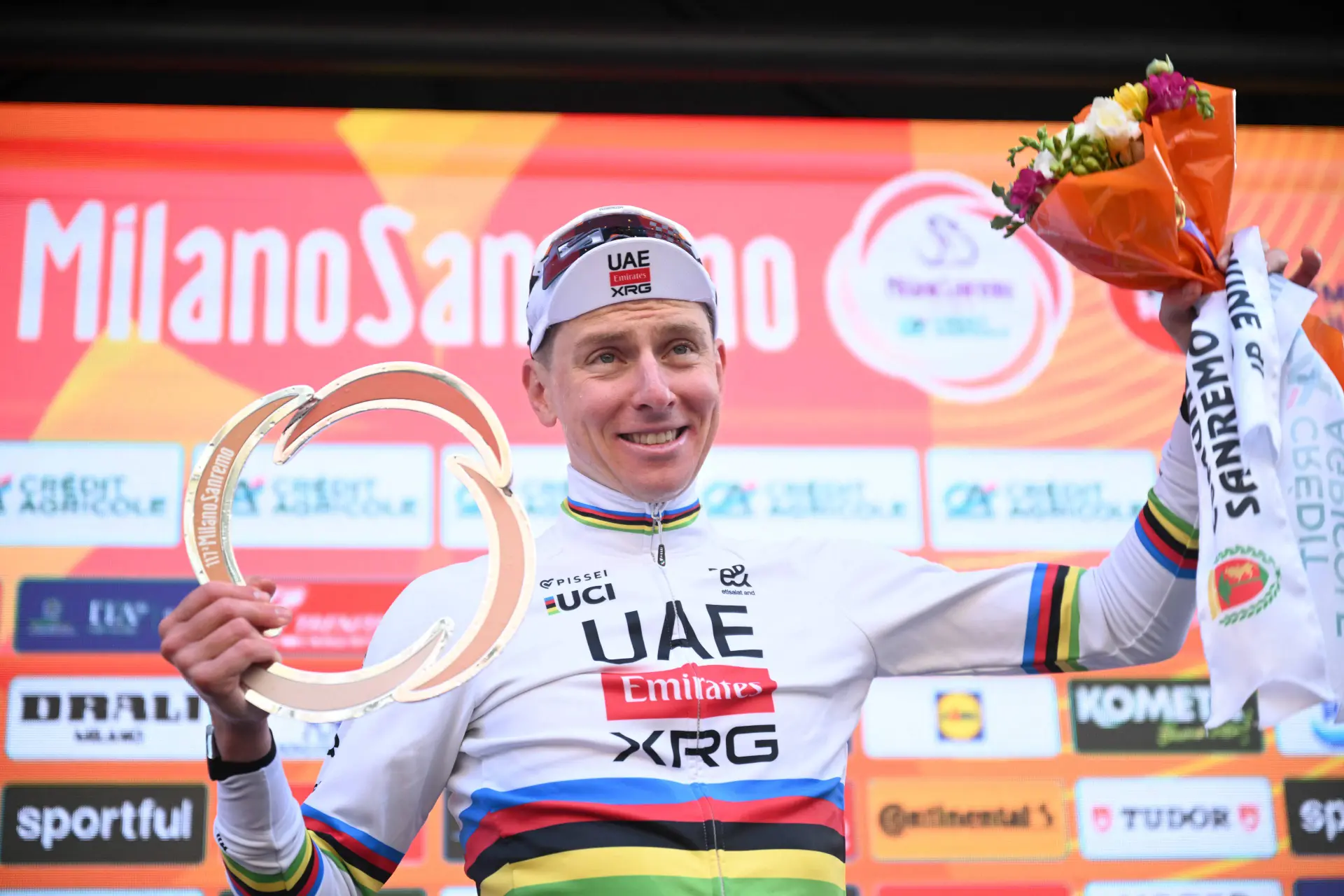
Pogacar finally conquers Sanremo after chaos-filled Monument
The men’s race followed the traditional script for more than 200 kilometres, with an early breakaway allowed to build a large advantage while the peloton remained under control, largely thanks to the steady work of Alpecin-Premier Tech and Silvan Dillier.
The tempo began to rise as UAE Team Emirates - XRG moved forward approaching the Ligurian coast. Domen Novak increased the pace and gradually reduced the gap, signalling the transition from endurance to intensity before the decisive climbs.
Tension exploded in the run-in to the Cipressa, where positioning became crucial. In the fight for the front, the race was turned upside down when Tadej Pogacar crashed heavily, bringing down Wout van Aert, Biniam Girmay and Matteo Jorgenson. All remounted, but the damage was significant. Van Aert lost time after a bike change, while Pogacar had to chase back despite visible signs of the fall.
Once on the Cipressa, Pogacar immediately took control. UAE had already thinned the peloton through Brandon McNulty and Isaac del Toro, but the Slovenian’s repeated accelerations forced the decisive selection. Tom Pidcock proved the only rider able to consistently respond, while Mathieu van der Poel struggled to hold position as the pace increased.
The climb did not produce a decisive gap, but the race was stretched and reduced heading toward the Poggio. There, Pogacar attacked again and this time the pressure dropped Van der Poel, leaving only Pidcock able to follow. The race was suddenly reduced to a two-man battle at the front, while Van der Poel was caught by a chasing group that included a recovering Van Aert.
Over the top of the Poggio, Pogacar and Pidcock committed fully. They worked together through the descent and into the final kilometres, knowing hesitation would allow the chasers back. Pidcock pushed the pace downhill, but Pogacar matched every move as the pair headed toward Sanremo.
Behind them, the chase remained alive. Van Aert launched a late attack in an attempt to bridge across, but the gap proved just too large.
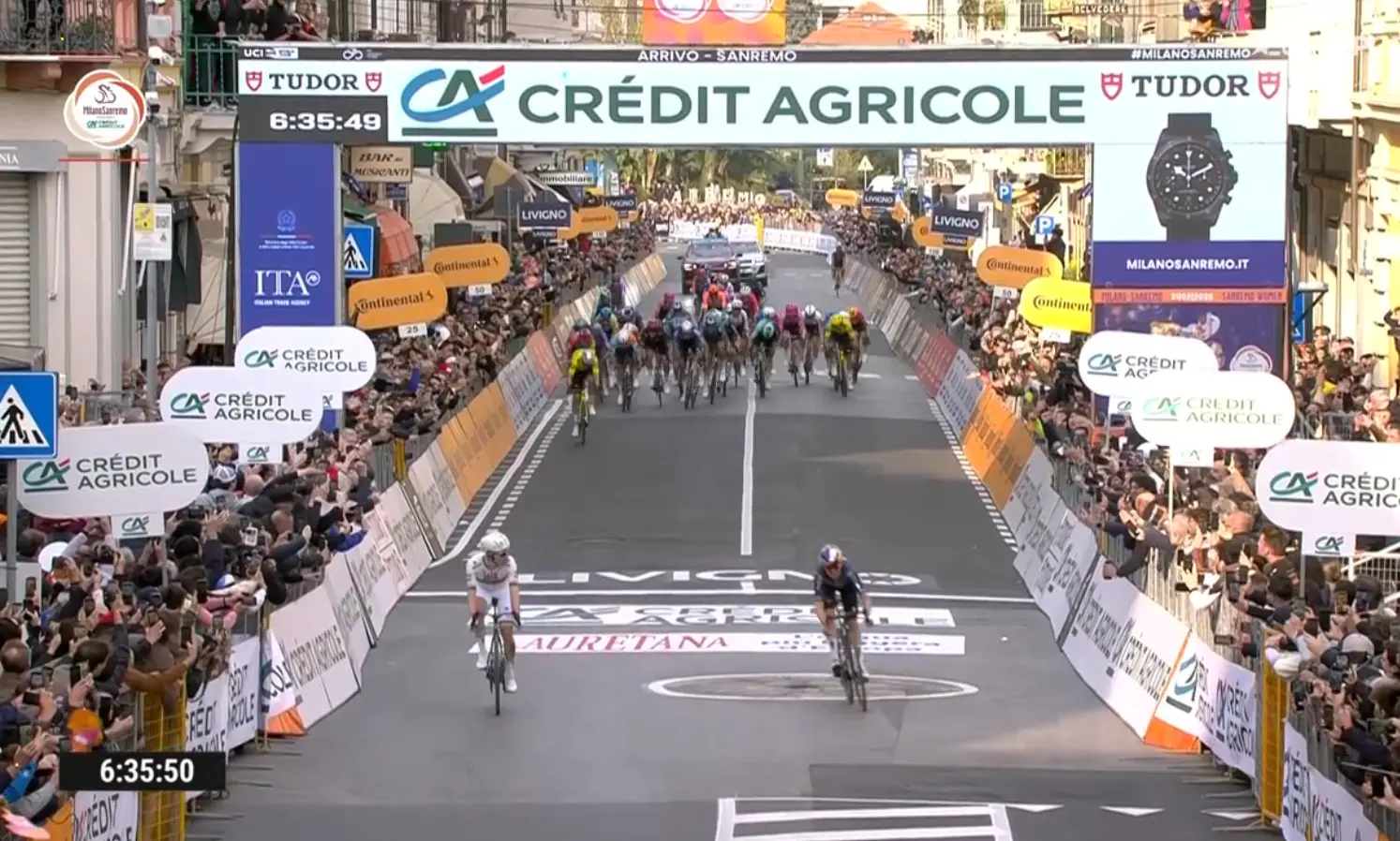
Inside the final kilometre, cooperation ended. Pidcock stopped pulling, forcing Pogacar to lead into the Via Roma. The Slovenian launched first, committing to a long sprint. Pidcock came alongside in the final metres, but a photo finish confirmed Pogacar as the winner, finally claiming Milano-Sanremo after years of aggressive attempts.
Pidcock’s ride confirmed his status among the elite, matching Pogacar on both the Cipressa and the Poggio and pushing him all the way to the line. Behind them, the sprint for third came from the reduced peloton after Van Aert’s late move was neutralised, completing a Monument defined by crashes, comebacks and relentless attacking.
Kopecky wins Milano-Sanremo Women after Poggio selection
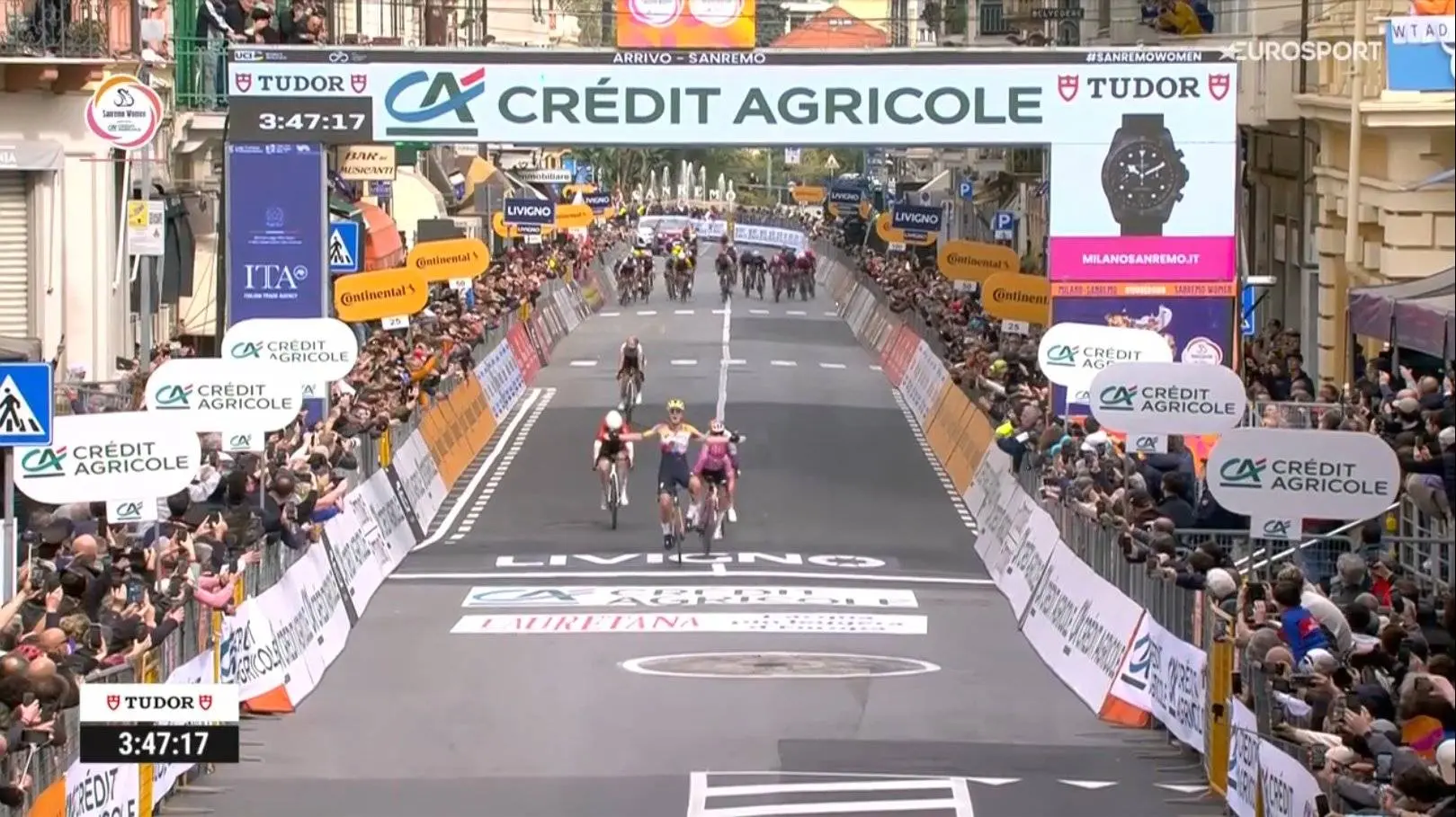
In the women’s race, Lotte Kopecky delivered a perfectly judged performance to win Milano-Sanremo Women 2026 from a small lead group, finishing ahead of Noemi Ruegg and Eleonora Gasparrini after a race shaped by crashes on the Cipressa and a decisive selection on the Poggio.
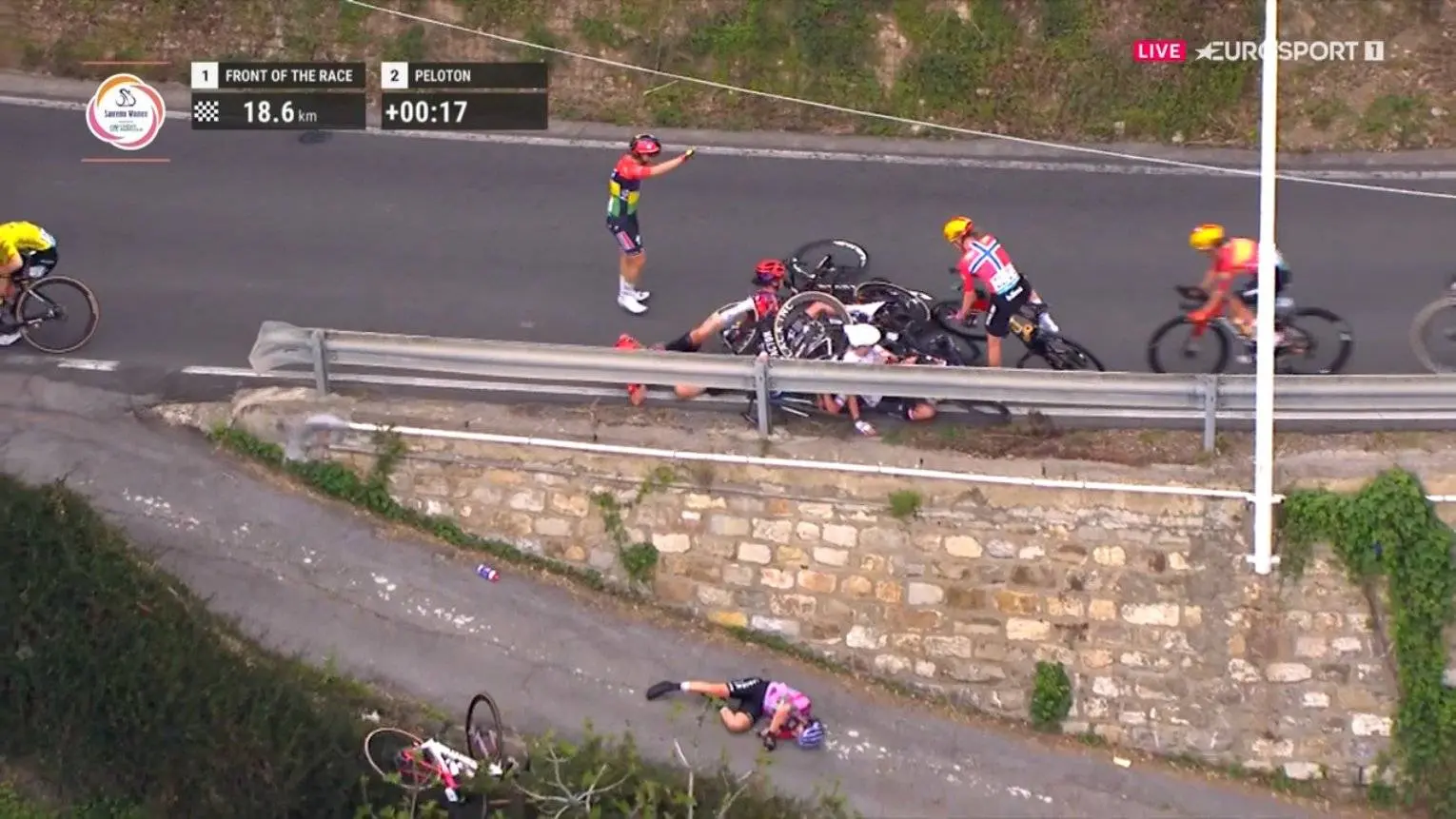
The race initially unfolded in controlled fashion, with SD Worx-Protime managing the peloton while the breakaway was brought back ahead of the Cipressa. The decisive phase began on the descent, where a heavy crash eliminated key contenders including Kasia Niewiadoma and Kim Le Court, disrupting the rhythm of the race at a crucial moment.
The incident allowed a larger group to reform briefly, raising the possibility of a sprint, but that scenario disappeared on the Poggio. A powerful acceleration from Puck Pieterse created the decisive split, with Kopecky, Ruegg and Gasparrini among those able to follow, while sprinters such as Lorena Wiebes were left behind.
Five riders - Kopecky, Ruegg, Gasparrini, Pieterse and Dominika Wlodarczyk - held a narrow advantage into the final kilometres. The cooperation was limited but enough to keep the chase at bay as the race approached Sanremo.
In the finale, Wlodarczyk worked on the front in support of Gasparrini, while Kopecky stayed perfectly positioned just behind, waiting for the sprint. When the finish opened on the Via Roma, the Belgian launched at exactly the right moment, securing victory with a powerful acceleration.
Kopecky’s win completed a race that never followed a single script. What began as a controlled scenario was first shaken by attacks on the Cipressa, then reshaped by the crash on the descent, before finally being decided by the selective effort on the Poggio.
Carlos Silva (CiclismoAtual)
Let’s start with the women’s race. The race truly began on the climb to the Cipressa. Until that point, SD Worx had kept the breakaway group under control. It was on the descent of the Cipressa that a frightening moment occurred, when a group of riders crashed heavily, and Débora Cipressi remained motionless after the violent fall.
On the Poggio, Puck Pieterse increased the pace and only five riders remained at the front of the race. That group entered Via Roma to contest the victory in a reduced sprint. Wiebes showed she was the strongest, launching her sprint and raising her arms to take home the first Monument of the year.
In the men’s race, things did not start in the best way. Just as had happened the week before in a women’s race, the organization cars led the riders off the course. It involved a group that was trying to break away from the peloton, and they were caught shortly afterwards.
Soon after, nine riders escaped and formed the breakaway of the day. Among them were two riders from Team Polti VisitMalta, who spent many hours at the front of the race and were able to show their special retro jerseys, commemorating the great achievements of the Italian team in the 1990s.
UAE lost one of its riders early, Jan Christen, who was supposed to be part of Pogacar’s train for the Cipressa, after a crash. Later, half of the INEOS Grenadiers team was also involved in a crash. Michał Kwiatkowski was the first to fall in a scary moment, as the Polish rider hit a road sign hard. I hope he is alright.
With the Tre Capi behind them, the peloton approached the Cipressa, and in a tense moment Tadej Pogacar, Wout van Aert, Biniam Girmay and others were involved in another crash. Pogacar and UAE had to recover the lost time before the start of the climb, and they managed to do so because no team was truly interested in attacking on the Cipressa, except UAE.
Pogacar rejoined the peloton, got on Brandon McNulty’s wheel and quickly moved to the front of the race, showing that despite the crash he was physically fine and the plan had not changed. McNulty kept the pace high, then when he pulled aside Isaac del Toro increased the speed, before the world champion launched his attack, followed only by Tom Pidcock and Mathieu van der Poel.
The trio crossed the top of the Cipressa with a small advantage over the chasing group, and that gap remained until the start of the final climb, the Poggio. Mathieu van der Poel was the first of the leading trio to struggle, and in my opinion it was not due to physical issues alone.
Although there is a possibility he was also involved in a crash that was not shown on television, something did not seem right with the Dutch rider. More than a physical problem, could it have been a nutrition issue? Pogacar had also crashed, so the drop in performance from the Dutchman on the final climb did not seem to be caused only by that possible fall.
Pogacar tried to drop Tom Pidcock on a Poggio packed with fans, but once again the gradients were not steep enough to create real differences. The two entered Via Roma together, chased by Wout van Aert, who had managed to escape from the peloton. The victory would be decided in a two-man sprint.
Pogacar launched his sprint, Pidcock stayed on his wheel and tried to pass him on the left, and for a moment they seemed to be side by side. The suspense, the emotion, the adrenaline were at their peak. Pogacar crossed the finish line and clenched his right fist. He had done it. The victory he had chased for years was finally his.
It was a hard-fought win, as Tom Pidcock made the Slovenian work for it until the very end. Now only Paris-Roubaix is missing.
Congratulations, Pogi. You deserved it.
Ruben Silva (CyclingUpTodate)
Well this really was just Pogacar's race wasn't it. Although it is by far the least selective monument, it has become a two-up race between him and Mathieu van der Poel on paper and regarding where everyone would look at.
This year Tom Pidcock managed to join them, nailing his positioning and having his best form. Filippo Ganna did too, but did not have the same legs as last year on the Cipressa, whilst Visma were struck by bad luck.
The crash changed everything. Or did it? Maybe it changed nothing? For months we've been talking about UAE's tactics, which of course consisted of positioning and pacing the first minutes of Cipressa - and who they would take to launch Pogacar.
Tim Wellens and Jhonatan Narváez injured, Jan Christen crashed out... No matter how much you make a plan for Sanremo, you can't make it happen as a videogame, because every single team will fight to the bottom of Cipressa, and its impossible to have everyone in the right place.In this case, no-one in the right place, as Pogacar crashed.

But then he went on to, by far, beat the climbing record on the Cipressa, battered and bruised. He started the climb from the bottom of the peloton, helped by his teammates and by BORA's Danny van Poppel whom he defended on social media last year (and has a contract running out, coincidentally) but because no other team even showed intent on pushing the pace, he quickly made it to the front and UAE did their plan as intended actually.
Isaac del Toro's presence was negligable, he paced for around 20 seconds, but honestly that's the role he was always likely to have.What we saw is what Pogacar got us used to. 'It doesn't make sense', right, it doesn't, that's what he does. He is simply head and shoulders above the competition in virtually every terrain, and I am certain he would've attacked and gone solo off the front on the Cipressa if he hadn't crashed.
After crashing and a less-than-ideal run-up to the Cipressa, he still beat the records on both climbs pacing almost exclusively by himself,pushed on the descents, dropped Mathieu van der Poel and also beat an impressive Tom Pidcock in a sprint.
The crash seemingly did nothing, and he was just as strong as one could've hoped for. I feel like Roubaix is the only thing in the way of winning all five monuments this season - alongside the Tour de France and World Title - because this display looks to be above even his 2025 level.

Tom Pidcock: I've praised him, but it's worth doing so again. Incredible climbing level, this time around he was perfect with the endurance and positioning aspects, which were his main obstacles. He did also deserve the win, but a second place here is fully worthy of a big mention.
Wout Van Aert: It's not secret I cheer on him quite a bit, because of his countless instances of bad luck, but also because he (and Mads Pedersen) are the 2 riders that can battle the 'big two' in the big classics (I guess Pidcock can be added, if there are no cobbles). Hence I always want him to have a perfect run.
The crash with Pogacar was the traditional bad luck, but he and Visma managed to work towards returning to the peloton and then his attack at the end led to an impressive return to the monument podiums, as the peloton was actually sizeable and with plenty sprinters. His form his very very good at the moment, and he is going into the cobbles with the best level he could hope for I feel.

Mathieu van der Poel: I fear the crash did take something out of him. As it does to regular humans I guess, something in which Pogacar does not fit. He looked perfect and I believed we were heading to a third win as soon as he responded to Pogacar's initial attack.
But either the crash or less good nutrition led to a complete crack on the Poggio, a bit of a shock as that was the climb that suited him best. I believe he is fully ready for the cobbled classics too, and he's won so much here that he can't really by fully disappointed.
Jorge Borreguero (CiclismoAldia)
Tadej Pogacar’s victory in Milano-Sanremo 2026 is much more than just a win: it is the culmination of a sporting obsession that had been driving him for years. Pogacar had always struggled with the ‘unpredictable’ nature of the Classicissima, a race that rarely rewards the strongest rider.
That is why this year’s victory is so impressive: not only did he win, but he pushed the race to make it more selective than usual. He attacked time and again - as many as six times between Cipressa and Poggio - including after a crash that would have thrown any other rider off balance.
That persistence reflects an almost obsessive determination to conquer this monument.The key moment came on the Poggio, where he finally managed to shake off Mathieu van der Poel, something that in itself is extraordinary in this type of finish.
However, he couldn’t get the better of Tom Pidcock, leading to an outcome that historically didn’t favour him: a small sprint. And yet, he won it. That detail is perhaps the most significant of all: not only did he try to avoid the sprint, but when he failed to do so, he was still able to prevail.
Ondrej Zhasil (CyclingUpToDate)
And just like that, Tadej Pogacar cleared what many considered the main obstacle on his path to winning every major cycling race - Milano-Sanremo. With that, the Slovenian will surely lose a lot of motivation to come back to La Primavera in the future... but will he?
Undeniably, there will always remain a shadow of doubt cast upon his victory. As impressive as his comeback from the crash before Cipressa was... Surely, Pogacar was affected, but the same goes for his main rival Mathieu van der Poel who, at the end of the day, appeared to have lost much more of his finesse than the world champion.
Pogacar is not one to take half-assed wins and he'll want to win the Monument on equal terms next year. Unless he's already planning a return to Giro...The hero of this edition was the incredible Tom Pidcock who rose above Van der Poel, Wout Van Aert, or Filippo Ganna to become Pogacar's only serious challenger.
And, were the finish line placed a 20 meters further, he would've most likely won as Pogacar was visibly withering down in the final meters. Lesson learned for the Brit; he will have his chance to win Sanremo in the future.Most disappointed will most likely be Filippo Ganna.
Not impacted by the crash of Pogacar, Van der Poel and Van Aert, he still fell awfully short of the three strongest men on Cipressa. There's work to do if the Italian wishes to compete at Paris-Roubaix in three weeks.
Pascal Michiels (RadsportAktuell)
You saw the result, right? Pogacar wins. Again. On paper, it looks almost routine. But this wasn’t routine. Not even close. Let me take you back for a second - because this race flipped on its head before the Cipressa.
A crash. Not just any crash. Pogacar went down. Van Aert too. And yes, Mathieu van der Poel - last year’s winner - was caught right in it. Although it wasn't on camera. And here’s the thing: Pogacar recovered. Van Aert fought back. But Van der Poel? He never really came back the same.
You could see it on the Poggio. That snap, that dominance we expect from him—it just wasn’t there. He tried, of course he did. But when Pogacar accelerated again, Van der Poel cracked. Just like that. From defending champion to chasing shadows, finishing eighth.
Now think about Pidcock.He avoided it all. Clean race. Perfect positioning. When Pogacar attacked, he was the only one who could follow. Cipressa? There. Poggio? Still there. No panic, no wasted effort. At that point you’re thinking: this might be his day.
Final kilometer. Two riders. Pogacar on the front, Pidcock glued to his wheel. You almost expect Pidcock to come around. But he doesn’t. Half a wheel. That’s all it took. Pogacar holds him off and finally adds Milan-Sanremo to his list.
And Van Aert? Somehow - after that crash, after that chase - he still takes third. So yes, Pogacar won. But the real story? Chaos, survival… and the one rider who escaped everything - yet still couldn’t finish it off.

And you? What’s your opinion on Milano - Sanremo 2026? Tell us what you think and join the discussion.
Carlos Silva is a writer for CyclingUpToDate.com, where he contributes race reports, interviews, analysis pieces, and live coverage of the international cycling calendar. Holding a degree in Sports from the Jean Piaget Institute, he combines academic knowledge of performance, training, and competition with hands-on journalism experience in professional cycling.
Throughout his career, Carlos has conducted interviews with leading figures in the sport, including Alberto Contador, Joaquim Rodríguez, Óscar Pereiro, João Almeida, Isaac del Toro, Derek Gee, John Degenkolb and Geraint Thomas. These conversations reflect direct engagement with Grand Tour winners, Classics specialists, and emerging talents.
He has provided on-site coverage at major events ranging from the Vuelta a España to the Tour de France, alongside stage races such as Vuelta a Andalucía, Volta ao Algarve, Volta a Portugal and O Gran Camiño. Covering the mythical climbs of the Giro d'Italia remains one of his professional ambitions.
Carlos is responsible for liveblog coverage of all major WorldTour races and beyond, including the Tour de France, Giro d'Italia and Vuelta a España. His reporting integrates verified data from ProCyclingStats to ensure statistical accuracy, contextual depth, and analytical precision.
A lifelong cycling enthusiast, he approaches storytelling across written, photographic, and video formats with a focus on credibility, tactical insight, and informed race interpretation.
claps 4visitors 4
Just in
Popular news
Latest comments
- Dumb?! Only you!MajorPayne16-10-2026
- Let’s hope it stays in!Lozza16-10-2026
- The words... “Remco, on certain days, will just destroy everyone”... don't hold water. Not EVERYONE, most of them, it all depends on the quality of the riders.PogiSloFans16-10-2026
- "The Tour remains at the centre of Simmons' plans". as long as this is the plan, it is unlikely he will succeed. First his team is stacked with leaders for all terrains so opportunity is less. 2nd the TDF is stacked with other top leaders who have more freedom. 3rd the battle between UAE, Visma, Red Bull is so intense that their leaders will win most of the stages with heir team pulling back most breaks.abstractengineer16-10-2026
- Quinn Simmons: “Maybe I’ll never reach the top level.” I also hope he doesn't. I don't care what he looks like, his religion or sexual preference... but when he's a rascist against black people, a Maga Trump voter, that's where I pull the line. The whole world hates Trump, we all know why, but he keeps voting for him. A person that thinks like Trump is ...????. Make your own decision. PS: Trek-Segafredo (today Lidl Trek) suspended him following the controversy over his pro-Trump comments and his use of a dark-skinned waving-hand emoji. The team said the suspension concerned his racist conduct online, not his political views themselves.PogiSloFans16-10-2026
- Denmarks coach reveals 2027 Rainbow Jersey has been targeted by Jonas for years !?!?!? PS: What??? No one believes this meaningless babbling. It's like saying: "The 2027 Monument - Il Lombardia has been targeted by Jonas for years."PogiSloFans16-10-2026
- I made a mistake and already fixed it. Hey twat, thanks.PogiSloFans16-10-2026
- Davide Piganzoli said: "Pogacar looked less brilliant at TDF than usual." We all see how stupid this comment is. What is happening to his brain cells? ... Hey Piganzoli, Tadej Pogačar’s record breaking ascent of Alpe d’Huez was one of the standout performances in the history of the Tour de France. Pantani's 1995 ascent stood for 31 years. Pogi went more than a minute faster. He accelerated near the foot of the climb, despite the leading breakaway being around three and a half minutes ahead. But in your delusional brain Pogi looked less brilliant???? .... Why don't you go find a corner and bang your head against a wall for about 10 minutes. Everyone is making fun of you.PogiSloFans16-10-2026
- MTB WC ? If he doesnt compete maybe allows MvDP to have a crack
 Davide16-10-2026
 - Jonas is declining now. A podium next year would be a good result for him.Renz16-10-2026
Loading
Write a comment