BREAKING: Visma rider Axel Zingle disqualified from E3 Saxo Classic after embarrassingly blatant sticky bottle
CyclingFriday, 27 March 2026 at 18:42
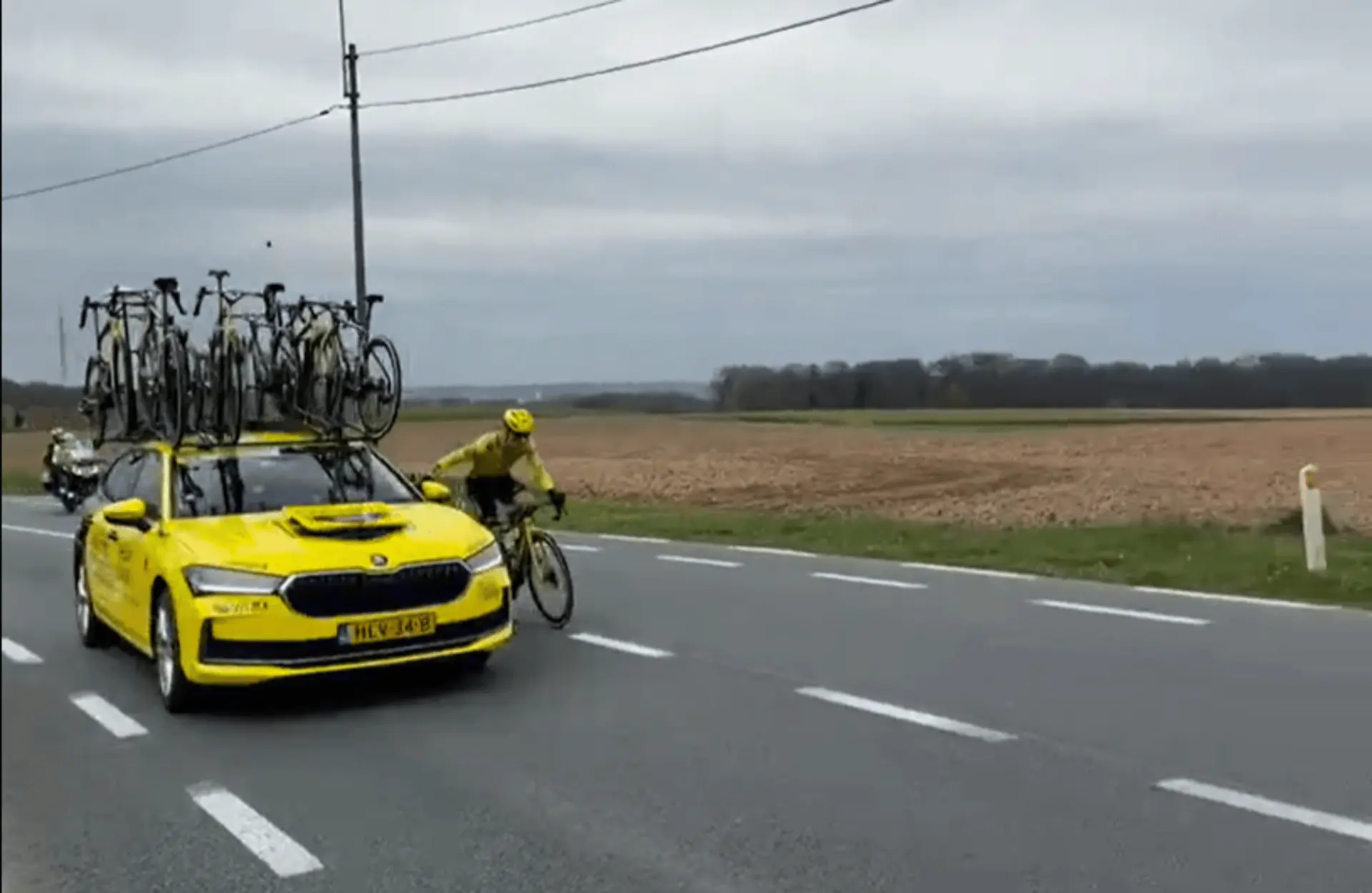
Axel Zingle’s E3 Saxo Classic ended not in the fight for position, but on the side of the road after one of the clearest rule breaches of the race.
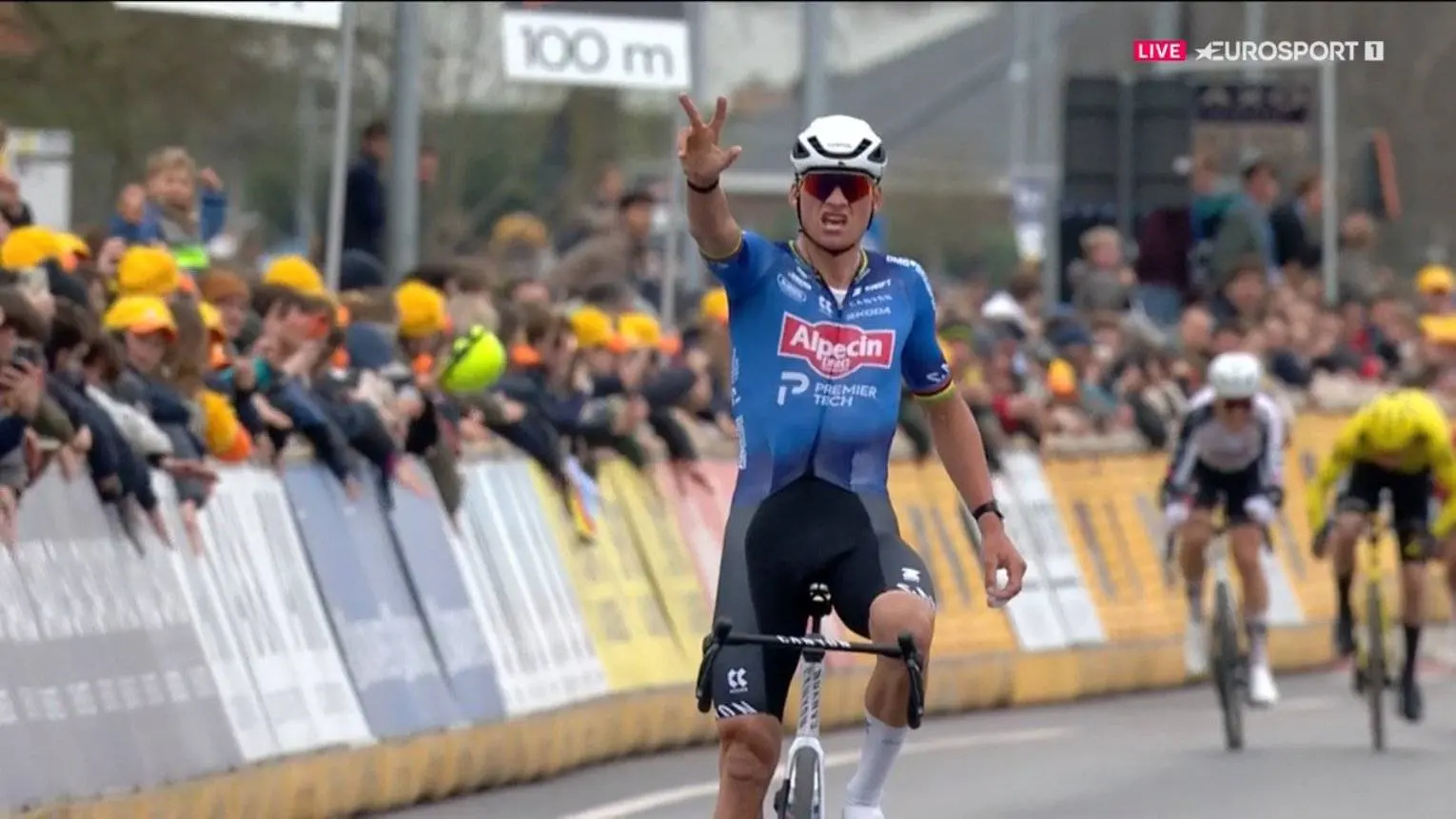
In a day defined by Mathieu van der Poel’s long-range solo and a chaotic finale behind, the Team Visma | Lease a Bike rider was removed from the results entirely after holding onto his team car following a puncture.
A decision made in seconds, a sanction that followed immediately
Zingle’s race had already been disrupted when he was forced to stop due to a mechanical issue. Like many riders in that situation, the immediate objective was simple: limit losses and regain contact with the peloton.
What followed went far beyond that. Rather than attempting to close the gap through acceleration and positioning, Zingle remained attached to the team car for a prolonged stretch. The assistance was not momentary. It was sustained, visible, and decisive in helping him regain speed.
In a race where positioning and effort define every outcome, that level of assistance left little room for interpretation.
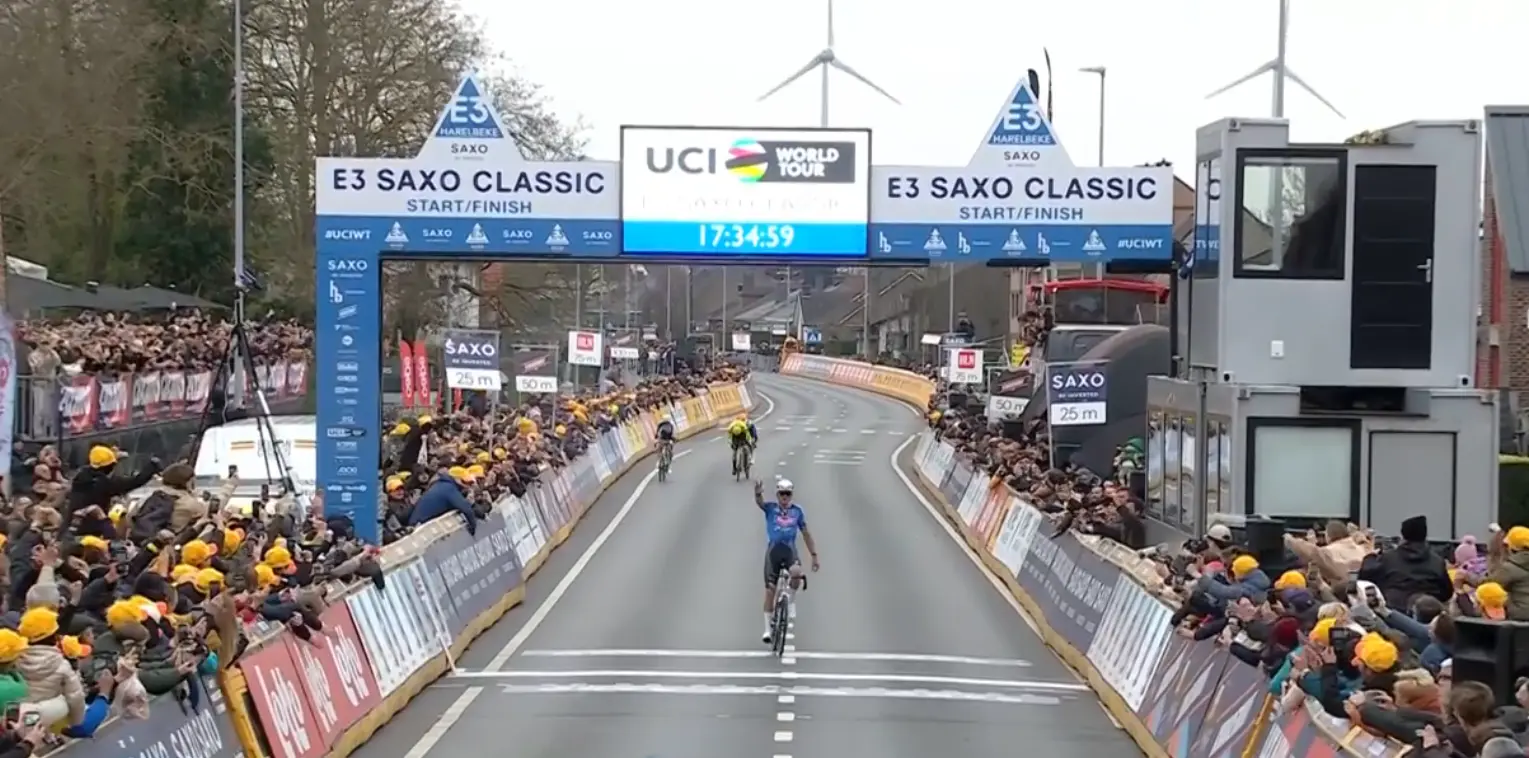
No ambiguity in the footage, no hesitation in the decision
The incident was captured clearly, both on broadcast images and in footage shared by spectators, showing the extent of the tow as Zingle tried to return to the race. There was no attempt to disguise it, and no grey area in how long the contact was maintained.
That clarity was reflected in the jury’s response. Zingle was disqualified from the race, ending his day immediately.
Sticky bottles are a familiar sight in professional cycling, often used briefly to help riders accelerate after a stop. But there is a clear line between a short hand-up and prolonged assistance. On this occasion, that line was crossed.
While the race itself built towards a dramatic conclusion in Harelbeke, Zingle’s involvement ended much earlier, defined not by tactics or strength, but by a moment that brought an immediate and unavoidable consequence. Further sanctions, including a potential fine, have not yet been confirmed.
Shame on you,
— Lv Cycling 🇧🇪 (@Lv_Cycling) March 27, 2026
Axel Zingle..
🤮
#E3SaxoClassic pic.twitter.com/raxeGVfIud

Kieran WoodDeputy Editor-in-Chief
Kieran Wood is a sports journalist based in Wales and has been active in journalism since 2022. He regularly contributes to DartsNews.com and CyclingUpToDate.com, where he covers professional cycling and darts. In cycling, his work includes liveblogs from major races, including the Tour de France, the Giro d’Italia, and La Vuelta a España, alongside race reports and analysis. He has also conducted interviews with professional riders.
His reporting spans the full racing calendar, from one-day classics to stage races, with a focus on accurate, real-time coverage and clear contextual analysis. For statistics, results, and historical context, he regularly uses resources such as ProCyclingStats. To support reporting on rider activity and training context where relevant, he also references Strava.
In his work, Kieran places strong emphasis on careful sourcing, editorial accuracy, and updating articles as new, verified information becomes available.
claps 1visitors 1
Top comment
abstractengineer27-03-20263
Thats a Nibali
Just in

Popular news
Latest comments
- i luv the transfers,rumours etc. Re Mattias Skjelmose i wouldnt blame him for being pissed off .it will be ashame if he leaves Trek ...the rumours about them chasing Gall dont help at all. Gee hasnt been impressive. Not sure if the lidl control has been a good thing. Thankfully Mads and Lucinda are there. Shame to see Shirin leave.
 Davide08-09-2026
 - did i miss something here?....what is the one 'specific detail' UAE insisted on?....i don't see that anywhere in the article.Zone0Rider08-09-2026
- You need to rethink... your comment.JBBriggs08-09-2026
- Conversation ruined by an idiot. Goodbye.RolandDekker07-09-2026
- On holiday in Torremolinos.RolandDekker07-09-2026
- Show you facts ? Autists ? Skin and memories ? You have become boring and argumentative! Back under your quilt.RolandDekker07-09-2026
- Regarding the scandal, I think you’re confusing the WC with national champs where the federation can ban riders who don’t participate. If I remember right, Remco was in doubt for the Tour or something like that because of it but yes, in that case his license wouldn’t be valid and there’d be nothing his team could do about it to register him.Jumpyjohn07-09-2026
- Agreed, around a minute. He’s going to gave to find something to surprise others in the mountains.Jumpyjohn07-09-2026
- Please show us your facts temperature in Andalusia hasn’t changed in 35y because all I can find are ones that confirm that like most of Europe, they have risen more than the global average and are already comfortably settled above the 1,5 degree target and still trending upward. Sorry but I really don’t trust anybody except certain autists to have skin and memories sensitive enough to recall variations over such a period better than official scientific notations, which are abundant enough.Jumpyjohn07-09-2026
- So now answer us this, between riders and fans, who are they supposed to keep happy and how would YOU organise things to keep BOTH happy?Jumpyjohn07-09-2026
Loading
3 Comments