Almost two years after Muriel Furrer’s tragic death, Provence scare reignites cycling’s GPS tracker debate: “An hour and a half before we found out Soren Kragh had crashed”
Cycling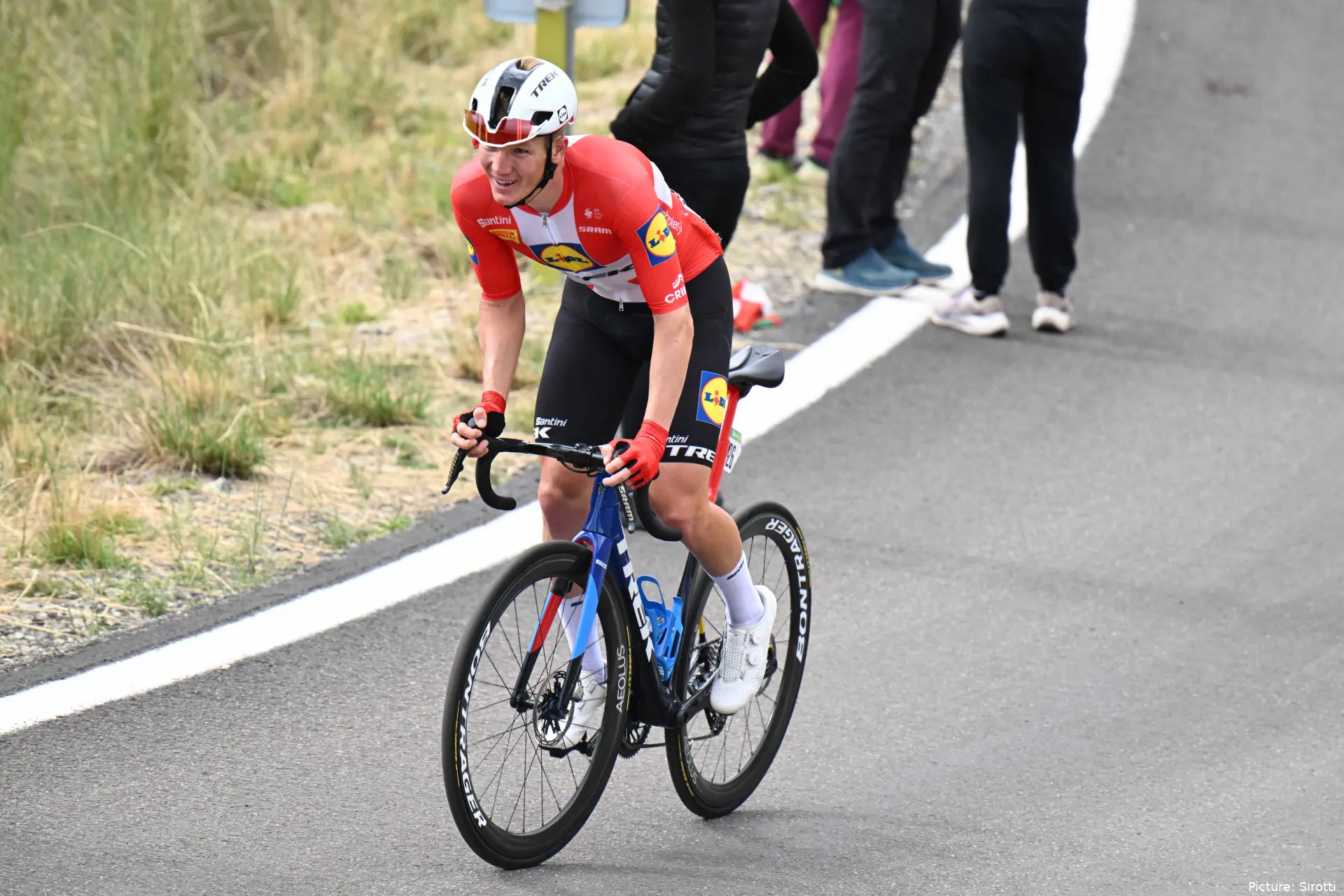
A rider attacks on a descent. He disappears from sight. The peloton assumes he has bridged across. The race rolls on. An hour and a half later, his team finally learns that he had not gone clear at all, but crashed off the road.
That was the account given by Mattias Norsgaard on the Forhjulslir podcast, reflecting on Lidl-Trek team mate Soren Kragh Andersen’s crash on the opening stage of the 2026 Tour de la Provence.
“There was an hour and a half before we found out that he had crashed,” Norsgaard said, describing how the bunch believed the Dane had made it across to the break before realising something was wrong.
For a sport that is still processing the fatal crash of Muriel Furrer at the 2024 Road World Championships in Zurich, the details felt uncomfortably familiar.
When a rider leaves the road
Furrer crashed during the junior women’s road race in Zurich and was later found unconscious off the course. She died the following day from her injuries. In the months that followed, one of the most troubling questions raised by riders and teams was how long she had gone without being located after leaving the road. While official investigations did not definitively establish that a delay caused her death, the incident forced cycling to confront the reality that a rider can disappear from view in a major event.
Norsgaard’s description of events in Provence inevitably echoes that fear. He recounted how Kragh Andersen launched a bold move on a descent in wet conditions, riding at a pace that startled even his own teammate. “He rode so f*cking fast,” Norsgaard said, adding that after only a few corners the gap had already stretched significantly. Then, silence.
According to Norsgaard, the team believed Kragh Andersen had successfully bridged to the breakaway. Only much later did they learn that he had gone off the road and down the mountainside. He eventually climbed back up by himself. A Lidl-Trek sports director later saw “a red hand waving from behind the barrier,” as Norsgaard described it.
The team subsequently communicated that Kragh Andersen suffered a muscle contusion. No further detail has been provided on his return to racing.
The motorcycle and the system
The most pointed part of Norsgaard’s account concerned the race convoy. He said footage suggested Kragh Andersen looked in control before entering the corner where he left the road, and criticised the motorcycle following the move.
“The motorcycle doesn’t stop. It just waits for the peloton. It is completely indifferent,” he said, arguing that such a failure “should be sanctioned” severely enough that the operator would “never be involved in cycling races again.”
Those comments move the conversation beyond one crash. They question the systems around it.
In the aftermath of Furrer’s death, the debate over mandatory GPS tracking intensified. The UCI has since trialled expanded tracking systems at major events, with governing bodies presenting them as safety tools rather than broadcast enhancements. Yet attempts to formalise their use have not been without controversy, with disputes emerging over implementation, responsibility and control.
For Norsgaard, the Provence incident reinforces his position. “I am 100 percent convinced after this season start that it should be introduced as quickly as possible,” he said of mandatory tracking devices, stressing that the primary purpose must be rider safety.
Cycling has invested heavily in barriers, route design reviews and safety protocols in recent years. But the uncomfortable reality remains that when a rider leaves the road out of sight, detection is not always immediate.
A year and a half after Zurich, Provence has reopened a debate that the sport hoped was moving towards resolution. The central question is no longer theoretical. It is stark and practical: how quickly can cycling locate a rider when something goes wrong?
Norsgaard’s account suggests that, even in 2026, the answer may still depend on chance.
Kieran WoodDeputy Editor-in-Chief
Kieran Wood is a sports journalist based in Wales and has been active in journalism since 2022. He regularly contributes to DartsNews.com and CyclingUpToDate.com, where he covers professional cycling and darts. In cycling, his work includes liveblogs from major races, including the Tour de France, the Giro d’Italia, and La Vuelta a España, alongside race reports and analysis. He has also conducted interviews with professional riders.
His reporting spans the full racing calendar, from one-day classics to stage races, with a focus on accurate, real-time coverage and clear contextual analysis. For statistics, results, and historical context, he regularly uses resources such as ProCyclingStats. To support reporting on rider activity and training context where relevant, he also references Strava.
In his work, Kieran places strong emphasis on careful sourcing, editorial accuracy, and updating articles as new, verified information becomes available.
claps 1visitors 1
Just in

Popular news
Latest comments
- Individual Gautherat is the most exciting given his age too I agree. But Frigo and Balderstone for uae will be super valuable as doms areound those leaders. UAE just quitly uppgrade w/stronger and younger guys. Sivakov was on the down and Frigo replace all that with bigger engine. Balderstone seems like another brilliant under the radar pickup UAE is masters off....so exhausting they never missmiguel25-10-2026
- Surprised it’s that inexpensive!Lozza25-10-2026
- Nah, I like it here. I like a challenge, against the people who hate me here. Jumping John, you ain't getting rid of me :))PogiSloFans25-10-2026
- Pogi deserves every penny he gets paid... and he's the only cyclist that should be paid more. If he's two classes above everyone else, his salary should also be. Ad acta.PogiSloFans25-10-2026
- It’s not only that, it’s this obsession with running after money, whether it be teams, riders, sponsors, broadcasters. As soon as one player gets ahead, others feel obliged to match their moves with increases for fear of losing out and for fear of someone else following in your place instead without looking at the long-term consequences of blindly following. Other sports ahead (or behind depending on how you look at it) in such matters should serve as a warning but humanity has a habit of heading straight into walls even when the writing is on it. When financial objectives and limits aren’t clear, it’s impossible to manage any organisation, you can’t even recruit the right riders or tell them what is needed to make sure they’re a good fit because you can’t clearly explain what they can expect. Not all riders are motivated by money alone and some of the teams are proof of that.Jumpyjohn25-10-2026
- To be honest, their signings weren't actually too bad. Oscar and Kevin had great 2025 seasons. Most of the top leaders were signed. But Red Bull, Lidl-Trek and Pinarello showed that that's not actually the coast. So team culture is probably the foremost reason. Whether there's a bad sporting culture now is debatable, but certainly there's the past. 2024 was the end of the old Ineos (it was not actually transition, it was slow decline)
 Rafionain-Glas25-10-2026
 - FYI. Pogi made his World Tour debut at the TDU in 2019. I remember it well because someone said watch out for Pogi as he did a good time up Corkscrew during training. Who would have thought he'd end up as the GOAT.Santiago25-10-2026
- FYI. Pogi's first World Tour race was at the TDU in 2019. I remember it well because someone said watch out for Pogi as he did a good time up Corkscrew during training. Who would have thought he end up as the GOAT.Santiago25-10-2026
- 50 million isnt low. But if you hire super domestiques for a million and 3rd rung leaders for 3-5 million, natural you dont have money left not the results expected. Most monuments and TDF are out of reach due to Pogi. But there were a promising 2nd rung leaders on the market and they went for broke to get Onley and Kevin. I put their entire troubles due to mismanagementabstractengineer25-10-2026
- I think it’s becoming clear that cycling got way ahead of itself for a few reasons and is now coming to the realisation that some rider salaries just exploded without justification and it snowballed until sponsors started pulling money out because THEY did not see any return on increased costs. Cycling is still a dying sport (that never moved out of the niche family) and will remain so if it doesn’t embrace and promote new ventures or manage to attract new markets. Even within cycling, fans are basically compartimentalised, (almost nobody here follows track for example), and the multiplication of possibilities hasn’t grown the sport, it has just split it into a larger number of smaller branches. If it weren’t for nation state sponsors (far too numerous already) other teams would never have (had to resort to) raised bigger budgets that are now leading to sponsor abandonment. That’s the difference between long-term steady growth and financial doping, the latter can also just blow up in your face. I will venture to wager that apart from one or two exceptional cases, rider salaries will no longer go up and are quite likely to actually drop over the next decade.Jumpyjohn25-10-2026
Loading

So Norsgaard in the "Forhjulslir" podcast says that when Søren Kragh crashed in provence and fell over the edge, the motorbike following him didn't wait or alert anyone. So Søren saw the motorbike and then the entire peloton pass by and realised no one would likely notice him. ⬇️
1 Comments