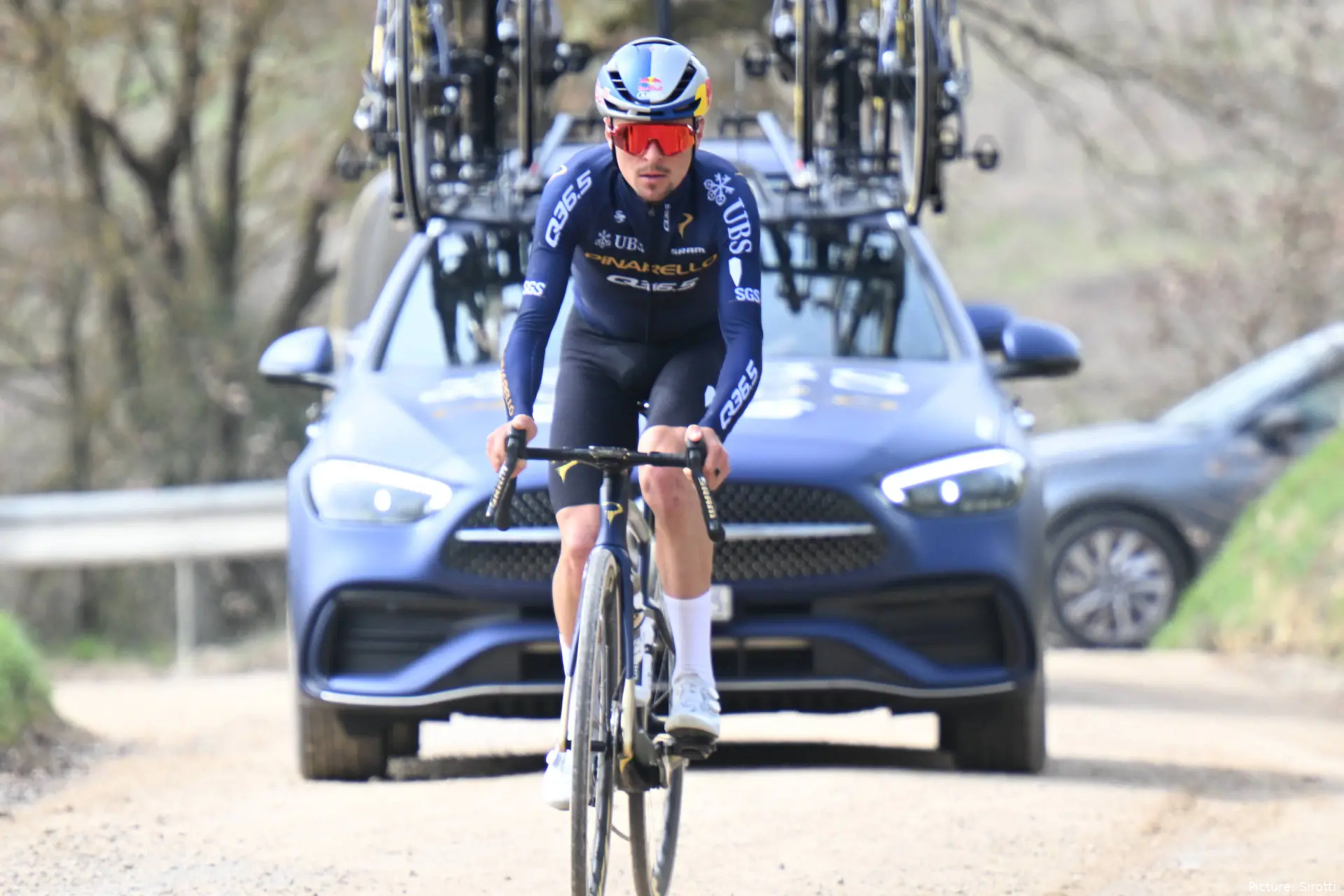
Few races expose the gap between belief and reality as clearly as Strade Bianche. For Tom Pidcock, that tension will again revolve around one name. Tadej Pogacar.
“In all the big races you’re going to encounter him,” Pidcock’s coach Kurt Bogaerts explained in conversation with Wielerflits ahead of the gravel classic in Tuscany.
“So yes, you have to deal with that," Bogaerts adds. "You have to try to be very good yourself and then see how you can battle with him.”
The rivalry already defined last year’s edition of Strade Bianche, where Pogacar eventually rode clear to victory but only after Pidcock had been the last rider capable of staying with him deep into the race.
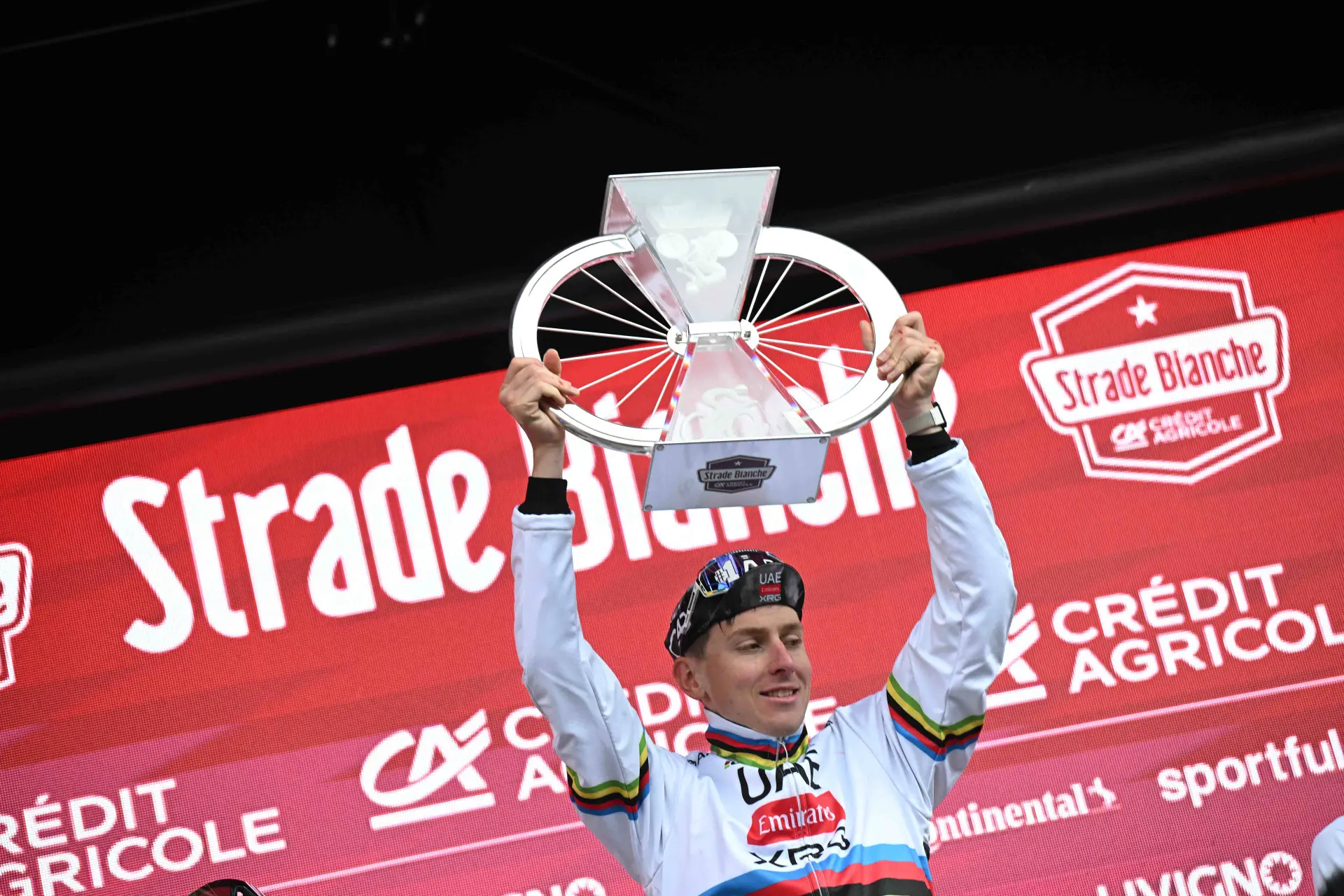
The reference point: Strade Bianche 2025
The 2025 race produced one of the clearest illustrations of how closely matched the two riders can be on Tuscany’s white roads.
Pidcock, racing in his first season with Q36.5 Pro Cycling Team, was the rider who animated the decisive phase alongside Pogacar. The pair went clear well before the final kilometres, trading attacks and pressure across the gravel sectors as the race split apart behind them.
When Pogacar crashed heavily on a descent with around 50 kilometres remaining, Pidcock did not press the advantage and waited for the Slovenian to return to the front group. The duel resumed soon afterwards and ultimately exploded on the Colle Pinzuto sector, where Pogacar’s acceleration finally distanced the Brit on the final gravel climb before Siena.
Pidcock still rode to second place, comfortably clear of the rest of the field. It reinforced a growing belief that Strade Bianche is one of the races that suits him best.
“I think there are characteristics in Strade that suit him very well,” Bogaerts said. “Tom is the type of rider who has qualities for many races, but it’s also about what excites you and what you feel strongly about when preparing mentally and physically.”

Tadej Pogacar crashes at Strade Bianche 2025
Learning from Omloop
Pidcock arrives in Tuscany after a disrupted Opening Weekend. The Brit finished 48th at Omloop Het Nieuwsblad, the only cobbled classic on his schedule this spring, after suffering from the cold and a series of setbacks during the race.
“We have to be honest that we made a few mistakes there,” Bogaerts admitted. “We should have made better clothing choices. Maybe we underestimated the bad weather a bit. Because of that, he got cold. He was also caught up in a crash and had to change bikes. I think that was simply too much to still make something of the race.”
Despite the disappointing result, Bogaerts pointed to signs that Pidcock’s condition is stronger than the finishing position suggests.
“Because of that bad luck, he was completely out of the race for a result, but from behind the last group, he still managed to ride back towards the front. I honestly don’t understand how he managed that. From that, I can conclude that physically, he rode a strong race.”
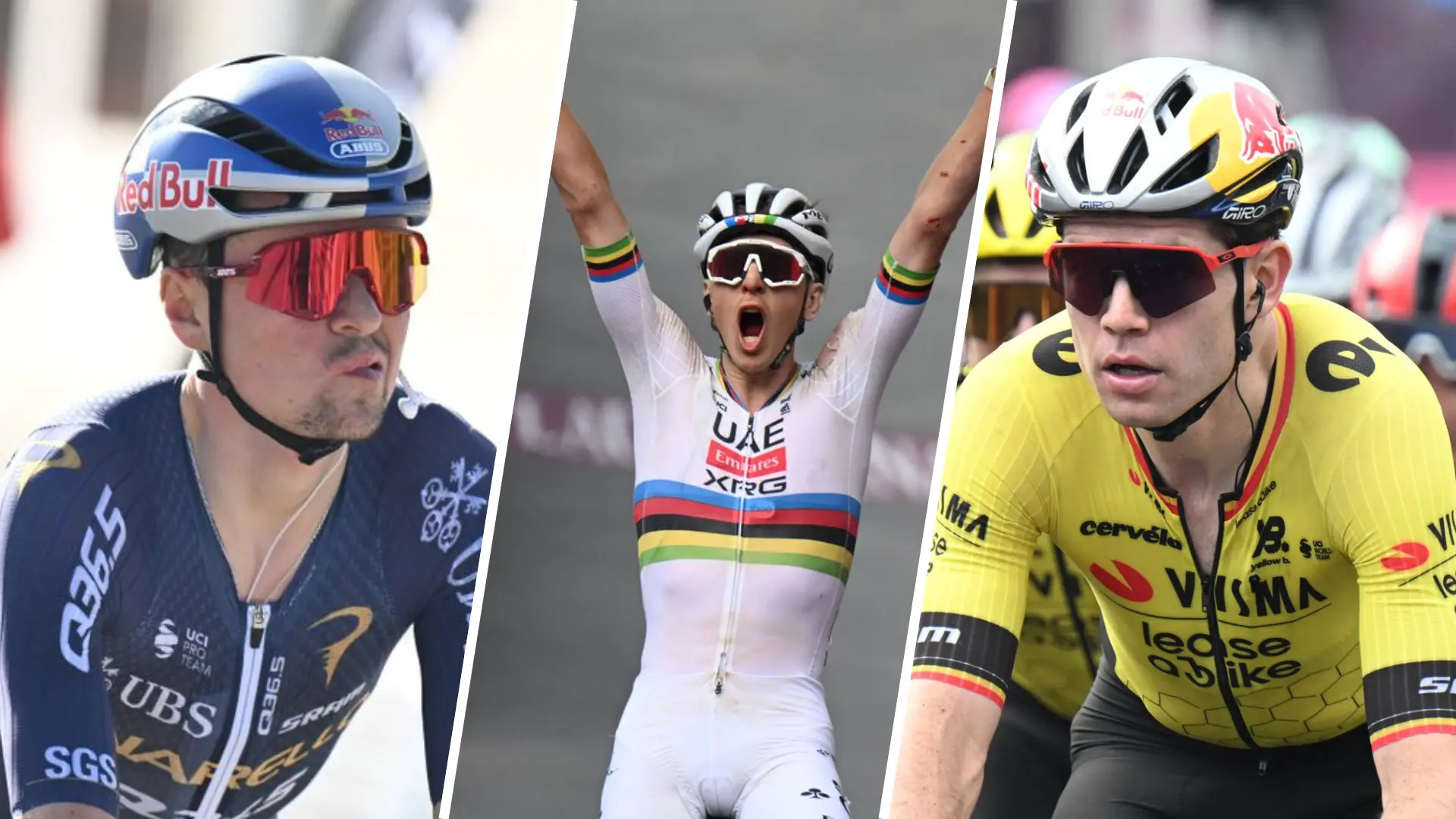
A race that suits him
Strade Bianche has long occupied a special place in Pidcock’s programme. The British rider already won the race earlier in his career and returned to the podium last season, reinforcing the idea that the gravel climbs and technical descents suit his cyclocross background.
“It is certainly one of the races he gets out of bed for,” Bogaerts said. “But Milano-Sanremo, Amstel Gold Race and Liege-Bastogne-Liege also mean something to him.”
The broader goal for the spring is to carry form through the classics block rather than peaking for a single race. “In the past, I’ve seen that once you find good form, you can take a bit of rest at the right moments and then sharpen that form again,” Bogaerts explained. “It’s definitely possible to be good across that whole period, and he has already shown that in previous years.”
The Pogacar reality
Even if Strade Bianche suits Pidcock perfectly, the central challenge remains the same.
Pogacar’s presence changes the dynamic of any race he enters. Bogaerts is realistic about that reality, but far from resigned. “I think something is possible,” he said. “If we focus on getting a good result, the rest will follow. We shouldn’t complain. It’s good for the sport that Pogacar is interested in such a wide range of races. Honestly, I actually like it.”
Pidcock’s approach will remain the same as it was last year. “Last year Tom made the first move,” Bogaerts added. “Not necessarily to anticipate, but mainly to play to his own strengths. Tom understands his capacities well, and then you wait to see how the competition reacts. That’s what we’ll try again.”
And crucially: “We’re not afraid to take the initiative ourselves.”
For a race built on chaos, gravel and daring attacks, that attitude might be the only way to confront the sport’s most dominant rider.
The roads of Tuscany will soon reveal whether it is enough.

Kieran WoodDeputy Editor-in-Chief
Kieran Wood is a sports journalist based in Wales and has been active in journalism since 2022. He regularly contributes to DartsNews.com and CyclingUpToDate.com, where he covers professional cycling and darts. In cycling, his work includes liveblogs from major races, including the Tour de France, the Giro d’Italia, and La Vuelta a España, alongside race reports and analysis. He has also conducted interviews with professional riders.
His reporting spans the full racing calendar, from one-day classics to stage races, with a focus on accurate, real-time coverage and clear contextual analysis. For statistics, results, and historical context, he regularly uses resources such as ProCyclingStats. To support reporting on rider activity and training context where relevant, he also references Strava.
In his work, Kieran places strong emphasis on careful sourcing, editorial accuracy, and updating articles as new, verified information becomes available.
claps 0visitors 0
Just in

Popular news
Latest comments
- The article makes it sound like a great thing and something to be applauded. The reality is is gives the Americans another 6 years to fleece European cycling fans or force them to hunt around Europe with VPN’s for free feeds. Not something to be celebrated in my book. Before someone points out that coverage of this depth costs money, yes, I agree but not £30+ per month a fee I will wager will gradually increase now this deal has been cemented.Paul53119-10-2026
- Great. Thrilled. (Satire) Oh, how I miss the days of GCN. Still wear my GCN hoodie with pride.anonymouscyclist19-10-2026
- You could also look at it another way. How many riders have had better or more consistent results since the Tour?Jumpyjohn19-10-2026
- Whilst I love Tadej (and Remco, who deserves to be mentioned here, too), @JumpyJohn makes a valid point, and he isn’t wrong @MajorPayne. It is a fact that today’s official broadcasters of cycling struggle to keep our attention once the likes of Tadej (or Remco) attacks at ~80km or so. In the 142nd issue of Rouleur, Ned Boulting reflects on the often stressful paradox of commentating on a race that is effectively over before the broadcast window even hits its stride. In this edition, he centres on Remco’s 1hr solo at the Challenge Mallorca this year, and captures the panic and dread shared by the commentators when a dominant rider kills off the racing tension early. I recommend you read it, it’s a fascinating insight into the world of commentary, and the true viewing figures of today’s cycling. I must add here, I love Tadej and Remco, but I would be lying if my heart rate wasn’t higher when watching the World Championships this year. And I’m sure Rob Hatch would say something akin regarding his commentary!anonymouscyclist19-10-2026
- The shattered women’s marathon record was clean and highly surprising and then a few months later the athlete was very positive in another test for something not taken by mistake when recording far less impressive results. Sounds to me like the problem is still the age old one, detection is often way behind. Just like with crime, it’s not because you can’t catch the criminals that you aren’t aware of the crime.Jumpyjohn19-10-2026
- Listen, you have a point but on the other hand in cycling, once some of the riders go solo and build a minute’s gap, there’s hardly any action left to watch. Cycling is definitely not for today’s generations of accelerated viewing. Other people find skydiving or chess exciting but you can’t force everyone to feel the same.Jumpyjohn19-10-2026
- That’s a funny one. Yeah obviously he’s more aero than some but most of the aero effect at elite level is the bike. Now you have me starting to feel sorry for the guy behind him when he pulls a groupetto.Jumpyjohn19-10-2026
- Knew a World Tour promotion was coming for Ben this season. Thrilled for him, and can't wait to see what he can do at this level. Another one to watch at the TTs.anonymouscyclist19-10-2026
- It honestly breaks my heart to see this. I had a feeling this might happen over the last few years, but I kept praying it wouldn't, and that Joey would find his niche, especially back racing alongside his brother. After growing up racing alongside PH-MAS, the Pidcock brothers have always felt like one of our own, as we’ve watched them grow from Club level all the way up to PC and WT. I wish Joey nothing but the best of luck in whatever he does next, but selfishly… I do wish for him to move into the role of Q36.5 team staff.anonymouscyclist19-10-2026
- Predictable, sure! But boring??? OMG! Was Mike Tyson predictable and boring in his prime? Air Jordan? Schumacher or Senna? OMG!!!MajorPayne19-10-2026
Loading
Write a comment