"We started preparing for this World Championships a year ago" - Belgian team doctor on the threats of Kigali
Cycling
The World Championships in Kigali, Rwanda are exotic. Both in the nice and less pretty sense. For team doctors it's a whole new level of worries and health hazards they need to be ready to react to. From mosquitoes and wild animals, through water and human contact, the dangers will be on every corner in the east-African country.
"We started preparing for this World Championships a year ago," Belgian team's doctor Kris Van der Mieren begins on the risks related to travelling to Africa in an interview for HLN. First step was getting riders vaccinated against the more common illnesses.
Municipal Health Service (GGD) recommends vaccinations for diseases such as Yellow Fever, DTP, and Hepatitis A. Additionally, vaccinations for Mumps, Measles, and Rubella are also generally obtained.
"Vaccination isn't mandatory, but it is strongly recommended," says the Belgian national doctor. Among the national team, there weren't any complaints about that. "There's been little discussion; there are no anti-vaxxers among them." Potential side effects have also been taken into account. "I can speak for the entire group: everyone started vaccinations well in advance."
Due to the high risk of malaria in Kigali, the vaccinations alone won't be sufficient. Riders will have to additionally take a pill a day to counter that risk. An infection could have lasting consequences. "Everyone has been briefed on that as well," says Van der Mieren.
In a sense, the travel risks of going to Rwanda are quite similar to 2022, when the World Championships took place in Australia. "I compared the list with what I took to Wollongong, Australia in 2022: there's hardly any difference."
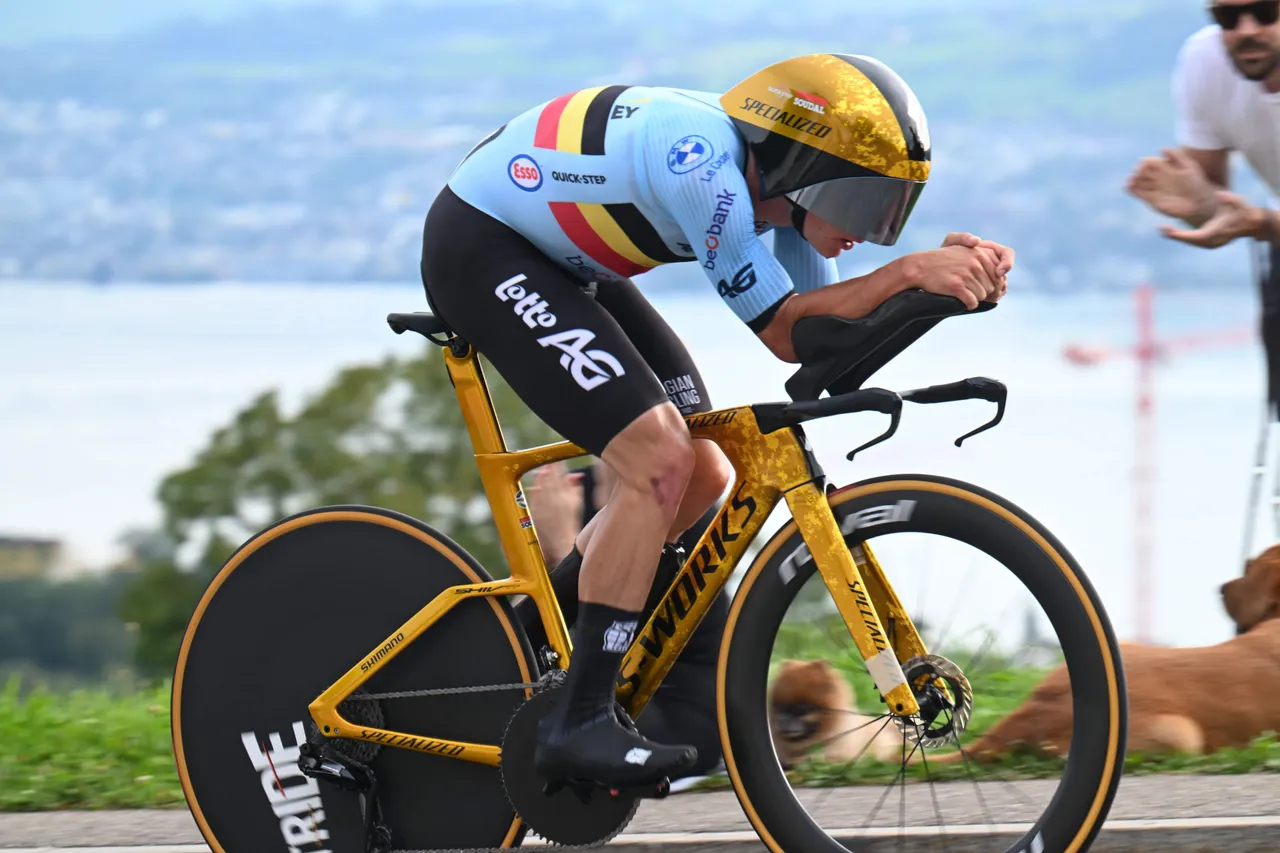
Remco Evenepoel, who travelled to Rwanda early for the time trial, also has to obey to the regulations
Van der Mieren knows that mosquito repellents and mosquito nets will be crucial to prevent the malaria from spreading. And these items are not as common in Rwanda, compared to Australia. "Most tropical diseases are spread by mosquitoes. Prevention is key. It's a 24/7 spraying and applying sunscreen. I also recommend everyone wear light-colored clothing: it's supposed to deter mosquitoes more than dark clothing."
Potable water
The next problem then. The drinking water in Rwanda isn't safe to drink everywhere. The Belgian delegation certainly won't be taking any risks. "The quality isn't guaranteed. So we're not taking any risks. Washing is fine, but for everything else, we'll use bottled water or boil it first."
That brings a tough challenge for any cooking team as salmonella must be prevented at all costs. "Our cooking team has a very important job. They'll have to put in a lot of extra work. It's quite possible that by the end of the World Championships, they'll have burned more calories than our riders," says Van der Mieren.
And some diseases can spread as simply as through handshakes. Thus rider's shall limit physical contact as much as possible. "Because things can enter someone's body through water that can be passed on through physical contact. The local population is partially resistant to that, but we in Europe, with our extreme focus on hygiene, are not."
Fear of rabies
Still, there's one truly major danger for Van der Mieren: rabies. The disease has been basically eliminated in Europe with only one case in 2025. However the situation is different in Africa. "That's my biggest fear," says the doctor. "My only real fear, actually. The chance of someone being bitten by a rabid dog is minimal, but if it happens, and it's a serious bite, then all hell breaks loose."
If such event were to happen, the doctor team is ready to take action to prevent symptoms from appearing - rabies is uncurable once symptoms surface. "Then it's immediate repatriation. An untreated infection is always fatal, but if you catch it quickly and treat it intensively with the right medication and wound care, it doesn't have to be fatal. But that's specialist work."
Should that indeed be the case, Van der Mieren is in close contact with other doctors. "I know which hospitals we can go to there. That was my first question when the World Championships were awarded to Rwanda. We also have a WhatsApp group with all the doctors from the participating countries and the UCI's chief physician."
Ondrej ZhasilCycling Journalist
Ondřej Zhasil is a cycling journalist at CyclingUpToDate and has been part of the team since 2023. He is based in Ostrava, the third-largest city in the Czech Republic, and covers professional cycling across the main UCI competitions, including the Tour de France, the Giro d’Italia, and La Vuelta a España. A key focus of his work is startlist analysis and pre-race coverage, where he examines team selections, rider line-ups, and tactical scenarios ahead of major events.
Alongside WorldTour coverage, Ondřej has developed specific expertise in junior cycling and in racing across East Asia, including competitions in China and Japan. He also maintains a broad working knowledge of other disciplines and levels, including cyclocross, while continuing to expand his understanding of mountain bike racing.
Ondřej holds a bachelor’s degree in Mathematics and Physics, which supports his analytical, data-driven approach to performance and race analysis. In his reporting, he regularly uses ProCyclingStats for results, statistics, and historical context. He places strong emphasis on careful sourcing, editorial accuracy, and updating articles promptly when new, verified information becomes available.
claps 0visitors 0
Just in

Popular news
Latest comments
- EF’s “island of misfit toys” squad is probably one of my favorites in the peloton. They are fun to watch, always trying stuff - they ride with heart and panache, and their kits are excellent.wrsty20-10-2026
- 'Children these days'... Wout, since the caveman learned to say "Ug", older generations have always said this about younger generations. Not every young rider is a cowboy. So what's to say that the fact that Poels was respectful meant that his peers were equally so?
 Rafionain-Glas19-10-2026
 - "...In a weakened field" Most definitely ! YAWN !frieders319-10-2026
- Noted. But I had to appease his fans.MajorPayne19-10-2026
- I wonder if he'll race Challenge MallorcaRafionain-Glas19-10-2026
- Head to head time-splits: Jay Vine vs Remco Evenepoel: 10.5 km - Vine lost 45 seconds to Evenepoel 34.2 km - Vine lost a further 1:10, and was caught in the vicinity of that checkpoint. Note: I remember Vine getting caught before the second checkpoint, and ProCyclingStats log supports that, however, the gap at the second checkpoint was less than 2 minutes. 45.4 km - Vine lost only 16 seconds Of course, Vine lost less time in the middle section than the early section, but at the final segment rate, he'd have lost 15 seconds in the opening section and and 34 seconds in the middle. It is possible that Vine paced himself very well but that seems unlikely. In comparison with Stefan Küng: Kung lost: 26 seconds at T1. A further 1:11 by T2. A further 40 seconds by the finish. Relative to Evenepoel, Küng did slow down by the end. Maxime Decomble: Lost 47 seconds at T1. A further 1:20 by T2. A further 26 seconds by the finish. Mikkel Bjerg: Lost 37 seconds at T1. A further 1:34 by T2. A further 46 seconds by the finish. It is not concrete evidence that Vine cheated though it certainly doesn't absolve him. However, watching the race, I am 100% sure that Vine did not pull over and follow a different line when Remco passed him. Remco pulled away quite quickly, but the gap did not balloon and Vine definitely got aero assistance.Rafionain-Glas19-10-2026
- That ship has sailed years agovappaxbipmv19-10-2026
- He doesn't have to. I'd be perfectly happy if he loses SB if he then wins everything elsevappaxbipmv19-10-2026
- Please don't put Remco in the same sentence as Tadej. It's disrespectful to Tadej. Please make a note of this.KissinKate19-10-2026
- ....and you just described how americans are fleecing american fans as well. We don't even get the eurosport coverage you get. What you see on yurrup HBO is not available in this country. Trust me, being a cycling fan sucks everywhere.KissinKate19-10-2026
Loading
Write a comment