"Tramadol has disappeared from the peloton and they are still crashing even more" - Analysts seek answers for so many crashes, while proposing solutions
Cycling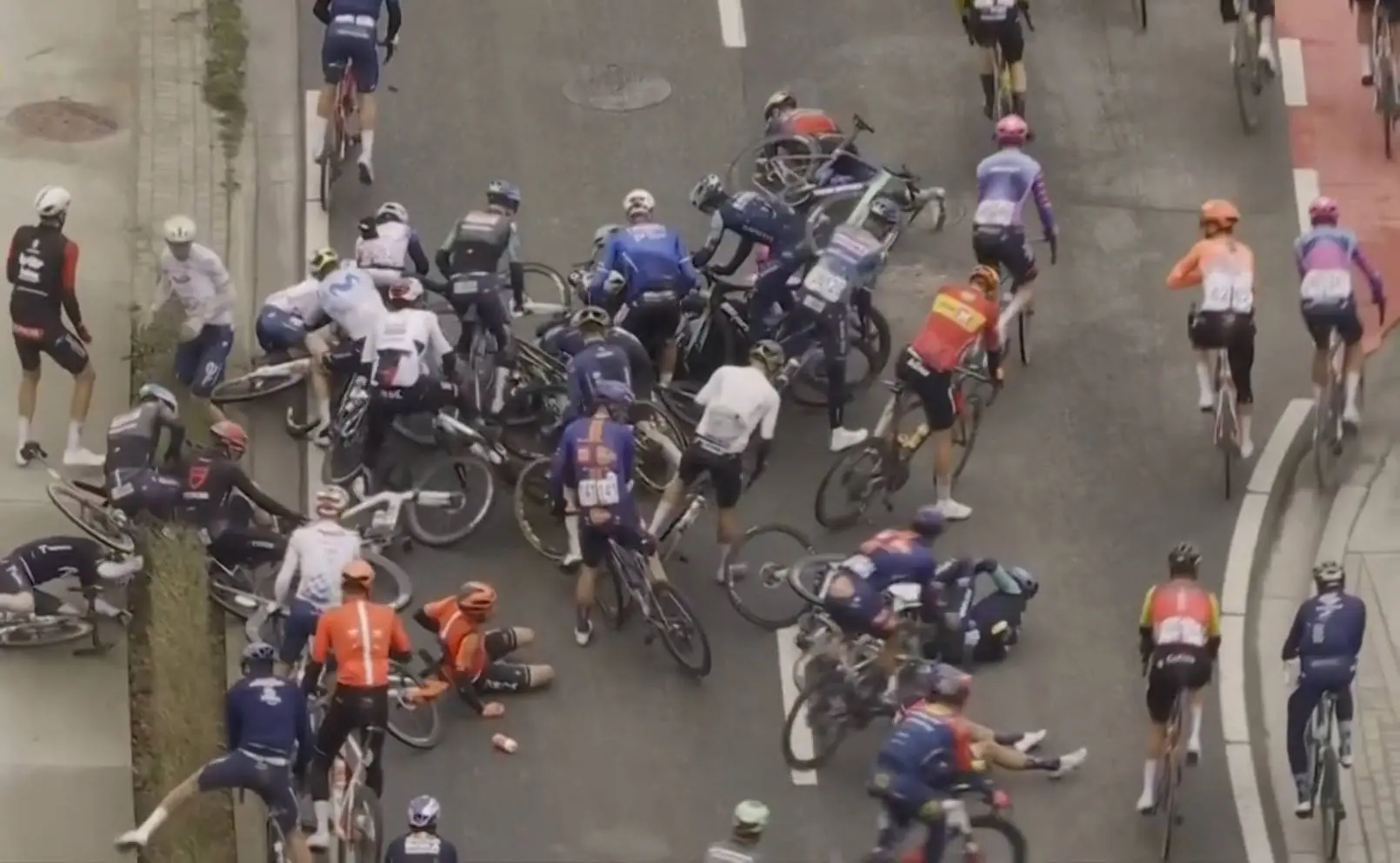
We have not yet reached the end of the first quarter of the 2026 season, yet the list of riders who have already crashed continues to grow at an alarming rate.
In almost every race there are incidents in the peloton, and many riders end up experiencing the terrible feeling of hitting the tarmac. The speed in the professional peloton keeps increasing, the risks multiply with every corner and not everyone manages to escape unharmed.
A weekend of carnage
While some riders get away with little more than cuts and bruises, others face far more serious consequences, including surgery, long recovery periods and weeks or even months away from the bike. The latest case involves Stefan Küng. The Swiss rider suffered a fracture to his left femur and posted a short message on social media after the operation: "Back home."
Meanwhile, Tudor Pro Cycling Team confirmed the seriousness of the injury in an official statement and explained that the rider faces a long rehabilitation process. "Unrestricted training is expected to be possible in approximately three months," the team said.
Tom Boonen analysed the opening weekend of the Spring Classics and tried to identify the causes behind the series of crashes. The former Belgian champion noted that the scenes on Flemish roads once again raised concerns. "It was noticeable last weekend that we are racing again on Flemish roads, because there were many crashes. Sometimes it is not pleasant to watch", he said on the VRT podcast Wattage.
Besides Stefan Küng, the weekend also produced several other serious injuries. Vlad Van Mechelen suffered a fractured collarbone, Ben Swift sustained a pelvic fracture, Rick Pluimers chipped several teeth, Tim Wellens fractured his collarbone and Rory Townsend broke his tibia.
"Crashes mainly happen on concrete sections. But that has nothing to do with the high speed" Boonen explained while analysing the situation. Dirk De Wolf, however, suggested another possible cause. "It’s because of that screen (the bike computer ed.), they look at while riding. That’s their television", he argued.
The discussion continued when Jan Bakelants took aim at measures previously introduced by the UCI. "Fifteen years ago, tramadol was considered the cause," the former Belgian rider recalled. "Now tramadol has disappeared from the peloton and they are still crashing even more."
Bakelants continued his reasoning by stressing that crashes are part of the sport but insisted that their consequences could be reduced. "Crashes are part of racing. We need to make sure crashes do not have consequences", he said.
Are airbags a solution?
One idea that has been raised involves introducing airbags integrated into riders’ clothing, something that could potentially be developed in partnership with cycling apparel manufacturers. "In horse riding and skiing this has existed for a long time. Why couldn’t it exist in cycling?", Bakelants asked.
Tom Boonen went even further and suggested the introduction of mandatory safety standards for cycling equipment. "Perhaps there should be a quality label that manufacturers must meet, with things like an abrasion index and an airbag. If the UCI made that mandatory, nobody could say: ‘We’re not going to use it.’"
After the series of crashes witnessed last weekend, pressure is growing for the governing bodies of the sport to seriously examine new safety solutions.
Crashing has always been part of cycling, but the evolution of the sport should also bring an evolution in rider protection. If there are ways to reduce the consequences of crashes, then it is time to act. Because a rider’s life will always be worth more than any victory.
Carlos Silva is a writer for CyclingUpToDate.com, where he contributes race reports, interviews, analysis pieces, and live coverage of the international cycling calendar. Holding a degree in Sports from the Jean Piaget Institute, he combines academic knowledge of performance, training, and competition with hands-on journalism experience in professional cycling.
Throughout his career, Carlos has conducted interviews with leading figures in the sport, including Alberto Contador, Joaquim Rodríguez, Óscar Pereiro, João Almeida, Isaac del Toro, Derek Gee, John Degenkolb and Geraint Thomas. These conversations reflect direct engagement with Grand Tour winners, Classics specialists, and emerging talents.
He has provided on-site coverage at major events ranging from the Vuelta a España to the Tour de France, alongside stage races such as Vuelta a Andalucía, Volta ao Algarve, Volta a Portugal and O Gran Camiño. Covering the mythical climbs of the Giro d'Italia remains one of his professional ambitions.
Carlos is responsible for liveblog coverage of all major WorldTour races and beyond, including the Tour de France, Giro d'Italia and Vuelta a España. His reporting integrates verified data from ProCyclingStats to ensure statistical accuracy, contextual depth, and analytical precision.
A lifelong cycling enthusiast, he approaches storytelling across written, photographic, and video formats with a focus on credibility, tactical insight, and informed race interpretation.
claps 2visitors 2
Just in
Popular news
Latest comments
- Dumb?! Only you!MajorPayne16-10-2026
- Let’s hope it stays in!Lozza16-10-2026
- The words... “Remco, on certain days, will just destroy everyone”... don't hold water. Not EVERYONE, most of them, it all depends on the quality of the riders.PogiSloFans16-10-2026
- "The Tour remains at the centre of Simmons' plans". as long as this is the plan, it is unlikely he will succeed. First his team is stacked with leaders for all terrains so opportunity is less. 2nd the TDF is stacked with other top leaders who have more freedom. 3rd the battle between UAE, Visma, Red Bull is so intense that their leaders will win most of the stages with heir team pulling back most breaks.abstractengineer16-10-2026
- Quinn Simmons: “Maybe I’ll never reach the top level.” I also hope he doesn't. I don't care what he looks like, his religion or sexual preference... but when he's a rascist against black people, a Maga Trump voter, that's where I pull the line. The whole world hates Trump, we all know why, but he keeps voting for him. A person that thinks like Trump is ...????. Make your own decision. PS: Trek-Segafredo (today Lidl Trek) suspended him following the controversy over his pro-Trump comments and his use of a dark-skinned waving-hand emoji. The team said the suspension concerned his racist conduct online, not his political views themselves.PogiSloFans16-10-2026
- Denmarks coach reveals 2027 Rainbow Jersey has been targeted by Jonas for years !?!?!? PS: What??? No one believes this meaningless babbling. It's like saying: "The 2027 Monument - Il Lombardia has been targeted by Jonas for years."PogiSloFans16-10-2026
- I made a mistake and already fixed it. Hey twat, thanks.PogiSloFans16-10-2026
- Davide Piganzoli said: "Pogacar looked less brilliant at TDF than usual." We all see how stupid this comment is. What is happening to his brain cells? ... Hey Piganzoli, Tadej Pogačar’s record breaking ascent of Alpe d’Huez was one of the standout performances in the history of the Tour de France. Pantani's 1995 ascent stood for 31 years. Pogi went more than a minute faster. He accelerated near the foot of the climb, despite the leading breakaway being around three and a half minutes ahead. But in your delusional brain Pogi looked less brilliant???? .... Why don't you go find a corner and bang your head against a wall for about 10 minutes. Everyone is making fun of you.PogiSloFans16-10-2026
- MTB WC ? If he doesnt compete maybe allows MvDP to have a crack
 Davide16-10-2026
 - Jonas is declining now. A podium next year would be a good result for him.Renz16-10-2026
Loading
1 Comments