“The big question now is whether Van der Poel is beatable” - Sean Kelly debates Milano-Sanremo focus of Tadej Pogacar
Cycling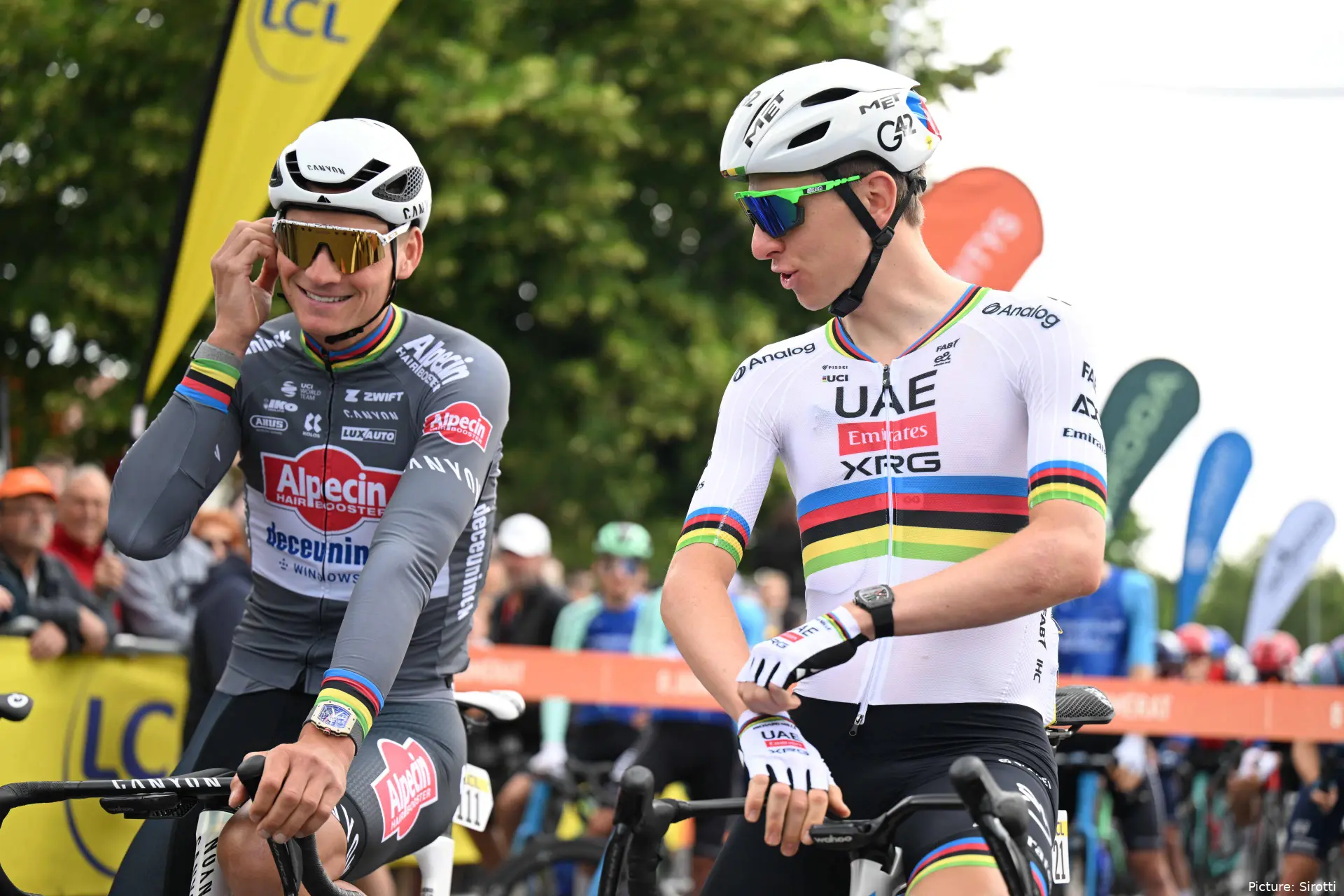
For all the talk around Tadej Pogacar and how he might finally win Milano-Sanremo, the race continues to revolve around a more stubborn reality. The Slovenian has already shown he can make the race selective. He has already proven he can arrive at the Poggio with only a handful of riders left. And yet, each time, the same problem remains. Mathieu van der Poel is still there.
That is the pattern that has defined recent editions, and it is the one that shapes the race again in 2026.
Speaking on TNT Sports, Sean Kelly pointed directly to that dynamic, arguing that the usual framing of the race misses the real issue. “The big question now is whether Van der Poel is beatable,” Kelly and TNT commentator Rob Hatch debate, shifting the emphasis away from Pogacar’s tactics and onto the rider who has repeatedly been able to follow them.
Pogacar’s Sanremo problem is not the attack
Pogacar does not need to prove he can animate Milano-Sanremo. That part has already been established.
His accelerations on the Cipressa and Poggio have turned what was once a sprinter-friendly Monument into a far more selective race, with last year’s edition the clearest example. The move on the Cipressa stripped the race down to its strongest riders, yet even then, it was not enough to create separation from Van der Poel.
That is why the question is no longer simply where Pogacar attacks, but whether those attacks can achieve anything more than reducing the group. As Kelly put it, “It’s going to be an interesting one for Pogacar… How does he beat Van der Poel and the rest?”

The form that changes everything
Part of the difficulty lies in timing. Pogacar arrives in strong condition, but so too does the rider he has been unable to distance. Van der Poel’s performances in recent weeks have only reinforced that sense of inevitability.
“I think we’re looking more at Tirreno-Adriatico this year because Van der Poel has been racing,” Hatch noted, with the Dutchman’s form described as “in excellent shape.” Pogacar, he added, is “also in excellent shape,” setting up a direct comparison rather than a clear hierarchy.
That balance is what makes the race so difficult to control. Pogacar can raise the level, but if Van der Poel can match it, the advantage quickly disappears.
A finale that resists control
Milano-Sanremo continues to compress its decisive moments into the final kilometres, leaving little margin for error. “It’s a long build-up, but what a final,” Kelly said, underlining the structure that has frustrated Pogacar in the past.
Everything comes down to the same point. “The Poggio… that’s where the big attack happens, where you see who has the legs.”
But even that is no guarantee. “Then you have the descent of the Poggio… Every year the suspense is just amazing.”
The nature of that sequence means that even a successful move on the climb can be undone before the finish, particularly against riders capable of recovering quickly and descending aggressively.
The same question, one more time
That is why, despite all the variations in tactics, the race keeps returning to the same scenario. If Pogacar goes early, Van der Poel follows. If the group is reduced, Van der Poel remains. And if they arrive together in the final kilometres, the balance begins to tilt.
Kelly summed up the uncertainty that sits over the race. “That is the question… and that’s one we’ll have to wait until Saturday.”
For Pogacar, the challenge is no longer simply to attack, but to solve a problem that has so far resisted every variation of his approach. And until that changes, Milano-Sanremo will continue to be shaped less by what he does, and more by whether the one rider who keeps following can finally be dropped.

Kieran WoodDeputy Editor-in-Chief
Kieran Wood is a sports journalist based in Wales and has been active in journalism since 2022. He regularly contributes to DartsNews.com and CyclingUpToDate.com, where he covers professional cycling and darts. In cycling, his work includes liveblogs from major races, including the Tour de France, the Giro d’Italia, and La Vuelta a España, alongside race reports and analysis. He has also conducted interviews with professional riders.
His reporting spans the full racing calendar, from one-day classics to stage races, with a focus on accurate, real-time coverage and clear contextual analysis. For statistics, results, and historical context, he regularly uses resources such as ProCyclingStats. To support reporting on rider activity and training context where relevant, he also references Strava.
In his work, Kieran places strong emphasis on careful sourcing, editorial accuracy, and updating articles as new, verified information becomes available.
claps 2visitors 2
Just in
Popular news
Latest comments
- Well said @RideHills 👏🏼anonymouscyclist14-10-2026
- OMG!!! As I wrote in the post below the other article, Paul is incredibly good, but he isn't quite at Tadej's level yet.MajorPayne14-10-2026
- The season is over, so there has to be something to write about. No one disputes that Paul is a top-tier young cyclist. But in the absence of other news, comparing him to Tadej is utter nonsense. He still has a lot of developing to do before he can win Grand Tours or Monuments that Tadej also competes in.MajorPayne14-10-2026
- It is easy to celebrate those who won the grand tours and the monuments. and the world championships. What I notice more are the ones who were at the world tour and kept going on the pro tour level for that little bit longer, still wanting to ride after their bodies had aged, after their teams no longer needed them. It is good to see the domestiques. as well. Congratulations to all these folks on an impressive career, no matter the wins. Cycling is a team sport, and it’s the ones we don’t see much of that allow the leaders to stand out and win the accolades.RidesHills14-10-2026
- Biestrebos is a real sprinting talent. Initially it was thought that he'd be a classics domestíque but his sprinting has improved dramatically over the course of the year. He's the only thing going well with Picnic now and for that reason it is likely that he'll leave
 Rafionain-Glas14-10-2026
 - well this one definitely makes my STUPIDEST ARTICLES OF 2026 list. chapeau…OCexile14-10-2026
- Cyclocross is nothing without stars like MVDP, WVA, Pidcock... etc. Out of all cycling disciplines, road racing is the most popular discipline in professional cycling, especially in terms of global prestige, major-event audiences, and the historical status of its greatest riders. People that don't follow cycling as a sport have heard of Merckx, Hinault, Pantani, Armstrong, Remco, Vingegaard, MvDP, Van Aert, Pogačar etc. So if we're talking about professional cycling and the sport's most famous athletes, road racing is the clear number one. Road cycling's greatest champions are judged across such a wide scale. E.g. - Pogačar can win the Tour de France and then go after Paris–Roubaix and other prestigious one day races. These races also have a wide range of versatility: cobbles, gravel, punchy, hilly, TT. This versatility is a huge part of why road racing is No.1 in cycling. Maybe Sven Nys is a dutch cycling "legend"... but that's where it starts and ends. Ad acta.PogiSloFans14-10-2026
- “at some point those guys will turn their backs on OUR sport”? after dedicating so much of their lives to cyclocross and in mathieu’s case winning more world championships than anyone, it would seem to me like they’ve earned the right for it to be always be THEIR sport, too, even after they retire from it.OCexile14-10-2026
- It takes two to tango. Riders also have a say. Maybe they didn't see any opportunities on a stacked team such as Visma's? Who knows, but could be a multitude of reasons why deals fall through.Pogboom14-10-2026
- Eventually Pogi will get older and slower. Father Time will favor the young. The question is whether he can beat Pogi before Pogi decides to retire. You never know... Pogi may retire after winning paris-roubaix :)b3tlla14-10-2026
Loading
Write a comment