From the 4th to 10th of August the World Tour calendar continues with it's first post-Tour de France stage-race: the Tour de Pologne. This week-long race in Poland is always packed with opportunities for the sprinters, classics riders and time-trialists. We take a look at it's profiles.
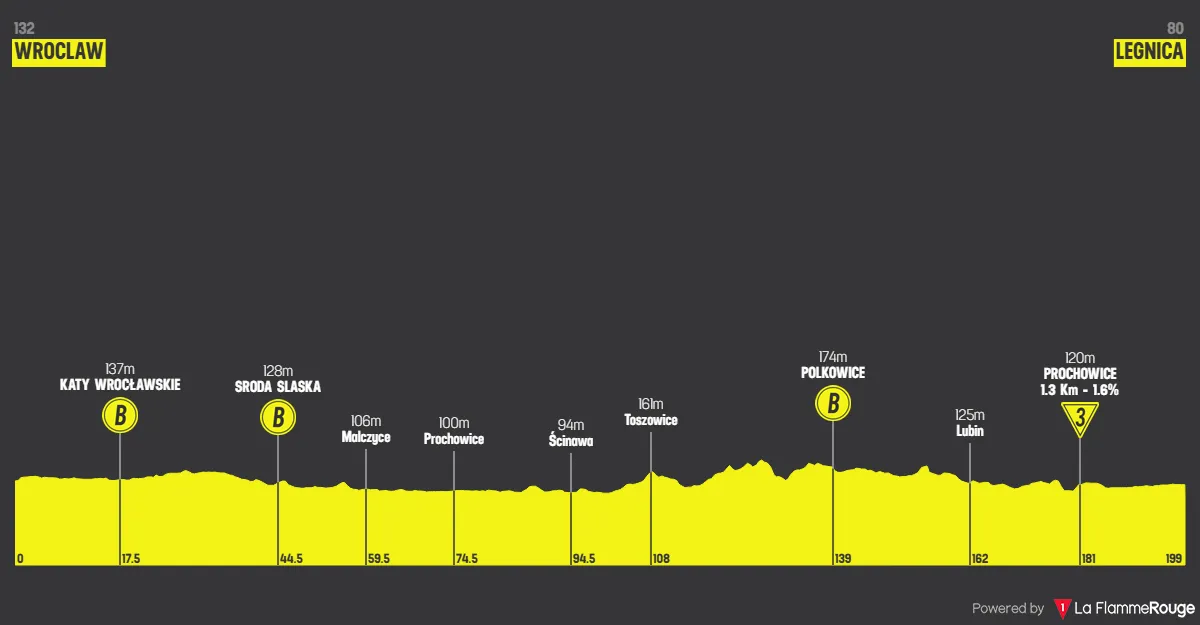
Stage 1: Wroclaw - Legnica, 199 kilometers
The race starts off in the city of Wroclaw and the opening stage will be fit for the sprinters. It will be one of the longest stages of the race with 199 kilometers in distance and there will be no obstacles in the way of the riders on the way to Legnica.
The final 2 kilometers will be somewhat technical however, not having any sharp corners present, but some slight turning all throughout these two minutes of effort that could be very treacherous and where entering well positioned will be crucial.

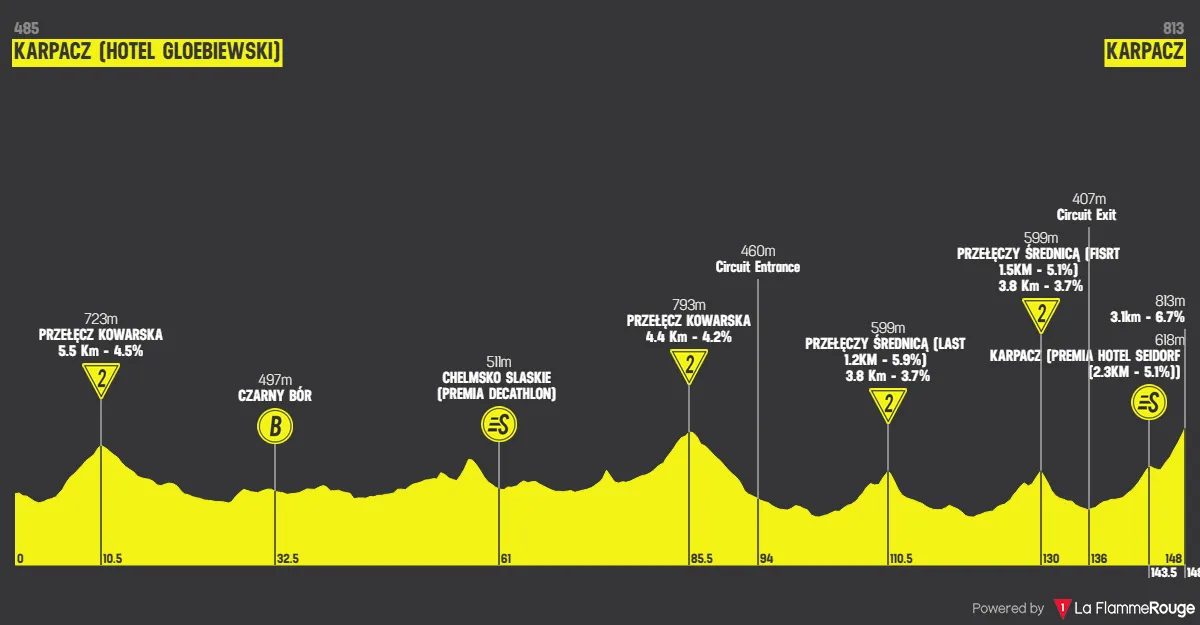
Stage 2: Karpacz - Karpacz, 148.3 kilometers
The second stage of the race will already be an important one for the overall classification as the riders go into the hills, starting and finishing off the day in Karpacz. A regular finale, however a shorter summit finish this time around, less well suited to the climbers.
Right at the start of the day there is some climbing, and then all over the stage there will be a few ascents scattered around. However all of the attention will be in the arrival which is a climb consisting of two sections. The first leads up to an intermediate sprint where the peloton finds a few kilometers at around 5%.
There is a small downhill section and then the final 3 kilometers average at 6.7%. It's not an ascent that is difficult enough to create serious differences and a sprint finish is likely, but there will be gaps and bonifications at play and of course, a first GC leader out of those who are fighting for the overall classification.

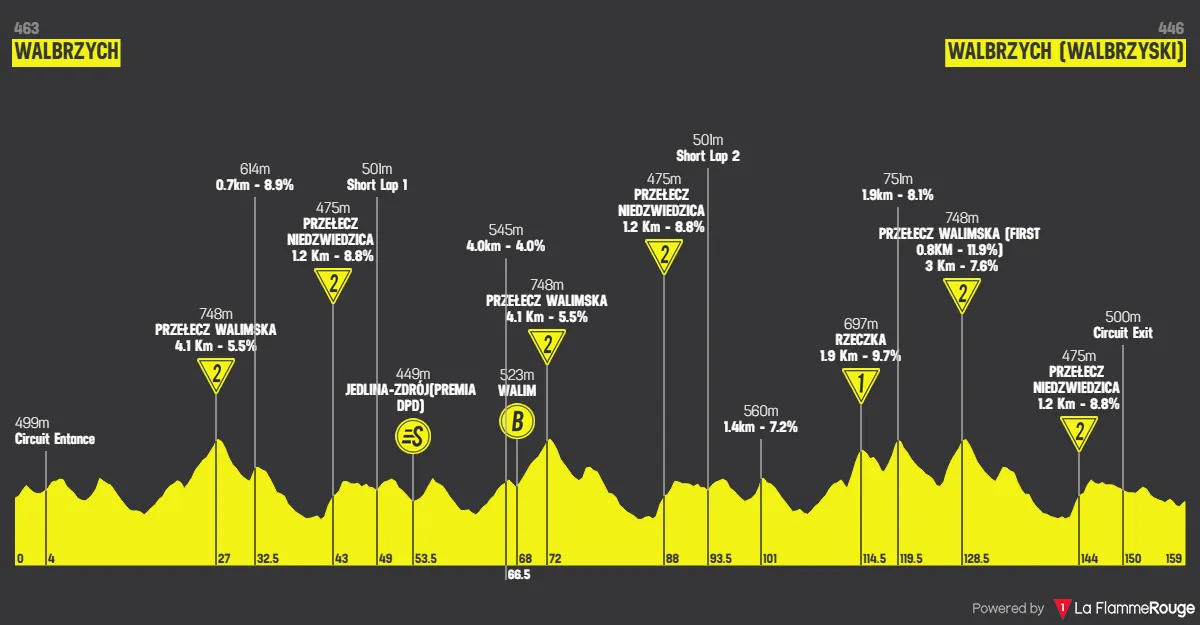
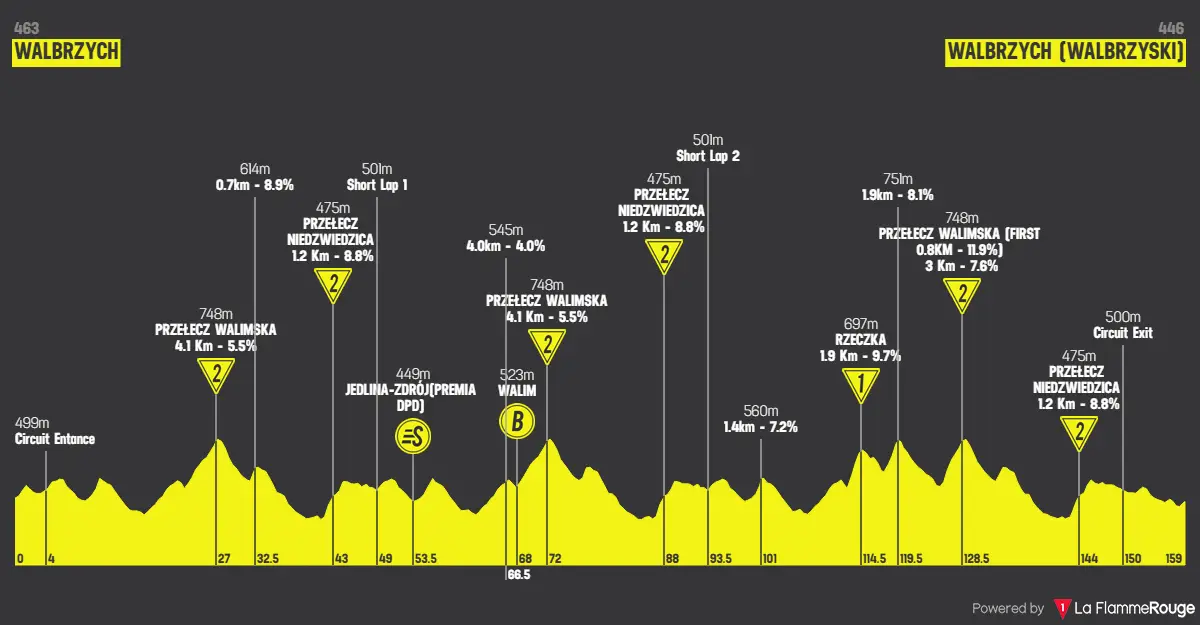
Stage 3: Walbrzych - Walbrzych, 158.7 kilometers
The third day of racing starts and finishes in the town of Walbrzych and for many it's a nightmarish day. Out of the 158 kilometers there is a barely a flat kilometer throughout the entire route and the total amount of climbing is of 3500 meters.
But these spread across dozens of climbs that the riders will face. There is no one moment of the stage where the race may explode, as there is climbing from start to finish. There are three steep ascents that could be more important due to their proximity to the finish and high gradient.
1.9Km at 9.7% (44.5Km to go); 3Km at 7.6% (30.5Km to go) and 1.2Km at 8.8% (15Km to go) certainly mark important points on the day before a slight downhill finish.

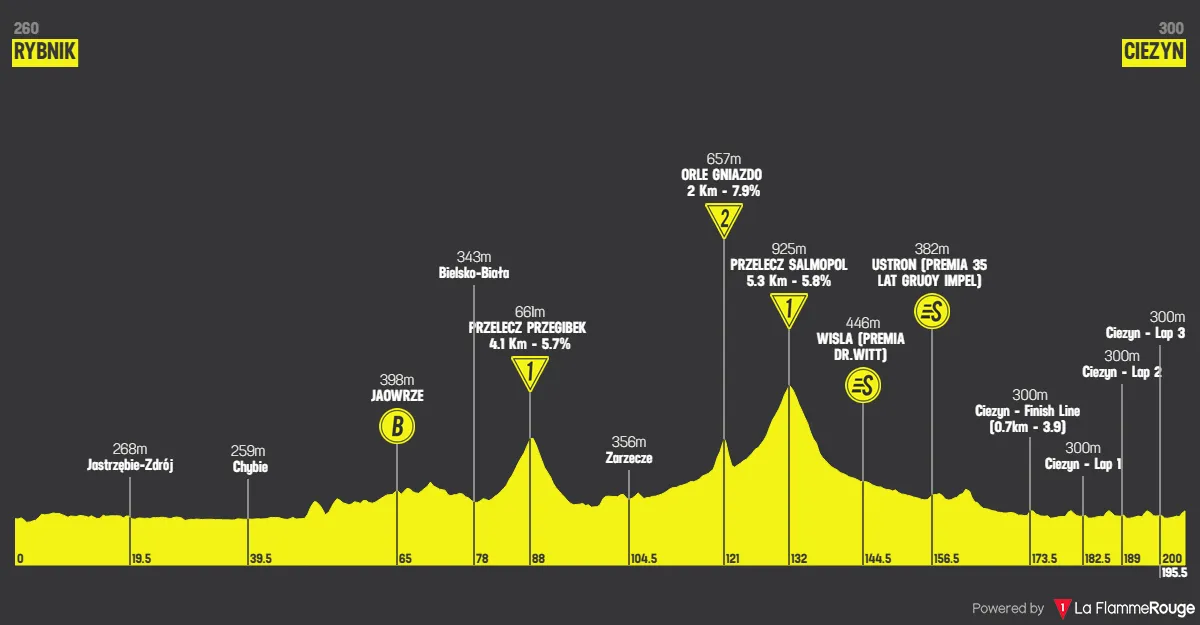
Stage 4: Rybnik - Ciezyn, 199.9 kilometers
Stage 4 sees a return of the sprinters to the front. It is a day with 200 kilometers on the menu starting in Rybnik and finishing in Ciezyn, however it's not all flat and the first two thirds of the day do feature some ascents where a high pace can put some in difficulty.
However it is not dramatic and the peloton will then travel to a final circuit where they will take on four urban laps finishing with a 700-meter ascents that averages at 4%. Not a pure sprint, it can be argued.

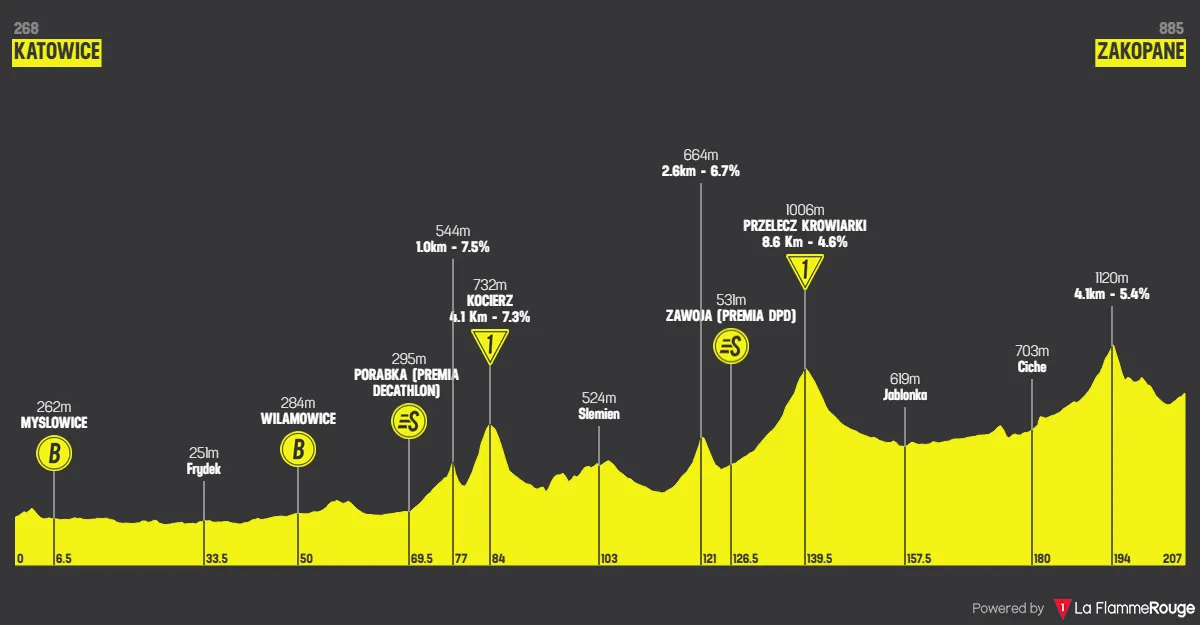
Stage 5: Katowice - Zakopane, 207.1 kilometers
The longest day of the race will come on stage 5, starting in Katowice and finishing in Zakopane, two locations used to receiving the race. This is a day for the puncheurs but it can also end in a reduced bunch sprint or breakaway.
The stage features some climbing but the most difficult ascents of the day come far from the finish and shouldn't be attacked. In the finale of the 207-kilometer stage we'll have a 4-kilometer long ascent at 5.4% that ends with 13 kilometers to go.
Then a downhill and a slight uphill drag to the line in Zakopane where even those who survive the climbing beforehand, will need good legs to reach the final meters with the ability to sprint.

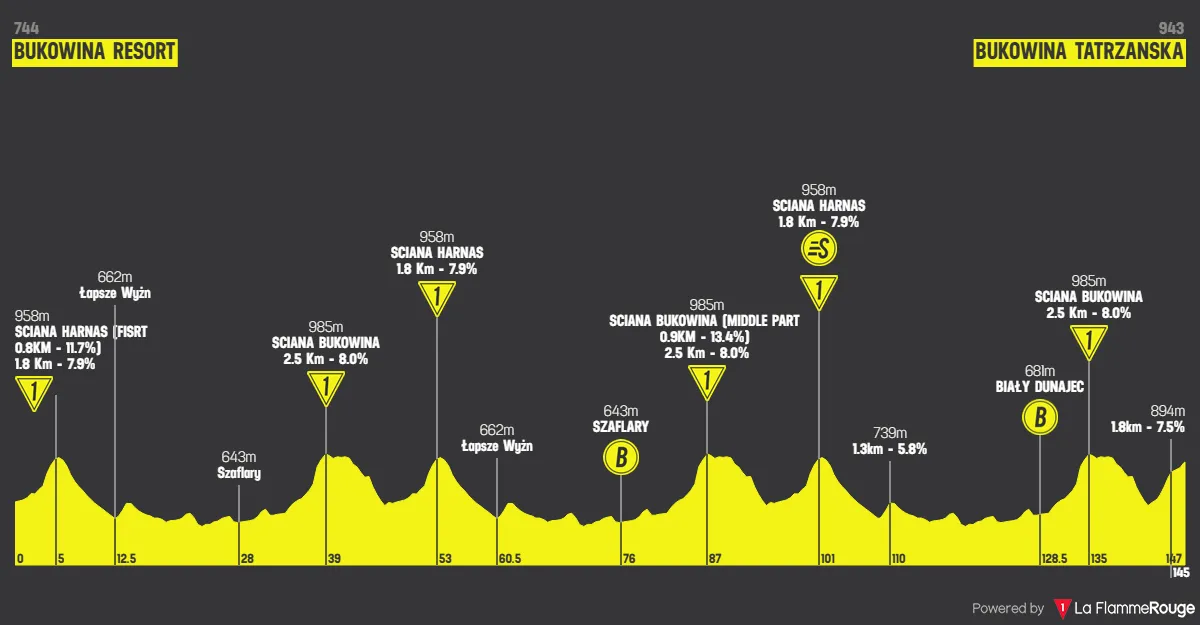
Stage 6: Bukowina Resort - Bukowina Tatrzanska, 147.1 kilometers
The queen stage? Most would say so, even if it is quite a short stage it is the one that presents the toughest climbs in the race and comes in the penultimate day which means fatigue will also play a role at this point of the week. The stage also does start off with a steep ascents where we may see some big attacks to form a breakaway.
The riders go on a little circuit that features two climbs during the middle part of the day and then late in the stage they tackle the first of the climbs again but then with a different summit finish. With 10 kilometers to go ends a climb of 2.5 kilometers at 8%, but the maximum is quite higher and the climb has serious ramps where big differences can be made.
But after this ascent and the small plateau that follows, there is still a final climb to Bukowina Tatranska to be tackled which is around 4.5 kilometers long at just over 5%. The hardest part of the climb is it's first half which averages around 7%.

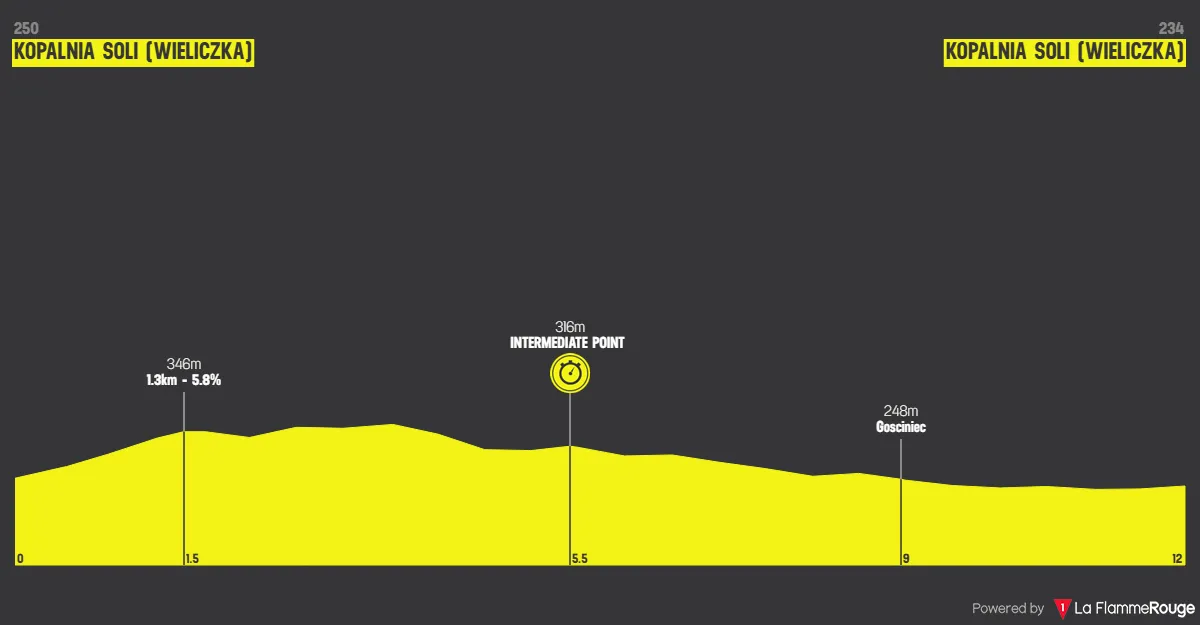
Stage 7 (ITT): Kopalnia Soli - Kopalnia Soli, 12.5 kilometers
The face finished with a time-trial in Kopalnia Soli. This will only be 12.5 kilometers in length, hence less decisive perhaps than usual in this race, and it will also be one that is not easy to manage.
Right of the starting ramp the riders find a climb where meaningful differences can be made with 1.3 kilometers at 5.8%. This is where the biggest amount of time can be gained but it must be a managed effort as the remainder is slightly downhill and quite a fast effort.

Rúben SilvaEditor-in-Chief
A founding contributor to CyclingUpToDate since its launch in January 2022, Ruben Silva has played a central role in shaping the site’s editorial direction and long-term growth. Before joining the project, he built his experience through independent blogging at Echelons Hub and by producing race previews for Ciclismo Internacional, developing a strong analytical voice rooted in daily engagement with professional cycling.
Beyond editorial work, he has been closely involved in the expansion and coordination of CyclingUpToDate’s wider network, helping establish and support sister platforms across multiple languages. This includes ongoing collaboration with CiclismoAlDia (Spanish), CiclismoAtual (Portuguese), WielrennenUpToDate (Dutch), and RadsportAktuell (German), contributing to a shared editorial vision and consistent international coverage.
He also helps oversee editorial governance across the network, setting standards for accuracy and consistency and coordinating updates or corrections when needed.
Originally from the Porto metropolitan area in Portugal, he holds a bachelor’s degree in Geography. His path into cycling journalism was shaped not through formal media training, but through independent reporting, community engagement, and sustained on-the-ground involvement in the sport.
Over the course of his career, he has conducted approximately 100 interviews across road cycling and cyclocross, ranging from one-to-one conversations and online formats to press conferences and on-site pre- and post-race coverage. His interviews include leading riders, team managers, and prominent figures within cycling media: Tadej Pogacar, Jonas Vingegaard, Mathieu van der Poel, Primoz Roglic, Wout van Aert, Joao Almeida and Tom Pidcock; managers like Patrick Lefevere and Joxean Matxin; and YouTube personality Bryan Kennedy (BKXC)...
Within 18 months of launch, he helped grow CyclingUpToDate’s English-language platform into one of the most-read cycling news websites, built entirely from the ground up. As both a professional journalist and lifelong cycling enthusiast, his focus remains on delivering accurate, timely, and well-contextualized coverage.
claps 1visitors 1
Just in

Popular news
Latest comments
- I'm a sepp fan and like to think he earned that LOL, indulge me : ) I think Jonas was fine. Roglic did not want to concede to Sepp. and I don't think you ever attack your own teammate in the leaders jersey if he is holding his own, which Sepp just about was.mij14-11-2026
- enough time? he's 24 years old. He's won 10 races over the last 2 years and some are significant. I won't argue about his attitude being good - it needs to improve. But with some coaching and mentorship he has a lot of winning ahead of him and has plenty of time to win a GT. I don't think he will ever beat Tadej, but everyone else is fair game Look at Mas and Valverde - they were 31 and 29, respectively, when they won the Vuelta.mij14-11-2026
- Pogacar has a fine head on his shoulders.Careful investments and a couple of coffee shops sounds like a wonderful way to chill after an intense career.Stay healthy GOAT.
 Brucegel14-11-2026
- I live in Maribor.PogiSloFans14-11-2026
- I live in Ljubljana and often go on trips in the surrounding area, where I frequently see young cyclists in 'Pogi Team' jerseys training, either alone or in groups. By simply motivating so many young people to take up cycling, Tadej has already achieved something truly significant.Velijo14-11-2026
- That's an excellent point. It's interesting that Vader came to that realization only after he learned that his contract wasn't going to be renewed.
 santiagobenites14-11-2026
- Indeed! A reluctant gift maybe. Even more reluctant gift from Roglic! Tho I can’t see that Rog would have beaten Ving anyway.Lozza14-11-2026
- That really nasty crash in 2022 Liege must have played a big part - broken ribs, pneumothorax. You only have to look at his points tallies pre and post.Lozza14-11-2026
- Yeah, good luck getting tv and race organisers like ASO etc to part with their cash!Lozza14-11-2026
- 36 and Ineos have bought a rider on the downward slope. Bring back Dave and Rob who could manage the team. How are Ineos going to win a grand tour with people past their sell by date.paultryan200214-11-2026
Loading
Write a comment