From the 12th to 18th of August we have on the road the Tour de Pologne. It collides with other big races in the calendar but every year it features a quality startlist with all kinds of riders. The seven stages will provide plenty opportunities in the only World Tour stage-race that comes between the Tour de France and Vuelta a Espana. We take a look at the profiles.


Stage 1: Wroclau - Karpacz, 157.2 kilometers
The race starts off with a hilly stage where the overall classification contenders will be tested. Overall, 157 kilometers on the menu and most of them relatively uneventful, with a few small ascents - categorized and uncategorized, but ultimately only in the final kilometers will we have real action.
It is a small hilltop finish in Karpacz. All about positioning. There is a 2.9-kilometers ascent at 4.5% which gradually becomes more steep up to the intermediate sprint which comes with only 4.5 kilometers to go. Shortly after there is a small ascent and there will be fight into that section and the bottom of the final climb.
The final hilltop is a gradual rise to the line as well, to end in a (possibly long) sprint. It's 3.2 kilometers at 6.5%, most of the climb in big-ring gradients, but in the final kilometer it goes up to 10%. The final 500 meters are the toughest and we may see small gaps at the finish.


Stage 2 (ITT): Myslakowice - Karpacz, 15.4 kilometers
Day 2 of the race is a time-trial, 15 kilometers long with a false-flat start and the same finale as the opening stage. There is a 2-kilometers ascent at 5% and the final kilometers will be familiar to the riders. It is a day for full time-trial setup as the first kilometers will be fast but even the climbs aren't really steep enough to justify any meaningful change.
The final hilltop is a gradual rise to the line as well It's 3.2 kilometers at 6.5%, most of the climb in big-ring gradients, but in the final kilometer it goes up to 10%. The final 500 meters are the toughest. It's not the easiest of time-trial to pace honestly, but there should be energy saved for the finale as there is road to make some important differences on that final climb.


Stage 3: Walbrzych - Duszniki-Zdrój, 155.5 kilometers
A very difficult day starting and finishing in locations that the average European will struggle to pronounce. But for the overall classification riders, they have no option but to know exactly what they are facing because this could be the most dangerous day of the entire race. Over 3100 meters of climbing in 155 kilometers with lots of climbing right from the start.
The depart in Walbrzych features right away a 1.3-kilometer ascent at 7.4% and 2.6Km at 6.9%... After that there are three second category ascents (and a difficult non-categorized one) which will make any chase difficult. Strong groups may gain advantage that will be hard to bring back. The most difficult of which is 2 kilometers long at 9.7%. Towards the final third of the stage there is a small section where it is possible to reorganize before the final ascents, but it is a difficult one to control.
The ascent to Karlow is 7 kilometers long at 5%, finishing with 18.5 kilometers to go, with a plateau right after the top. After a small descent the peloton still faces an explosive hilltop finish where in one way or another differences are promised and a thrilling finish is likely. The final 900 meters average 8% and the gradients go up to 14% before gradually coming down to the finish line.


Stage 4: Kudowa-Zdrój - Prudnik, 194.7 kilometers
The fourth day of racing starts immediately with a climb right out of Kudowa-Zdrój. 6.8 kilometers at 5.2% is hard enough for quality riders to go up the road and form a strong group that can fight for the stage win and steal the win from the sprinters. The first half of the stage is very rolling and features a few ascents that are not easy. But it does get easier towards the end.
The final half of the day is mostly flat and honestly with very little to mention. The riders head east with a bunch sprint expected in Prudnik. It's not a technical bunch sprint at all, but a regular one. There's no downhill or uphill, only very slight bends in the final kilometers but one where the leadouts will wait until as late as possible to move to the front.


Stage 5: Katowice - Katowice, 187.3 kilometers
A very simple day for the peloton in Poland. A day for the sprinters, starting and finishing in Katowice where there is very little that can prevent the expected outcome. There is only a small loop in the route before ultimately returning to the city through the same roads. What follows is a technical finale.
It's not a particular final kilometer that is difficult, but instead the whole final 9 kilometers. Right at this entrance to the city there are several corners that will stretch out the peloton quite a bit and there will be a fight for positioning to this spot.
From 5 to 2 kilometers to go there are several corners as well where the same will happen and tension will be constant. Speeds will also be very high after an easy and flat day. The final corner is placed with 700 meters to go, a sharp left-hander into the big avenue finale.


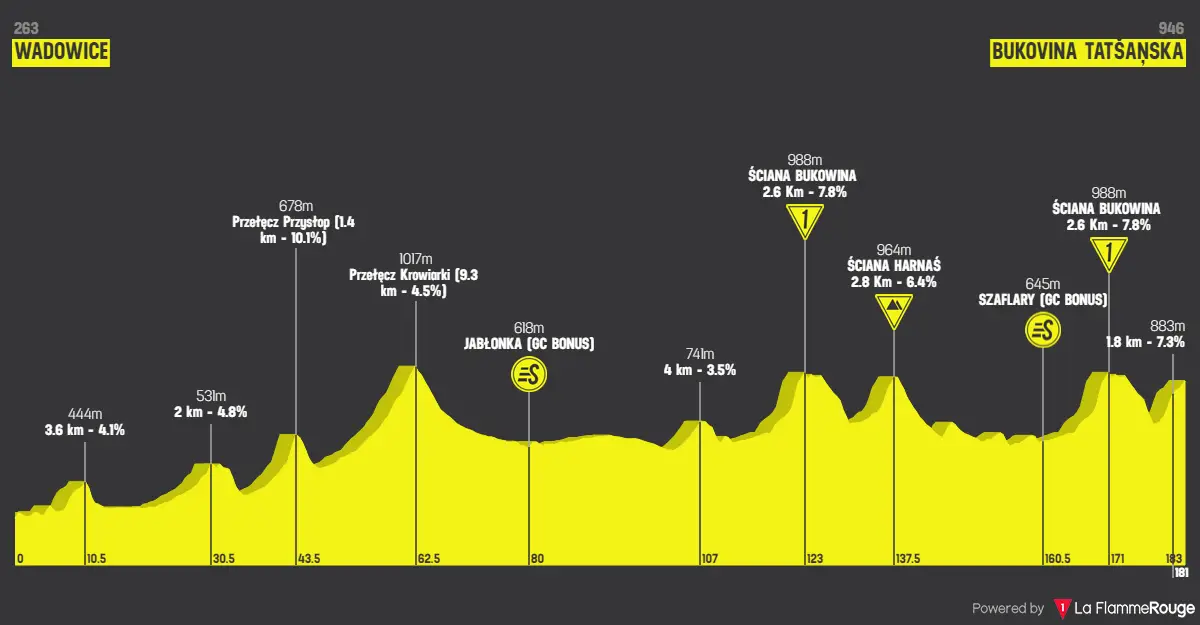
Stage 6: Wadowice - Bukovina Tatsanska, 182.9 kilometers
The queen stage? Perhaps some days earlier in the week were more dangerous, but I argue this is the most difficult one. Another 3100 meters of climbing but we have got difficult climbing this time around close to the end, with very steep gradients also included. Early in the day however there is also a set of four climbs, each hard enough for strong climbers or classics riders to go up the road. It could be important for the overall classification but also the fight for the stage win.
The riders then climb up Sciana Bukovina (2.6Km; 7.8%) and Sciana Harnas (2.8Km; 6.4%) that summit with 60 and 46 kilometers to go. They will be hard, but taking into consideration the finale, there will likely not be too much action yet on these ascents. Sciana Bukovina is the main climb of the day, the average is not too high but the gradients go over 20% on the climb and the final time up it sees the summit finish with only 12 kilometers to go. It is an ascent where differences can be made, with no doubt.
After the summit there is a small plateau and then a very fast descent into the base of the final climb directly. This is the ascent to the Bukovina Tatsanska which is 4 kilometers at around 5%. The first 2 kilometers average around 7% and it does provide the chance for attacks to still happen. It then flattens out but, if a sprint is to happen, it will still have some uphill gradients to the line in a smooth straightforward road.


Stage 7: Kopalnnia Soli Wieliczka - Krakow, 143.1 kilometers
The final stage of the race starts in the city of Wieliczka, location of the famous salt mines that are one of Poland's most famous natural monuments. The peloton will go away from the Krakow area but returns for the finale where... A breakaway could succeed due to the many small ascents in the first half of the day, but the finale will be completely flat with the sprinter teams likely to be able to control the race.
The finale will then consist of three six-kilometer laps just outside the city center, which will be very fast. Three 90-degree corners mark this, it is similar to a criterium. The final corner will come with 1.8 kilometers to go and the finale will be completely straightforward and pan-flat.

Rúben SilvaEditor-in-Chief
A founding contributor to CyclingUpToDate since its launch in January 2022, Ruben Silva has played a central role in shaping the site’s editorial direction and long-term growth. Before joining the project, he built his experience through independent blogging at Echelons Hub and by producing race previews for Ciclismo Internacional, developing a strong analytical voice rooted in daily engagement with professional cycling.
Beyond editorial work, he has been closely involved in the expansion and coordination of CyclingUpToDate’s wider network, helping establish and support sister platforms across multiple languages. This includes ongoing collaboration with CiclismoAlDia (Spanish), CiclismoAtual (Portuguese), WielrennenUpToDate (Dutch), and RadsportAktuell (German), contributing to a shared editorial vision and consistent international coverage.
He also helps oversee editorial governance across the network, setting standards for accuracy and consistency and coordinating updates or corrections when needed.
Originally from the Porto metropolitan area in Portugal, he holds a bachelor’s degree in Geography. His path into cycling journalism was shaped not through formal media training, but through independent reporting, community engagement, and sustained on-the-ground involvement in the sport.
Over the course of his career, he has conducted approximately 100 interviews across road cycling and cyclocross, ranging from one-to-one conversations and online formats to press conferences and on-site pre- and post-race coverage. His interviews include leading riders, team managers, and prominent figures within cycling media: Tadej Pogacar, Jonas Vingegaard, Mathieu van der Poel, Primoz Roglic, Wout van Aert, Joao Almeida and Tom Pidcock; managers like Patrick Lefevere and Joxean Matxin; and YouTube personality Bryan Kennedy (BKXC)...
Within 18 months of launch, he helped grow CyclingUpToDate’s English-language platform into one of the most-read cycling news websites, built entirely from the ground up. As both a professional journalist and lifelong cycling enthusiast, his focus remains on delivering accurate, timely, and well-contextualized coverage.
claps 0visitors 0
Just in

Popular news
Latest comments
- This is a really interesting idea, which, if well prepared could even be very successful. Very little money needs to be involved for a first season and any success could lead to rapid interest from sponsors.Jumpyjohn07-11-2026
- Hmmm, you seem to have a very convenient black and white view of things. Perhaps you haven’t been around much to discover how complex problems can become over time with people who know how to control, manipulate (or worse) others so gradually or subtly that you arrive at an irresolvable situation before you realise. This is how many inconveniences get introduced to the young, naïve, passionate or “desperate”, knowing they are not armed, protected or strong enough to defend themselves once it’s too late. Why do you think omerta culture is so widespread, why do you think so many people continue to go through so many awful things in life that others can’t understand anyone getting into? Life may be far more jolly for you but you would do well to understand (or reflect more on) the real world to refrain from being so quick to criticise those in a hard spot that may have genuine reason for speaking out.Jumpyjohn07-11-2026
- Seriously do you think when somebody gets into a serious accident, the ambulance is called by the hurt person?🤦 there is always a buddy system in place for a risky job. police , firefighters etc so that if someone gets hurt, the other call that in.abstractengineer07-11-2026
- I get the point totally. We live in the snowflake society where some riders forget they are getting paid to ride and get results. When they have a few issues they try to look outside of the real issue instead of themselves. It odd so many of the team are making no complaints and getting on with their job. If you do not like what you do find another job simples. Tough love as my mum would say.paultryan200207-11-2026
- many people advise him to grow slowly and rather do giro and/or vuelta instead of tdf. but i can totally understand that he is not satisfied with taking over once pogi declines, but instead beat him in his prime. so if he goes for tdf again, i‘m all for it. let‘s hope that pogi recovers soon!Ketterechts07-11-2026
- So gracious to offer something no-one would be prepared to pay for. The Giro is not the Tour and doesn’t command the same interest or attract the same “elite” (those willing to pay to be a part of something they consider has ego boosting potential). Roadside viewing will always largely remain free for everyone outside circuits. Introduction of a symbolic entrance to mountain climbs is worthy of exploration. Asking 1-2€ isn’t going to repulse real fans (most will spend 50-100€ on their outing that day all things included) but will prevent a portion of the total knobhead thrillseekers who will join in any large gathering as long as it’s free, just because they’re attracted to crowds, without which it it difficult for them to work up their anti-social behaviour.Jumpyjohn07-11-2026
- How is radio going to help when someone went over a cliff or bridge or off the roadside into a forest unnoticed and is laying there unconscious?Jumpyjohn07-11-2026
- Yep, next we’ll be accusing F1 drivers of avoiding Le Mans.Jumpyjohn07-11-2026
- But on what is that opinion based? Are you holding him to a different standard than others? Are you saying he should do learn to like something he doesn’t Are you saying he hasn’t achieved enough Are you saying he pretends to be better than his results? It’s actually a really strange opinion to oust if you consider it objectively or rationally. Try applying it to others or yourself by asking if not EVERYONE should then be doing more? Nobody in athletics or swimming gets criticism for not expanding their repertoire when a rival or someone else does. In fact, most who move to another event get accused of running from their rival. Opinions are boring, the reasons behind them are what count.Jumpyjohn07-11-2026
- for a medical chief to throw things like is just bad. There are already radios which were banned for spectacle. allow radios. Gps trackers are not a complete solutionabstractengineer07-11-2026
Loading

The route for the 81st Tour de Pologne has been revealed! 😍🚴🏻♂️ In less than a month, the 81st Tour de Pologne will begin in Wrocław. The competition will traditionally last 7 days and conclude at Kraków's Błonia, where we will learn the winners of various classifications. CHECK

Write a comment