“If this is a disqualification, then change cycling” – Giro stage winner defends Jan Christen amid online storm after Van Gils crash
Cycling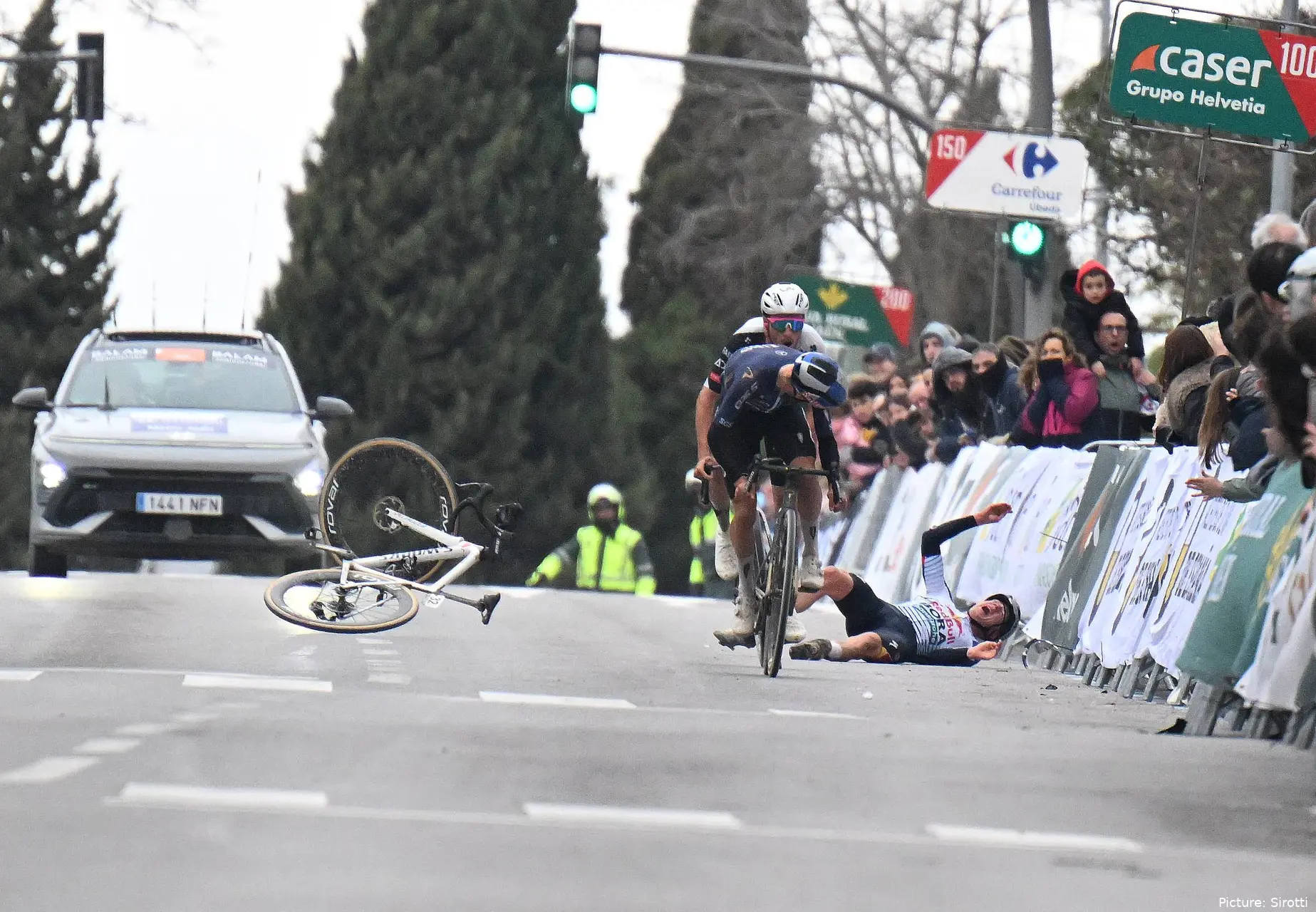
Sacha Modolo has publicly defended Jan Christen following the Swiss rider’s disqualification from Clasica Jaen, pushing back against the jury decision that reshaped the podium and left Maxim Van Gils seriously injured.
Christen was disqualified after deviating across the road in the sprint for third place and sending Van Gils into the barriers, a move judged by officials to warrant the maximum sporting sanction. The decision elevated Benoit Cosnefroy to the podium and immediately triggered a wave of debate online around sprint dynamics, rider responsibility, and where the limits are now being drawn.
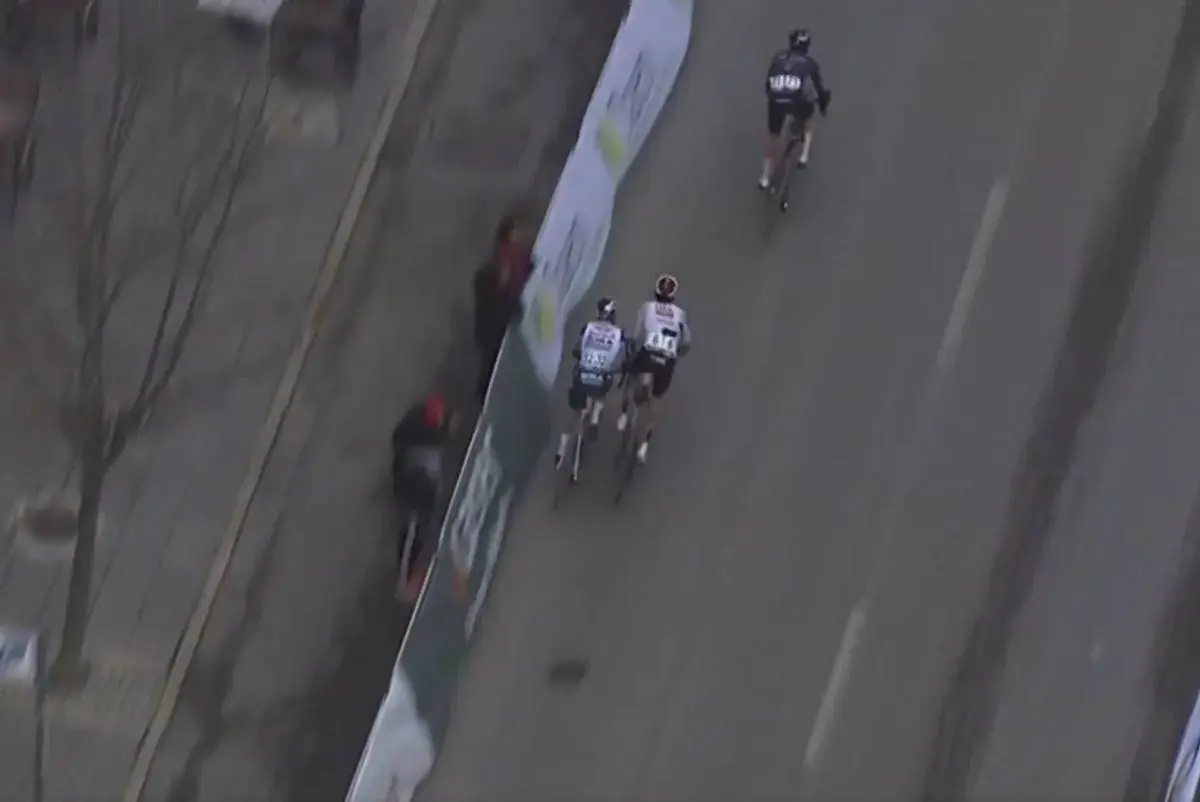
Modolo, a Giro d'Italia stage winner and former WorldTour sprinter, weighed in via Instagram stories as the reaction intensified. “Help me understand whether I’m getting old or I just don’t understand anymore,” Modolo wrote. “A cyclist starts wide near the barriers. Jan looks at him and moves left to get into the slipstream of the rider who started wide, not to close him off. The rider behind knows that the dynamics will carry him towards the barriers and that he won’t have space, but he stays there anyway. He touches Jan’s saddle, has his hands on it, falls, and honestly falls a bit naively, and it’s Jan’s fault?”
Modolo’s comments focused on how sprint positioning and momentum interact, questioning whether Christen’s movement should automatically be interpreted as a punishable offence rather than part of a high-speed contest for position.
Read also
Debate intensifies as injury details emerge
The reaction has been amplified by the seriousness of Van Gils’ injuries. Medical checks after the race confirmed that the Belgian suffered a fractured pelvis in the crash, ruling him out for several months and dealing a major blow to his early-season momentum.
That development has added weight to the discussion, shifting it beyond abstract rule interpretation to the real physical cost of sprint incidents. While the jury decision at Clasica Jaen was swift and decisive, the fallout has continued to grow as riders, fans, and former professionals assess whether current enforcement reflects how sprints actually unfold.
Modolo took that argument further in a second message, suggesting that the direction of travel risks changing the sport itself. “If this is also a manoeuvre that deserves disqualification, then maybe it’s better to change cycling like in triathlon, where drafting is forbidden, or like in swimming, where from 10 km to the finish everyone stays in their own lane,” he wrote.

Maxim van Gils suffered a fractured pelvis in the crash at Clasica Jaen
A flashpoint moment, not a settled argument
The Clasica Jaen decision stands in contrast to earlier incidents involving Christen this season, including episodes at the AlUla Tour that resulted in time penalties but not disqualification. In Jaen, however, the crash, the barriers, and the direct impact on another rider left officials little room to apply anything other than the harshest penalty available.
That has not prevented debate. Instead, it has crystallised a wider question about modern sprinting, responsibility, and how much latitude riders are now afforded when space disappears at speed.
With Van Gils facing months on the sidelines and Christen’s disqualification still fresh, Modolo’s intervention has ensured the conversation will not fade quickly. What remains unresolved is whether Clasica Jaen becomes a reference point for stricter enforcement or simply another flashpoint in an ongoing argument about where racing ends and rule-breaking begins.

Kieran WoodDeputy Editor-in-Chief
Kieran Wood is a sports journalist based in Wales and has been active in journalism since 2022. He regularly contributes to DartsNews.com and CyclingUpToDate.com, where he covers professional cycling and darts. In cycling, his work includes liveblogs from major races, including the Tour de France, the Giro d’Italia, and La Vuelta a España, alongside race reports and analysis. He has also conducted interviews with professional riders.
His reporting spans the full racing calendar, from one-day classics to stage races, with a focus on accurate, real-time coverage and clear contextual analysis. For statistics, results, and historical context, he regularly uses resources such as ProCyclingStats. To support reporting on rider activity and training context where relevant, he also references Strava.
In his work, Kieran places strong emphasis on careful sourcing, editorial accuracy, and updating articles as new, verified information becomes available.
claps 7visitors 7
Just in

Popular news
Latest comments
- I would prefer him to do the Giro and Vuelta, and leave Seixas, Remco and Jonas to fight it out in France. Btw 'redemption' implies he has disappointed us and has something to prove. I don't think he has anything to prove, but of course ticking off the Vuelta would be good. Pity he can't get a 'prior learning credit' for the first week in the Vuelta, and join in for the last two weeks!Hills3320-10-2026
- Bet you 90% of Slovenians will stop watching cycling once your boy stops. But. More pertinently, have you prepared for his retirement? I think you have extreme difficulties in understanding the difference between being a fan of cycling and being fan of a cyclist.Jumpyjohn20-10-2026
- I would keep a VERY open mind.Jumpyjohn20-10-2026
- Listen, maybe he did, maybe it’s more complicated but unless there are images* or witnesses, I wouldn’t go on stats alone. There are so many factors, terrain, wind, pacing, psychological/hormonal effects, etc. and that’s without consideration of Remco maybe changing his effort. As a rider I know all too well the effect of being overtaken can have, just like it’s always easier to push yourself when you are racing instead of training where you have no target to catch or pressure from behind. * obviously there is going to be a lack of commissaires in TTs to keep a constant eye on things but hey it’s 2026, these problems can be solved cheaply with on-board cameras or drones, they could even increase revenue and attractiveness through broadcasting right.Jumpyjohn20-10-2026
- Do you watch dog racing too? Do you remember what Einstein said about madness? What are you watching specifically, the way his ass moves over the saddle more efficiently? You should really ask yourself some psychological questions if what you enjoy is watching someone do exactly the same as all the others only slightly faster some of the time but not in any way noticeably without the immediate proximity of competitors. Would you watch time trials if no results or times were taken? You should really think about the real reasons why you enjoy watching someone much more than others (or why you can’t enjoy watching others doing the same). If you would argue it was for other reasons than simply wanting to watch the best (and I’m pretty sure you don’t watch e.g. cyclocross or kayaking because you want to dictate a hierarchy in sport) I would have more understanding (nothing else) for your choices (nationalism, ego, prediction talents, etc.)Jumpyjohn20-10-2026
- In theory you’re right but sometimes news is sparse or not funny or the discussion rather limited or predictable so a little lighthearted mocking can be a welcome distraction. Also, it doesn’t hurt to attract to agendareers and schemers.Jumpyjohn20-10-2026
- A suggestion to commentators, prepare to include interesting unrelated material when there’s little to report on. This is why the TdF grew an audience, it attracted more than hardcore cycling fans or fans of particular riders who’d find it interesting to hear or even discuss their choice of toilet paper at home. If you can’t keep viewers’ attention with surroundings, history, tourist information, etc. there’s always, highlights, best of past races, betting odds, international newsflashes, weather forecasts, etc. or the suggestion to go make a cup of tea. In fact, maybe the whole idea of one long live broadcast is the problem, a general sports update during the race would probably interest many, like the format in football where they flip across matches where goals or interesting events happen. Can’t see the point of comparing watching a guy turning his pedals in a constant fashion on an empty road with one hitting a tennis ball in a different strategic place each time or moving around a football field in an infinite number of unpredictable combinations wrt teammates and opponents every minute.Jumpyjohn20-10-2026
- Says Mr Non-stop repeating himselfJumpyjohn20-10-2026
- Phew I hope we do not get Jiffygate 2🤣🤣🤣🤣🤣 oh and by the way Bradley still has not answred the question re jiffygate even in his latwst book🙄🙄🙄🙄paultryan200220-10-2026
- What a stupid comment. If they are as good and if not better why should they sit on seasoned pros wheels. Sexias is a prime example . Move with the times they are fitter and more hungry and more ambition. If you cannot abide being 2nd string find a new profession.paultryan200220-10-2026
Loading
4 Comments