“If that car hadn’t been blocking everyone at the entrance to the Forest...” - Alpecin boss takes blame for Van der Poel’s decisive Arenberg setback
Cycling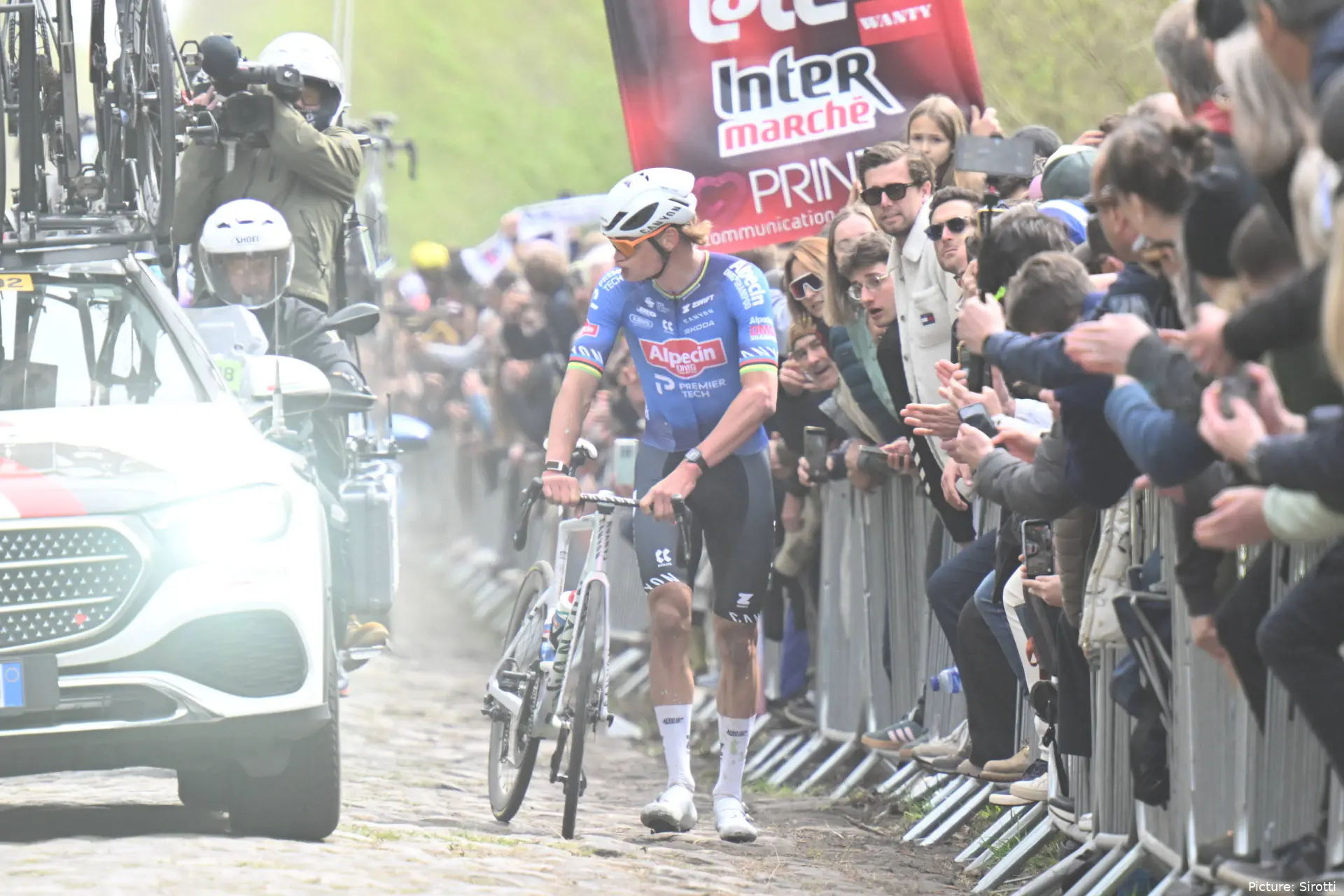
What was supposed to be another defining day for Mathieu van der Poel at Paris-Roubaix instead unravelled in a matter of moments inside the Trouée d’Arenberg, and in the aftermath, Alpecin’s team boss did not shy away from where things went wrong.
Speaking after the race to IDL Pro Cycling, Christoph Roodhooft pointed to the chaotic sequence at the entrance to the Forest as the turning point, explaining: “We were stood still for over a minute. Behind us, the peloton came through and was able to pass,” before adding, “If that car hadn't been blocking everyone at the entrance to the Forest, I think nothing would have been lost.”
A chain reaction that changed everything
What followed was not a single mistake, but a cascade of problems that quickly took Van der Poel out of contention. Roodhooft described how the situation escalated within seconds, noting that “there was a long chain of events leading up to it,” while also stressing how fine the margins were in that moment: “We should simply have been there a minute earlier.”
The sense of lost opportunity only grew when reflecting on the position they held before everything went wrong. “At that point, I think we were in a really good position in the race,” he said, underlining just how quickly the situation turned.
Among the issues was Van der Poel’s front-wheel puncture, which forced an improvised solution that only added to the disruption. “He eventually takes Jasper’s bike, but it had different pedals on it,” Roodhooft explained, a detail that would soon become central to the post-race discussion.
Prototype gamble backfires
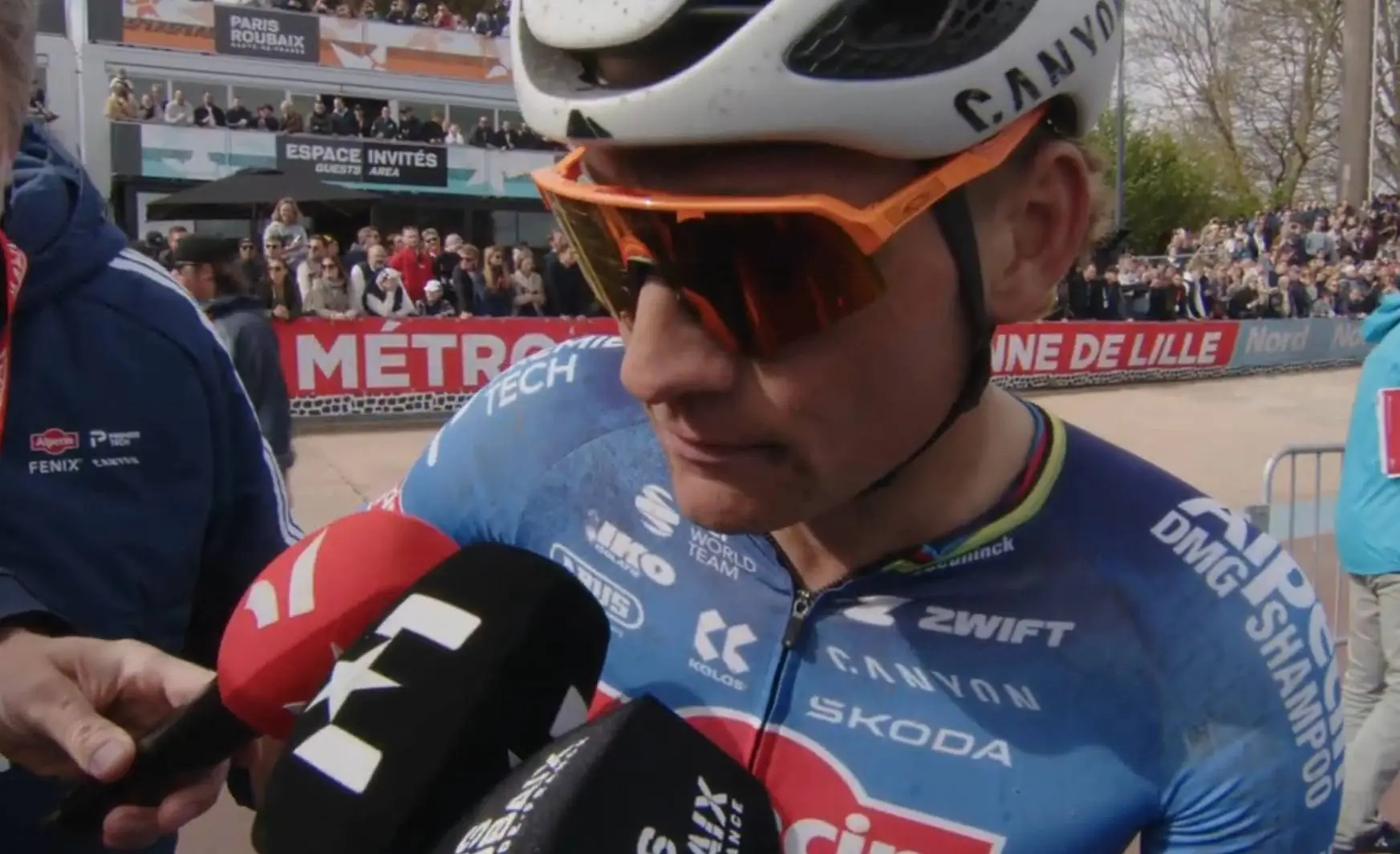
That decision has since come under heavy scrutiny. Alpecin had opted to use prototype pedals as part of ongoing testing, a call Roodhooft openly addressed. “They are prototype pedals. I had agreed for them to also be tested in competition,” he said, before admitting the consequences could not have come at a worse time: “today it came at an incredibly bad moment.”
With hindsight, the responsibility was clear in his own mind. “Right now I think it was very stupid of me,” he said, before adding, “I don't understand how I didn't think of it. It’s more unlikely than winning the lottery, all of it falling together like that.”
He also made clear that lessons had already been taken from the incident. “It won’t happen again. But it’s done now.”

Mathieu van der Poel at the 2026 Paris-Roubaix
Chaos without control
The situation was compounded by the unique circumstances inside Arenberg. For the first time, no personnel were allowed in the sector with spare wheels, while team cars were unable to move forward due to the blockage at the entrance. As Roodhooft put it, “we had no chance to fix it or to be there,” leaving riders to react on instinct.
That instinct was evident in the moment Jasper Philipsen handed over his bike, with Roodhooft reflecting that “at that moment, they would actually have been better off with just the wheel, but that's all easy to say in hindsight,” a line that summed up the split-second decisions forced by Roubaix’s chaos.
A performance lost in the chaos
Despite everything, Van der Poel still fought his way to fourth place, a ride that underlined both his form and what might have been. “It will have been close to his best race ever, I think,” Roodhooft said, a striking assessment given how the race had unfolded.
That contrast defines the frustration of the day. The condition was there, the position was there, but the chance to fight for victory slipped away before the race had fully taken shape.
From dominance to disappointment
For a rider chasing a fourth consecutive Paris-Roubaix victory, the emotional toll was inevitable.
Roodhooft captured that feeling bluntly when reflecting on the aftermath, saying: “When you're in this condition, in this race, and you've won the last three editions, and then you have to let it slip away like that… that's enough to make you never want to ride a bike again.”
On a day shaped by chaos, timing and misfortune, even the strongest rider in the race was left chasing events rather than controlling them, a reminder that at Paris-Roubaix, nothing is ever guaranteed.
Kieran WoodDeputy Editor-in-Chief
Kieran Wood is a sports journalist based in Wales and has been active in journalism since 2022. He regularly contributes to DartsNews.com and CyclingUpToDate.com, where he covers professional cycling and darts. In cycling, his work includes liveblogs from major races, including the Tour de France, the Giro d’Italia, and La Vuelta a España, alongside race reports and analysis. He has also conducted interviews with professional riders.
His reporting spans the full racing calendar, from one-day classics to stage races, with a focus on accurate, real-time coverage and clear contextual analysis. For statistics, results, and historical context, he regularly uses resources such as ProCyclingStats. To support reporting on rider activity and training context where relevant, he also references Strava.
In his work, Kieran places strong emphasis on careful sourcing, editorial accuracy, and updating articles as new, verified information becomes available.
claps 1visitors 1
Just in

Popular news
Latest comments
- Yes, he won't ride away yet, but he will and that day will be notable
 leedorney13-10-2026
 - Expect the young French rider to slowly asphyxiate the Slovenian into retirement.
 Front24213-10-2026
 - My thinking is that Pog's experience and strength would have outweighed any fatigue in Il Lombardia. But the sad thing is, we'll never see peak Pog (call it Pog 2) go head to head with Seixas. However well he recovers from his crash, he'll return as Pog 3, with the shadow of severe concussion always there.Hills3313-10-2026
- Some speculation and opinion. Had Tadej not crashed out of the Vuelta he would have been less fresh and I'm not sure he would have beaten Seixas in this race. Maybe he would have been able to contest the race in a sprint and maybe not. Believe me when I say I keep up with many of Tadej's climbing feats and records and I understand how great he is but the Paul we just saw at Il Lombardia was not that far behind Tadej.awp13-10-2026
- Firstly, someone who says parenting is babysitting is delusional and shouldn't be taken seriously. Secondly, with pro athletes it is not the same as a normal worker. They are being rewarded for doing something for which they have a talent which doesn't actually help people (besides inspiration). It's quite a different dynamic
 Rafionain-Glas12-10-2026
 - only way for him to effectively learn to microdose is to go to uae. other than that there is no reason for him to go to uae.whkman12-10-2026
- that was a great win, and quite a surprise at the time. That was a loaded field, and he held of Valverde for the win. Still shocking that Valverde never won Lombardia. He seemed perfect for it. Mollema just went to work every day.mij12-10-2026
- I hope he races Volta a Majorca. We'll really be able to see if he can do one-day-races (but do they count?)Rafionain-Glas12-10-2026
- See, you can write a sensible comment without just slagging off everyone else! Well done!👏😆 🫣Lozza12-10-2026
- Seixas best chance is obviously UAE. They are the best team in history of the sport and they developed pogacar into the goat. They also developed Del Toro to be nr 2 in world. Seixas would become unstoppable at UAE. Lets see if Seixas stays at decathlon but if UAE comes knocking its impossible to say no. Barcelone and real madrid combined into one team, thats UAE in cycling it feels like..miguel12-10-2026
Loading
Write a comment