“I don’t have words... I’m speechless” – Paul Seixas leaves team boss stunned after ‘insane’ breakthrough
Cycling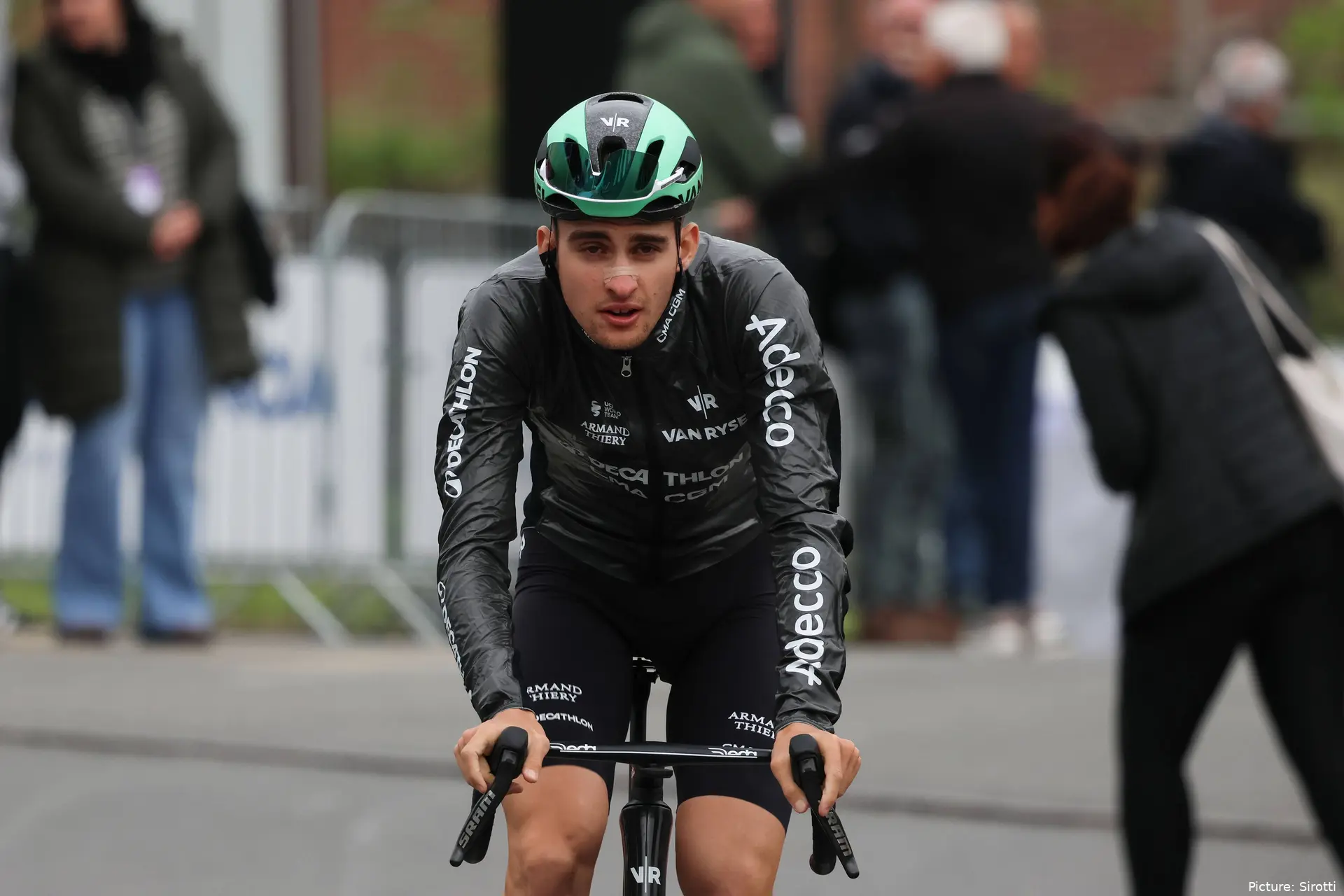
There are moments in a rider’s rise where performance alone no longer explains the reaction around them. That is where Paul Seixas now finds himself.
His victory at Itzulia Basque Country did more than add a WorldTour stage race to his palmares. It shifted expectations inside his own team, forcing even those closest to him to reassess what might be possible next.
Speaking on The Cycling Show, Decathlon CMA CGM sporting director Heinrich Haussler struggled to put that shift into words. “I don’t have words. I can’t describe it. Like now, I’m speechless.”
A level that demands attention
Seixas’ breakthrough has not been built on a single result. It has come through a sequence of performances that have steadily raised the ceiling. A first professional win at the Volta ao Algarve confirmed his ability to finish at the highest level. A second place at Strade Bianche behind Tadej Pogacar showed he could compete directly with the sport’s defining rider. Then came Itzulia, where he won three stages and the overall title, dominating across different terrains rather than relying on one specific strength.
For Haussler, the significance lies not only in what Seixas is doing, but how he is doing it. “His mental approach, the way he rides, the way he follows the peloton, the moves in the final, for a 19-year-old, I’m completely blown away with his talent.”
That description points to something more complete than raw ability. It suggests a rider already capable of reading races and executing under pressure, rather than simply reacting to them.
Changing the dynamic inside the team
The impact has not been limited to results sheets. Within Decathlon CMA CGM Team, Seixas’ emergence is already altering the mindset of the group around him. “This pushes the level from the whole team, because if you have a rider like that and you go to the start line, everyone knows, not just the riders but also the staff, okay we’re here to win.”
That shift is significant given the context the team operates in. In a peloton increasingly defined by super teams with vast resources, smaller structures are often forced into reactive roles. A rider capable of changing that dynamic, even temporarily, becomes a central figure very quickly.

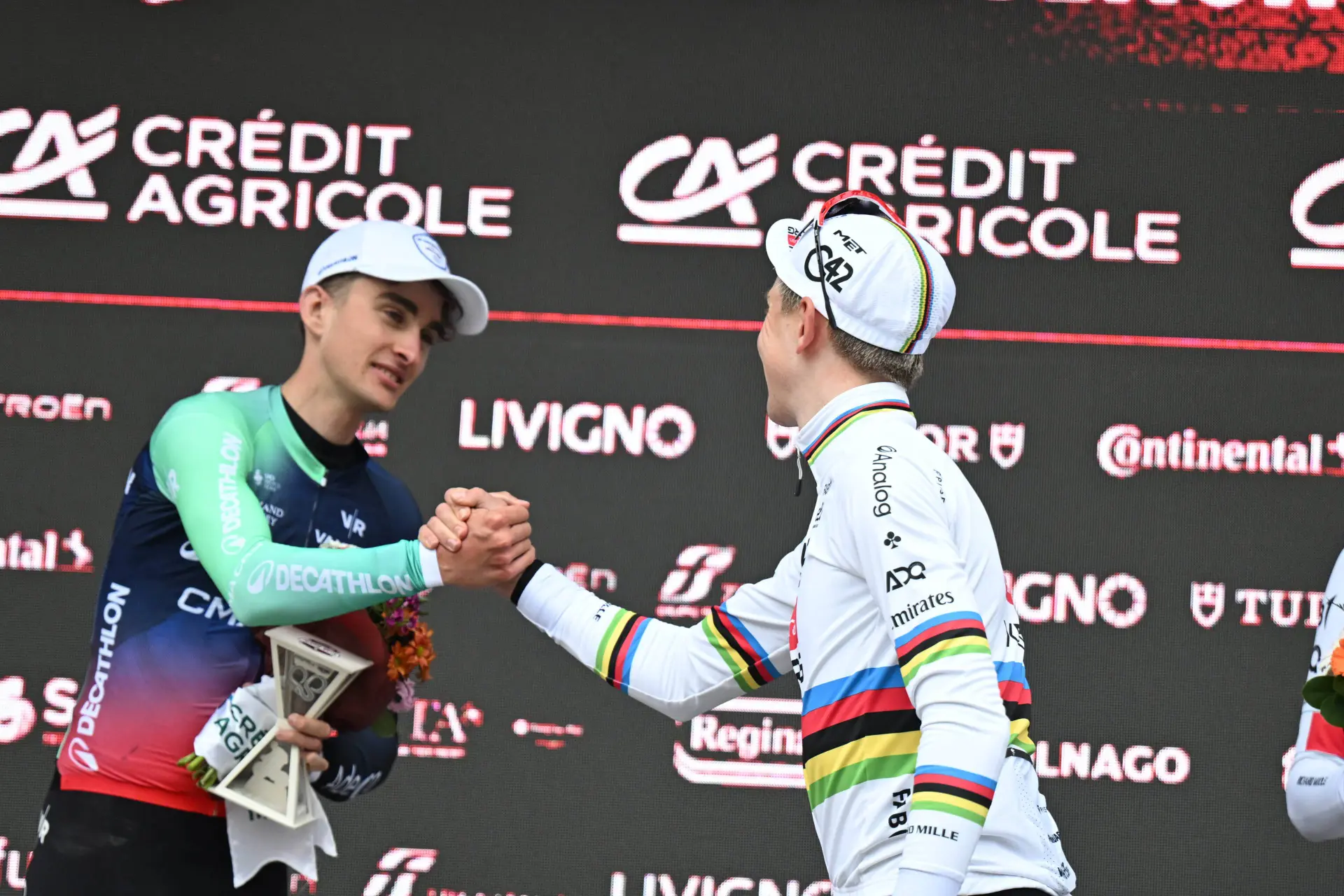
Paul Seixas with Mattias Skjelmose on his wheel at Itzulia Basque Country 2026
More than a promising talent
Seixas has already been labelled one of the most exciting prospects in cycling, but the language around him is beginning to move beyond that. “He is the next big talent.”
The statement is simple, but it reflects a growing consensus. Results, consistency and versatility have combined to place him in a different category to most riders at a similar stage of their career. There is still caution in how his future is framed. “I’m really curious to see what he’s capable of in the next years.”
That uncertainty is inevitable. Development is rarely linear, and expectations can shift as quickly as they rise. But for now, the direction of travel is clear. Seixas is no longer being discussed as a rider for the future alone. His performances have already forced a recalibration of what can be expected in the present.
And when even those working with him every day are left searching for words, it suggests that the scale of that progression may still be unfolding.

Kieran WoodDeputy Editor-in-Chief
Kieran Wood is a sports journalist based in Wales and has been active in journalism since 2022. He regularly contributes to DartsNews.com and CyclingUpToDate.com, where he covers professional cycling and darts. In cycling, his work includes liveblogs from major races, including the Tour de France, the Giro d’Italia, and La Vuelta a España, alongside race reports and analysis. He has also conducted interviews with professional riders.
His reporting spans the full racing calendar, from one-day classics to stage races, with a focus on accurate, real-time coverage and clear contextual analysis. For statistics, results, and historical context, he regularly uses resources such as ProCyclingStats. To support reporting on rider activity and training context where relevant, he also references Strava.
In his work, Kieran places strong emphasis on careful sourcing, editorial accuracy, and updating articles as new, verified information becomes available.
claps 14visitors 13
Just in

Popular news
Latest comments
- Nothing. Against Pogi nothingabstractengineer18-10-2026
- He didn't even try to sprint all outvappaxbipmv18-10-2026
- Campenaerts looked like a rolling pumpkin with that all orange leaders skinsuit !frieders318-10-2026
- He can take his dumb a$$ politics somehwere else !frieders318-10-2026
- good to have her back. fingers crossed she‘ll be able to stay!Ketterechts17-10-2026
- A tenner and he wins the Tour next year, too 😂anonymouscyclist17-10-2026
- the answer is either stick to classics or GTs but not bothabstractengineer17-10-2026
- the exodus already stared with Ciccone. Already they were struggling with two sprinters, now there are three. Also Ganna will demand leadership. Gall is the most proven GC, Ayuso has the most potential. GC leadership for everybody will be impossible. Literally a UAE style mess without pogi.abstractengineer17-10-2026
- I raced as an amateur for 12 years, including six years on my country’s national road cycling team. I secured two national titles and competed in three World Championships plus more than 15 international stage races. At 23, we travelled to Italy for a training camp—or so I assumed. On a rest day, we watched a presentation about adopting a more “professional” training approach. It was crystal clear what “professional” meant. That moment first exposed me to this dilemma. After returning from Italy, I left cycling—at least at the competitive level I had known. Over the following two years, the whole team was caught doping. I hold that everyone is innocent until proven guilty. In my view, current stakeholders operate on a different scale, and the sums involved are vast. I am unsure whether any doping would ever be revealed. I try to stay positive and enjoy the show. My 2c.
 vannpelt17-10-2026
 - Fiver he wins 🤣
 leedorney17-10-2026
Loading
12 Comments