"I don’t believe it’s completely clean" – Oscar Onley calls blind faith in a clean peloton “naive” as he chases Grand Tour dream with INEOS
Cycling
Oscar Onley is not trying to shock anyone. He is not claiming cycling is rotten. But he is also not prepared to pretend that everything is perfect.
“I don’t believe it’s completely clean,” he said in conversation with BBC Radio Scotland. In one calm sentence, he summed up the balance he now lives with as a Grand Tour contender in the Pogacar and Vingegaard era.
He knows how much testing exists. He knows how much riders are monitored. But he also believes it would be “naive” to assume that history has been completely erased. It is realism, not accusation. And it comes at the exact moment he is trying to climb from “nearly” to “good enough” at the very top of the sport.
“Naive” to assume cycling is spotless
“I believe the sport’s come a long way in the past 10 to 15 years,” Onley said. “I also don’t believe it’s completely clean. I think it’s quite naive to think it’s clean throughout the whole world, but I think it’s in a better place than it was before I started cycling.”
He spoke openly about the scale of testing he experiences. “I know how much we get tested and how much I personally get tested as well throughout the year and throughout the Tour,” he said.
The system, in his view, is serious. But not magical. “It’s not much I think about. I can only compete with who I am up against. I am not riding along thinking, ‘this guy might be getting an advantage over me’. It’s not really the thought process I or many other riders have. You have just got to focus on yourself and trust that everyone else is playing by the rule book. With the guidelines we have, I think it is very hard to cheat nowadays.”
That mixture of trust and doubt mirrors his position in the peloton itself. He believes he belongs. He does not believe he has arrived.
Chasing the front two
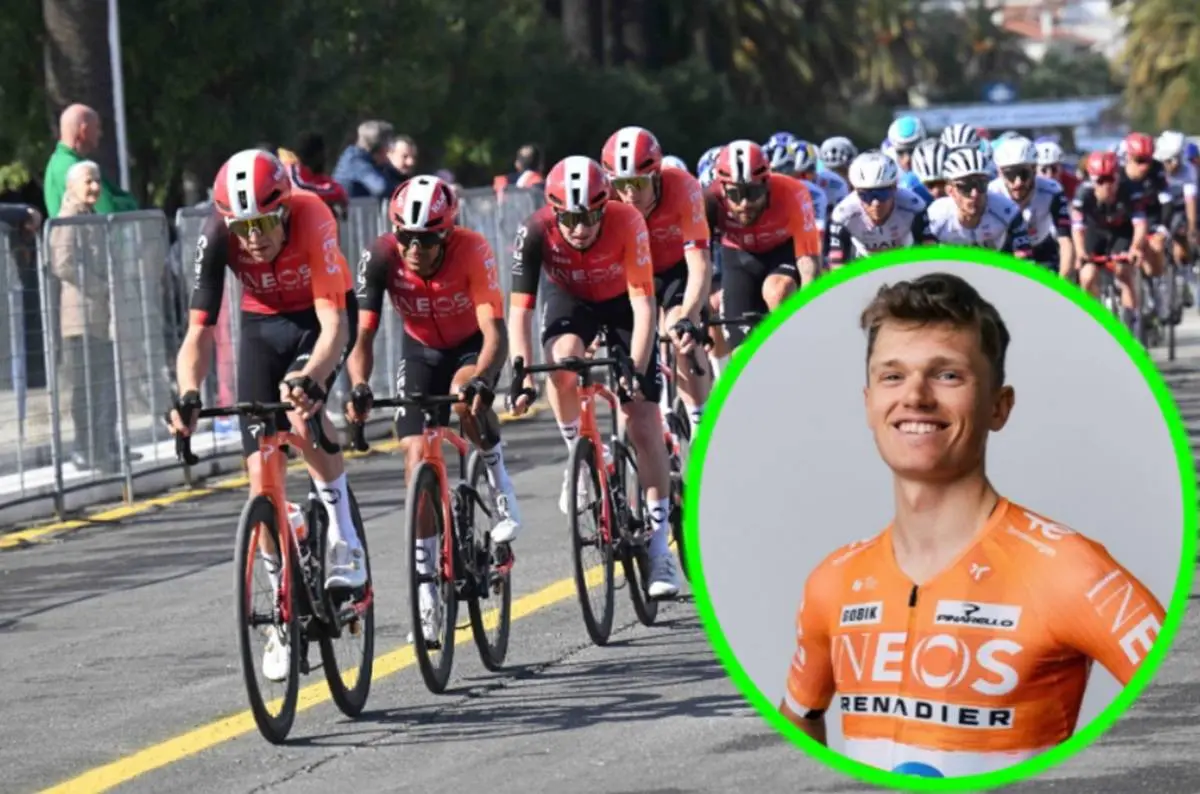
Last summer, Onley finished fourth at the Tour de France, equalling the best result ever achieved by a Scottish rider. But even that breakthrough has not convinced him that the summit is close. “I still feel very far away,” he said. “To the front two, there is a big gap from the rest of us.”
Those two are Tadej Pogacar and Jonas Vingegaard, the riders who turned his best season into proof of distance as much as promise. Pogacar finished more than 12 minutes ahead of him. Vingegaard was eight minutes clear.
Onley finished just over a minute behind third place. Close enough to dream. Far enough to know it is not a fantasy that becomes real by accident.

Onley locked to the back wheel of Vingegaard and Pogacar during the 2025 Tour de France
From survival to belief
The change has come quickly. A year earlier, he arrived at the Tour with very different goals. “I was just trying to go for stage results, which meant there is certain days when I would sit up and take it a bit easier,” he said. “That was with the knowledge that I was not in a position to be fighting for a top-five finish overall.”
Then everything shifted.“It really feels like it came quite quickly in the last few months before the Tour,” he said. “Everything started to click into place and so I was starting to gain a lot more confidence in myself as well.”
The confidence is not loud. It is measured. “In the next couple of years, a podium finish is definitely possible if things go the right way for me,” he said.
Looking beyond the Tour
He is not limiting that ambition to July. “There’s also two other Grand Tours in Italy and Spain, where sometimes the competition’s slightly less deep,” he said. “If it goes the right way, then why can’t I try to win one of those?”
It is not a rejection of the Tour. It is a recognition of reality. Winning any Grand Tour is rare. Winning one in the era of Pogacar and Vingegaard is rarer still.
Onley is not running from that challenge. But he is also not pretending there is only one road to the top.
A calculated step
That thinking has shaped the next phase of his career. He is moving to INEOS to turn belief into structure, and potential into results. He has spoken about how he looks up to riders who could focus on one goal each year and build everything around it. Racing beside figures like Geraint Thomas showed him what long term purpose looks like inside the peloton.
Now he is trying to build that for himself. Not by pretending the sport is perfect. Not by pretending the gap is small. But by accepting both, and working anyway.
Kieran WoodDeputy Editor-in-Chief
Kieran Wood is a sports journalist based in Wales and has been active in journalism since 2022. He regularly contributes to DartsNews.com and CyclingUpToDate.com, where he covers professional cycling and darts. In cycling, his work includes liveblogs from major races, including the Tour de France, the Giro d’Italia, and La Vuelta a España, alongside race reports and analysis. He has also conducted interviews with professional riders.
His reporting spans the full racing calendar, from one-day classics to stage races, with a focus on accurate, real-time coverage and clear contextual analysis. For statistics, results, and historical context, he regularly uses resources such as ProCyclingStats. To support reporting on rider activity and training context where relevant, he also references Strava.
In his work, Kieran places strong emphasis on careful sourcing, editorial accuracy, and updating articles as new, verified information becomes available.
claps 2visitors 2
Just in
Popular news
Latest comments
- "The Spaniard also highlighted Florian Lipowitz, third in the recent World Championship time trial, as a rider to watch as he continues to gain experience." Please stop the AI slop
 Rafionain-Glas24-10-2026
 - I think it's great! Now there's a real reason forcing the people-who-don't-fix-the-potholes to fix the potholes... or notRafionain-Glas24-10-2026
- Roglič brought in as many points as some of the lower standing teams, so you would think that more than one team would be trying to get one of the top 25 points machines onto their team. He brought in only 500 points less than the entire Picnic Post NL team. Take those points and Unibet is still not in the top 18, but put him on one of the teams fighting for 18th and they get some security. NSN at 18th with Roglič’s 2100 points would be in 11th place.RidesHills24-10-2026
- He's 20, in two years or so he will be the guy winning everything.awp24-10-2026
- You're talking about being lucky if someone crashes out... I'm talking about quality.PogiSloFans24-10-2026
- He finished 2nd this year at the Tour. Pogacar crashed out of the Vuelta. If he had crashed out of the Tour, Remco would have won.acem8224-10-2026
- Lance never won a TdF, so not sure why he and Hincapie are listed here. I thought this was best domestiques for TdF winners.mij24-10-2026
- Pelizzaari is not Remco's domestiqueabstractengineer24-10-2026
- YetJumpyjohn24-10-2026
- Nibali got into the lead because he wanted the team car further forward in the caravan (I love this as a sign of tactical thinking). He solidified the lead on the rainy cobbles day when he was just brilliant, while other contenders crashed out on the wet roads. Strategic and skillful, yes, but the English roads weren’t as decisive as they might seem.RidesHills24-10-2026
Loading
Write a comment