From Olano to Alejandro Valverde and even a record-holder - Spain's luxurious palmarès at the World Championships
CyclingFriday, 18 September 2026 at 11:35
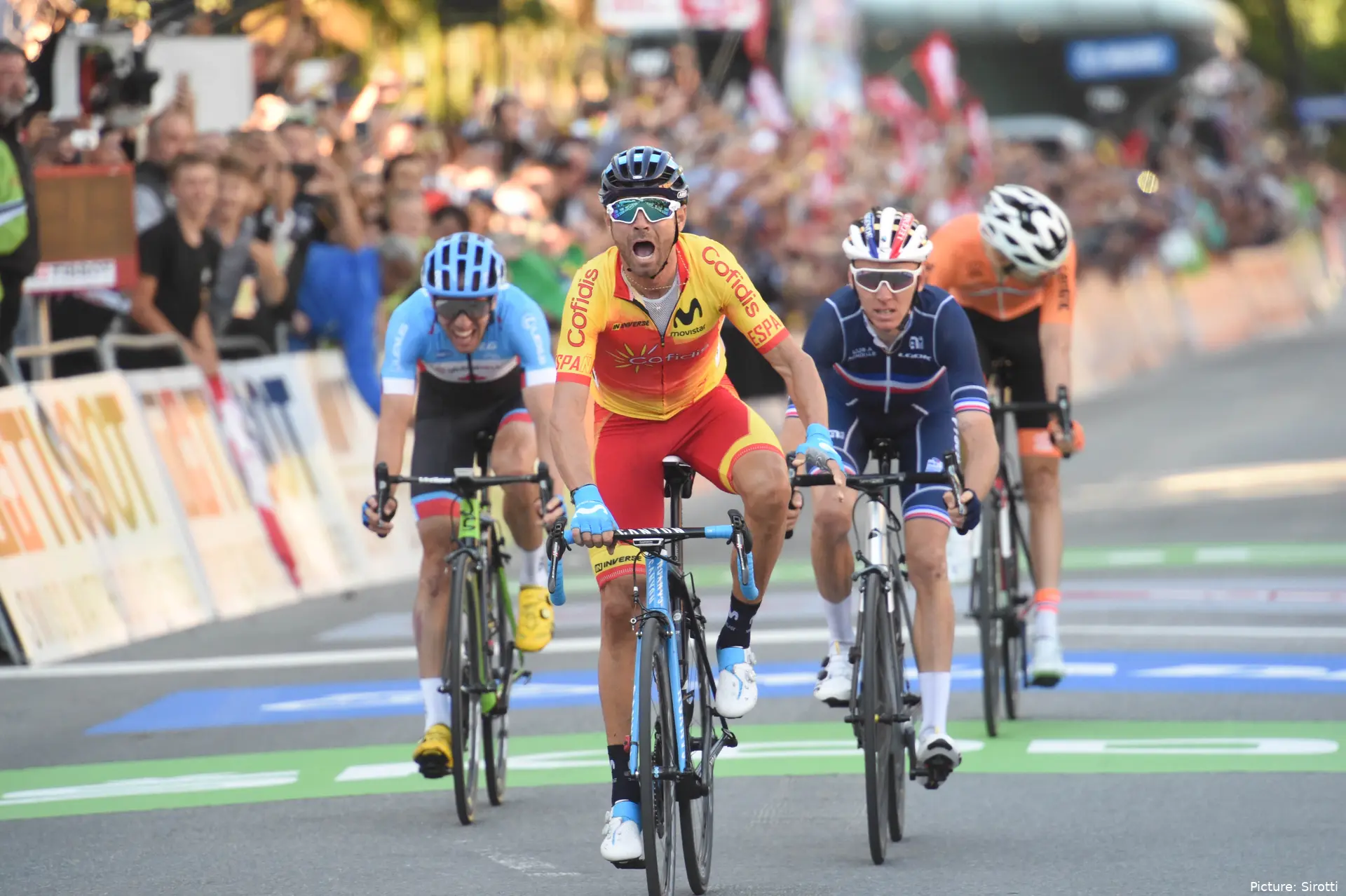
Spain has a historic bond with the UCI Road World Championships. Across the decades, the Spanish national team has built a palmarès that places it among the discipline’s powerhouses, with leading roles in both men’s and women’s racing.
The overall medal table reflects that trajectory: Spain has amassed 44 medals at the World Championships, split between 11 golds, 14 silvers, and 19 bronzes. A collection that sums up decades of success and has often found its most illustrious protagonists in the men’s road race.
Among all those results, four stand out. Not only because they ended with a gold medal, but because each marked a decisive moment in the winner’s career and left a distinct imprint on Spanish cycling history.
Abraham Olano, Óscar Freire, Igor Astarloa, and Alejandro Valverde all conquered the rainbow in completely different circumstances. Four wins, four styles, four eras that explain much of Spain’s stature at the Worlds.
Abraham Olano, 1995: the rainbow jersey that confirmed a star
Abraham Olano’s victory in Duitama in 1995 was one of the great demonstrations of endurance and ambition by a Spanish rider at a World Championships. The rider from Gipuzkoa arrived in Colombia after finishing second at the 1995 Tour de France and faced a brutal course at over 2,500 metres of altitude.
Olano did not wait for a sprint. He attacked in the final phase and went clear alone, dropping Miguel Indurain, who finished second to complete a historic Spanish one-two. The image of the pair in gold and silver captured the scale of the performance.
The triumph cemented Olano’s international status as one of the great riders of his generation. Winning the Worlds under those conditions and ahead of a teammate of Indurain’s stature made it one of the most important days of his career and one of Spain’s greatest collective successes.

Abraham Olano was world champion in 1995
Óscar Freire, 1999: the unexpected birth of a legend
Verona changed Óscar Freire’s career forever. The Cantabrian arrived at the 1999 Worlds outside the front rank of favourites and delivered one of the biggest surprises in the modern history of the World Championships.
Freire used his speed and race craft to prevail in an extremely tight finish. His victory came on a day when any mistake could have cost him the rainbow. He picked the perfect moment and became world champion at just 23.
That gold was more than an upset. It was the start of a legendary relationship with the Worlds. Freire would reclaim the rainbow in 2001 and 2004, becoming one of only three riders in history with three world titles in the road race. Verona, then, was the first chapter in an extraordinary bond with the rainbow jersey.
Igor Astarloa, 2003: a victory against all odds
Hamilton 2003 produced one of Spain’s most unexpected wins. Igor Astarloa did not start as the leading contender for gold, but he read the race superbly and exploited a demanding course to play his cards at the decisive moment.
The Basque rider attacked in the closing kilometres and carved out the gap he needed to reach the finish alone. Behind, the big favourites fought for the minor places, but none could reel in the Spaniard’s move.
For Astarloa, that day was the greatest triumph of his professional career. The world title elevated an already notable trajectory into something exceptional and returned the rainbow to Spain four years after Freire’s first. It also proved the jersey was not reserved solely for the sport’s most high-profile names.

Alejandro Valverde, a legend of Spanish cycling
Alejandro Valverde, 2018: the reward for an entire career
If any Worlds carries a special emotional weight for Spain, it is Alejandro Valverde’s in Innsbruck. After four medals in the road race and years of chasing the rainbow, the rider from Murcia finally claimed what had long eluded him.
The Austrian course was a true survival test, with the brutal ascent to Igls as the main selection point. Valverde reached the reduced group set to decide the title and, despite facing much younger rivals, waited until the last moment.
In the final sprint he outpaced Romain Bardet and Michael Woods to capture the only major title missing from his palmarès. At 38, Valverde turned a career marked by Worlds near-misses into gold and ended a wait of almost two decades. His triumph was also Spain’s fourth men’s road race world title and one of the most celebrated moments in the nation’s recent cycling history.
Read also
Spain among the world’s great powers
The four victories span four generations and four distinct ways to claim the rainbow jersey. Olano mastered altitude and mountains; Freire turned a sprint into a historic chance; Astarloa stunned with a decisive attack, and Valverde found reward after years of trying.
Their significance is even clearer when you look at the all-time Worlds medal table. Spain has 44 medals, placing it tenth historically, with 11 golds, 14 silvers, and 19 bronzes. Italy, Belgium, and the Netherlands lead the ranking, but the Spanish team belongs to the select group of nations that have turned the Worlds into a steady source of success.
| Pos. | Country | Gold | Silver | Bronze | Total |
| 1 | Italy | 47 | 44 | 48 | 139 |
| 2 | Belgium | 44 | 30 | 27 | 101 |
| 3 | Netherlands | 40 | 44 | 25 | 109 |
| 4 | France | 33 | 30 | 26 | 89 |
| 5 | Germany | 32 | 31 | 37 | 100 |
| 6 | United States | 20 | 20 | 15 | 55 |
| 7 | Russia | 17 | 22 | 25 | 64 |
| 8 | Switzerland | 15 | 21 | 20 | 56 |
| 9 | Australia | 14 | 26 | 19 | 59 |
| 10 | Spain | 11 | 14 | 19 | 44 |
| 11 | United Kingdom | 11 | 10 | 16 | 37 |
| 12 | Denmark | 8 | 7 | 10 | 25 |
| 13 | Sweden | 8 | 4 | 4 | 16 |
| 14 | Norway | 8 | 2 | 7 | 17 |
Javier RampeCycling Journalist
Javier Rampe is a sports analyst with more than 15 years of experience. He holds a degree in Economics from the University of Rome and a Diploma in Business Studies from the University of Cádiz. Despite coming from an academic background not particularly associated with cycling, his passion for both cycling and journalism was instilled in him from an early age. He grew up following Miguel Indurain and José María “El Chava” Jiménez. An admirer of Michael Robinson’s communication style and journalistic approach, he was inspired to pursue a degree in Journalism at the University of Buenos Aires, which he is currently completing.
He has always maintained close ties with the worlds of sport and culture, contributing from a young age to sports blogs and film and music review websites. His work has appeared in media outlets such as Cope, RAI, and Radio Con Vos. He is also the founder of the cycling-focused podcast El Contraanálisis and the football interview channel Días De Fútbol, dedicated to conversations with professional footballers.
In addition to his work at Ciclismoaldia, Javier has interviewed some of the most influential figures in modern cycling, including Alejandro Valverde and Tadej Pogačar, as well as key voices in anti-doping policy such as Alberto Yelmo, David Varillas, and Marcelo Milano. Marcos Maynar, in relation to the ‘Operación Ílex’ case, is also among the personalities he has interviewed. He enjoys conducting in-depth analysis of the cycling ecosystem and has attended major events such as Strade Bianche, the Vuelta a Andalucía, and Itzulia, as well as numerous national cyclo-cross races.
His background in economics, combined with extensive experience in marketing and corporate communications, drives his continuous study of positioning strategies and ensures that he always keeps his focus on crafting compelling and evocative headlines.
claps 0visitors 0
Just in
Popular news
Latest comments
- Perhaps they'll do 9 more articles, eventually finishing with Italy?
 Rafionain-Glas18-09-2026
 - "Sex sells" - of course it does, and it always has done. Prostitutes have been around for as long as anyone can remember. But should it sell? When you think with your morality as a human being, there is only one answer - NO. And the fact of the matter is that even though the entertainment industry is full of whores like Sweeny, people in general are better and condemn this. So while it's obvious that you can't eliminate it, that doesn't mean that it should be accepted as alright. Let sport be sportRafionain-Glas18-09-2026
- Chapeau Davide! What a ride. Watch out for this lad at the Worlds, he could well be a factorRafionain-Glas18-09-2026
- Spain ranks 10/14 on this list for total medals. How does that make them a great power, they are not even in the top 1/3?mij18-09-2026
- I wonder if they will sign Sydney Sweeney next. in her latest commercial she appears to be a multi discipline athlete too.mij18-09-2026
- what a great story - he overcame all of that to become what he is.mij18-09-2026
- No doubt Remco's father will e be preparing excuse if he loses the TT.Looking forward to worlds but not the constant excuses and whinging from Remco. You never get excuses or moaning from Pog when he is beaten.paultryan200218-09-2026
- That's true and he'd be feeling confident considering his Tour podium.awp18-09-2026
- I'd like Del Toro to go back. THAT'S some unfinished business.wrsty18-09-2026
- It was a high likelihood he would have won the 2023 Giro had he not come down with covid. By the time he had withdrawn he had won two stages and was leading on gc by almost a minute. I doubt Tadej races the Giro next year. If Tadej and Jonas don't race it and Remco can keep the rubber side down he has another good chance to win the race.awp18-09-2026
Loading
2 Comments