"Finding a new business model would resolve 80 to 90 per cent of the issues": Jayco AlUla manager urges structural reform to protect professional cycling's future
Cycling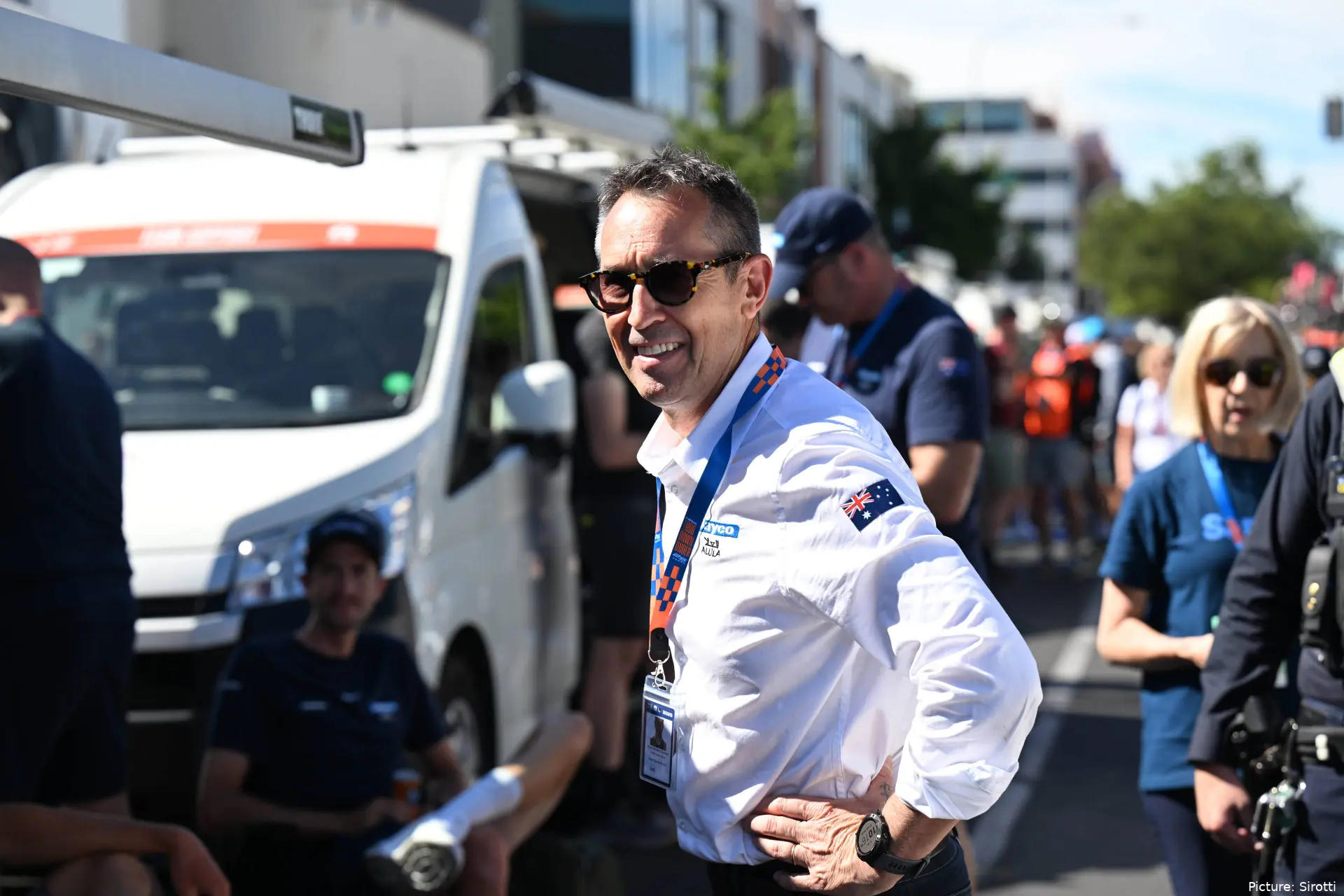
As professional cycling struggles with skyrocketing operational costs and a widening wealth gap between the sport's elite squads and the rest of the peloton, the push for financial regulation is increasing. Brent Copeland, the general manager of Team Jayco AlUla and president of the International Association of Professional Cycling Teams (AIGCP), has revitalized his campaign for a mandatory team budget cap to safeguard the interests of corporate investors and ensure long-term competitive balance.
The changing attitudes toward financial regulation
When Copeland initially raised the concept of financial caps within the peloton two years ago, his ideas were met with widespread resistance from other teams. However, as top-tier team budgets have expanded drastically (with elite squads now operating at up to €60 million, nearly double the average WorldTeam budget of €32 million) the perspective of most team executives has undergone a profound shift.
"When I first mentioned budget cap two years ago I was shot down by the majority of our members. Now I see a lot of our members are actually calling for it and doing public interviews about the budget cap because they understand that it's getting to a situation which is unsustainable," Copeland told Domestique.
Copeland emphasized that current team sponsors expect predictable returns and a fair playing field rather than an unregulated spending race that could instantly devalue their corporate commitments if hyper-wealthy external entities disrupt the market.
"These people are all businessmen. They're all investors. They invest in many different sports. They don't want to just throw money at a sport. They want to have a competitive team for sure, but they also want to have security for the investment that they make. Without a budget cap, you're not giving them any security at all."
The threat of unchecked foreign investments remains a primary concern for mid-tier operations that risk losing prime television and jersey placement to massive budget injections from new state-backed projects.
"Because maybe next year Qatar comes in and buys a team and they invest 100 million. And the year after, the Saudis come in and invest 150 million. Then suddenly your 20 million that you've promised your first naming-right sponsor is suddenly the real estate space that it's worth is a small logo on the shoulder."

UAE Team Emirates became a state-backed team in 2017
Adapting established salary models
To find a viable path forward, Copeland has looked toward successful implementations of financial constraints in other international sporting leagues like Australia's AFL (National Football League) and NRL (National Rugby League).
"I've been fortunate enough to be introduced to people who introduced the budget caps to those two sports. The way it was done was complicated, for sure. The cap was out of the bag back then. So it's good to listen to those people, to get their point of view on how they had to go through the grandfathering process of eventually getting to the year where they said: right, the budget cap starts this year."
The structural overhaul of the sport is expected to gain momentum as the AIGCP's business-model working group returns to the negotiating table following a temporary hiatus at the end of 2025. Copeland noted that resolving these commercial struggles is the key to unlocking solutions for nearly all of cycling's conflicts.
"Finding a new business model, finding new revenue for the teams, finding a format that gives more value to the licences of the teams would resolve 80 to 90 per cent of the issues that cycling finds itself in."
A primary byproduct of this unstable financial environment is the stress placed upon riders and staff, creating an ecosystem where safety is frequently compromised in the desperate pursuit of UCI points and job security.
"That is safety. The riders are pushing the limits. They're wanting contracts, they're desperate to resign their contracts and it's fully understandable that they will push the limits in order to resign that contract. The teams are putting pressure on the riders to get points because they need the points to stay within the ranking, and you're just creating this vicious circle of a situation that is not safe."
Addressing peloton dynamics and the role of SafeR
As a member of SafeR's Supervisory Board, Copeland also defended the safety body, explaining that fans and media often underestimate the logistical difficulties involved in organizing modern professional races.
"It's unfortunate that a lot of people don't really see what's going on in the background to create a safer environment for cycling. I know it's very easy to criticise from abroad or from behind the TV screen, but if you're on the ground you see the challenges that the organisers have to go through in order to make a safe race environment."
Among SafeR's highly debated initiatives are restrictions on minimum handlebar widths, a response to shifting peloton dynamics and escalating speeds. "The initial discussion around that point was more about the capability of bike handling within the peloton. Cycling has evolved tremendously in the last five years, never mind 10 years, and the speeds are increasing at a rapid pace."
Copeland pushed back against the narrative that these equipment adjustments are arbitrary choices made without consulting the wider cycling community. "There was a lot of discussion that went on before that decision was made. It wasn't just someone who said, oh, let's make it a narrower bar and go with that. I can understand from the public's point of view that often happens. They'll have a look at it and say, just a few people sitting around in an office, the UCI taking that decision. That is not the case."
Legal hurdles and the need for unified progress
The safety body's progressive agenda recently faced a setback when the Belgian Competition Authority blocked a proposed trial restricting maximum gear ratios, leading to a legal challenge by the UCI. Although the AIGCP voted against funding this specific court battle, Copeland remains fully supportive of ongoing experimentation to advance safety measures.
"Let's hope it doesn't create a precedent for the future, because I personally think testing is incredibly important. Without testing, you can't really advance the sport."
Ultimately, Copeland believes that internal finger-pointing will only worsen the issues of safety and finance, calling for a unified front across all stakeholder groups to stabilize professional cycling.
"We've got to look at it from a bigger picture. We have a fragile business model, we have a fragile sport as such where we all know the situations and difficulties that many of us face, whether it's safety, the business model of cycling, etc. So if we start to point fingers within the sport, it just makes us all weaker."
Félix SernaCycling Journalist
Félix Serna is a writer at CyclingUpToDate and has been part of the team since 2025. He covers professional cycling across both the men’s and women’s calendars, with a focus on UCI rankings, race developments, and rider performance. His work includes interview-based reports, liveblogs, and tournament coverage designed to provide clear, accurate context throughout the season.
In his reporting, Félix regularly uses ProCyclingStats for results, statistics, and historical reference. He places strong emphasis on careful sourcing, editorial accuracy, and updating articles promptly when new, verified information becomes available. He holds a bachelor’s degree in International Studies.
claps 0visitors 0
Just in
Popular news
Latest comments
- My thinking is that Pog's experience and strength would have outweighed any fatigue in Il Lombardia. But the sad thing is, we'll never see peak Pog (call it Pog 2) go head to head with Seixas. However well he recovers from his crash, he'll return as Pog 3, with the shadow of severe concussion always there.Hills3313-10-2026
- Some speculation and opinion. Had Tadej not crashed out of the Vuelta he would have been less fresh and I'm not sure he would have beaten Seixas in this race. Maybe he would have been able to contest the race in a sprint and maybe not. Believe me when I say I keep up with many of Tadej's climbing feats and records and I understand how great he is but the Paul we just saw at Il Lombardia was not that far behind Tadej.awp13-10-2026
- Firstly, someone who says parenting is babysitting is delusional and shouldn't be taken seriously. Secondly, with pro athletes it is not the same as a normal worker. They are being rewarded for doing something for which they have a talent which doesn't actually help people (besides inspiration). It's quite a different dynamic
 Rafionain-Glas12-10-2026
 - only way for him to effectively learn to microdose is to go to uae. other than that there is no reason for him to go to uae.whkman12-10-2026
- that was a great win, and quite a surprise at the time. That was a loaded field, and he held of Valverde for the win. Still shocking that Valverde never won Lombardia. He seemed perfect for it. Mollema just went to work every day.mij12-10-2026
- I hope he races Volta a Majorca. We'll really be able to see if he can do one-day-races (but do they count?)Rafionain-Glas12-10-2026
- See, you can write a sensible comment without just slagging off everyone else! Well done!👏😆 🫣Lozza12-10-2026
- Seixas best chance is obviously UAE. They are the best team in history of the sport and they developed pogacar into the goat. They also developed Del Toro to be nr 2 in world. Seixas would become unstoppable at UAE. Lets see if Seixas stays at decathlon but if UAE comes knocking its impossible to say no. Barcelone and real madrid combined into one team, thats UAE in cycling it feels like..miguel12-10-2026
- I think he does or goes to whichever team gives him the scope to become the rider everyone thinks he'll be when Tadej stops.. that simpleslappers6612-10-2026
- I remember at one time he was mentioned in the same breath as Seixas. no more. Onley has a lot of work to do to be deserving of that.mij12-10-2026
Loading
Write a comment