Demi Vollering is approaching total dominance 'à la Tadej Pogacar', according to Tom Dumoulin
Cycling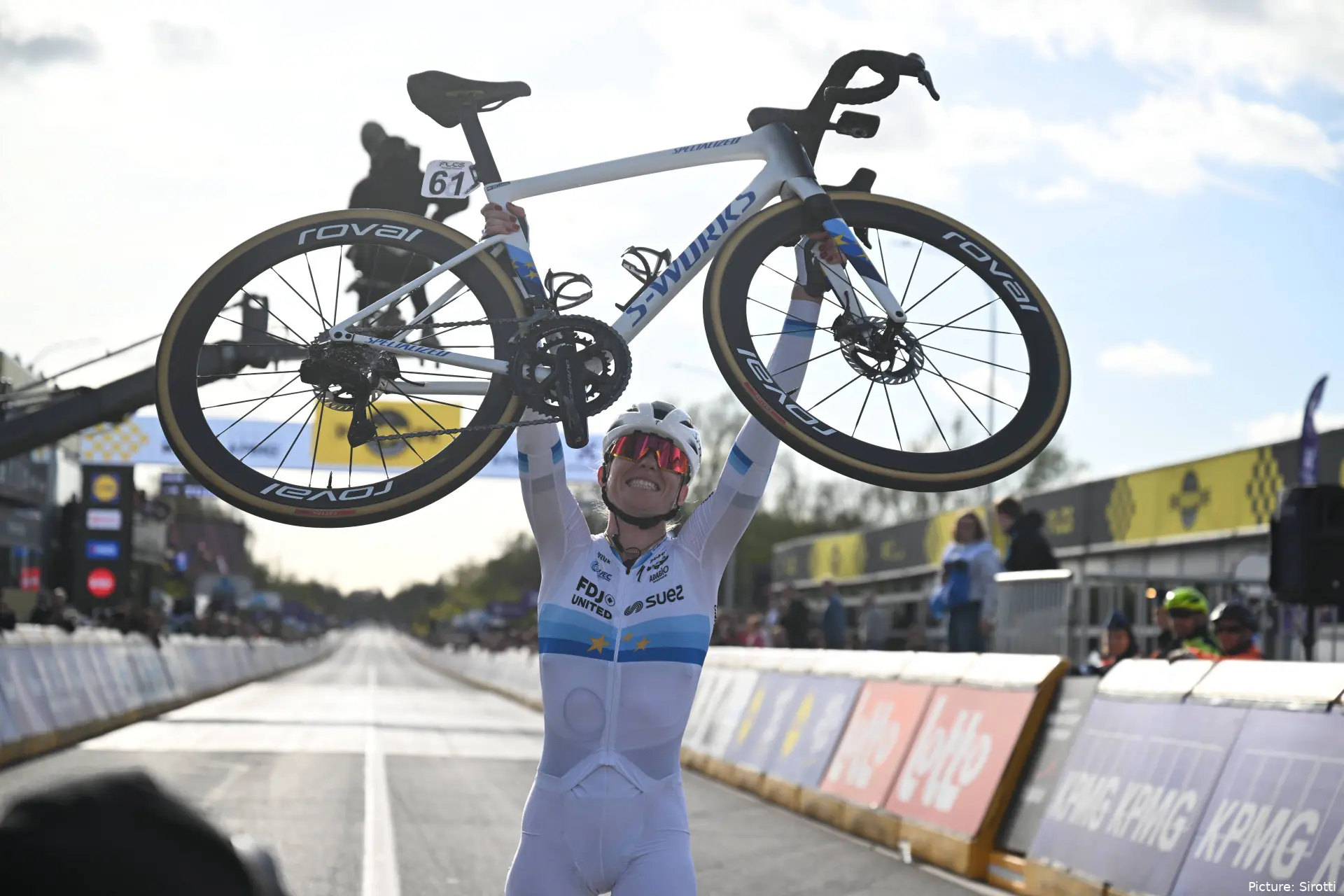
Demi Vollering appears to have found the perfect environment to unlock her full potential. The 29-year-old Dutch star has long been one of the biggest names in women’s cycling, but her move to FDJ - Suez has given her something she did not always have in previous years, complete trust, clear leadership and a team built around her strengths.
After several successful seasons with SD Worx - Protime, Vollering began a new chapter ahead of the 2025 campaign. Her first year with the French squad was more about adaptation than domination. Now, in 2026, the difference is clear. The victories are coming naturally and her body language on the bike reflects confidence and calm.
Her recent Tour of Flanders triumph only reinforced that impression. Speaking on the IDL Pro Cycling, Tom Dumoulin compared FDJ - Suez’s current racing style to the aggressive model often used by Tadej Pogacar. “Throwing the cat among the pigeons yourself and not waiting for others to attack and then having to react.”
For the former Grand Tour winner, the biggest change is the way Vollering now races from a position of control. “In De Ronde, Demi really put her team at the front in Pogacar-style and they tore everything apart, leaving others happy just to still be in the group. On the Kwaremont, Vollering eventually let her demons loose.”
According to Dumoulin, in previous seasons Vollering often spent too much energy responding to rivals rather than forcing the race herself. Now the script has changed. FDJ - Suez hardens races early, takes command and delivers its leader to the decisive moments in the best possible position.
“In the past, she often had to fire her shots much earlier,” Dumoulin added.
Vollering herself admits 2025 was a year of learning. “Last year we also made a plan that we thought was the right one, but sometimes you find out afterwards that it wasn't perfect. That’s how you learn more every year.”
The progress is not limited to the team leader. Inside the squad there is a clear feeling that the whole group has stepped forward. Elise Chabbey, one of the team’s most important riders, described the new mentality.
“We have confidence in Demi and know that if we make it a very hard race, that is good for her. The whole team is committed to her, but particularly the fact that we now make every climb hard is different from previous years.”
The Swiss rider believes trust has developed naturally over time. “Demi naturally had to learn to trust her teammates, because when we work together, we are stronger.”
She also made clear how strongly the team believes in its leader. “We really go for her; she has to believe in that. When you have the strongest rider in the team, you have to go for it. That motivates us enormously as well.”
Read also
Franziska Koch also highlighted the atmosphere around Vollering. “Demi is a great rider, but also a fantastic person. It’s nice to have her around. In the past, she often had to chase in the Tour of Flanders, so we made sure that didn't have to happen now.”
Whenever Vollering lines up, the collective level seems to rise another notch. Amber Kraak explained why. “We have a good time together and, above all, we have one goal. That makes everyone really go through fire for each other. Demi is a very good leader in that regard. She is very accommodating and very grateful for the work we do.”
The Dutch rider added that having a genuine winner as team leader changes everything. “When you know your leader can actually win, you can often go a bit further. In De Ronde, I knew my lead-out towards the Koppenberg was very important, for example, so you really tell yourself that it has to happen. Then you can go just that bit harder.”
Away from racing, those closest to Vollering also see a happier and stronger version of the rider. Her partner Jan de Voogd believes she has reached a new level. “I do think we are seeing a new level from Demi this year, yes. And in my eyes, there is still some margin; it can get a tiny bit better.”
He also praised the stability of the environment around her. “When the whole team radiates calmness and vision, and I’m talking about teammates, staff, management, partners and everything and everyone involved, and you ensure that you listen to one another, then something special is created. That is what we are seeing now.”
Jan was equally complimentary about the work being done inside FDJ - Suez. “At FDJ, they are doing very well. If you all go full gas for Demi or another top rider and you really see her as plan A, then she is always there to finish it off.“
“That is quite special. She possesses certain leadership qualities, so if you put her in an environment like they are doing now, she delivers. Those girls really go through fire for one another.”
One of the key figures behind this rise has been coach Lieselot Decroix. After a first season of adjustments, Vollering’s programme for 2026 was redesigned with the Tour de France Femmes as the major objective.
“We wanted a slightly different approach to the Tour, with a bit more rest and altitude camps and slightly less racing. You don't want that feeling of being rushed from pillar to post again. We had good conversations about that. There isn't one single 'best' route, but it has to be a route you believe in.”
Calendar management became a major priority. “Demi needs to be home a bit more and have rest. We have to plan when she needs to be in top form, but especially plan when the pressure can be taken off for a while. We know that Demi can perform immediately after a good block of training; she doesn't necessarily need a lot of races.”
Decroix also believes the relationship between Vollering and the squad was crucial in the team’s development.
“I think we have noticed above all how important it is to get to know each other well. You do everything for that in a new team, but it also just takes time. You have to spend time together, also off the bike. The team grew during 2025; you saw that the girls better understood what Demi wanted and how she communicated that.”

Despite tactical changes, the coach does not expect Vollering herself to change dramatically. “The basis remains that you do what you know, but if you do the same thing every year, you get the same result. So, we can never stand still.”
She finished by underlining the Dutchwoman’s physical consistency. “Demi’s base is very large, so she needs to put in the hours. She is always fit and won't change much physically. Sometimes a kilo might come off, but she is the textbook example of a healthy and strong athlete. That is what we want to hold on to.”
More mature, fully backed by her team and working to a carefully built plan, Vollering looks to have found the balance she was searching for. If that continues, 2026 could become the season in which she truly defines a new era in women’s cycling.
Carlos Silva is a writer for CyclingUpToDate.com, where he contributes race reports, interviews, analysis pieces, and live coverage of the international cycling calendar. Holding a degree in Sports from the Jean Piaget Institute, he combines academic knowledge of performance, training, and competition with hands-on journalism experience in professional cycling.
Throughout his career, Carlos has conducted interviews with leading figures in the sport, including Alberto Contador, Joaquim Rodríguez, Óscar Pereiro, João Almeida, Isaac del Toro, Derek Gee, John Degenkolb and Geraint Thomas. These conversations reflect direct engagement with Grand Tour winners, Classics specialists, and emerging talents.
He has provided on-site coverage at major events ranging from the Vuelta a España to the Tour de France, alongside stage races such as Vuelta a Andalucía, Volta ao Algarve, Volta a Portugal and O Gran Camiño. Covering the mythical climbs of the Giro d'Italia remains one of his professional ambitions.
Carlos is responsible for liveblog coverage of all major WorldTour races and beyond, including the Tour de France, Giro d'Italia and Vuelta a España. His reporting integrates verified data from ProCyclingStats to ensure statistical accuracy, contextual depth, and analytical precision.
A lifelong cycling enthusiast, he approaches storytelling across written, photographic, and video formats with a focus on credibility, tactical insight, and informed race interpretation.
claps 0visitors 0
Just in

Popular news
Latest comments
- He didn't even try to sprint all outvappaxbipmv18-10-2026
- Campenaerts looked like a rolling pumpkin with that all orange leaders skinsuit !frieders318-10-2026
- He can take his dumb a$$ politics somehwere else !frieders318-10-2026
- good to have her back. fingers crossed she‘ll be able to stay!Ketterechts17-10-2026
- A tenner and he wins the Tour next year, too 😂anonymouscyclist17-10-2026
- the answer is either stick to classics or GTs but not bothabstractengineer17-10-2026
- the exodus already stared with Ciccone. Already they were struggling with two sprinters, now there are three. Also Ganna will demand leadership. Gall is the most proven GC, Ayuso has the most potential. GC leadership for everybody will be impossible. Literally a UAE style mess without pogi.abstractengineer17-10-2026
- I raced as an amateur for 12 years, including six years on my country’s national road cycling team. I secured two national titles and competed in three World Championships plus more than 15 international stage races. At 23, we travelled to Italy for a training camp—or so I assumed. On a rest day, we watched a presentation about adopting a more “professional” training approach. It was crystal clear what “professional” meant. That moment first exposed me to this dilemma. After returning from Italy, I left cycling—at least at the competitive level I had known. Over the following two years, the whole team was caught doping. I hold that everyone is innocent until proven guilty. In my view, current stakeholders operate on a different scale, and the sums involved are vast. I am unsure whether any doping would ever be revealed. I try to stay positive and enjoy the show. My 2c.
 vannpelt17-10-2026
 - Fiver he wins 🤣
 leedorney17-10-2026
 - “…measures to reduce speeds.” Might as well shorten the race course to just 50km as well? ASO generates at minimum €300m a year and 30- 40% profit. Maybe stop being greedy and spend more of the profit to protect the riders instead.b3tlla17-10-2026
Loading
Write a comment