“Anyone who rides through the light must be removed from the race” - UCI rule raises questions after Pogacar and Evenepoel railway incident at Tour of Flanders
CyclingSunday, 05 April 2026 at 13:50
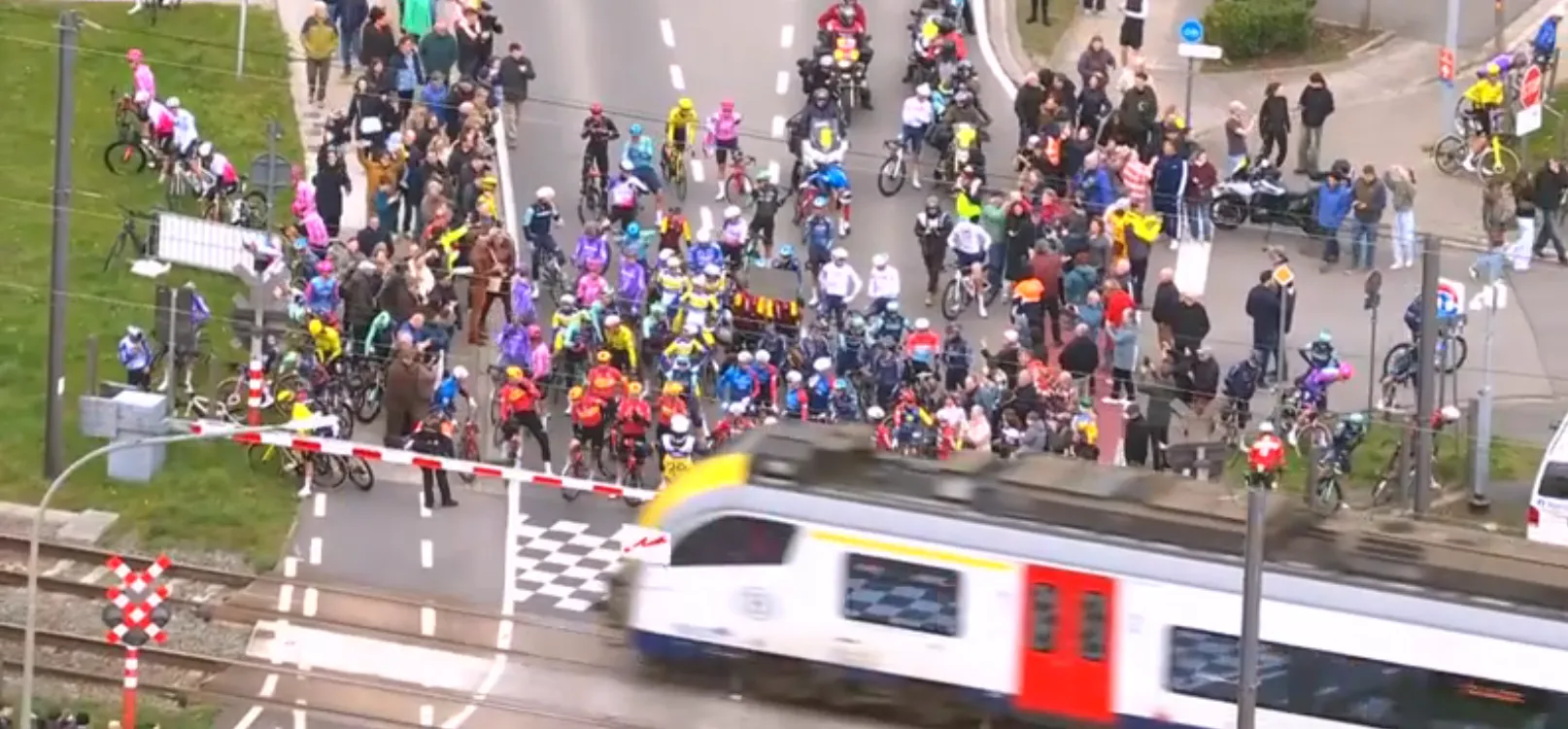
The Tour of Flanders was thrown into early confusion by an unusual and potentially controversial moment, as a split peloton at a railway crossing briefly raised the prospect of disqualification for some of the race’s biggest names.
As the bunch approached the crossing, the barriers began to fall, forcing part of the peloton to stop while others continued through. Among those who made it across were Tadej Pogacar and Remco Evenepoel, while a second group, including Mathieu van der Poel, was held up behind the closed gates.
Race officials quickly moved to neutralise the situation, instructing the front part of the peloton to ease their pace and allow those delayed to return.
The breakaway up the road, however, was not affected and was allowed to continue, extending its advantage in the process.
Read also
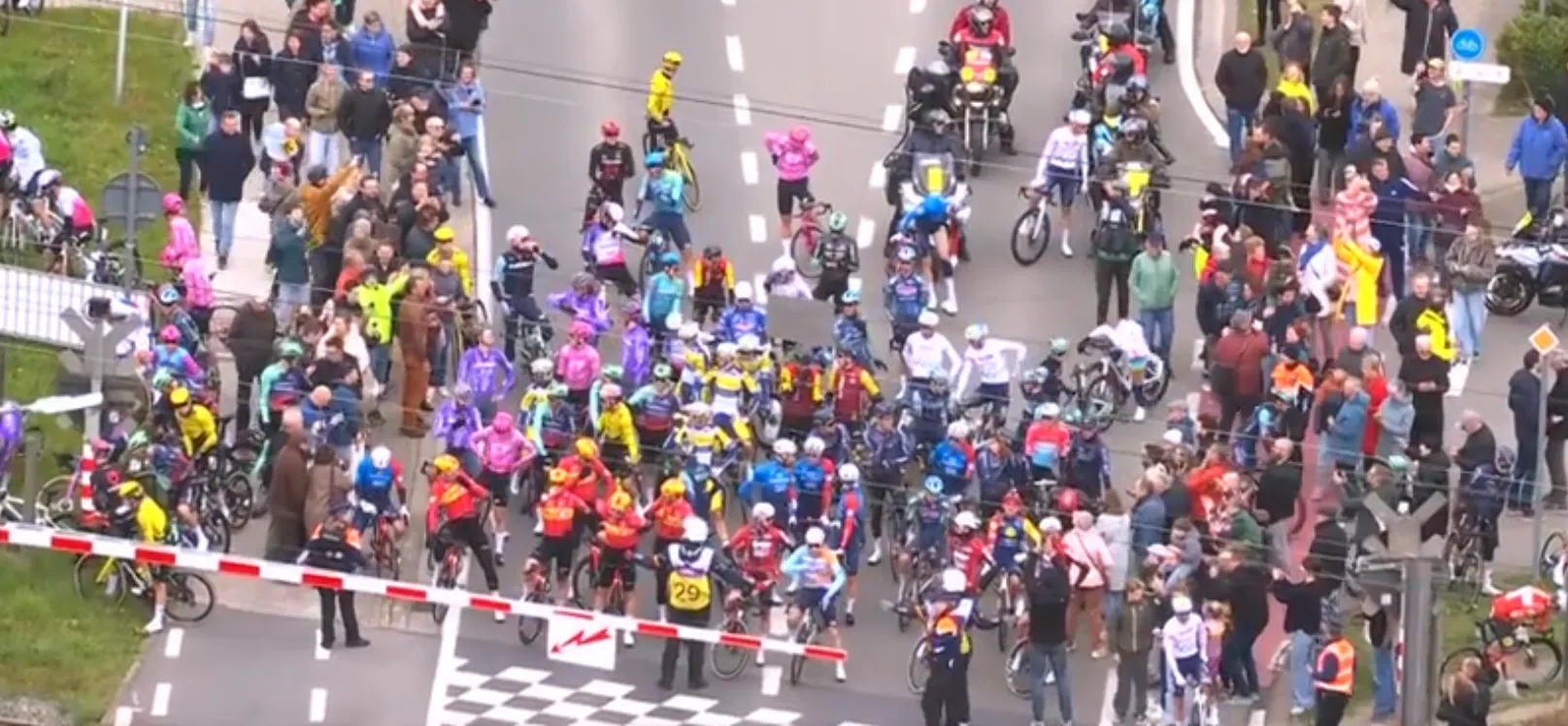
UCI rule leaves little room for interpretation
While the race itself moved on, the incident immediately raised questions around the application of UCI regulations. “Riders are obliged to stop at a red light,” the governing body stated in conversation with Het Nieuwsblad. “Anyone who rides through the light must be removed from the race.”
The rule is explicit in its wording, leaving little ambiguity in principle. Any rider who passes a closed railway crossing after the signal has turned red risks disqualification, alongside additional penalties including fines and a deduction of UCI points.
The only potential nuance lies in the exact timing of the signal change, specifically whether the light was already red at the moment riders crossed.
Race context moves on, questions remain
On the road, the race quickly settled back into its natural rhythm. A 13-rider breakaway remained clear, while UAE Team Emirates - XRG continued to control the peloton in support of Pogacar following the earlier disruption. The favourites were all brought back together after the incident, restoring parity ahead of the decisive phases still to come later in the race.
Yet while the sporting situation has been resolved, the episode leaves a lingering question around consistency in rule enforcement. The regulation itself is clear. The reality, at least in this instance, appears more flexible. And in a race as tightly contested as the Tour of Flanders, even a momentary divergence between the two is enough to spark debate.
claps 8visitors 3
Just in

Popular news

Latest comments
- Mads you have another chance next week at Paris Roubaix. Flanders is Flanders but PR is a whole different ball game. You are made for this race.Cyclingsbestfan05-04-2026
- Tadej really had to dig deep to stay away from MVDP. I think staying away from Remco, where he did more work than MDVP, cost him, but once he got a gap more than 15 seconds he simply cruised at a higher speed than his rivals and looked less ragged doing so. Kudos!velodan05-04-2026
- It would be best for Florian Vermeersch to leave the UAE and sign a good contract somewhere else, because it is more than obvious that he only wants to be the captain. Pogi allowed him to be the captain until today, and today he could not give 100% for Pogi. It is time for him to go.Mou-Cro-HR05-04-2026
- An excellent result and an accurate self diagnosis. Much like in the mountains against Pogacar and Vingegaard, he doesn’t have the explosive acceleration to stay with Pogacar and van der Poel. A commendable debut at a crazy race, better than Pogacar’s (when he was fourth in a two up sprint).RidesHills05-04-2026
- An incredible ride, fabulous and carefully planned tactics with Vermeesch blowing things up the first time, then the big names actually taking turns up front to secure the gap, then the next acceleration and again a gap to secure. I don’t think I’ve ever seen Pogacar so nervous, looking back to soften. Amstel seems burned in his mind. A deserving win. Oh, and grumpy old de Vlaeminck, you’re now third on the list of monument wins. It took 5 decades but it finally happened.RidesHills05-04-2026
- Either there are rules or not. If you don’t like them it is your problem.averagecyclist05-04-2026
- Great race with a dominent Pogacar again. Can't see why there is criticism of Vermeersch. I guess he saw the race in a different way?. Vermeersch didn't ride for himself. Why would he? He wasn't ever going to go against team orders and go on to win. I saw him talking to Pog and it looked like Pog said drive it and tire the peleton out. Which very effectively he did and then he faded back to the group behind. At one point with Pog right on his wheel, he very clearly indicated with double elbows for Pog to stay back as he was about to get up on the pedals. If you know about riding close up on another riders wheel, when you get up on the pedals the bike goes back slightly. Hardly the actions of a rider riding for himself.Cyclingsbestfan05-04-2026
- MVDP is certainly the best classics rider of his generation, But He ran into the greatest classics rider of all timeabstractengineer05-04-2026
- Disqualify everyone just so Aert can win. You are a country of losers, dear Belgians. Realize that Wout will never win Flanders because he doesn't have the quality... so don't hate the winner if you feel like a mouse and a loser. Nothing can help you against Pogi my dear haters. You would disqualify half the peloton if it meant Pogi can't win. You only hate him because he's been destroying you for years... a cycling country. Eat your hearts out. Capish? 🤣🤣🤣🤣🤣🤣🤣🤣🤣🤣🤣Mou-Cro-HR05-04-2026
- Pogačar, Evenepoel and all the riders who did not stop must be disqualified. This time it was OK, but maybe next time they'll get hit by the train. Such behaviour is unacceptable
 Rafionain-Glas05-04-2026
Loading
4 Comments